From Kernel to Operator: Making a Hand-Written Kernel a Real PyTorch Op
From Kernel to Operator: Making a Hand-Written Kernel a Real PyTorch Op
Thesis
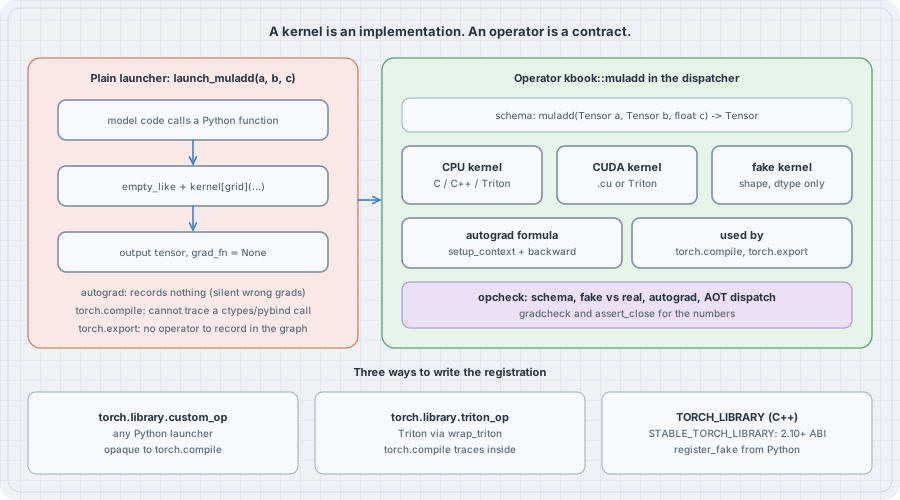
Most kernel worklogs end at the same place: a .cu file or a @triton.jit function, a launcher that allocates the output and calls it, and a benchmark that beats the baseline. Then someone drops the launcher into a model and things go wrong, mostly without an error message. Autograd records nothing, so gradients that flow through the kernel are silently dropped. torch.compile cannot see inside a compiled native call (a pybind11 or ctypes binding), so it quietly breaks the graph there, or refuses to compile if you asked for fullgraph=True. torch.export has no operator to record for that call. The kernel was correct the whole time. What was missing was the operator: the PyTorch-facing contract that says what the kernel takes, what it returns, what it mutates, what its outputs look like without running it, and how to differentiate it.
This chapter takes one small kernel (a * b + c, the same example the official PyTorch C++ tutorial uses) and walks it from a bare launcher to a registered operator that passes torch.library.opcheck, torch.autograd.gradcheck and torch.compile(fullgraph=True). The kernel is written in Triton and run here in the Triton interpreter, because this box has no GPU. Every Python listing below was run on the box with PyTorch 2.14.1 (CPU build) and Triton 3.8.0. The C++/CUDA registration at the end (TORCH_LIBRARY and the LibTorch stable ABI’s STABLE_TORCH_LIBRARY) is taken from the official tutorial and was not built here. The box has a C compiler but no C++ compiler or Python headers, and no CUDA device.
Mental model
| Term | Plain meaning |
|---|---|
| Kernel | The implementation: a CUDA __global__ function, a @triton.jit function, a C loop |
| Launcher | Host code that checks inputs, allocates outputs and launches the kernel |
| Operator | The contract PyTorch dispatches on: a namespaced name, a schema and a set of registrations |
| Schema | muladd(Tensor a, Tensor b, float c) -> Tensor: types, plus which inputs are mutated (Tensor(a!)) |
| Dispatcher | PyTorch’s per-operator table that picks a kernel by backend (CPU, CUDA, Meta) and by feature (Autograd) |
| Fake kernel | A function that returns tensors with the right shape, dtype, device and strides without reading data. torch.compile and torch.export trace with it |
| Autograd formula | setup_context saves what backward needs; backward returns one gradient per input |
opcheck |
torch.library.opcheck: tests the contract (schema, fake vs real, autograd registration, AOT dispatch), not the numbers |
PyTorch’s Python custom-ops guide states the split in two sentences: “A kernel is the implementation. An operator is the PyTorch-facing contract: name, inputs, outputs, mutation behavior, and subsystem registrations.” Everything below follows from taking that seriously.
Worked examples
The environment is a userland virtual environment with CPU wheels:
python -c "import sys, torch, triton; print(sys.version.split()[0], torch.__version__, triton.__version__, 'cuda available:', torch.cuda.is_available())"Output:
3.13.5 2.14.1+cpu 3.8.0 cuda available: FalseCase 1: The bare launcher, and the gradient that vanishes
Here is the kernel and the launcher a kernel repo usually ships. Nothing in it is wrong.
# kernel.py: the hand-written kernel (Triton) and a bare launcher, with no PyTorch registration at all
import torch
import triton
import triton.language as tl


@triton.jit
def muladd_kernel(a_ptr, b_ptr, out_ptr, c, n, BLOCK: tl.constexpr):
    pid = tl.program_id(0)
    offs = pid * BLOCK + tl.arange(0, BLOCK)
    mask = offs < n
    a = tl.load(a_ptr + offs, mask=mask)
    b = tl.load(b_ptr + offs, mask=mask)
    tl.store(out_ptr + offs, a * b + c, mask=mask)


def launch_muladd(a: torch.Tensor, b: torch.Tensor, c: float) -> torch.Tensor:
    """Allocate the output, launch the kernel, return. This is all most kernel repos ship."""
    assert a.shape == b.shape and a.dtype == b.dtype
    a, b = a.contiguous(), b.contiguous()
    out = torch.empty_like(a)
    n = a.numel()
    if n:
        muladd_kernel[(triton.cdiv(n, 256),)](a, b, out, c, n, BLOCK=256)
    return out
Now use it the way a model would. Run it in the interpreter (TRITON_INTERPRET=1 executes the Triton program with NumPy on the CPU; on a GPU you drop the variable and the same code compiles to PTX):
# opaque.py: what goes wrong when the launcher is called as a plain function
import torch
from kernel import launch_muladd

torch.manual_seed(0)
a = torch.randn(1000)
b = torch.randn(1000)
print("1. eager forward matches a*b+1:", torch.allclose(launch_muladd(a, b, 1.0), a * b + 1))

# 2. Training: the kernel writes into a buffer that autograd never sees being computed.
a.requires_grad_()
y = launch_muladd(a, b, 1.0)
print("2. output requires_grad:", y.requires_grad, "| grad_fn:", y.grad_fn)

# 3. The quiet version of the same bug: mix the kernel with ordinary ops.
loss = (launch_muladd(a, b, 1.0) + a).sum()
loss.backward()
print("3. d loss / d a, first 3 entries:", a.grad[:3].tolist())
print(" correct (b + 1), first 3 entries:", (b + 1)[:3].tolist())TRITON_INTERPRET=1 python opaque.pyOutput:
1. eager forward matches a*b+1: True
2. output requires_grad: False | grad_fn: None
3. d loss / d a, first 3 entries: [1.0, 1.0, 1.0]
   correct (b + 1), first 3 entries: [-1.2657949924468994, 2.099088668823242, 1.163913369178772]
Line 2 shows the problem directly. The kernel wrote into a buffer made by torch.empty_like, and autograd only records operations it dispatches, so the output has no grad_fn. Line 3 shows why this is dangerous rather than merely inconvenient. Called on its own, backward() would at least raise an error, because nothing in the loss requires grad. Mixed with an ordinary + a, the loss does require grad, backward runs, and a.grad is exactly 1.0 everywhere: the + a term’s contribution, with the kernel’s b silently missing. Nothing is printed and the model trains on wrong gradients.
Case 2: A native call that torch.compile cannot see into
A CUDA extension bound with pybind11, or any compiled library called through ctypes, is a callable with no Python bytecode. TorchDynamo traces Python bytecode, so it has nothing to trace. The box has gcc, so the same kernel as a plain C function stands in for the compiled extension:
/* muladd.c: the same kernel as a native CPU function, built with: gcc -O2 -shared -fPIC muladd.c -o libmuladd.so */
#include <stdint.h>

void muladd_f32(const float *a, const float *b, float c, float *out, int64_t n) {
    for (int64_t i = 0; i < n; i++) out[i] = a[i] * b[i] + c;
}
# native.py: a compiled native kernel called through ctypes; Dynamo cannot look inside it
import ctypes
import torch
import torch._dynamo
lib = ctypes.CDLL("./libmuladd.so")
lib.muladd_f32.argtypes = [ctypes.c_void_p, ctypes.c_void_p, ctypes.c_float, ctypes.c_void_p, ctypes.c_int64]
def native_muladd(a: torch.Tensor, b: torch.Tensor, c: float) -> torch.Tensor:
assert a.dtype == b.dtype == torch.float32 and a.shape == b.shape and a.device.type == "cpu"
a, b = a.contiguous(), b.contiguous()
out = torch.empty_like(a)
lib.muladd_f32(a.data_ptr(), b.data_ptr(), c, out.data_ptr(), out.numel())
return out
if __name__ == "__main__":
a, b = torch.randn(1000), torch.randn(1000)
print("eager matches a*b+1:", torch.allclose(native_muladd(a, b, 1.0), a * b + 1))
@torch.compile(fullgraph=True)
def f(a, b):
return native_muladd(a, b, 1.0).relu()
try:
f(a, b)
print("torch.compile(fullgraph=True): compiled")
except Exception as e:
lines = [l.strip() for l in str(e).strip().splitlines() if l.strip()]
print("torch.compile(fullgraph=True) raised", type(e).__name__)
for l in lines[:2]:
print(" ", l[:150])
# Without fullgraph=True there is no error: Dynamo splits the graph around the call.
report = torch._dynamo.explain(lambda a, b: native_muladd(a, b, 1.0).relu())(a, b)
print("without fullgraph:", report.graph_break_count, "graph break,", report.graph_count, "graphs")
print(" break reason:", str(report.break_reasons[0].reason).strip().splitlines()[0][:120])gcc -O2 -shared -fPIC muladd.c -o libmuladd.so && python native.pyOutput:
eager matches a*b+1: True
torch.compile(fullgraph=True) raised Unsupported
   call to a callable object with no traceable __call__
   Explanation: Dynamo could not trace a Python `__call__` method on this object.
without fullgraph: 1 graph break, 2 graphs
   break reason: call to a callable object with no traceable __call__
The last two lines show the default behaviour without fullgraph=True. There is no error, just a graph break: Dynamo compiles the code before the call, runs the call in eager Python, then compiles the code after it, and torch._dynamo.explain counts one break and two graphs. That is slower (no fusion across the boundary, extra guards) and it hides the problem. fullgraph=True is the honest test, and it is a good default while integrating a kernel.
A raw @triton.jit launch is a special case. The PyTorch recipe Using User-Defined Triton Kernels with torch.compile documents that, on a GPU, torch.compile can trace a Triton launch directly, without any wrapper. Under the CPU interpreter used here it cannot: running opaque.py’s launcher under torch.compile(fullgraph=True) on this box fails with Unsupported inside triton/runtime/jit.py. Even on a GPU, the same recipe’s chart lists a bare Triton launch as lacking a CPU fallback, FlopCounter support and tensor-subclass support, and that is where triton_op comes in (Case 5).
Case 3: Register it: custom_op plus a fake kernel
torch.library.custom_op (PyTorch 2.4+) turns a Python function with type hints into an operator. The schema is inferred from the hints. mutates_args=() declares that the function returns fresh tensors and writes into none of its inputs. register_fake gives the metadata-only implementation that torch.compile and torch.export call with FakeTensors.
# op.py: register the launcher as a real operator, kbook::muladd
import torch
from kernel import launch_muladd


@torch.library.custom_op("kbook::muladd", mutates_args=())
def muladd(a: torch.Tensor, b: torch.Tensor, c: float) -> torch.Tensor:
    return launch_muladd(a, b, c)  # real kernel: runs only on real tensors


@muladd.register_fake
def _(a, b, c):
    # Metadata only: shape, dtype, device, strides. Never read a.data here.
    torch._check(a.shape == b.shape)
    torch._check(a.dtype == b.dtype)
    torch._check(a.device == b.device)
    return torch.empty_like(a, memory_format=torch.contiguous_format)


if __name__ == "__main__":
    print("schema:", muladd._opoverload._schema)
    print("same object as torch.ops path:", torch.ops.kbook.muladd.default is muladd._opoverload)

    graphs = []

    def show_graph(gm, example_inputs):
        graphs.append(gm)
        return gm.forward

    def body(a, b):
        return torch.ops.kbook.muladd(a, b, 1.0).relu() * 2

    f = torch.compile(body, backend=show_graph, fullgraph=True, dynamic=True)

    a, b = torch.randn(1000), torch.randn(1000)
    print("compiled result correct:", torch.allclose(f(a, b), (a * b + 1).relu() * 2))
    print("graphs captured:", len(graphs))
    for node in graphs[0].graph.nodes:
        if node.op not in ("placeholder", "output"):
            print(f"  {node.op:13s} {node.target}")

    g = torch.compile(body, backend="aot_eager", fullgraph=True)
    print("aot_eager (fake tensors + functionalization) correct:", torch.allclose(g(a, b), (a * b + 1).relu() * 2))

    from torch._subclasses.fake_tensor import FakeTensorMode
    with FakeTensorMode():
        fa = torch.empty(7, 3)
        fo = muladd(fa, torch.empty(7, 3), 1.0)
        print("fake call -> shape", tuple(fo.shape), "dtype", fo.dtype, "type", type(fo).__name__)

    res = torch.library.opcheck(muladd, (a, b, 1.0))
    print("opcheck:", res)
    res = torch.library.opcheck(muladd, (torch.randn(0), torch.randn(0), 2.0))
    print("opcheck on an empty tensor:", res)
    nc = torch.randn(8, 6).t()
    res = torch.library.opcheck(muladd, (nc, torch.randn(6, 8), 0.5))
print("opcheck on a transposed input:", res)TRITON_INTERPRET=1 python op.pyOutput:
schema: kbook::muladd(Tensor a, Tensor b, float c) -> Tensor
same object as torch.ops path: True
compiled result correct: True
graphs captured: 1
  call_function kbook.muladd
  call_method   relu
  call_function <built-in function mul>
aot_eager (fake tensors + functionalization) correct: True
fake call -> shape (7, 3) dtype torch.float32 type FakeTensor
opcheck: {'test_schema': 'SUCCESS', 'test_autograd_registration': 'SUCCESS', 'test_faketensor': 'SUCCESS', 'test_aot_dispatch_dynamic': 'SUCCESS'}
opcheck on an empty tensor: {'test_schema': 'SUCCESS', 'test_autograd_registration': 'SUCCESS', 'test_faketensor': 'SUCCESS', 'test_aot_dispatch_dynamic': 'SUCCESS'}
opcheck on a transposed input: {'test_schema': 'SUCCESS', 'test_autograd_registration': 'SUCCESS', 'test_faketensor': 'SUCCESS', 'test_aot_dispatch_dynamic': 'SUCCESS'}
Read the output top to bottom:
- The decorator produced a real dispatcher operator,
kbook::muladd(Tensor a, Tensor b, float c) -> Tensor, andtorch.ops.kbook.muladd.defaultis the same object. Code that only has the name (a C++ caller, an exported graph) can find it. torch.compile(fullgraph=True, dynamic=True)captured one graph containingkbook.muladdas a single opaque node, followed by thereluandmulthat Inductor is free to fuse. This is what “opaque” means forcustom_op. The compiler keeps the operator whole, calls the real kernel at run time, and uses the fake kernel only to learn output shapes while tracing. The listing prints the graph with a tiny custom backend, because Inductor’s CPU backend generates C++ and this box has no C++ compiler.backend="aot_eager"runs the full fake-tensor and functionalization path without code generation, and its result matches.- Calling the operator under
FakeTensorModereturns aFakeTensorof shape(7, 3)without launching anything. opcheckran its four default tests (test_schema,test_autograd_registration,test_faketensor,test_aot_dispatch_dynamic) on a normal input, an empty tensor and a transposed, non-contiguous one, as the guide recommends (“edge shapes such as empty tensors; important memory formats or non-contiguous strides”).
The fake kernel returns a contiguous tensor because the launcher calls .contiguous() before allocating with empty_like. The fake kernel must describe what the real kernel returns, strides included, not what looks plausible. The trap section below shows what happens when it doesn’t.
Case 4: Teach autograd the backward
register_autograd takes a backward(ctx, grad) and a setup_context(ctx, inputs, output). The backward has to be built from operators PyTorch understands. The C++ tutorial is explicit that if you want your own kernel in the backward, “it must be wrapped into a custom operator”. Here the backward reuses kbook::muladd itself with c = 0, which is legal precisely because it is now an operator.
# grad.py: teach autograd the backward of kbook::muladd, then check it
import torch
from op import muladd


def setup_context(ctx, inputs, output):
    a, b, c = inputs
    saved_a = a if ctx.needs_input_grad[1] else None
    saved_b = b if ctx.needs_input_grad[0] else None
    ctx.save_for_backward(saved_a, saved_b)


def backward(ctx, grad):
    a, b = ctx.saved_tensors
    grad_a = muladd(grad, b, 0.0) if ctx.needs_input_grad[0] else None  # d(a*b+c)/da = b
    grad_b = muladd(grad, a, 0.0) if ctx.needs_input_grad[1] else None  # d(a*b+c)/db = a
    return grad_a, grad_b, None  # c is a float: no gradient


muladd.register_autograd(backward, setup_context=setup_context)

if __name__ == "__main__":
    torch.manual_seed(0)
    a = torch.randn(1000, requires_grad=True)
    b = torch.randn(1000)
    y = muladd(a, b, 1.0)
    print("output requires_grad:", y.requires_grad, "| grad_fn:", type(y.grad_fn).__name__)

    loss = (muladd(a, b, 1.0) + a).sum()
    loss.backward()
    print("d loss / d a, first 3 entries:", a.grad[:3].tolist())
    print("correct (b + 1), first 3:     ", (b + 1)[:3].tolist())
    print("matches b + 1 everywhere:", torch.allclose(a.grad, b + 1))

    a64 = torch.randn(64, dtype=torch.float64, requires_grad=True)
    b64 = torch.randn(64, dtype=torch.float64, requires_grad=True)
    print("gradcheck (float64):", torch.autograd.gradcheck(lambda x, y: muladd(x, y, 3.0), (a64, b64)))

    args = (torch.randn(32, requires_grad=True), torch.randn(32, requires_grad=True), 1.0)
    print("opcheck with requires_grad inputs:", torch.library.opcheck(muladd, args))

    f = torch.compile(lambda a, b: muladd(a, b, 1.0).sum(), backend="aot_eager", fullgraph=True)
    a.grad = None
    f(a, b).backward()
print("compiled backward matches b:", torch.allclose(a.grad, b))TRITON_INTERPRET=1 python grad.pyOutput:
output requires_grad: True | grad_fn: GeneratedBackwardFor_kbook_muladd_defaultBackward
d loss / d a, first 3 entries: [-1.2657949924468994, 2.099088668823242, 1.163913369178772]
correct (b + 1), first 3:      [-1.2657949924468994, 2.099088668823242, 1.163913369178772]
matches b + 1 everywhere: True
gradcheck (float64): True
opcheck with requires_grad inputs: {'test_schema': 'SUCCESS', 'test_autograd_registration': 'SUCCESS', 'test_faketensor': 'SUCCESS', 'test_aot_dispatch_dynamic': 'SUCCESS'}
compiled backward matches b: True
The same (kernel(a, b) + a).sum() loss that produced 1.0 everywhere in Case 1 now produces b + 1. gradcheck compares the formula with finite differences in float64. The Triton kernel is dtype-generic, so the same kernel runs the double-precision check. opcheck with requires_grad=True inputs exercises test_autograd_registration for real this time, and a compiled forward and backward (aot_eager) matches too.
Case 5: The same contract from C++, and the Triton-native route
The two steps that custom_op hid are visible in the lower-level torch.library.Library API: define a schema, then register a kernel per dispatch key. This is exactly what the C++ macros do, and it runs here:
# two_step.py: TORCH_LIBRARY's two steps (define a schema, then register per-backend kernels), done from Python
import torch
from kernel import launch_muladd

lib = torch.library.Library("kbook2", "DEF")   # like TORCH_LIBRARY(kbook2, m)
lib.define("muladd(Tensor a, Tensor b, float c) -> Tensor")
lib.impl("muladd", launch_muladd, "CPU")       # like TORCH_LIBRARY_IMPL(kbook2, CPU, m)

a, b = torch.randn(6), torch.randn(6)
print("CPU kernel via the dispatcher:", torch.allclose(torch.ops.kbook2.muladd(a, b, 1.0), a * b + 1))

meta = torch.empty(6, device="meta")
try:
    torch.ops.kbook2.muladd(meta, meta, 1.0)
except NotImplementedError as e:
    print("meta tensor, no fake kernel yet ->", str(e).split(". ")[0])


@torch.library.register_fake("kbook2::muladd")  # the Python half of a C++ op, as in the tutorial
def _(a, b, c):
    return torch.empty_like(a)


out = torch.ops.kbook2.muladd(meta, meta, 1.0)
print("meta tensor, after register_fake ->", out.shape, out.device)
print("opcheck:", torch.library.opcheck(torch.ops.kbook2.muladd.default, (a, b, 1.0)))TRITON_INTERPRET=1 python two_step.pyOutput:
CPU kernel via the dispatcher: True
meta tensor, no fake kernel yet -> kbook2::muladd: attempted to run this operator with Meta tensors, but there was no fake impl or Meta kernel registered
meta tensor, after register_fake -> torch.Size([6]) meta
opcheck: {'test_schema': 'SUCCESS', 'test_autograd_registration': 'SUCCESS', 'test_faketensor': 'SUCCESS', 'test_aot_dispatch_dynamic': 'SUCCESS'}
The meta-tensor call failing before register_fake and succeeding after it is the whole job of a fake kernel. With the fake kernel in place, PyTorch can push shapes through the operator without running it.
In C++ the same split is TORCH_LIBRARY (define) and TORCH_LIBRARY_IMPL (implement per backend). For PyTorch 2.10 and later the tutorial recommends the LibTorch stable ABI variant, which builds one wheel that works across PyTorch 2.10, 2.11, 2.12 and later releases instead of one wheel per PyTorch version. The stable headers (torch/csrc/stable/library.h, with STABLE_TORCH_LIBRARY, STABLE_TORCH_LIBRARY_IMPL and TORCH_BOX) ship in the 2.14.1 wheel used here; the code below is from the official tutorial and was not compiled on this box (no g++, no Python.h, no CUDA device):
// Not built here. From "Custom C++ and CUDA Operators" (docs.pytorch.org), stable-ABI tab, abridged.
#include <torch/csrc/stable/library.h>
#include <torch/csrc/stable/ops.h>
#include <torch/csrc/stable/tensor.h>
#include <torch/csrc/stable/c/shim.h>
#include <cuda.h>
#include <cuda_runtime.h>

__global__ void muladd_kernel(int numel, const float* a, const float* b, float c, float* result) {
  int idx = blockIdx.x * blockDim.x + threadIdx.x;
  if (idx < numel) result[idx] = a[idx] * b[idx] + c;
}

torch::stable::Tensor mymuladd_cuda(const torch::stable::Tensor& a,
                                    const torch::stable::Tensor& b, double c) {
  STD_TORCH_CHECK(a.sizes().equals(b.sizes()));
  STD_TORCH_CHECK(a.scalar_type() == torch::headeronly::ScalarType::Float);
  STD_TORCH_CHECK(a.device().type() == torch::headeronly::DeviceType::CUDA);
  torch::stable::Tensor a_contig = torch::stable::contiguous(a);
  torch::stable::Tensor b_contig = torch::stable::contiguous(b);
  torch::stable::Tensor result = torch::stable::empty_like(a_contig);
  int numel = a_contig.numel();
  void* stream_ptr = nullptr;
  TORCH_ERROR_CODE_CHECK(aoti_torch_get_current_cuda_stream(a.get_device_index(), &stream_ptr));
  muladd_kernel<<<(numel + 255) / 256, 256, 0, static_cast<cudaStream_t>(stream_ptr)>>>(
      numel, a_contig.const_data_ptr<float>(), b_contig.const_data_ptr<float>(), c,
      result.mutable_data_ptr<float>());
  return result;
}

STABLE_TORCH_LIBRARY(extension_cpp, m) {
  m.def("mymuladd(Tensor a, Tensor b, float c) -> Tensor");   // "float" is C++ double
}

STABLE_TORCH_LIBRARY_IMPL(extension_cpp, CUDA, m) {
  m.impl("mymuladd", TORCH_BOX(&mymuladd_cuda));
}
# Not built here. setup.py from the same tutorial: one wheel for CPython 3.9+ and PyTorch 2.10+.
# Use cpp_extension.CUDAExtension instead of CppExtension when the sources include .cu files.
from setuptools import setup
from torch.utils import cpp_extension
setup(name="extension_cpp",
ext_modules=[cpp_extension.CppExtension(
"extension_cpp", ["muladd.cpp"],
extra_compile_args={"cxx": ["-DPy_LIMITED_API=0x03090000",
"-DTORCH_TARGET_VERSION=0x020a000000000000"]},
py_limited_api=True)],
cmdclass={"build_ext": cpp_extension.BuildExtension},
options={"bdist_wheel": {"py_limited_api": "cp39"}})TORCH_TARGET_VERSION is encoded as [major][minor][patch][5-byte ABI tag], so 0x020a000000000000 means “2.10.0 or later”. The Python half is the same register_fake and register_autograd calls as Cases 3 and 4, made by name ("extension_cpp::mymuladd") after the library is loaded. The library is loaded either by importing a stub _C module or, with no Python.h at all, by calling torch.ops.load_library(path_to_so). The tutorial warns that the order matters: the C++ definitions must be loaded before the Python registrations.
Two older routes are worth recognising when you meet them in existing code. torch.utils.cpp_extension.load_inline(..., functions=[...]) and a PYBIND11_MODULE that binds muladd directly produce exactly the Case 2 situation: a callable PyTorch cannot see. They are fine for a quick eager-mode experiment and wrong for anything that trains or compiles. The tutorial also points out that pybind11 does not limit itself to the stable CPython API, which is why it builds its _C stub module with plain PyModule_Create under Py_LIMITED_API.
For a kernel that is already Triton, there is a third route: torch.library.triton_op with wrap_triton(kernel)[grid](...). Unlike custom_op, which the Triton recipe describes as creating “opaque callables with respect to torch.compile”, torch.compile traces into a triton_op and can optimise around the kernel, while the op still supports register_autograd, a CPU fallback and FlopCounter. It needs real fake-tensor tracing of the Triton launch. Under the CPU interpreter it fails here: the interpreter reads the data pointers of FakeTensors, and PyTorch rejects that (“Attempted to set the storage of a tensor on device "meta" to a storage on different device "cpu"”). So this route is described from the recipe and labelled not run. On a GPU it is the natural wrapper for Triton kernels. The recipe’s chart has one trade-off: custom_op works with torch.compile(fullgraph=True) “in all cases”, while triton_op and bare launches do “in the majority of cases”, because tracing into the kernel is more ambitious than treating it as a black box.
The trap
The trap is that a wrong registration runs fine in eager mode. The schema and the fake kernel are promises. Eager execution never checks them; the compiler and exporter rely on them. All three of these broken registrations compute the right forward result in eager mode:
# trap.py: three registrations that run fine in eager mode and are still wrong
import torch
from kernel import launch_muladd
from torch.library import custom_op, opcheck


def first_line(e):
    return str(e).strip().splitlines()[0].replace(" (scroll up for stack trace)", "")[:230]


def failed_tests(op, args):
    try:
        return opcheck(op, args)
    except Exception as e:
        return f"{type(e).__name__}: {first_line(e)}"


# A. A kernel that writes into its input, registered as if it were functional.
@custom_op("trap::scale_", mutates_args=())          # wrong: should be mutates_args={"x"}
def scale_(x: torch.Tensor, s: float) -> None:
    x.mul_(s)                                          # stands in for a kernel that stores into x


x = torch.ones(4)
scale_(x, 3.0)
print("A. eager result:", x.tolist())
print("   opcheck:", failed_tests(scale_, (torch.ones(4), 3.0)))


# B. A row-sum kernel whose fake kernel copies the input's shape.
@custom_op("trap::rowsum", mutates_args=())
def rowsum(x: torch.Tensor) -> torch.Tensor:
    return x.sum(dim=1)                                # stands in for a hand-written reduction


@rowsum.register_fake
def _(x):
    return torch.empty_like(x)                         # wrong: real output has shape (rows,)


print("B. eager shape:", tuple(rowsum(torch.ones(5, 3)).shape))
print("   opcheck:", failed_tests(rowsum, (torch.ones(5, 3),)))


# C. A functional kernel with a fake kernel but no autograd registration.
@custom_op("trap::muladd_noautograd", mutates_args=())
def muladd_na(a: torch.Tensor, b: torch.Tensor, c: float) -> torch.Tensor:
    return launch_muladd(a, b, c)


@muladd_na.register_fake
def _(a, b, c):
    return torch.empty_like(a)


a = torch.randn(4, requires_grad=True)
try:
    muladd_na(a, torch.randn(4), 1.0).sum().backward()
    print("C. backward ran; a.grad =", a.grad)
except Exception as e:
print("C. backward raised", type(e).__name__ + ":", first_line(e))TRITON_INTERPRET=1 python trap.pyOutput:
A. eager result: [3.0, 3.0, 3.0, 3.0]
   opcheck: OpCheckError: opcheck(op, ...): test_schema failed with Argument x is not defined as mutable but was mutated
B. eager shape: (5,)
   opcheck: OpCheckError: opcheck(op, ...): test_faketensor failed with When comparing the output of trap.rowsum.default on FakeTensor and concrete Tensors, found mismatched tensor metadata: Shapes torch.Size([5]) and torch.Size([5, 3]) are not equal!
C. backward raised RuntimeError: Trying to backward through trap.muladd_noautograd.default but no autograd formula was registered. Please use register_autograd to add one.- A declares
mutates_args=()for a kernel that writes intox. The guide is blunt about the rule: “the operator may not mutate an input that is not marked as being mutated”. PyTorch does not infer the contract from the function body. Functionalization and the compiler treat the call as pure, so they may reorder or drop work around a write they were never told about.opcheck’stest_schemacatches the write. - B has a fake kernel that copies the input’s shape for a row reduction. A
torch.compiletrace would carry(5, 3)forward where the real tensor is(5,), and every downstream shape would be wrong.test_faketensorruns fake and real side by side and reports the mismatch. - C has no autograd formula. This one at least fails loudly at
backward(), instead of training on the wrong gradient as the bare launcher did in Case 1.
None of these are numerical bugs, and opcheck is not a numerical test either. The guide says so: use torch.testing.assert_close for the forward and gradcheck for the gradient. You need both kinds of test.
The boring rule
Never hand a model a kernel launcher. Hand it an operator:
- Name it in a namespace you own (
yourproject::op) and write the schema first, including every mutated argument (mutates_args, orTensor(a!)in C++). - Register the kernel per backend:
custom_opfor any Python launcher,triton_op+wrap_tritonfor Triton on a GPU,TORCH_LIBRARY/STABLE_TORCH_LIBRARYfor C++/CUDA (prefer the stable ABI on 2.10+). If the model must run without Python (AOTInductor), the Python guide says to define the operator and its kernels in C++. The Triton recipe’s chart markscustom_opas not supported by AOTInductor. - Register a fake kernel that returns exactly the real output’s metadata and never reads data.
- If it trains, register autograd with a backward built from operators, including your own kernels wrapped as operators.
- Before anyone uses it, run
opcheckon representative inputs (empty, non-contiguous, every dtype and device you support,requires_grad=True), plusassert_closeandgradcheck, and compile once withfullgraph=True.
Try this
- Change
op.py’s fake kernel toreturn torch.empty_like(a)with nomemory_formatand runopcheckon the transposed input.empty_likepreserves the input’s strides, so the fake output is transposed while the real one is contiguous. Whichopchecktest reports it, and with what message? - Write an in-place
kbook::muladd_that stores intoa, declaremutates_args={"a"}, and confirmopcheckpasses. Then returnafrom it and read the C++ tutorial’s note on why returning a mutated input breakstorch.compile. - Remove
ctx.needs_input_gradfromsetup_contextand save both tensors unconditionally. Everything still passes. What memory does the conditional save, and when does it matter? - On a machine with a GPU, rewrite
op.pywithtriton_op+wrap_triton, compile with the default Inductor backend, and compare the generated code (TORCH_LOGS=output_code) with thecustom_opversion. Which one fused therelu?
Sources
- PyTorch tutorials, Custom C++ and CUDA Operators (Richard Zou):
TORCH_LIBRARY,STABLE_TORCH_LIBRARY,TORCH_BOX,Py_LIMITED_API,TORCH_TARGET_VERSION,torch.ops.load_library, Python-sideregister_fake/register_autograd. Companion code: pytorch/extension-cpp. - PyTorch tutorials, Custom Python Operators: the kernel-versus-operator definition, the schema and mutation/aliasing contract, fake-kernel rules and
opcheckcoverage. - PyTorch tutorials, The Custom Operators Manual.
- PyTorch recipes, Using User-Defined Triton Kernels with torch.compile: bare Triton launches under
torch.compile,triton_opandwrap_triton, and the comparison chart againstcustom_op. - PyTorch docs, torch.library (
custom_op,register_fake,register_autograd,opcheck,Library) and torch.utils.cpp_extension (load_inline,CppExtension,CUDAExtension). - PyTorch notes, LibTorch Stable ABI.
- Triton docs, Debugging Triton (
TRITON_INTERPRET=1). - Python docs, ctypes.