Scheduler Deep Dive (GMP)
Scheduler Deep Dive (GMP)
Overview
Go multiplexes millions of goroutines (G) onto fewer OS threads (M) using logical processors (P). Understanding GMP turns vague advice (“don’t spawn unbounded goroutines”) into capacity math.
Diagram-rich companion series: Internals for Interns — The Scheduler.
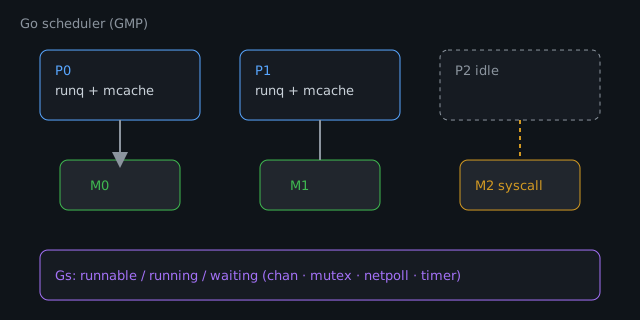
G  = goroutine (stack + state: runnable / running / waiting / dead)
M  = OS thread that executes Go code
P  = scheduling context (run queue, memory caches, limits) — count ≈ GOMAXPROCS
Only an M bound to a P runs ordinary Go code. Syscalls may park the P or spin another M so other Gs keep running.
Diagram: GMP at a glance
                    GOMAXPROCS ≈ number of Ps
  ┌─────────────────────────────────────────────────────────┐
  │  P0                    P1                    P2         │
  │  runq [G G G]          runq [G G]            runq []    │
  │  mcache …              mcache …              (idle)     │
  └──────────┬─────────────────────┬────────────────────────┘
             │ bound               │ bound
             v                     v
           M0 (OS thread)        M1 (OS thread)     M2 in syscall
             │                     │                  │
             v                     v                  │ P2 may be
           G-run                 G-run                │ retaken for
                                                      │ another M
  Waiting Gs: chan / mutex / netpoll / timer ──park──► wait queues
Only an M bound to a P runs ordinary Go code. Syscalls may free the P so other Gs keep running.
Lifecycle of a G (creation → park → run)
                    ┌──────────────┐
           recycle  │     Dead     │
          ┌────────►│  (free list) │◄──────── goexit
          │         └──────┬───────┘
          │                │ go f / goready
          │                v
          │         ┌──────────────┐
          │         │   Runnable   │◄──── wake / preempt
          │         └──────┬───────┘
          │                │ schedule (needs M+P)
          │                v
          │         ┌──────────────┐     entersyscall
          │         │   Running    │──────────────────┐
          │         └──────┬───────┘                  v
          │    park        │                   ┌──────────────┐
          │  (chan/mutex/  │                   │   Syscall    │
          │   sleep/poll)  │                   └──────┬───────┘
          │                v                          │
          │         ┌──────────────┐    return /      │
          │         │   Waiting    │    retake P      │
          │         └──────────────┘◄─────────────────┘
Core Loop (Mental Model)
                    +------------------+
  new G  ---------> |  global runq     |
                    +--------+---------+
                             | steal / distribute
                    +--------v---------+
                    |  P local runq    |  (per P)
                    +--------+---------+
                             |
              M executes G <-+
                             |
              G blocks (chan, mutex, I/O park)
                             |
G becomes runnable again -----> runq- Each P has a local run queue (cheap, no global lock).
- Overflow / balancing uses a global run queue.
- Idle Ps work-steal from other Ps’ local queues.
- Network poller and timers inject runnable Gs.
GOMAXPROCS
runtime.GOMAXPROCS(0) // current setting- Defaults to number of CPU cores (cgroup-aware on Linux in modern Go).
- Caps how many Gs run Go code in parallel (approx. number of Ps).
- Does not cap total goroutines or OS threads (threads can grow for syscalls).
Under a CPU quota (K8s), a wrong GOMAXPROCS causes either under-utilization or thrashing. Prefer auto-detection or set from cgroup limits intentionally.
Preemption
Modern Go can preempt long-running Gs (async preemption) so a tight loop without function calls is less likely to starve the GC or other Gs. Still:
- Avoid owning a P forever with non-cooperative C code via cgo without care.
runtime.Gosched()yields voluntarily — rare need if profiles do not show unfairness.
Hand-off and Syscalls
When a G enters a syscall:
- M may release its P so another M can run other Gs.
- On return, M tries to reacquire a P; if none free, G goes runnable and M may park.
This is why blocking syscalls ≠ “all Go freezes,” but too many blocking syscalls create many Ms and scheduler overhead.
Scheduling Latency Signals
| Signal | Tool | Meaning |
|---|---|---|
High runtime.schedule / findrunnable |
CPU pprof | Scheduler overhead, not enough real work |
| Runnable Gs queueing | go tool trace |
Over-subscription or lock/chan contention |
| Idle Ps + runnable Gs | trace | Load imbalance / GC / netpoll delays |
| Threads >> GOMAXPROCS | runtime.NumCgoCall / OS metrics |
Syscall or cgo heavy |
Design Rules From GMP
- Bound concurrency at the entrance (semaphores, worker pools) — Gs are cheap, not free.
- Prefer non-blocking design at boundaries — give every wait a context deadline.
- Match fan-out to Ps for CPU work —
GOMAXPROCSworkers for pure CPU; more for I/O-bound wait. - Measure under the real quota — laptop cores ≠ pod millicores.
Experiment
go mod init example
GOMAXPROCS=1 go run .
GOMAXPROCS=4 go run .
package main
import (
"fmt"
"runtime"
"sync"
"time"
)
func burn(d time.Duration) {
end := time.Now().Add(d)
for time.Now().Before(end) {
// busy spin
}
}
func main() {
fmt.Println("GOMAXPROCS", runtime.GOMAXPROCS(0))
var wg sync.WaitGroup
start := time.Now()
n := 4
for i := 0; i < n; i++ {
wg.Add(1)
go func() {
defer wg.Done()
burn(200 * time.Millisecond)
}()
}
wg.Wait()
fmt.Println("elapsed", time.Since(start))
}What to notice: With GOMAXPROCS=1, four 200ms CPU burns serialize (~800ms). With 4, they overlap (~200ms). I/O-bound work would not scale the same way.
Try next: Capture go tool trace around a server under load; find “Proc start/stop” and long stretches where Gs are runnable but not running.