Syllabus
Networking Journey — Syllabus A (working)
Working title: Networking from first principles to NetOps
A personal notebook on how to learn computer networking from scratch to expert / NetOps practice, using open-source and freely available lab images (especially via Containerlab).
No vendor certification branding. No proprietary exam blueprints. Competence is defined by what you can design, build, break, prove, and operate.
Lab platform: Containerlab + free/open network OS and endpoint images (e.g. FRR, Linux, Nokia SR Linux community images, SONiC, VyOS, and other kinds that do not require paid licenses).
Diagrams: under images/diagram-*.svg — transparent SVG using currentColor so they work in Quarto light and dark themes.
0. How a world-class path is taught
0.1 Pedagogy
- Models before features — planes, encapsulation, state machines
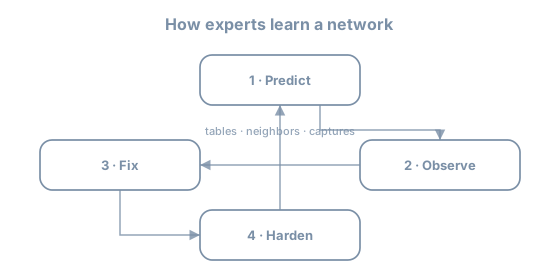
- Predict → observe → fix → harden — every lab
- Lab-as-code — topologies in git; rebuild from nothing
- Failure is curriculum — shut links, poison routes, break MTU
- Vendor-agnostic language — concepts first; CLI is a dialect
- Open tools only on the main path — paid images are optional footnotes later, never required
0.2 Definition of “expert” here
You can:
- Design a multi-site L2/L3 network with clear underlay/overlay roles
- Implement it in Containerlab with free images
- Diagnose control-plane vs data-plane failures with tables + captures
- Apply routing policy without creating loops
- Automate lab lifecycle and basic config/validation
- Operate services with observability and recovery habits
0.3 Open lab stack (default)
| Role | Examples (free/open) |
|---|---|
| Orchestration | Containerlab |
| Routing NOS | FRR, SR Linux (community), SONiC, VyOS |
| Endpoints | Alpine/Ubuntu/Debian containers |
| Capture | tcpdump, tshark |
| Traffic | iperf3, mtr, scapy (as needed) |
| Automation | Ansible, Python (scrapli/netmiko-class tools), git |
| CI | deploy topology smoke tests |
Journey map
Models + lab craft
  → Host networking for labs
  → Bridging domains (L2)
  → Addressing & forwarding (L3)
  → Interior routing
  → Edge routing & policy
  → Resilience & services
  → Filtering, QoS intro, hardening
  → Overlays & fabrics
  → Automation & NetOps
  → Capstones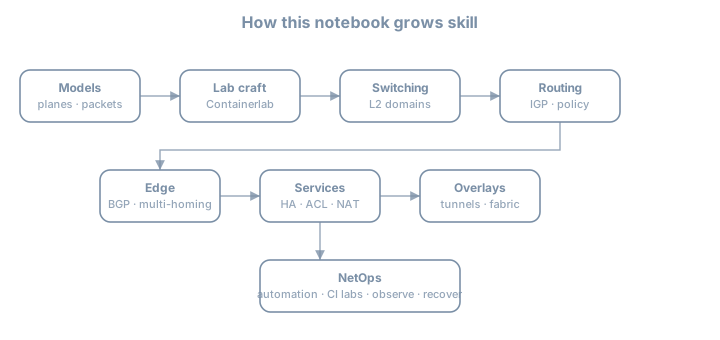
Part 00 — Front matter
Ch 00 — Syllabus (this document + variants)
Ch 01 — How I learn networking
- Note-taking, lab journal, when to stop and rebuild
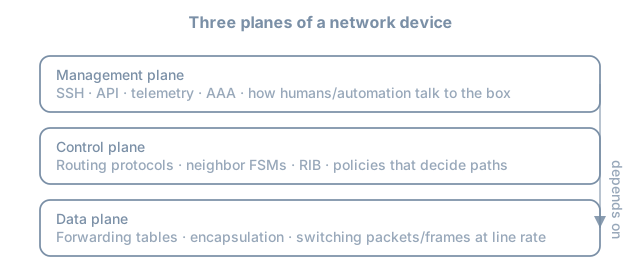
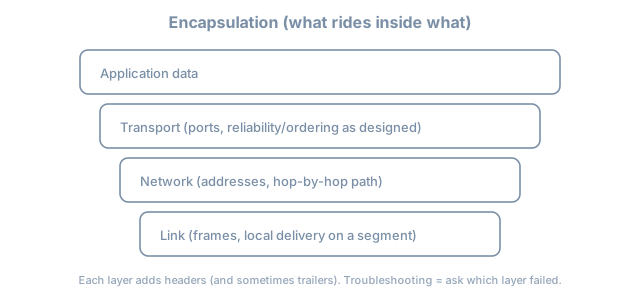
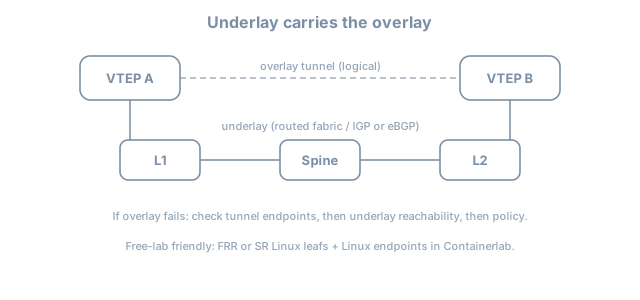
### Ch 02 — Mental models that never expire - Planes, encapsulation, underlay/overlay
Ch 03 — Verification culture
- Predict → observe → fix → harden
Part 01 — Lab craft (Containerlab + Linux)
Ch 01 — Linux networking for lab hosts
- namespaces, veth, bridges, routes, basic filtering
### Ch 02 — Containerlab fundamentals - topology YAML, kinds, links, mgmt network, lifecycle
### Ch 03 — Free image matrix & resources - what runs without licenses; RAM/CPU planning
### Ch 04 — Lab hygiene - addressing plans, naming, git layout, diagram habit
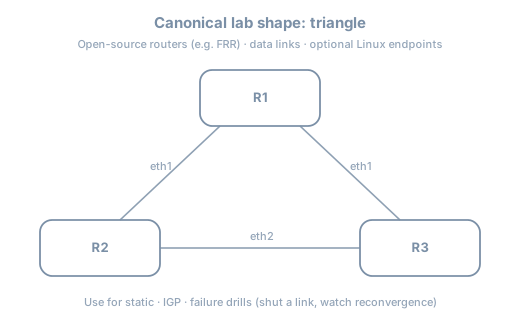
Lab: deploy/destroy a triangle of open routers; export a graph.
Checkpoint: topology-as-code is muscle memory.
Part 02 — Bridging domains (layer-2)
Ch 01 — Ethernet & MAC learning
Ch 02 — VLANs & trunks
Ch 03 — Loop prevention (spanning tree family)
Ch 04 — Link aggregation
Ch 05 — L2 failure drills
Labs: multi-switch VLAN/trunk; root failover; native-VLAN mismatch.
Checkpoint: you can heal a broken multi-switch domain with evidence.
Part 03 — Addressing & basic forwarding
Ch 01 — IPv4 structure, subnetting, summarization
Ch 02 — IPv6 essentials for dual-stack labs
Ch 03 — Static routing & floating statics
Ch 04 — Host vs router behavior (ARP/ND)
Labs: dual-stack; summary black-hole; static failover.
Part 04 — Interior routing
Ch 01 — Dynamic routing ideas (distance-vector vs link-state)
Ch 02 — Link-state IGP in one area (adjacency, flood, SPF)
Ch 03 — Multi-area link-state design
Ch 04 — IPv6 IGP notes
Ch 05 — Redistribution & loop prevention
Labs: triangle IGP; cost change; multi-area; filtered redistribution.
Checkpoint: reconvergence is predictable and documented.
Part 05 — Edge routing & policy
Ch 01 — Inter-domain routing fundamentals
Ch 02 — Session types & path selection mental model
Ch 03 — Policy (prefix filters, attributes, route-maps as idea)
Ch 04 — Scaling internal meshes (route reflection concepts)
Ch 05 — Dual-homing & traffic engineering
Labs: dual upstream; policy steer; session loss drill.
Part 06 — Resilience & network services
Ch 01 — First-hop redundancy concepts
Ch 02 — Address assignment & relay
Ch 03 — Translation at edges (NAT family)
Ch 04 — Time, name, and log hygiene in labs
Labs: active/standby first hop; NAT edge; DHCP relay.
Part 07 — Policy enforcement, QoS intro, hardening
Ch 01 — Packet filters (ACL thinking, direction, implicit deny)
Ch 02 — Protecting the control plane (concepts)
Ch 03 — QoS vocabulary (classify, mark, queue, shape/police)
Ch 04 — Device & lab hardening checklist
Labs: filter lockout/recovery; simple mark/class demo.
Part 08 — Overlays, tunnels, multicast
Ch 01 — Tunneling ideas (why encapsulate)
Ch 02 — Site connectivity patterns
Ch 03 — DC overlay intro (VXLAN-class data plane)
Ch 04 — EVPN-class control plane (conceptual + lab if free images allow)
Ch 05 — Multicast essentials
Labs: point-to-point tunnel; mini overlay fabric with open NOS.
Part 09 — Fabrics & multi-node design
Ch 01 — Clos / leaf-spine
Ch 02 — Underlay design choices
Ch 03 — Multi-implementation labs (FRR + SR Linux + Linux endpoints)
Labs: small leaf-spine; break a leaf; watch convergence.
Part 10 — NetOps, automation, observability
Ch 01 — Config as code against lab nodes
Ch 02 — Containerlab in CI (smoke deploy)
Ch 03 — Telemetry & captures as operations
Ch 04 — Runbooks & incident notes
Labs: Ansible/Python push; CI deploy; intentional outage write-up.
Part 11 — Capstones
C1 — Campus-style dual core (open images)
C2 — Dual-homed site to “provider” edge
C3 — Mini fabric with overlay
C4 — Incident week: break, detect, restore, prevent
Part 99 — Appendices
A — Addressing plan templates
B — Free image matrix & host sizing
C — Verification cheatsheet (vendor-neutral show/intent)
D — Diagram library index
E — Resources (RFCs, Containerlab docs, free labs, manuals)
F — Deliberate exclusions (wireless deep-dive, paid-only NOS, exam cram)
Writing order (when content starts)
- Models + Containerlab craft + diagrams
- L2 + single-area IGP (highest ROI)
- Edge routing dual-home
- Services & filters
- Multi-area / policy depth
- Overlay/fabric
- NetOps/CI
Changelog
| Date | Note |
|---|---|
| 2026-07-24 | Initial multi-syllabus exploration |
| 2026-07-24 | Vendor-agnostic rewrite; open images only; expert pedagogy; diagrams |