IPv4 Addressing and Subnetting
IPv4 Addressing and Subnetting
IPv4 addressing is the daily language of lab design: prefixes, masks, subnets, and who is on-link. Master this before multi-router labs.
Learning goals
- Read and write CIDR prefixes (
a.b.c.d/nn) fluently
- Convert between prefix length and dotted masks
- Design non-overlapping lab subnets and point-to-point links
- Identify special-use and documentation ranges
- Configure addresses on Linux and verify with
ip
IPv4 structure
- 32 bits, usually dotted decimal (four 0–255 octets)
- Prefix length
/N= number of network bits; host bits =32 − N
- Network address: host bits zero
- Broadcast address (classical Ethernet/IPv4): host bits one (except special cases like /31)
| Prefix | Mask | Classical usable hosts | Common use |
|---|---|---|---|
| /32 | 255.255.255.255 | 1 | Host route, loopback |
| /31 | 255.255.255.254 | 2 | Point-to-point (RFC 3021) |
| /30 | 255.255.255.252 | 2 | Classic P2P |
| /29 | 255.255.255.248 | 6 | Small segment |
| /24 | 255.255.255.0 | 254 | Common LAN |
| /16 | 255.255.0.0 | many | Summaries / big labs |
| /8 | 255.0.0.0 | huge | Rare in labs |
CIDR and masks
192.168.10.0/24
network: 192.168.10.0
mask:    255.255.255.0
hosts:   192.168.10.1 – 192.168.10.254
bcast:   192.168.10.255
# Linux: add address
ip addr add 192.168.10.10/24 dev eth1
ip -br addrOn-link decision
If the destination is inside a connected prefix, the host resolves L2 (ARP) on that interface. Otherwise it looks up a route (often default via gateway).
ip route get 192.168.10.50
ip route get 8.8.8.8
Private and documentation ranges
| Range | Role |
|---|---|
10.0.0.0/8, 172.16.0.0/12, 192.168.0.0/16 |
Private (RFC 1918)—default lab space |
192.0.2.0/24, 198.51.100.0/24, 203.0.113.0/24 |
Documentation (TEST-NET)—safe in examples |
127.0.0.0/8 |
Loopback |
169.254.0.0/16 |
Link-local (APIPA) |
224.0.0.0/4 |
Multicast |
Lab hygiene: pick a documented plan (10.20.0.0/16 etc.) and never invent overlapping subnets “for now.”
Subnetting for multi-tier labs
Example allocation from 10.20.0.0/16:
| Use | Block |
|---|---|
| Access / users A | 10.20.1.0/24 |
| Access / users B | 10.20.2.0/24 |
| Servers | 10.20.10.0/24 |
| P2P core | 10.20.255.0/24 carved as /31 or /30 |
| Loopbacks | 10.20.254.0/24 as /32s |
Rules:
- No accidental overlap
- Leave growth room
- Write the plan before deploy
- Align future summaries with real topology
Point-to-point links
| Style | Example | Notes |
|---|---|---|
| /31 | 10.20.255.0/31 → .0 and .1 |
Preferred in modern designs |
| /30 | 10.20.255.0/30 → .1 and .2 usable |
Classic textbooks |
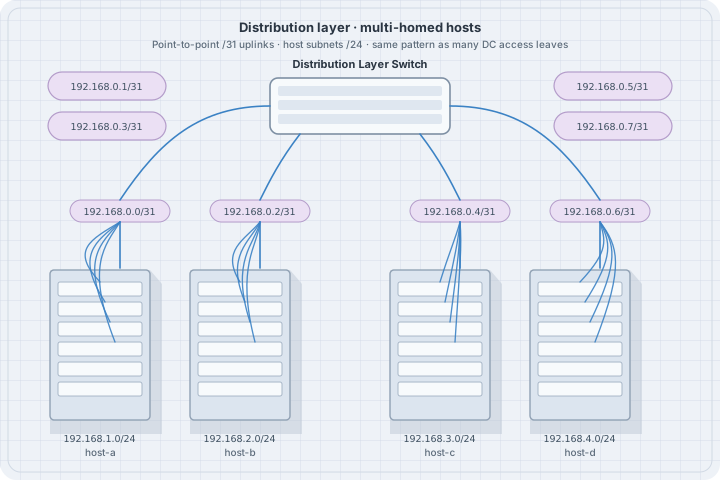
Summarization (intro)
Advertising 10.20.0.0/22 for four /24s only works if you own the whole /22. Bad summaries blackhole traffic for space you do not have.
| Action | Risk |
|---|---|
| Summary too broad | Blackholes |
| No aggregation ever | Table growth later (IGP/BGP scale) |
Layer 3 part continues summarization drills; foundations need the danger signal.
VLSM
Variable Length Subnet Masking: different prefix lengths in one design (/24 LAN + /31 core). Required for efficient labs—do not force everything to /24.
Host configuration checklist
- Address + prefix on the correct interface
- Up state (
ip link set eth1 up)
- Gateway if leaving the subnet
- DNS only if apps need names (separate from pure L3 reachability)
ip addr add 10.20.1.10/24 dev eth1
ip link set eth1 up
ip route add default via 10.20.1.1
ip -br a
ip route
Worked subnet: /26 from a /24
Parent: 192.168.10.0/24 (256 addresses). Split into four /26s (64 addresses each):
| Block | Network | Usable hosts | Broadcast |
|---|---|---|---|
| 0 | 192.168.10.0/26 |
.1–.62 |
.63 |
| 1 | 192.168.10.64/26 |
.65–.126 |
.127 |
| 2 | 192.168.10.128/26 |
.129–.190 |
.191 |
| 3 | 192.168.10.192/26 |
.193–.254 |
.255 |
Host bits: /26 → 6 host bits → \(2^6 = 64\) addresses → 62 usable (reserve network + broadcast) on Ethernet-style LANs. Point-to-point often uses /31 (RFC 3021) or /30.
Longest-prefix match: if a router has both 10.0.0.0/16 and 10.1.2.0/24, a packet to 10.1.2.5 uses the /24. More specific wins—plan summarization so you do not punch accidental holes.
Private vs public (RFC 1918)
| Range | Typical use |
|---|---|
10.0.0.0/8 |
Large private / DC |
172.16.0.0/12 |
Mid private |
192.168.0.0/16 |
Home/lab LANs |
100.64.0.0/10 |
CGNAT (ISP shared) — not “your” private LAN plan |
Lab rule: pick one private block for the whole topology and document the plan before cabling Containerlab.
Paper drills
- Network, first host, last host, broadcast for
172.16.5.0/26
- How many /24s fit in
10.0.0.0/16?
- Can
10.0.1.0/24and10.0.1.128/25coexist without overlap?
- From
10.50.0.0/16, carve three/24s and one/28for a mgmt VLAN without overlap
Checkpoint
Design addresses for: two LANs (/24 each), one router-router link (/31), two router loopbacks (/32). No overlaps; list every interface IP.