Clos Leaf-Spine
Clos Leaf-Spine
Modern data-center fabrics prefer scale-out leaf-spine (Clos-inspired) topologies over deep access-aggregation trees. This chapter builds the underlay model and a free Containerlab fabric snack with FRR + Linux endpoints (mid-2026).
Learning goals
By the end of this chapter you can:
- Explain leaf, spine, and east-west vs north-south roles
- Design a 2-spine × 2-leaf IP underlay with ECMP
- Choose eBGP vs OSPF underlay trade-offs at a model level
- Deploy a Clos-ish lab and verify multipath
- Predict behavior when one spine or one leaf uplink fails
Why Clos-style fabrics
| Classic tree pain | Leaf-spine idea |
|---|---|
| Oversubscription at aggregation | East-west via spines with planned ratio |
| STP blocking / L2 sprawl | L3 underlay to leaf; overlay for L2 if needed |
| Hard horizontal scale | Add leaves/spines with more links |
| Big failure domains | Limit L2; contain blasts |
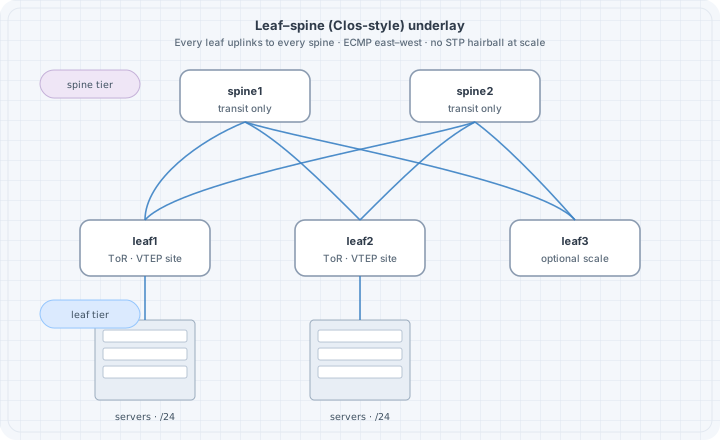
        +--------+      +--------+
        | spine1 |      | spine2 |
        +---+----+      +----+---+
         /  \   \        /   /  \
        /    \   \      /   /    \
   +---+    +---+ \  +---+ /    +---+
   | l1 |    | l2 |  | l3 |     | l4 |   ...
   +-+--+    +-+--+  +-+--+     +-+--+
     |         |       |          |
    hosts     hosts   hosts      hosts
Small lab: 2 spines × 2 leaves (diagram shows a third leaf for scale intuition).
Roles
| Role | Function |
|---|---|
| Leaf | Connects servers; VTEP if overlay; default GW / anycast GW often here |
| Spine | Transit underlay only (usually no endpoints) |
| Super-spine / border | Optional higher tier or DC edge (later) |
Spines should not become “core with lots of features” on day one—move packets between leaves.
Oversubscription (awareness)
oversubscription ≈ (sum leaf downlink speeds) / (sum leaf uplink speeds)Lab ignores real bandwidth; production designs document the ratio.
Underlay protocol choices
| Underlay | Pros | Cons |
|---|---|---|
| eBGP (often unnumbered) | Scale, policy, isolation | More session design |
| OSPF / IS-IS | Simple adjacency model | Large single domain care |
| Static | Tiny labs | No scale |
This book’s first fabric: OSPF or eBGP on FRR—pick one and stay consistent. eBGP fabric is popular; OSPF is fine for 2×2 learning.
Addressing plan (2×2)
| Node | Loopback | Links |
|---|---|---|
| s1 | 10.0.0.1/32 | to l1, l2 |
| s2 | 10.0.0.2/32 | to l1, l2 |
| l1 | 10.0.0.11/32 | to s1, s2; host eth |
| l2 | 10.0.0.12/32 | to s1, s2; host eth |
| h1 | 192.168.1.10/24 | via l1 |
| h2 | 192.168.2.10/24 | via l2 |
Point-to-point /31 or /30 on fabric links—example /30:
| Link | Subnet |
|---|---|
| l1–s1 | 10.1.1.0/30 |
| l1–s2 | 10.1.2.0/30 |
| l2–s1 | 10.1.3.0/30 |
| l2–s2 | 10.1.4.0/30 |
Host subnets via leaf: advertise leaf loopbacks + host subnets into underlay or keep hosts only for L3 via leaf and use overlay later.
For pure underlay ECMP lab: ping between leaf loopbacks and between hosts with leaf default routing + OSPF advertised LANs.
Topology YAML
name: clos22

topology:
  nodes:
    s1:
      kind: linux
      image: quay.io/frrouting/frr:10.2.1
      binds:
        - ./config/s1:/etc/frr
    s2:
      kind: linux
      image: quay.io/frrouting/frr:10.2.1
      binds:
        - ./config/s2:/etc/frr
    l1:
      kind: linux
      image: quay.io/frrouting/frr:10.2.1
      binds:
        - ./config/l1:/etc/frr
    l2:
      kind: linux
      image: quay.io/frrouting/frr:10.2.1
      binds:
        - ./config/l2:/etc/frr
    h1:
      kind: linux
      image: alpine:3.20
      exec:
        - apk add --no-cache iproute2 iputils
        - ip addr add 192.168.1.10/24 dev eth1
        - ip link set eth1 up
        - ip route add default via 192.168.1.1
    h2:
      kind: linux
      image: alpine:3.20
      exec:
        - apk add --no-cache iproute2 iputils
        - ip addr add 192.168.2.10/24 dev eth1
        - ip link set eth1 up
        - ip route add default via 192.168.2.1

  links:
    - endpoints: ["l1:eth1", "s1:eth1"]
    - endpoints: ["l1:eth2", "s2:eth1"]
    - endpoints: ["l2:eth1", "s1:eth2"]
    - endpoints: ["l2:eth2", "s2:eth2"]
    - endpoints: ["h1:eth1", "l1:eth3"]
    - endpoints: ["h2:eth1", "l2:eth3"]
FRR daemons
zebra=yes
ospfd=yes
# or bgpd=yes for eBGP underlay
OSPF underlay sketch (l1)
frr version 10.2.1
hostname l1
!
interface lo
 ip address 10.0.0.11/32
 ip ospf area 0
!
interface eth1
 ip address 10.1.1.1/30
 ip ospf network point-to-point
 ip ospf area 0
!
interface eth2
 ip address 10.1.2.1/30
 ip ospf network point-to-point
 ip ospf area 0
!
interface eth3
 ip address 192.168.1.1/24
 ip ospf area 0
!
router ospf
 ospf router-id 10.0.0.11
 passive-interface eth3
!
line vty
Spines: loopbacks + fabric links in area 0; no host interfaces. l2 mirrors with its addresses. Point-to-point OSPF avoids DR drama on p2p links.
eBGP underlay sketch (optional alternate)
router bgp 65101
 bgp router-id 10.0.0.11
 neighbor 10.1.1.2 remote-as 65100
 neighbor 10.1.2.2 remote-as 65100
 address-family ipv4 unicast
  network 10.0.0.11/32
  network 192.168.1.0/24
  neighbor 10.1.1.2 activate
  neighbor 10.1.2.2 activate
  maximum-paths 4
 exit-address-family
Spines use ASN 65100 (or each spine unique ASN—design choice). Leaves unique ASNs. Enable multipath.
Deploy and ECMP verify
sudo containerlab deploy -t clos22.clab.yml

docker exec clab-clos22-l1 vtysh -c 'show ip ospf neighbor'
docker exec clab-clos22-l1 vtysh -c 'show ip route 10.0.0.12'
docker exec clab-clos22-l1 vtysh -c 'show ip route 192.168.2.0'
docker exec clab-clos22-h1 ping -c 3 192.168.2.10
docker exec clab-clos22-h1 traceroute -n 192.168.2.10
Predict
- Each leaf: 2 OSPF neighbors (both spines)
- Route to remote leaf/host shows multiple nexthops (ECMP) if multipath installed
- traceroute may show s1 or s2
Observe multipath
docker exec clab-clos22-l1 ip route show 192.168.2.0/24
# or
docker exec clab-clos22-l1 vtysh -c 'show ip route 192.168.2.0/24'
FRR/zebra may need maximum-paths under OSPF:
router ospf
 maximum-paths 4
Drill 1 — Spine loss
docker exec clab-clos22-s1 ip link set eth1 down
docker exec clab-clos22-s1 ip link set eth2 down
sleep 3
docker exec clab-clos22-l1 vtysh -c 'show ip route 192.168.2.0'
docker exec clab-clos22-h1 ping -c 20 192.168.2.10
Predict → observe → fix
Predict | ECMP shrinks to remaining spine; brief loss |
Observe | single nexthop via s2 |
Fix | if blackhole, check l2 uplink to s2 and SPF |
Restore interfaces after.
Drill 2 — One leaf uplink down
docker exec clab-clos22-l1 ip link set eth1 down
docker exec clab-clos22-l1 vtysh -c 'show ip ospf neighbor'
docker exec clab-clos22-h1 traceroute -n 192.168.2.10
Predict
Still reachable via other spine; neighbor count 1.
Drill 3 — Polarization awareness
Send many parallel iperf flows; without entropy, paths may skew. Underlay traceroute from different sources may stick to one spine. Note in journal; overlays later add UDP entropy.
East-west vs north-south
| Pattern | Path |
|---|---|
| East-west h1↔︎h2 | leaf → spine → leaf |
| North-south to Internet | leaf → border/spine path to edge |
Do not attach WAN carelessly to all spines without a border design.
Overlay placement (preview)
VTEPs usually on leaves. Spines stay underlay-only. That separation keeps failure domains clean—connects to VXLAN/EVPN chapters.
Verification checklist
| Check | Intent |
|---|---|
| All fabric adjacencies | Full mesh leaf-spine links up |
| Loopback mesh | Any lo to any lo |
| ECMP present | ≥2 nexthops where topology allows |
| Host traffic | Data plane |
| Spine failure | Continuity |
Common mistakes
| Mistake | Symptom |
|---|---|
| Hosts on spines | Weird roles, scale pain |
| L2 across spines | Back to tree problems |
| Different OSPF areas accidentally | Missing routes |
| No p2p network type | Extra DR complexity |
| Expecting overlay without VTEP | Hosts same L2 fantasy |
Summary
- Leaf-spine Clos-style fabrics scale east-west with L3 underlays
- Spines transit; leaves attach endpoints (and VTEPs)
- 2×2 FRR lab is enough to feel ECMP and spine loss
- Pick OSPF or eBGP underlay deliberately
- Keep overlays on leaves in later designs
Next: multi-area OSPF—when a single area is no longer the right underlay shape (campus/WAN more than fabric).