/boot Is Full: How systemd-boot Fills the ESP, and How to Empty It
/boot Is Full: How systemd-boot Fills the ESP, and How to Empty It
Goal: Understand what NixOS copies onto the EFI system partition (ESP) for every generation and why a 512 MiB partition can fill up. Learn why nix-collect-garbage -d frees nothing on /boot until the boot loader is installed again, and how boot.loader.systemd-boot.configurationLimit caps the menu. Get a host whose nixos-rebuild stops with No space left on device booting new generations again.
Version note: everything below comes from the nixpkgs systemd-boot module and its installer script, systemd-boot-builder.py, at nixpkgs commit 1c89083 (nixos-unstable, October 2026). The lab runs that real script, unchanged apart from its build-time placeholders, against a fake store and a 96 MiB tmpfs standing in for the ESP. Two calls are replaced: the nix-env --list-generations call and the path of the system profile. Nothing was booted, and no firmware variables were touched. The host commands in Try this are marked as not run.
Mental model
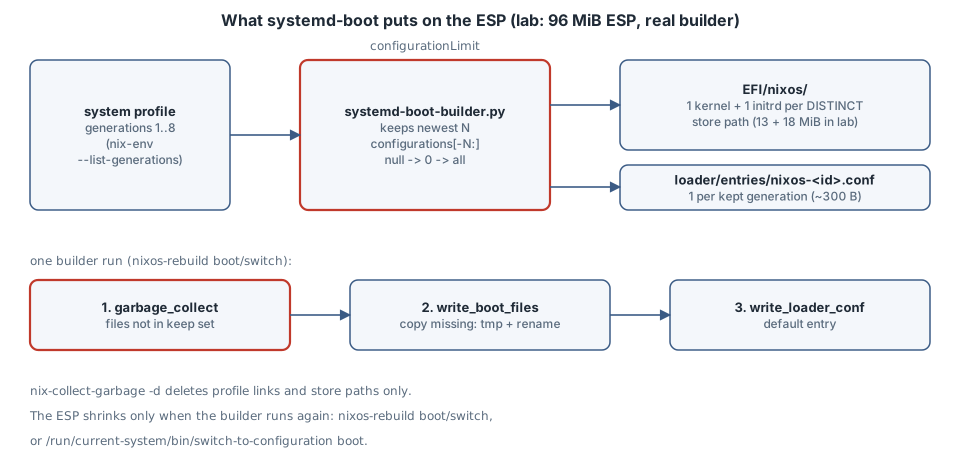
The kernel and initrd of every NixOS generation live in /nix/store. Firmware cannot read /nix/store, because it is usually on ext4, btrfs or ZFS, and sometimes encrypted. So on each nixos-rebuild boot or switch, the systemd-boot installer copies them onto the FAT-formatted ESP:
/boot                                       (the ESP, FAT32, often 512 MiB)
├── EFI/nixos/<store-hash>-linux-6.12.58-bzImage.efi        ← one per DISTINCT kernel
├── EFI/nixos/<store-hash>-initrd-linux-6.12.58-initrd.efi  ← one per DISTINCT initrd
└── loader/entries/nixos-<id>.conf                          ← one per generation, ~300 bytes
Three facts follow from the builder’s code:
- The cost is the distinct kernels and initrds, not the generations.
boot_path()names each copy after its store path. Ten generations that share one kernel and one initrd cost one copy of each, but each kernel update or initrd change adds another 30 MiB or so. - Which generations get files is decided by the profile, filtered by
configurationLimit. The builder lists/nix/var/nix/profiles/systemand keeps the newest N. - The ESP is only cleaned when the builder runs. It deletes ESP files that are not in the keep set before copying new ones. Deleting generations, by hand or with
nix-collect-garbage -d, changes the profile. It does not touch/boot.
The code that decides
get_generations() ends like this (source):
    configurationLimit = CONFIGURATION_LIMIT
    ...
    return configurations[-configurationLimit:]
The module passes the option through with configurationLimit = if cfg.configurationLimit == null then 0 else cfg.configurationLimit;. With the default null, the builder computes configurations[-0:], and since -0 == 0 in Python, that is the whole list. The option’s own description says it is “Useful to prevent boot partition running out of disk space”, and its default is no limit at all:
| Boot loader | Option | Default |
|---|---|---|
| systemd-boot | boot.loader.systemd-boot.configurationLimit |
null (all generations) |
| GRUB | boot.loader.grub.configurationLimit |
100 |
extlinux (generic-extlinux-compatible) |
boot.loader.generic-extlinux-compatible.configurationLimit |
20 |
In install_bootloader() the order is:
    garbage_collect(boot_files)
    ...
    write_boot_files(boot_files, critical_paths)
    ...
    write_loader_conf(default_entry_id)
    ...
    remove_extra_files()
garbage_collect removes every file in EFI/nixos/ and every loader/entries/nixos-*.conf that the current list of generations does not need. write_boot_files deduplicates by destination path, and its CopyWriter skips any file that already exists. Otherwise it copies into a temporary file in the same directory, fsyncs it and renames it into place. Before any of this, the script refuses to run when the profile lists no generations at all (error: no system generations found ..., refusing to remove all boot loader entries).
Lab: the real builder against a 96 MiB ESP
The NixOS manual’s install guide creates a 512 MiB ESP (mkpart ESP fat32 1MB 512MB). To keep the lab fast, everything is scaled down: a 96 MiB tmpfs ESP, a 13 MiB “kernel” and an 18 MiB “initrd” of random bytes. That gives the same ratio: about three kernel and initrd pairs fit, and a fourth does not.
The driver loads systemd-boot-builder.py with its @placeholders@ filled in. It replaces two things: run(), so that nix-env --list-generations prints the lab’s generation numbers, and generation_dir(), so that profiles live under /tmp/bootlab. Then it calls the builder’s own get_generations, boot_file, garbage_collect and write_boot_files in the same order as install_bootloader(). It leaves out bootctl and loader.conf.
# esp_lab.py (excerpt) — the rest builds the fake store and prints the ESP state
src = Path("builder.py").read_text()
for k, v in {"@efiSysMountPoint@": str(ESP), "@bootMountPoint@": str(ESP), "@nixosDir@": "/EFI/nixos",
             "@configurationLimit@": "0", "@storeDir@": str(STORE), "@distroName@": "NixOS",
             "@timeout@": "5", "@bootCountingTries@": "3", "@bootCounting@": "False"}.items():
    src = src.replace(k, v)
b = types.ModuleType("builder"); exec(compile(src, "systemd-boot-builder.py", "exec"), b.__dict__)

b.run = fake_run                                   # prints GENS like nix-env --list-generations
b.generation_dir = lambda profile, gen: PROFILES / f"system-{gen}-link"

def install(limit):
    """The core of install_bootloader(), minus bootctl and loader.conf."""
    b.CONFIGURATION_LIMIT = limit
    gens = b.get_generations()
    files = []
    for g in gens:
        files.extend(b.boot_file(*g, None, b.get_bootspec(g.profile, g.generation))[0])
    b.garbage_collect(files)
    b.write_boot_files(files, set())
    return [g.generation for g in gens]

# Eight generations; the kernel changes three times, the initrd once more on its own.
plan = [(1, "6.12.50", 1), (2, "6.12.50", 1), (3, "6.12.50", 1), (4, "6.12.54", 1),
        (5, "6.12.54", 2), (6, "6.12.54", 2), (7, "6.12.58", 1), (8, "6.12.58", 1)]
It runs as an unprivileged user inside a private mount namespace:
unshare -rm sh -c 'mkdir -p /tmp/bootlab/esp &&
  mount -t tmpfs -o size=96m lab-esp /tmp/bootlab/esp && python3 esp_lab.py'
1) configurationLimit = null (the builder sees 0), generations [1, 2, 3, 4]
ESP 62.0 of 96 MiB used, 2 kernels, 2 initrds, 4 entries
2) four more generations, still no limit: OSError: [Errno 28] No space left on device
ESP 96.0 of 96 MiB used, 3 kernels, 3 initrds, 6 entries, leftover ['iiiiiiii61258r1-initrd-linux-6.12.58-initrd.efidh8j2wzz.tmp']
3) no generation deleted, configurationLimit = 3: [6, 7, 8]
ESP 62.0 of 96 MiB used, 2 kernels, 2 initrds, 3 entries
profile still lists [1, 2, 3, 4, 5, 6, 7, 8] -- the store keeps all of them until GC
4) what is on the ESP now:
EFI/nixos/iiiiiiii61254r2-initrd-linux-6.12.54-initrd.efi 18 MiB
EFI/nixos/iiiiiiii61258r1-initrd-linux-6.12.58-initrd.efi 18 MiB
EFI/nixos/kkkkkkkk61254-linux-6.12.54-bzImage.efi 13 MiB
EFI/nixos/kkkkkkkk61258-linux-6.12.58-bzImage.efi 13 MiB
loader/entries/nixos-352e28cdc428c9072ddc293e607a848b9ae72319ad54a966a9d45cc4fef4f95f.conf 288 bytes
loader/entries/nixos-b1572c14203fc5ede08d627cc292ce38c8ea27b39d77136c20fb24affdbd32be.conf 288 bytes
loader/entries/nixos-c3a35b9bc97e0cc4c3e51138b42086d607308cdba91b07d59fd44ecbaf4e0114.conf 288 bytes
5) one entry (nixos-c3a35b9bc97e...):
title NixOS
version Generation 6 26.05 (Linux 6.12.54), built on 2026-10-31
linux /EFI/nixos/kkkkkkkk61254-linux-6.12.54-bzImage.efi
initrd /EFI/nixos/iiiiiiii61254r2-initrd-linux-6.12.54-initrd.efi
options init=/tmp/bootlab/store/00000006-nixos-system-lab-26.05/init quiet
sort-key nixosThe store paths in the lab are fake (kkkkkkkk…, iiiiiiii…), so the file names are short. On a real host they start with the 32-character store hash. Reading the run:
- Step 1. Four generations cost two kernels and two initrds (62 MiB), not four of each. Generations 1 to 3 share one pair, and generation 4 brought kernel 6.12.54.
- Step 2. Generation 5 changed only the initrd, which is another 18 MiB. Generation 7 brought kernel 6.12.58. The builder copied that kernel, then ran out of space part-way through the matching initrd. It raised
ENOSPCand left a partial….tmpfile behind. Entries for generations 7 and 8 were never written, because a generation’s entry comes after its files in the builder’s list. A realnixos-rebuildstops at this point with the same PythonOSError. - Step 3. With
configurationLimit = 3and the same profile, the next builder run succeeded. Its garbage collection runs first, so it removed the 6.12.50 pair, the generation-4 initrd and the leftover.tmpbefore copying the 6.12.58 initrd. That ordering is why lowering the limit can fix a full ESP without any manual deletion, as long as the generations you keep fit. - Step 5. The entry’s
optionsline pointsinit=into/nix/store. The ESP holds only the kernel and initrd. Everything after the initrd comes from the store.
The trap: garbage collection that forgets the ESP
nix-collect-garbage -d deletes old profile generations and then the store paths that nothing refers to any more (Nix manual). It does not run the boot loader installer, so the ESP keeps:
- the kernels and initrds of the deleted generations, which wastes space that the next rebuild may need;
- menu entries for the deleted generations. Their
init=points at a store path that no longer exists, so picking one in the menu loads the kernel and initrd and then fails to findinit.
The ESP catches up the next time the builder runs: nixos-rebuild boot or switch, or, with no rebuild at all, /run/current-system/bin/switch-to-configuration boot. nix.gc.automatic has the same gap. It frees the store on a timer, and /boot waits for your next rebuild.
The boring rule
Set boot.loader.systemd-boot.configurationLimit to the number of generations you would actually roll back to. Ten is plenty for most hosts, and it caps the ESP at ten distinct kernel and initrd pairs. After pruning generations, run switch-to-configuration boot so /boot matches the profile. If the ESP is still too small for the kernels you keep, put the copies on a larger partition with boot.loader.systemd-boot.xbootldrMountPoint. Its description says it stores “boot loader entries and extra files instead of the EFI partition”.
Try this (not run here)
On a systemd-boot NixOS host:
df -h /boot                                               # how full is the ESP?
ls /boot/EFI/nixos | wc -l; du -sh /boot/EFI/nixos         # copies currently held
ls /boot/loader/entries | wc -l                            # menu entries
nix-env --list-generations -p /nix/var/nix/profiles/system # what the builder will see
To recover a host whose rebuild failed with No space left on device:
boot.loader.systemd-boot.configurationLimit = 10;sudo nix-collect-garbage --delete-older-than 14d # optional: free the store as well
sudo nixos-rebuild boot # builder GCs the ESP first, then copies
df -h /bootIf even the kept generations do not fit, delete more generations first (sudo nix-env --delete-generations +3 -p /nix/var/nix/profiles/system), then run sudo /run/current-system/bin/switch-to-configuration boot. Deleting *.efi files from /boot/EFI/nixos by hand also works, but leave the files that belong to the running generation and the default entry alone. The builder will copy anything that is missing on its next run.
Sources
- nixpkgs,
systemd-boot-builder.pyat1c89083: https://github.com/NixOS/nixpkgs/blob/1c89083e451e891152365b799595cf7790a43325/nixos/modules/system/boot/loader/systemd-boot/systemd-boot-builder.py - nixpkgs,
systemd-boot.nix(optionsconfigurationLimit,xbootldrMountPoint) at1c89083: https://github.com/NixOS/nixpkgs/blob/1c89083e451e891152365b799595cf7790a43325/nixos/modules/system/boot/loader/systemd-boot/systemd-boot.nix - NixOS options,
boot.loader.systemd-boot.configurationLimit: https://nixos.org/manual/nixos/stable/options#opt-boot.loader.systemd-boot.configurationLimit - nixpkgs, GRUB and extlinux
configurationLimitdefaults:nixos/modules/system/boot/loader/grub/grub.nix,nixos/modules/system/boot/loader/generic-extlinux-compatible/default.nixat1c89083 - NixOS manual, installation (512 MiB ESP): https://github.com/NixOS/nixpkgs/blob/1c89083e451e891152365b799595cf7790a43325/nixos/doc/manual/installation/installing.chapter.md
- Nix manual,
nix-collect-garbage: https://nix.dev/manual/nix/latest/command-ref/nix-collect-garbage - UAPI Group, Boot Loader Specification (type #1 entries): https://uapi-group.org/specifications/specs/boot_loader_specification/