Read an Update Before You Switch: diff-closures, path-info and why-depends
Read an Update Before You Switch: diff-closures, path-info and why-depends
Goal: Turn nix flake update from a leap of faith into a change you have read. Build the new system without activating it, list exactly which packages changed version or size, explain any surprise down to the file that holds the reference and the nixpkgs line that caused it, and only then pick switch, boot, or “not today”.
Other chapters touch nix store diff-closures in passing: after an unattended upgrade, or when chasing reproducibility. This one makes it the main tool, and runs it on a real update between two pinned nixpkgs revisions.
Thesis
A NixOS system is a store path, and so is the next one. Two store paths can be compared before either is running. Everything nixos-rebuild switch is about to do to your machine is already written in the difference between /run/current-system and ./result. Read that difference and the update stops being a surprise.
Mental model
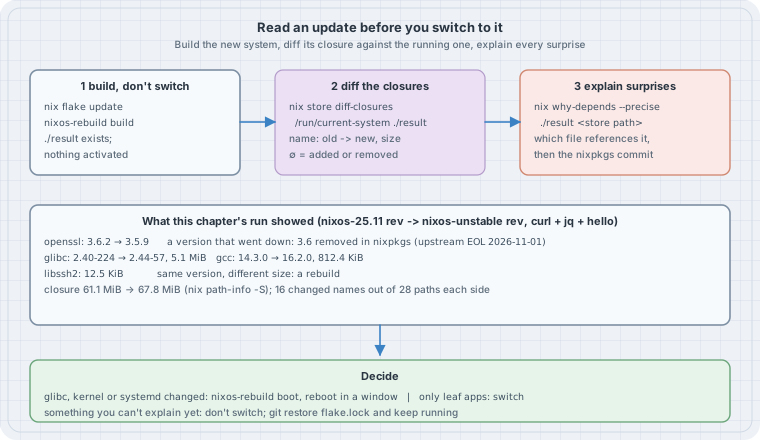
Three commands, each answering one question:
| Question | Command | Answer looks like |
|---|---|---|
| What changed? | nix store diff-closures A B |
glibc: 2.40-224 → 2.44-57, 5.1 MiB |
| How big is it now? | nix path-info -Sh A B |
closure size per path |
| Why is this in there? | nix why-depends --precise B <path> |
the chain of references, down to the file and the bytes |
A and B are any two store paths: two system toplevels, two home-manager generations, two dev shells, or two nix build results.
Concepts
What diff-closures prints
nix store diff-closures takes the full closure (every path reachable by reference) of each side and groups store paths by package name, so glibc-2.40-224 and glibc-2.44-57 line up as one entry. For each name it prints:
old → newwhen the set of versions differs.∅means “none”:∅ → 15.2.0is a package added,2.12.3 → ∅a package removed.- a size delta (red for growth when the terminal has colour), but only when it is at least 8 KiB. The rule is
std::abs(sizeDelta) >= 8 * 1024insrc/nix/diff-closures.cc. Smaller changes are noise and get dropped. - a name with a size and no version change, like
libssh2: 12.5 KiB. That’s a rebuild: same version, different inputs (a new compiler, a new dependency), so a different path and different bytes.
A name appears only if its versions changed or its size moved by 8 KiB or more. A quiet diff-closures means a quiet update.
Reading it for risk
Sort the lines into three groups:
- Platform:
linux,systemd,glibc,gcc(its-liboutput is in almost every closure),openssl,nixitself. Every service links against these. A kernel or initrd change needs a reboot to take effect anyway, so prefernixos-rebuild bootand a reboot in a window. - Your services:
postgresql,nginx,openssh, and so on. Check the release notes, especially for a major version jump (on-disk formats, config syntax). - Surprises: a version that went down, a package you didn’t know you had (
∅ → …), a big size jump on a rebuild. Each needs awhy-dependsand a look at nixpkgs before you switch.
why-depends –precise
nix why-depends A B prints the shortest reference chain from A to B. With --precise, it also prints which file in each path contains the reference, and a snippet of the bytes around the hash. Store references are just hashes inside files, so this is a literal answer: “curl’s binary has openssl’s path in its RPATH”.
Worked example: a real update (run here)
To keep the run small, the “system” is a three-package buildEnv. The commands are the same for a full NixOS toplevel, which is just a bigger store path. Both nixpkgs revisions are channel heads, so everything comes from cache.nixos.org and nothing needs compiling.
toolbox.nix:
# A tiny stand-in for a system closure: three tools from one nixpkgs revision.
{ rev }:
let
  pkgs = import (builtins.fetchTarball
    "https://github.com/NixOS/nixpkgs/archive/${rev}.tar.gz") { };
in
pkgs.buildEnv {
  name = "toolbox";
  paths = [ pkgs.curl pkgs.jq pkgs.hello ];
}
toolbox2.nix is the same with [ pkgs.curl pkgs.jq pkgs.ripgrep ]: a configuration change instead of a nixpkgs change.
read-update.sh:
#!/bin/sh
# Build the same toolbox from two pinned nixpkgs revisions, then read the difference.
set -e
OLD=b6018f87da91d19d0ab4cf979885689b469cdd41   # nixos-25.11 channel
NEW=1c89083e451e891152365b799595cf7790a43325   # nixos-unstable channel
nix build --impure -f toolbox.nix --argstr rev "$OLD" -o old
nix build --impure -f toolbox.nix --argstr rev "$NEW" -o new
echo "== what changed";      nix store diff-closures ./old ./new
echo "== closure sizes";     nix path-info -Sh ./old ./new
echo "== paths in each";     nix path-info -r ./old | wc -l; nix path-info -r ./new | wc -l
OSSL=$(nix path-info -r ./new | grep -- '-openssl-3[.0-9]*$')
echo "== why openssl";       nix why-depends --precise ./new "$OSSL"
echo "== why did openssl go down?"
SRC=$(nix eval --impure --raw --expr \
  "builtins.fetchTarball \"https://github.com/NixOS/nixpkgs/archive/$NEW.tar.gz\"")
nix store cat "$SRC/pkgs/top-level/all-packages.nix" | grep -n '^  openssl = '
nix store cat "$SRC/pkgs/top-level/aliases.nix"      | grep -n '^  openssl_3_6 = '
echo "== a configuration change on the same revision"
nix build --impure -f toolbox2.nix --argstr rev "$NEW" -o new2
nix store diff-closures ./new ./new2
$ sh read-update.sh
== what changed
bash: 5.3p3 → 5.3p20, 36.1 KiB
brotli: 1.1.0 → 1.2.0, 40.4 KiB
curl: 8.20.0 → 8.22.0, 285.2 KiB
gcc: 14.3.0 → 16.2.0, 812.4 KiB
glibc: 2.40-224 → 2.44-57, 5.1 MiB
hello: 2.12.2 → 2.12.3
jq: 1.8.1 → 1.8.2, 25.8 KiB
krb5: 1.22.1 → 1.22.2, 80.3 KiB
libssh2: 12.5 KiB
libunistring: 1.4.1 → 1.4.2
nghttp2: 1.68.1 → 1.70.0, 16.1 KiB
nghttp3: 1.15.0 → 1.18.0, 20.3 KiB
ngtcp2: 1.22.1 → 1.23.0, 77.2 KiB
openssl: 3.6.2 → 3.5.9, 166.5 KiB
publicsuffix-list: 0-unstable-2026-01-25 → 0-unstable-2026-09-02
xgcc: 14.3.0 → 16.2.0
== closure sizes
/nix/store/9ylain3a520r6i57303lh3za99rqpzs8-toolbox 61.1 MiB
/nix/store/xqs9h77yj2abhbv2994g9hlw6pdk9zlj-toolbox 67.8 MiB
== paths in each
28
28
== why openssl
/nix/store/xqs9h77yj2abhbv2994g9hlw6pdk9zlj-toolbox
└───bin/curl -> /nix/store/5lpg7j8y8lf8c4zv318yi4rmgyn5yhip-curl-8.22.0-bin/bin/curl
→ /nix/store/5lpg7j8y8lf8c4zv318yi4rmgyn5yhip-curl-8.22.0-bin
└───bin/curl: …f4xh2-zstd-1.5.7/lib:/nix/store/lazac5vw20j0pyahzbaxz8z8hyf7m9zf-openssl-3.5.9/lib:/nix/store/2b…
→ /nix/store/lazac5vw20j0pyahzbaxz8z8hyf7m9zf-openssl-3.5.9
== why did openssl go down?
6136: openssl = openssl_3_5;
2064: openssl_3_6 = throw "'openssl_3_6' has been removed, due to upstream end of life on 2026-11-01"; # Added 2026-10-25
== a configuration change on the same revision
hello: 2.12.3 → ∅, -273.0 KiB
pcre2: ∅ → 10.49, 2.0 MiB
ripgrep: ∅ → 15.2.0, 6.7 MiBReading this output
- Sixteen names changed, out of 28 paths on each side. The three packages we asked for (curl, jq, hello) all moved, but so did glibc, gcc, bash and the HTTP/2 and HTTP/3 libraries curl links against. This is normal: a channel bump moves the whole dependency graph, not just the leaves.
- glibc 2.40 → 2.44 is the biggest item at 5.1 MiB, and it’s a platform change. On a real host it is the line that says “plan a reboot window”, together with any
linuxline. openssl: 3.6.2 → 3.5.9went down. That is the surprise to explain.why-depends --preciseshows the reference sits in the RPATH ofbin/curl, so curl picked it up from nixpkgs’ defaultopenssl. The twogreplines show why: on the new revisionopenssl = openssl_3_5;, andopenssl_3_6is now an alias that throws, because the 3.6 branch reaches upstream end of life on 2026-11-01. So the default moved to the 3.5 long-term-support branch. That’s a deliberate choice, not a bug, but you only know that because you read it.libssh2: 12.5 KiBhas no version arrow: the same libssh2 version, rebuilt against new inputs.- hello changed version but shows no size. Its delta was 5,024 bytes (274,568 → 279,592), under the 8 KiB threshold.
- The configuration change (
toolbox2.nix) shows the∅forms: hello removed (−273.0 KiB), ripgrep added (6.7 MiB), plus pcre2 (2.0 MiB), which nobody asked for by name.nix why-depends ./new2 <pcre2 path>shows it comes in with ripgrep (Try this #1).
On a NixOS host (from the manuals, not run here)
The build box for this book isn’t a NixOS machine, so this part follows the nixos-rebuild(8) and Nix reference manuals and was not run. The steps are the ones above with real system paths:
cd /etc/nixos                                   # your flake
nix flake update                                # or: nix flake update nixpkgs
nixos-rebuild build --flake .#$(hostname)       # writes ./result; activates nothing, needs no root
nix store diff-closures /run/current-system ./result
nix path-info -Sh /run/current-system ./result
nix why-depends --precise ./result /nix/store/<hash>-openssl-3.5.9   # for each surprise
Then decide:
# Only leaf applications changed:
sudo nixos-rebuild switch --flake .#$(hostname)
# Kernel, initrd, systemd or glibc changed: stage it and reboot in a window
sudo nixos-rebuild boot --flake .#$(hostname)
# Something you can't explain yet: don't switch at all
git restore flake.lock
Two more forms from the Nix manual are worth knowing:
nix profile diff-closures --profile /nix/var/nix/profiles/systemprints the diff between every pair of consecutive system generations: your upgrade history as a changelog.nix store diff-closures /run/booted-system /run/current-systemshows what you’ve switched to since the last boot. Iflinuxorsystemdis in that list, the running kernel or PID 1 is older than the configuration says.
nixos-rebuild dry-activate complements this. It doesn’t diff packages: it reports which systemd units an activation would start, stop, restart or reload. One tells you what changes, the other what happens when it does.
The trap
Reading the diff after switch. Once you’ve switched, the diff is just history. Run build first. It needs no root, can’t break the running system, and the result is the exact path switch would activate: same inputs, same hash.
Second trap: trusting that a quiet diff means a safe update. diff-closures only sees packages. A change to NixOS module logic (a new default for an option, a renamed systemd unit setting) can land in etc, unit files or the activation script without any package version moving. In the diff, that usually shows up not at all, because those generated paths are tiny and their changes fall under the 8 KiB threshold. Read the NixOS release notes when you cross a release boundary, and use dry-activate to see which units would restart.
The boring rule
nix flake update && nixos-rebuild build && nix store diff-closures /run/current-system ./result, every time. Explain every version that goes down and every ∅ → you didn’t ask for. Then boot if the platform moved, switch if it didn’t, and restore flake.lock if you can’t explain it.
Try this
- Run
nix why-depends --precise ./new2 <pcre2 path>and confirm it comes in with ripgrep. Which file in ripgrep holds the reference? - Pin
NEWto an older nixos-unstable revision and re-run. Find the revision range whereopensslswitched from 3.6 to 3.5 (git log -S 'openssl = openssl_3_5' -- pkgs/top-level/all-packages.nixin a nixpkgs checkout). - Add
pkgs.gittotoolbox.nix. How many new names doesdiff-closuresshow for one package, and which is the biggest? - On a NixOS machine, run
nix profile diff-closures --profile /nix/var/nix/profiles/system | lessand find the generation where the kernel last changed.
Verification
read-update.shwas run with Nix 2.35.3 as an unprivileged single-user install with a chroot store, on a Linux box that is not NixOS. Store paths and output are the same as on NixOS, because the store paths depend only on the inputs. Every line of output above is genuine. ANSI colour codes were stripped for print.- Both nixpkgs revisions are the channel heads at the time of writing:
b6018f87…(nixos-25.11) and1c89083e…(nixos-unstable). Everything was substituted from cache.nixos.org, except the twobuildEnvderivations, which build locally in a second. - The 8 KiB threshold was read in
src/nix/diff-closures.ccon Nix master. The hello sizes (274,568 and 279,592 bytes) come fromnix path-info -s. - The NixOS-host section (
nixos-rebuild build/switch/boot,nix profile diff-closures,dry-activate) was not run. It is written from the manuals linked below.
Sources
- Nix reference manual,
nix store diff-closures: https://nix.dev/manual/nix/latest/command-ref/new-cli/nix3-store-diff-closures - Nix reference manual,
nix why-depends: https://nix.dev/manual/nix/latest/command-ref/new-cli/nix3-why-depends - Nix reference manual,
nix path-info: https://nix.dev/manual/nix/latest/command-ref/new-cli/nix3-path-info - Nix reference manual,
nix profile diff-closures: https://nix.dev/manual/nix/latest/command-ref/new-cli/nix3-profile-diff-closures - Nix source,
src/nix/diff-closures.cc: https://github.com/NixOS/nix/blob/master/src/nix/diff-closures.cc - NixOS manual, upgrading NixOS and
nixos-rebuild: https://nixos.org/manual/nixos/stable/#sec-upgrading - nixpkgs
pkgs/top-level/aliases.nixandall-packages.nixat1c89083e451e891152365b799595cf7790a43325: https://github.com/NixOS/nixpkgs/tree/1c89083e451e891152365b799595cf7790a43325/pkgs/top-level