Length-Prefixed Strings: an sds-Style String Library in Under 60 Lines
Length-Prefixed Strings: an sds-Style String Library in Under 60 Lines
Thesis
A C string is a pointer to bytes that ends at the first '\0'. That one decision has three consequences. Finding the length is O(n). Appending in a loop is O(n²), because each strcat rescans the whole string. And the string can’t contain a NUL byte, so it isn’t binary safe.
Pascal took the other route and stored the length in front of the data, originally in a single byte, which capped strings at 255 characters. The modern C version stores a full header in front of the bytes and keeps the trailing NUL. Then it hands the caller a pointer to the bytes, not to the header. That is the design of antirez’s SDS, used by Redis. The result is still a char * that works with printf and strlen, but its length is O(1), appends are amortised O(1), and it can hold any bytes.
This chapter builds a minimal version of that design, measures it, and shows the one rule it makes you follow.
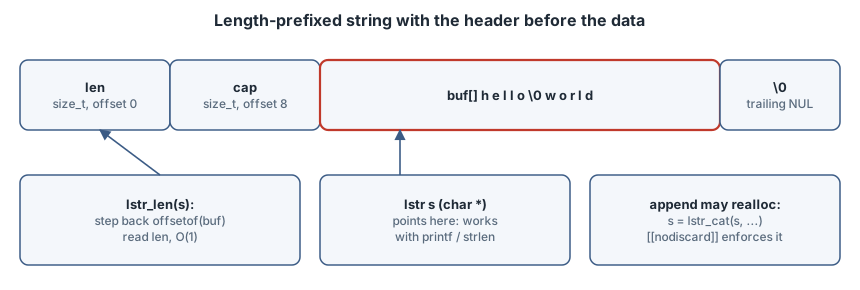
The whole library
/* lstr.h - minimal sds-style length-prefixed string (single header) */
#ifndef LSTR_H
#define LSTR_H
#include <stddef.h>
#include <stdlib.h>
#include <string.h>

#if defined(__STDC_VERSION__) && __STDC_VERSION__ > 201710L   /* GCC 14 -std=c23 reports 202000L */
#define LSTR_MUST_USE [[nodiscard]]
#else
#define LSTR_MUST_USE __attribute__((warn_unused_result))   /* GCC/Clang */
#endif

typedef char *lstr;                 /* points at buf[], so it is also a C string */

struct lstr_hdr {
    size_t len;                     /* bytes in use, excluding the trailing NUL */
    size_t cap;                     /* bytes available in buf, excluding the NUL */
    char buf[];                     /* flexible array member */
};

#define LSTR_HDR(s) ((struct lstr_hdr *)((s) - offsetof(struct lstr_hdr, buf)))

static inline size_t lstr_len(const lstr s) { return LSTR_HDR(s)->len; }
static inline size_t lstr_cap(const lstr s) { return LSTR_HDR(s)->cap; }

static inline lstr lstr_newlen(const void *p, size_t n) {
    struct lstr_hdr *h = malloc(sizeof *h + n + 1);
    if (!h) return NULL;
    h->len = h->cap = n;
    if (n) memcpy(h->buf, p, n);
    h->buf[n] = '\0';
    return h->buf;
}
static inline lstr lstr_new(const char *c) { return lstr_newlen(c, strlen(c)); }
static inline void lstr_free(lstr s) { if (s) free(LSTR_HDR(s)); }

/* May move the string: always use the returned pointer (s = lstr_catlen(s, ...)). */
LSTR_MUST_USE static inline lstr lstr_catlen(lstr s, const void *p, size_t n) {
    struct lstr_hdr *h = LSTR_HDR(s);
    if (h->cap - h->len < n) {
        size_t need = h->len + n;
        size_t cap = need < 1024 * 1024 ? need * 2 : need + 1024 * 1024;
        h = realloc(h, sizeof *h + cap + 1);
        if (!h) return NULL;
        h->cap = cap;
    }
    memcpy(h->buf + h->len, p, n);
    h->len += n;
    h->buf[h->len] = '\0';
    return h->buf;
}
LSTR_MUST_USE static inline lstr lstr_cat(lstr s, const char *c) { return lstr_catlen(s, c, strlen(c)); }
#endif
Points to notice:
buf[]is a flexible array member. The header and the bytes come from a singlemalloc, sized assizeof *h + n + 1.LSTR_HDRsteps back from the user pointer byoffsetof(struct lstr_hdr, buf)to reach the header. That is whylstr_lenis a single load.- Growth doubles up to 1 MiB, then adds 1 MiB at a time. SDS uses the same policy (
SDS_MAX_PREALLOC,1024*1024insds.h). It keeps appends amortised O(1) without doubling huge buffers. lstr_catlencan move the string, so it returns the new pointer and is marked must use. The last section explains why.- Failure: if
reallocfails, the function returnsNULLand the old block is still allocated. A caller who writess = lstr_cat(s, ...)leaks it. SDS behaves the same way. Code that has to survive out-of-memory should keep the old pointer and check forNULLbefore overwriting it.
It is still a C string, and also binary safe
#include <stdio.h>
#include "lstr.h"

int main(void) {
    lstr s = lstr_new("hello");
    printf("as a C string: %s (strlen %zu, lstr_len %zu)\n", s, strlen(s), lstr_len(s));

    s = lstr_catlen(s, "\0world", 6);           /* binary-safe: embedded NUL */
    printf("after binary append: strlen %zu, lstr_len %zu\n", strlen(s), lstr_len(s));
    fwrite(s, 1, lstr_len(s), stdout);
    putchar('\n');

    printf("header %zu bytes, len at offset %zu, buf at offset %zu\n",
           sizeof(struct lstr_hdr), offsetof(struct lstr_hdr, len),
           offsetof(struct lstr_hdr, buf));

    size_t last = lstr_cap(s), grows = 0;
    for (int i = 0; i < 100000; i++) {
        s = lstr_cat(s, "x");
        if (lstr_cap(s) != last) { grows++; last = lstr_cap(s); }
    }
    printf("100000 appends: len %zu, cap %zu, reallocations %zu\n", lstr_len(s), lstr_cap(s), grows);
    lstr_free(s);
}
#define _POSIX_C_SOURCE 199309L
#include <stdio.h>
#include <time.h>
#include "lstr.h"
static double now(void) { struct timespec t; clock_gettime(CLOCK_MONOTONIC, &t); return t.tv_sec + t.tv_nsec / 1e9; }
int main(void) {
enum { N = 200000 };
char *plain = calloc(N + 1, 1);
double t = now();
for (int i = 0; i < N; i++) strcat(plain, "x"); /* rescans the whole string each time */
double t_strcat = now() - t;
lstr s = lstr_new("");
t = now();
for (int i = 0; i < N; i++) s = lstr_cat(s, "x"); /* O(1) to find the end */
double t_lstr = now() - t;
printf("%d one-byte appends: strcat %.1f ms, lstr_cat %.2f ms (same result: %s)\n",
N, t_strcat * 1e3, t_lstr * 1e3, strcmp(plain, s) == 0 ? "yes" : "no");
free(plain);
lstr_free(s);
}#include <stdio.h>
#include "lstr.h"
int main(void) {
lstr s = lstr_new("short");
lstr_cat(s, " and now much longer than the capacity"); /* BUG: result ignored */
printf("%s\n", s); /* s may point at freed memory */
lstr_free(s);
}#!/bin/sh
set -x
cd "$(dirname "$0")"
gcc -std=c17 -O2 -Wall -Wextra -Werror demo.c -o demo && ./demo | cat -v
gcc -std=c17 -O2 -Wall -Wextra bench.c -o bench && ./bench
gcc -std=c17 -g -fsanitize=address,undefined -Wall -Wextra demo.c -o demo-asan && ./demo-asan > /dev/null && echo "ASan/UBSan: clean"
gcc -std=c23 -dM -E -x c /dev/null -o macros.txt
grep STDC_VERSION macros.txt
gcc -std=c23 -g -fsanitize=address -Wall -Wextra stale.c -o stale && ./stale 2> asan.txt
grep -E "ERROR|READ of|freed by|previously allocated|#[0-9] .*stale.c" asan.txtAll output is from GCC 14.2 and glibc 2.41 on x86-64 Linux. The ASan process ID is masked.
+ dirname ./run.sh
+ cd .
+ gcc -std=c17 -O2 -Wall -Wextra -Werror demo.c -o demo
+ ./demo
+ cat -v
as a C string: hello (strlen 5, lstr_len 5)
after binary append: strlen 5, lstr_len 11
hello^@world
header 16 bytes, len at offset 0, buf at offset 16
100000 appends: len 100011, cap 196606, reallocations 13
+ gcc -std=c17 -O2 -Wall -Wextra bench.c -o bench
+ ./bench
200000 one-byte appends: strcat 165.2 ms, lstr_cat 0.38 ms (same result: yes)
+ gcc -std=c17 -g -fsanitize=address,undefined -Wall -Wextra demo.c -o demo-asan
+ ./demo-asan
+ echo ASan/UBSan: clean
ASan/UBSan: clean
+ gcc -std=c23 -dM -E -x c /dev/null -o macros.txt
+ grep STDC_VERSION macros.txt
#define __STDC_VERSION__ 202000L
+ gcc -std=c23 -g -fsanitize=address -Wall -Wextra stale.c -o stale
stale.c: In function ‘main’:
stale.c:6:5: warning: ignoring return value of ‘lstr_cat’, declared with attribute ‘nodiscard’ [-Wunused-result]
    6 |     lstr_cat(s, " and now much longer than the capacity");   /* BUG: result ignored */
      |     ^~~~~~~~~~~~~~~~~~~~~~~~~~~~~~~~~~~~~~~~~~~~~~~~~~~~~
In file included from stale.c:2:
lstr.h:53:34: note: declared here
   53 | LSTR_MUST_USE static inline lstr lstr_cat(lstr s, const char *c) { return lstr_catlen(s, c, strlen(c)); }
      |                                  ^~~~~~~~
+ ./stale
+ grep -E ERROR|READ of|freed by|previously allocated|#[0-9] .*stale.c asan.txt
==PID==ERROR: AddressSanitizer: heap-use-after-free on address 0x503000000050 at pc 0x7f7171a692ec bp 0x7fffc2cc4280 sp 0x7fffc2cc3a40
READ of size 6 at 0x503000000050 thread T0
    #1 0x557c9b814594 in main /tmp/lab/stale.c:7
freed by thread T0 here:
    #3 0x557c9b814588 in main /tmp/lab/stale.c:6
previously allocated by thread T0 here:
    #3 0x557c9b81456e in main /tmp/lab/stale.c:5
What the run shows:
%sandstrlenjust work, becausespoints atbufand the bytes end in a NUL.- Binary safety: after appending
"\0world",strlenstill says 5, whilelstr_lencorrectly says 11.fwrite(s, 1, lstr_len(s), ...)writes all 11 bytes, andcat -vshows the embedded NUL as^@. - The header costs 16 bytes on a 64-bit target: two
size_t, withbufstarting at offset 16. SDS goes further and picks among 1-, 3-, 5-, 9- or 17-byte packed headers (sdshdr5tosdshdr64, each with aflagsbyte) based on the length. That saves memory on millions of short keys, at the cost of a type dispatch on every access. - 100,000 appends cause only 13 reallocations, thanks to geometric growth.
- O(n²) vs O(n): 200,000 one-byte
strcatcalls took 165.2 ms in the run above, whilelstr_cattook 0.38 ms and produced the same string. Two earlier runs gave 147.6/0.34 ms and 140.2/0.42 ms.
The one rule: always keep the returned pointer
Appending may realloc the block to a new address. That makes the API look like SDS’s s = sdscat(s, "..."), and forgetting the assignment leaves s pointing at freed memory. stale.c makes that mistake. AddressSanitizer reports a heap-use-after-free: the block was allocated at line 5, freed by the realloc inside lstr_cat at line 6, and read by printf at line 7.
The compiler can catch this before it runs. Mark the append functions [[nodiscard]] (C23), or __attribute__((warn_unused_result)) on older standards, and the ignored result becomes a -Wunused-result warning. Add -Werror to make it an error.
There is a portability trap here. GCC 14 in -std=c23 mode defines __STDC_VERSION__ as 202000L, not C23’s final 202311L, as the run shows. A #if __STDC_VERSION__ >= 202311L check therefore silently falls back to the GCC attribute on GCC 14. That’s why lstr.h tests for anything newer than C17 (> 201710L) instead.
When to use which
NUL-terminated char * |
length-prefixed (lstr/SDS) |
|
|---|---|---|
| length | O(n) strlen |
O(1) header load |
| append in a loop | O(n²) with strcat |
amortised O(1) |
embedded \0 |
impossible | fine |
| pass to libc / OS APIs | native | native (s is a char *) |
| string literals, stack buffers | yes | no, heap only, freed with lstr_free |
| pointer stable across appends | n/a | no, always reassign |
Use length-prefixed strings for owned, growing, possibly binary data: buffers, protocol messages, keys. Keep plain char * for literals and borrowed views. Never pass a plain char * to lstr_len or lstr_free: they would read a header that isn’t there.
Takeaways
- Putting the header before the bytes and returning a pointer to the bytes gives you O(1) length and binary safety while staying compatible with
printfandstrlen. - Geometric growth turns repeated appends from O(n²) into amortised O(1): 13 reallocations for 100,000 appends.
- Any function that may
reallocmust return the new pointer, and the API should make ignoring it a compile-time warning with[[nodiscard]]. - When feature-testing C23, remember that GCC 14 reports
__STDC_VERSION__ == 202000L.
Sources
- antirez/sds: README (design,
s = sdscat(s, ...)usage, binary safety) andsds.h(sdshdr5…sdshdr64packed headers) - C23 working draft N3220 (the
nodiscardattribute, flexible array members,__STDC_VERSION__=202311L): https://www.open-std.org/jtc1/sc22/wg14/www/docs/n3220.pdf - GCC manual:
warn_unused_resultfunction attribute - AddressSanitizer