The XOR-Swap Trap and a Type-Safe C23 SWAP Macro
The XOR-Swap Trap and a Type-Safe C23 SWAP Macro
Thesis
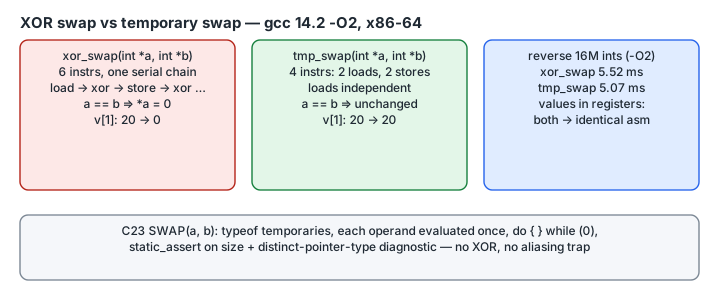
a ^= b; b ^= a; a ^= b; swaps two integers without a temporary. It turns up in interview answers, old embedded code and “clever C” threads. On a modern compiler and CPU it has three problems and no benefit:
- Aliasing. If
aandbname the same object, the first XOR sets it to zero, and from then on it stays zero. - Undefined behaviour in the one-liner.
a ^= b ^= a ^= bmodifiesatwice without a sequence point between the two modifications. - It isn’t faster. Through pointers it compiles to more instructions in a serial dependency chain. With values in registers, the compiler emits the same code for both versions.
A temporary is correct, and C23’s standard typeof lets you wrap one in a macro that evaluates each operand once and refuses mismatched types. All numbers and diagnostics below come from gcc 14.2.0 (Debian) on x86-64.
Trap 1: swapping an element with itself
A self-swap happens more often than it sounds. A Fisher–Yates shuffle swaps v[i] with v[j] where j may equal i, and a partition step may swap an element with itself.
#include <stdio.h>
static void xor_swap(int *a, int *b) { *a ^= *b; *b ^= *a; *a ^= *b; }
static void tmp_swap(int *a, int *b) { int t = *a; *a = *b; *b = t; }
int main(void) {
    int v[4] = {10, 20, 30, 40};
    int i = 1, j = 1;                       /* e.g. a shuffle that picked the same index */
    tmp_swap(&v[i], &v[j]);  printf("tmp_swap(&v[1], &v[1]) -> v[1] = %d\n", v[1]);
    xor_swap(&v[i], &v[j]);  printf("xor_swap(&v[1], &v[1]) -> v[1] = %d\n", v[1]);
    int x = 3, y = 5;
    xor_swap(&x, &y);        printf("xor_swap(3, 5)         -> %d %d\n", x, y);
    return 0;
}
gcc -std=c23 -O2 -Wall -Wextra alias.c && ./a.out:
tmp_swap(&v[1], &v[1]) -> v[1] = 20
xor_swap(&v[1], &v[1]) -> v[1] = 0
xor_swap(3, 5)         -> 5 3
The compiler gives no warning, and the bug only shows up when two indices happen to collide. With *a and *b the same object, *a ^= *b computes x ^ x, which is 0, and the next two XORs keep it at zero. The usual “fix” is if (a != b), which adds a branch to an idiom whose only selling point was saving a register.
Trap 2: the one-liner is undefined
#include <stdio.h>
int main(void) { int a = 3, b = 5; a ^= b ^= a ^= b; printf("a=%d b=%d\n", a, b); }
oneliner.c: In function ‘main’:
oneliner.c:2:38: warning: operation on ‘a’ may be undefined [-Wsequence-point]
2 | int main(void) { int a = 3, b = 5; a ^= b ^= a ^= b; printf("a=%d b=%d\n", a, b); }
| ^~
a=5 b=3It printed the “right” answer on this build, which is what makes it dangerous. The C standard makes it undefined to modify the same scalar twice without the modifications being sequenced (evaluation order; C23 N3220 §6.5). GCC’s -Wsequence-point, which -Wall enables, flags it. Treat that warning as an error.
Trap 3: it is not faster
void xor_swap(int *a, int *b) { *a ^= *b; *b ^= *a; *a ^= *b; }
void tmp_swap(int *a, int *b) { int t = *a; *a = *b; *b = t; }
int  xor_regs(int a, int b) { a ^= b; b ^= a; a ^= b; return a - b; }
int  tmp_regs(int a, int b) { int t = a; a = b; b = t; return a - b; }
gcc -std=c23 -O2 -S -masm=intel (directives trimmed):
xor_swap:
    mov eax, DWORD PTR [rdi]
    xor eax, DWORD PTR [rsi]
    mov DWORD PTR [rdi], eax
    xor eax, DWORD PTR [rsi]
    mov DWORD PTR [rsi], eax
    xor DWORD PTR [rdi], eax
    ret
tmp_swap:
    mov eax, DWORD PTR [rdi]
    mov edx, DWORD PTR [rsi]
    mov DWORD PTR [rdi], edx
    mov DWORD PTR [rsi], eax
    ret
xor_regs:
    mov eax, esi
    sub eax, edi
    ret
tmp_regs:
    mov eax, esi
    sub eax, edi
    ret
Three observations:
- Through pointers,
xor_swapis 6 instructions. Each one depends on the previous result, and the finalxor DWORD PTR [rdi], eaxis a read-modify-write to memory. The compiler must keep that shape, because it can’t rule outa == b, and the XOR version gives a different result (zero) in that case.tmp_swapis 4 instructions, with two loads that can issue in parallel followed by two stores. - In registers, both versions compile to the same two instructions. GCC sees through the XOR sequence and just renames registers. A temporary in source code doesn’t cost a register in the output.
- The “saves a register” argument comes from machines with very few registers and no register renaming. x86-64 has 16 general-purpose registers plus renaming in hardware.
A micro-benchmark that reverses a 16M-element int array in place with each swap (bench.c, best of 20 passes, clock_gettime(CLOCK_MONOTONIC), 8-vCPU Intel Xeon VM):
-O2: reverse 16M ints, best of 20: xor_swap 5.52 ms, tmp_swap 5.07 ms (v[0]=0)
-O3: reverse 16M ints, best of 20: xor_swap 5.93 ms, tmp_swap 5.26 ms (v[0]=0)
Three more runs of the -O2 binary gave 8.43/7.58, 7.93/7.27 and 7.42/6.81 ms. Absolute times move around on a shared VM, but tmp_swap won every run by about 8–12%. This loop is mostly memory-bound, so the gap is modest. The point is that the XOR version never wins.
Doing it right: a C23 SWAP macro
C23 standardises typeof, which GCC and Clang had long supported as an extension (cppreference). That makes a type-generic swap possible without passing the type as an argument:
#include <stdio.h>
#include <assert.h>
/* C23: typeof is standard. Same-type check via a pointer assignment, evaluated once. */
#define SWAP(a, b) do {                                           \
        typeof(a) *swap_pa_ = &(a);                                \
        typeof(b) *swap_pb_ = &(b);                                \
        static_assert(sizeof *swap_pa_ == sizeof *swap_pb_,        \
                      "SWAP: operands differ in size");            \
        (void)(swap_pa_ == swap_pb_); /* distinct types -> diagnostic */ \
        typeof(a) swap_t_ = *swap_pa_;                             \
        *swap_pa_ = *swap_pb_;                                     \
        *swap_pb_ = swap_t_;                                       \
    } while (0)
Design choices:
- Each operand is evaluated once. The macro takes
&(a)and&(b)a single time and works through the pointers, soSWAP(v[i++], v[2])incrementsiexactly once. A naivet = a; a = b; b = t;macro would evaluatev[i++]twice. - Self-swap is harmless because it uses a temporary, not XOR.
- Type checks. The
static_assertcatches operands of different sizes at compile time. Comparing the two pointers catches different types of the same size (intvsfloat), using GCC’s-Wcompare-distinct-pointer-types(warning options). Build with-Werrorto make that a hard error. do { … } while (0)makes the macro a single statement, soif (x) SWAP(p, q); else …parses as intended. A GCC statement expression isn’t needed, because a swap produces no value.- The operands must be lvalues. Bit-fields and
registervariables can’t have their address taken, so swap those with a plain temporary.
The test driver:
int main(void) {
    int v[3] = {1, 2, 3}; int i = 0;
    SWAP(v[i++], v[2]);           /* i++ evaluated exactly once */
    printf("v = {%d, %d, %d}, i = %d\n", v[0], v[1], v[2], i);
    SWAP(v[1], v[1]);             /* self-swap is harmless */
    printf("self-swap v[1] = %d\n", v[1]);
    double d = 1.5, e = 2.5; SWAP(d, e); printf("d=%.1f e=%.1f\n", d, e);
#ifdef BAD
    int n = 1; long long w = 2; SWAP(n, w);
    float f = 1; SWAP(n, f);
#endif
    return 0;
}
v = {3, 2, 1}, i = 1
self-swap v[1] = 2
d=2.5 e=1.5
$ gcc -std=c23 -DBAD -Wall macro.c
macro.c:7:9: error: static assertion failed: "SWAP: operands differ in size"
macro.c:9:25: warning: comparison of distinct pointer types lacks a cast [-Wcompare-distinct-pointer-types]
macro.c:9:25: warning: comparison of distinct pointer types lacks a cast [-Wcompare-distinct-pointer-types]The size assertion fires for int vs long long, and the distinct-pointer warning fires for int vs float. GCC also reports that warning on the long long line, which is why it appears twice.
Takeaways
- Never use XOR swap through pointers: it zeroes the value when the pointers alias, and it compiles to a longer dependency chain.
a ^= b ^= a ^= bis undefined behaviour, so keep-Wall(which includes-Wsequence-point) on and treat it as fatal.- Write the temporary. The optimiser removes it whenever it can.
- For a reusable swap, use C23
typeofwith take-the-address-once semantics, plus a sizestatic_assertand a pointer-type check.