Arena Allocators: Bump Pointers, Alignment, and Lifetimes Instead of free()
Arena Allocators: Bump Pointers, Alignment, and Lifetimes Instead of free()
Thesis
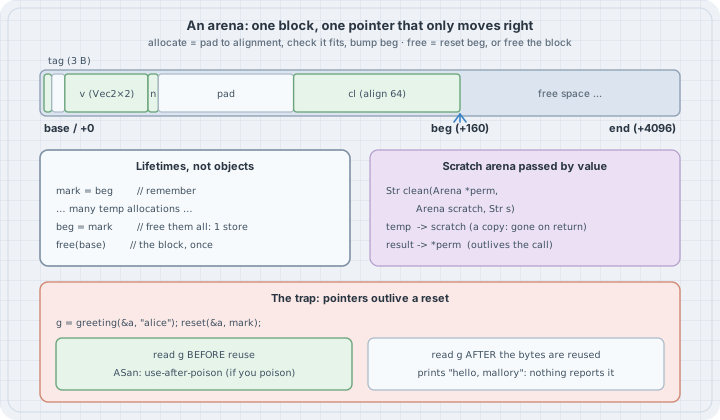
Most malloc/free bugs come from tracking the lifetime of every object one at a time. Many programs don’t have a million independent lifetimes, though. They have a few: this request, this frame, this parse, until exit. An arena (also called a region, bump or linear allocator) matches that shape. It takes one big block and allocates by moving a pointer forward. It frees everything at once by moving the pointer back.
The core is about ten lines. The details that make it correct are:
- Alignment: pad before each allocation.
- Overflow-checked sizes: never compute
count * sizeblindly. - An explicit out-of-memory policy.
- Honesty about the cost: a pointer that outlives a reset is a use-after-free that no allocator will catch for you, unless you teach AddressSanitizer about the arena.
Mental model
malloc/free |
Arena | |
|---|---|---|
| Allocate | general-purpose search of size-class bins | pad + bounds check + pointer add |
| Free one object | free(p) |
not supported (by design) |
| Free a whole structure | walk it and free every node |
beg = mark or free(base): O(1) |
| Per-object overhead | chunk header (8–16 B on glibc x86-64) plus rounding | only alignment padding |
| Lifetime bugs | per object: double free, leak, UAF | per region: pointers that escape the region |
| Tool support | ASan/Valgrind understand it out of the box | ASan only if you add manual poisoning |
Worked examples
All listings were compiled with GCC 14.2.0 (Debian), -std=c17 -Wall -Wextra -O2 (warning-free) against glibc 2.41, and run on an 8-vCPU x86-64 Xeon VM. The current GCC release is 16.2. Nothing here depends on the compiler version beyond C11 _Alignof/alignas and the sanitizer interface. Every output block is pasted from a real run.
The whole allocator
// arena.h — a minimal bump ("linear") arena allocator
#ifndef ARENA_H
#define ARENA_H
#include <stddef.h>
#include <stdint.h>
#include <stdlib.h>
#include <string.h>

#if defined(__has_feature)
#  if __has_feature(address_sanitizer)
#    define ARENA_ASAN 1
#  endif
#endif
#if defined(__SANITIZE_ADDRESS__)
#  define ARENA_ASAN 1
#endif
#ifdef ARENA_ASAN
#  include <sanitizer/asan_interface.h>
// Out-of-line on purpose: GCC 14's -Wmaybe-uninitialized misfires when fresh malloc memory
// is passed straight to the poison call's const volatile void * parameter.
__attribute__((noinline)) static void arena_poison_(void *p, size_t n) { ASAN_POISON_MEMORY_REGION(p, n); }
#  define ARENA_POISON(p, n)   arena_poison_((p), (n))
#  define ARENA_UNPOISON(p, n) ASAN_UNPOISON_MEMORY_REGION((p), (n))
#else
#  define ARENA_POISON(p, n)   ((void)(p), (void)(n))
#  define ARENA_UNPOISON(p, n) ((void)(p), (void)(n))
#endif

typedef struct {
    char *beg;   // next free byte
    char *end;   // one past the last usable byte
} Arena;

// Carve an arena out of one malloc'd block. The caller frees *base once, at the end.
static inline Arena arena_new(size_t cap, void **base)
{
    char *mem = malloc(cap);
    *base = mem;
    Arena a = { mem, mem ? mem + cap : NULL };
    if (mem) ARENA_POISON(a.beg, (size_t)(a.end - a.beg));   // ASan: unallocated bytes are off-limits
    return a;
}

// Allocate count objects of size bytes each, aligned to align (a power of two), zeroed.
// Returns NULL when the arena is exhausted or count*size would overflow.
static inline void *arena_alloc(Arena *a, ptrdiff_t size, ptrdiff_t align, ptrdiff_t count)
{
    ptrdiff_t pad = -(uintptr_t)a->beg & (uintptr_t)(align - 1);
    ptrdiff_t avail = a->end - a->beg - pad;
    if (avail < 0 || count > avail / size) {
        return NULL;                       // checked: no count*size overflow
    }
    char *p = a->beg + pad;
    a->beg = p + count * size;
    ARENA_UNPOISON(p, (size_t)(count * size));
    return memset(p, 0, (size_t)(count * size));
}

#define arena_new_of(a, T, n) ((T *)arena_alloc((a), sizeof(T), _Alignof(T), (n)))

// Scratch lifetimes: remember where we were, and roll back to it later.
static inline char *arena_mark(const Arena *a) { return a->beg; }
static inline void arena_reset(Arena *a, char *mark)
{
    ARENA_POISON(mark, (size_t)(a->beg - mark));
    a->beg = mark;
}
#endif
Five decisions in this header deserve a sentence each:
- Signed sizes (
ptrdiff_t).availcan go negative when the padding alone doesn’t fit. The checkcount > avail / sizethen rejects any request whosecount * sizewould exceed the space left, without ever computing the overflowing product. - Alignment padding is
-(uintptr_t)beg & (align - 1). That is the distance to the next multiple of a power-of-twoalign.arena_new_offeeds it_Alignof(T), so every type gets its own alignment, not a one-size-fits-all 16. - Zeroing in
arena_allocmakes “zero is a valid initial state” designs free to use and removes a whole class of uninitialised reads. The cost is touching every byte you allocate, so drop thememsetif you measure it mattering. - Out-of-memory returns
NULL. Some arenas abort instead, orlongjmpto a per-request handler. Pick one policy and use it everywhere. - ASan poisoning is compiled in only under
-fsanitize=address. Case 4 is the reason it exists.
Case 1: Sizes, padding and the alignment malloc doesn’t promise
// basics.c — what a bump allocator actually does with sizes and alignment
#include <stdio.h>
#include <stdalign.h>
#include "arena.h"

typedef struct { double x, y; } Vec2;          // alignment 8
typedef struct { alignas(64) char line[64]; } CacheLine;   // alignment 64

int main(void)
{
    void *base;
    Arena a = arena_new(4096, &base);
    char *start = a.beg;

    char     *tag  = arena_new_of(&a, char, 3);
    Vec2     *v    = arena_new_of(&a, Vec2, 2);
    int      *n    = arena_new_of(&a, int, 1);
    CacheLine *cl  = arena_new_of(&a, CacheLine, 1);

    printf("block %% 64 = %zu (malloc only promises %zu)\n",
           (size_t)((uintptr_t)start % 64), alignof(max_align_t));
    printf("tag  at +%-4td size %zu\n", tag - start, 3 * sizeof *tag);
    printf("v    at +%-4td size %zu  (padded to align %zu)\n", (char *)v - start, 2 * sizeof *v, alignof(Vec2));
    printf("n    at +%-4td size %zu\n", (char *)n - start, sizeof *n);
    printf("cl   at +%-4td size %zu  (align %zu: addr %% 64 = %zu)\n", (char *)cl - start, sizeof *cl,
           alignof(CacheLine), (size_t)((uintptr_t)cl % 64));
    printf("used %td of 4096 bytes, 4 allocations, 1 malloc\n", a.beg - start);

    // Overflow-checked: a huge count fails cleanly instead of wrapping.
    void *huge = arena_alloc(&a, sizeof(Vec2), alignof(Vec2), PTRDIFF_MAX / 4);
    printf("huge request -> %s\n", huge ? "non-NULL (BUG)" : "NULL");

    free(base);   // every allocation above is released here, at once
    return 0;
}
$ gcc -std=c17 -Wall -Wextra -O2 -o basics basics.c && ./basics
block % 64 = 32 (malloc only promises 16)
tag at +0 size 3
v at +8 size 32 (padded to align 8)
n at +40 size 4
cl at +96 size 64 (align 64: addr % 64 = 0)
used 160 of 4096 bytes, 4 allocations, 1 malloc
huge request -> NULLRead the offsets. tag takes 3 bytes, then 5 bytes of padding, because Vec2 needs 8-byte alignment. CacheLine asks for 64-byte alignment, which is more than malloc guarantees: C only promises alignment for types with a fundamental alignment, which is alignof(max_align_t), 16 here. The block itself happened to start 32 bytes past a 64-byte boundary. So the arena padded from offset 44 all the way to 96, where the address is a multiple of 64. Alignment is about addresses, not offsets: the same code against a different block would pad differently. The last line shows the overflow check working. The request for about 2^61 Vec2 objects fails cleanly instead of wrapping to a small size.
Case 2: Two lifetimes, and a scratch arena passed by value
Real programs have at least two lifetimes: results that must survive, and temporaries that only exist while a function runs. Give each one its own arena.
// scratch.c — two lifetimes: a permanent arena for results, a scratch arena passed BY VALUE
#include <ctype.h>
#include <stdio.h>
#include "arena.h"

typedef struct { char *data; ptrdiff_t len; } Str;

// Upper-cased, de-duplicated-spaces copy of s. The temporary work buffer comes from
// `scratch`, a COPY of the caller's arena: anything allocated in it is gone on return.
static Str clean(Arena *perm, Arena scratch, Str s)
{
    char *tmp = arena_new_of(&scratch, char, s.len);      // temporary: dies with this frame
    if (!tmp) return (Str){ NULL, 0 };
    ptrdiff_t n = 0;
    for (ptrdiff_t i = 0; i < s.len; i++) {
        if (s.data[i] == ' ' && (n == 0 || tmp[n - 1] == ' ')) continue;
        tmp[n++] = (char)toupper((unsigned char)s.data[i]);
    }
    while (n > 0 && tmp[n - 1] == ' ') n--;
    Str out = { arena_new_of(perm, char, n + 1), n };     // permanent: outlives the call
    if (!out.data) return (Str){ NULL, 0 };
    memcpy(out.data, tmp, (size_t)n);
    return out;
}

int main(void)
{
    void *pbase, *sbase;
    Arena perm = arena_new(1 << 16, &pbase);
    Arena scratch = arena_new(1 << 16, &sbase);
    char *p0 = perm.beg, *s0 = scratch.beg;

    const char *in[] = { "  hello   arena  ", "bump   pointers are   cheap", " free   it all at once " };
    Str out[3];
    for (int i = 0; i < 3; i++) {
        out[i] = clean(&perm, scratch, (Str){ (char *)in[i], (ptrdiff_t)strlen(in[i]) });
        printf("\"%s\"\n", out[i].data ? out[i].data : "(out of memory)");
    }
    printf("perm used %td bytes, scratch used %td bytes (each call reused the same scratch space)\n",
           perm.beg - p0, scratch.beg - s0);

    // The same thing with explicit mark/reset, for code that holds an Arena * everywhere.
    char *mark = arena_mark(&scratch);
    char *big = arena_new_of(&scratch, char, 4000);
    big[0] = 'x';
    printf("after a 4000-byte temp: scratch used %td\n", scratch.beg - s0);
    arena_reset(&scratch, mark);
    printf("after reset:            scratch used %td\n", scratch.beg - s0);

    free(sbase);
    free(pbase);
    return 0;
}
$ gcc -std=c17 -Wall -Wextra -O2 -o scratch scratch.c && ./scratch
"HELLO ARENA"
"BUMP POINTERS ARE CHEAP"
"FREE IT ALL AT ONCE"
perm used 56 bytes, scratch used 0 bytes (each call reused the same scratch space)
after a 4000-byte temp: scratch used 4000
after reset: scratch used 0clean takes perm by pointer, because its allocations must persist, and scratch by value. The callee bumps its copy of beg, so when it returns, the caller’s scratch is exactly as it was. Every call reused the same scratch bytes, and scratch used 0 bytes at the end. No free, no reset call, no way to forget one. For code that already holds an Arena * everywhere, arena_mark/arena_reset gives the same effect explicitly.
Case 3: What it buys, measured
// bench.c — 1M small nodes: malloc/free per node vs one arena, two workloads
#define _POSIX_C_SOURCE 200809L
#include <stdio.h>
#include <sys/resource.h>
#include <time.h>
#include "arena.h"

typedef struct Node { struct Node *left, *right; uint64_t key; char name[16]; } Node;
enum { N = 1000000, RUNS = 5 };

static double now(void)
{
    struct timespec ts;
    clock_gettime(CLOCK_MONOTONIC, &ts);
    return ts.tv_sec + ts.tv_nsec / 1e9;
}
static long minflt(void)
{
    struct rusage ru;
    getrusage(RUSAGE_SELF, &ru);
    return ru.ru_minflt;
}

static uint64_t rng;
static uint64_t next(void) { rng ^= rng << 13; rng ^= rng >> 7; rng ^= rng << 17; return rng; }

// Workload "list": allocation-dominated (push N nodes on a list).
// Workload "tree": search-dominated (insert N random keys into an unbalanced BST).
static Node *insert(Node *root, Node *n, int tree)
{
    if (!tree) { n->right = root; return n; }
    Node **slot = &root;
    while (*slot) slot = n->key < (*slot)->key ? &(*slot)->left : &(*slot)->right;
    *slot = n;
    return root;
}
static void free_all(Node *n)                       // per-node teardown that malloc forces on you
{
    while (n) { free_all(n->left); Node *r = n->right; free(n); n = r; }
}

static double median(double *v)
{
    for (int i = 1; i < RUNS; i++)
        for (int j = i; j > 0 && v[j] < v[j - 1]; j--) { double t = v[j]; v[j] = v[j - 1]; v[j - 1] = t; }
    return v[RUNS / 2];
}

static void run(int tree, Arena *a)
{
    double bm[RUNS], tm[RUNS], ba[RUNS], ta[RUNS];
    long fm = 0, fa = 0;
    for (int r = 0; r < RUNS; r++) {
        rng = 0x9E3779B97F4A7C15u;
        Node *root = NULL;
        long f0 = minflt();
        double t0 = now();
        for (int i = 0; i < N; i++) {
            Node *n = calloc(1, sizeof *n);
            if (!n) exit(1);
            n->key = next();
            root = insert(root, n, tree);
        }
        double t1 = now();
        free_all(root);
        double t2 = now();
        fm = minflt() - f0;
        bm[r] = t1 - t0; tm[r] = t2 - t1;

        rng = 0x9E3779B97F4A7C15u;
        root = NULL;
        char *mark = arena_mark(a);
        f0 = minflt();
        t0 = now();
        for (int i = 0; i < N; i++) {
            Node *n = arena_new_of(a, Node, 1);
            if (!n) exit(1);
            n->key = next();
            root = insert(root, n, tree);
        }
        t1 = now();
        arena_reset(a, mark);                        // one store releases every node
        t2 = now();
        fa = minflt() - f0;
        ba[r] = t1 - t0; ta[r] = t2 - t1;
    }
    printf("%s workload\n", tree ? "tree (search-dominated)" : "list (allocation-dominated)");
    printf("  malloc  build %7.1f ms  teardown %7.3f ms  minor faults %6ld\n", median(bm) * 1e3, median(tm) * 1e3, fm);
    printf("  arena   build %7.1f ms  teardown %7.3f ms  minor faults %6ld\n", median(ba) * 1e3, median(ta) * 1e3, fa);
}

int main(void)
{
    void *base;                                      // one long-lived arena, reset per run
    Arena a = arena_new((size_t)N * sizeof(Node), &base);
    if (!base) return 1;
    run(0, &a);
    run(1, &a);
    free(base);
    printf("(median of %d runs, %d nodes of %zu bytes; faults from the last run; the arena's first run paid its page faults once)\n", RUNS, N, sizeof(Node));
    return 0;
}
$ gcc -std=c17 -Wall -Wextra -O2 -o bench bench.c && ./bench
list (allocation-dominated) workload
malloc build 8.1 ms teardown 6.835 ms minor faults 0
arena build 6.5 ms teardown 0.000 ms minor faults 0
tree (search-dominated) workload
malloc build 578.1 ms teardown 59.858 ms minor faults 0
arena build 384.4 ms teardown 0.000 ms minor faults 0
(median of 5 runs, 1000000 nodes of 40 bytes; faults from the last run; the arena's first run paid its page faults once)Two results hold up. One doesn’t:
- Teardown is the big, robust win. Freeing a million nodes one at a time costs roughly 7 ms for a list and roughly 55–60 ms for a tree. The tree walk misses cache on every node. The arena’s teardown is a single store, which rounds to 0.000 ms.
- Allocation itself is somewhat faster in the allocation-dominated list workload (about 6.5 ms vs 8 ms). Nodes are also denser: 40 bytes each with no 16-byte chunk header in between.
- Don’t trust the tree build column. It is dominated by cache misses during the search, not by the allocator. On this VM it moved by ±40% between variants of the same benchmark. In an earlier variant that
malloc’d a fresh 40 MB arena block on every run, the arena tree build was about 10% slower thanmalloc(≈440–470 ms vs ≈400 ms). That run paid 9,766 minor page faults to first-touch the new block: exactly 40,000,000 / 4096, rounded up. A 40 MB request is far above glibc’sM_MMAP_THRESHOLD, so unless it can be carved out of heap spacemallochas just released, it arrives as fresh, untouched pages. The arena wins on build only when the block is reused, and a long-lived, reset-per-request arena is how they’re meant to be used anyway.
Case 4: The trap, a pointer that outlives its reset
// dangling.c — the arena trap: a pointer that outlives its reset
#include <stdio.h>
#include "arena.h"

static const char *greeting(Arena *a, const char *name)
{
    char *s = arena_new_of(a, char, 64);
    if (!s) return "(oom)";
    snprintf(s, 64, "hello, %s", name);
    return s;
}

int main(int argc, char **argv)
{
    int early = argc > 1 && strcmp(argv[1], "early") == 0;  // read the stale pointer before or after reuse?
    void *base;
    Arena a = arena_new(4096, &base);

    char *mark = arena_mark(&a);
    const char *g = greeting(&a, "alice");      // g points into the arena...
    printf("before reset: %s\n", g);
    arena_reset(&a, mark);                      // ...and this just made it dangling
    if (early) printf("stale read:   %s\n", g);  // bytes are poisoned until reused

    const char *h = greeting(&a, "mallory");    // reuses the same bytes
    printf("after reset:  %s   (same address? %s)\n", g, g == h ? "yes" : "no");

    free(base);
    return 0;
}
Plain -O2 build, read after reuse, then read before reuse:
$ ./dangling
before reset: hello, alice
after reset:  hello, mallory   (same address? yes)
$ ./dangling early
before reset: hello, alice
stale read:   hello, alice
after reset:  hello, mallory   (same address? yes)
Both runs are bugs: g refers to an allocation the program has released. Neither run complains. As far as C and the hardware can tell, the bytes are still part of a live malloc block, so there is no crash and nothing to catch. Now build with AddressSanitizer. The arena’s ARENA_POISON/ARENA_UNPOISON hooks switch on, so released bytes are marked unaddressable:
$ gcc -std=c17 -Wall -Wextra -O1 -g -fsanitize=address -fno-omit-frame-pointer -o dangling-asan dangling.c
$ ./dangling-asan early
=================================================================
==309323==ERROR: AddressSanitizer: use-after-poison on address 0x521000000100 at pc 0x7f8175c9c79c bp 0x7ffd1a9226c0 sp 0x7ffd1a921e80
READ of size 13 at 0x521000000100 thread T0
    #0 0x7f8175c9c79b in printf_common ../../../../src/libsanitizer/sanitizer_common/sanitizer_common_interceptors_format.inc:563
    #1 0x7f8175cc849a in vprintf ../../../../src/libsanitizer/sanitizer_common/sanitizer_common_interceptors.inc:1644
    #2 0x7f8175cca08e in printf ../../../../src/libsanitizer/sanitizer_common/sanitizer_common_interceptors.inc:1702
    #3 0x5642669db52c in main /tmp/arena/dangling.c:23
    #4 0x7f8175a35ca7  (/lib/x86_64-linux-gnu/libc.so.6+0x29ca7) (BuildId: 5e5b51f4c39af9ac589408c1dc432ba390a273cc)
    #5 0x7f8175a35d64 in __libc_start_main (/lib/x86_64-linux-gnu/libc.so.6+0x29d64) (BuildId: 5e5b51f4c39af9ac589408c1dc432ba390a273cc)
    #6 0x5642669db150 in _start (/tmp/arena/dangling-asan+0x1150) (BuildId: b7a93a7760343370a47176c7abbe1b9570bfbbc9)

0x521000000100 is located 0 bytes inside of 4096-byte region [0x521000000100,0x521000001100)
allocated by thread T0 here:
    #0 0x7f8175cf4c57 in malloc ../../../../src/libsanitizer/asan/asan_malloc_linux.cpp:69
    #1 0x5642669db398 in arena_new /tmp/arena/arena.h:37
    #2 0x5642669db398 in main /tmp/arena/dangling.c:17
    #3 0x7f8175a35ca7  (/lib/x86_64-linux-gnu/libc.so.6+0x29ca7) (BuildId: 5e5b51f4c39af9ac589408c1dc432ba390a273cc)

SUMMARY: AddressSanitizer: use-after-poison ../../../../src/libsanitizer/sanitizer_common/sanitizer_common_interceptors_format.inc:563 in printf_common
[... shadow-byte map trimmed ...]
$ ./dangling-asan
before reset: hello, alice
after reset: hello, mallory (same address? yes)That second run is the real lesson. Poisoning catches a stale read only until the bytes are handed out again. Once greeting(&a, "mallory") re-allocates the same address, g is a perfectly valid pointer as far as any tool can tell. It silently reads someone else’s data. With malloc, ASan holds freed chunks in a quarantine and delays their reuse, so a stale read after free is usually still caught. An arena that knows nothing of that reuses the exact address on the very next allocation.
The trap
The trap is letting a pointer escape the lifetime of its arena. The bug isn’t in the allocator. It’s in an API that returns arena memory to a caller who doesn’t know which arena, or which reset, owns it:
- caching a
const char *from a per-request arena in a global or long-lived struct; - keeping an element pointer while “growing” an arena-backed array by copying it to a new allocation (the old pointer still “works” until reuse);
- passing a scratch arena by pointer where the code assumed by value (or the reverse), so temporaries outlive, or are freed under, their users;
- resetting a shared arena in one thread while another still reads from it. The ASan interface is explicitly not thread-safe for concurrent poisoning of the same region either.
Two subtler costs are worth knowing:
- ASan’s manual poisoning works at 8-byte granularity.
ASAN_UNPOISON_MEMORY_REGION“may unpoison a super-region” of what you asked for, so tiny overruns into padding can go unreported. - This arena places allocations back to back, with no redzones, so an overrun from one object into the next is never reported. The sanitizer docs suggest leaving poisoned redzones between chunks (see Try this #3).
The boring rule
Use an arena when a group of objects shares one lifetime (a request, a frame, a parse, a phase) and free the group, never the member. Size requests with an overflow check, align with
_Alignof(T), and choose one out-of-memory policy. Pass scratch arenas by value so that temporaries clean themselves up, and keep long-lived results in a separate arena passed by pointer. Never let arena pointers outlive their arena’s reset. Make that impossible to miss by keeping arenas out of globals and APIs short-lived. In debug builds, poison on reset under ASan, and keep a build mode wherearena_alloccallsmalloc, so the ordinary tools see every object.
Try this
- Change
basics.cto allocateCacheLinefirst. How much padding is left, and why does the answer depend on the addressmallocreturned? - Add
void *arena_realloc_last(Arena *a, void *p, ptrdiff_t old, ptrdiff_t new)that grows in place whenpwas the most recent allocation and copies otherwise. Use it for a growable string builder and count how many copies it makes for 1,000 appends. - Give
arena_alloca debug-only 16-byte poisoned redzone after every allocation, as the ASan manual-poisoning guide suggests. Write a one-byte overrun fromtagintov, and confirm that ASan reports it now and didn’t before. - Add
-DARENA_MALLOCsupport so thatarena_alloccallscallocand records each pointer in a list thatarena_resetfrees. Rundangling.cunder ASan in that mode. What does ASan report for the “late” read now? - Rework
bench.cso that each run uses a fresh arena block created witharena_new. Reproduce the page-fault cost from Case 3, then pre-touch the block withmemsetbefore timing. Which column moves?
Sources
- ISO C, §6.2.8 Alignment of objects and §7.22.3 Memory management functions (“suitably aligned so that it may be assigned to a pointer to any type of object with a fundamental alignment requirement”; the same section numbers and wording in C11 and C17). Quoted from the public C11 committee draft N1570: https://www.open-std.org/jtc1/sc22/wg14/www/docs/n1570.pdf
- GNU C Library manual, “Aligned Memory Blocks” and “Memory Allocation Tunables” (
M_MMAP_THRESHOLD,M_TRIM_THRESHOLD): https://sourceware.org/glibc/manual/latest/html_node/Aligned-Memory-Blocks.html, https://sourceware.org/glibc/manual/latest/html_node/Memory-Allocation-Tunables.html - AddressSanitizer manual poisoning (the custom-arena workflow, 8-byte alignment,
allow_user_poisoning): https://github.com/google/sanitizers/wiki/AddressSanitizerManualPoisoning - Sanitizer interface header
asan_interface.h(__asan_poison_memory_region/__asan_unpoison_memory_regionsemantics and thread-safety note): https://github.com/llvm/llvm-project/blob/main/compiler-rt/include/sanitizer/asan_interface.h - GCC manual, Instrumentation Options (
-fsanitize=address): https://gcc.gnu.org/onlinedocs/gcc/Instrumentation-Options.html - GCC releases (GCC 16.2 current): https://gcc.gnu.org/releases.html
- Linux
getrusage(2)(ru_minflt): https://man7.org/linux/man-pages/man2/getrusage.2.html