Function Interposition with LD_PRELOAD
Function Interposition with LD_PRELOAD
Thesis
On a dynamically linked Linux program, every call to an exported library function such as open or malloc is resolved by the dynamic loader ld.so at run time. LD_PRELOAD puts your own shared object at the front of that search, so your definition wins. Inside the wrapper, dlsym(RTLD_NEXT, "open") hands you the definition that would have been used, so you can log, count, or fake a call and then pass it through. You don’t need to recompile, relink, or have the source.
The technique is useful for tracing, fault injection and test doubles. It is also easy to get subtly wrong. This chapter builds a working shim, then shows the four places where it silently does nothing.
Mental model
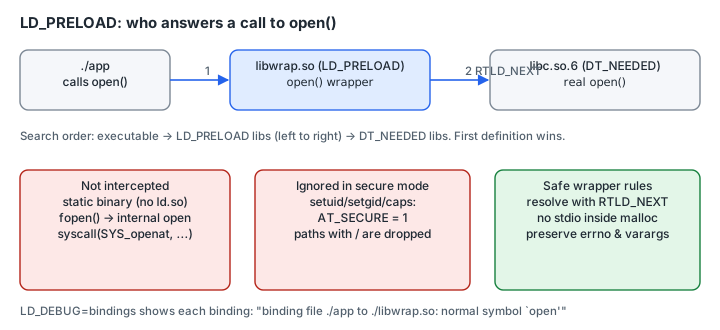
ld.so(8) defines the order. The loader builds one global lookup scope: the executable first, then each LD_PRELOAD object in order, then the DT_NEEDED dependencies breadth-first. A reference to open binds to the first object in that scope that defines it. RTLD_NEXT is a pseudo-handle for dlsym(3) that means “search the objects after the one making this call”, which is exactly the real implementation.
Worked example
Verified on Debian 13 with GCC 14.2 and glibc 2.41 (x86-64).
The target is an ordinary program that you won’t modify:
/* app.c - an ordinary program that allocates and opens a file */
#include <fcntl.h>
#include <stdio.h>
#include <stdlib.h>
#include <string.h>
#include <unistd.h>

int main(void) {
  char *buf = malloc(64);
  if (!buf) return 1;
  strcpy(buf, "hello");
  int fd = open("/etc/hostname", O_RDONLY);
  printf("app: buf=%s fd=%d\n", buf, fd);
  if (fd >= 0) close(fd);
  free(buf);
  return 0;
}
The shim wraps open (logging the path and result) and counts malloc calls, printing the total from a destructor when the process exits:
/* wrap.c - LD_PRELOAD shim that wraps open() and counts malloc() */
#define _GNU_SOURCE
#include <dlfcn.h>
#include <errno.h>
#include <fcntl.h>
#include <stdarg.h>
#include <stdatomic.h>
#include <stdio.h>
#include <stdlib.h>
#include <string.h>
#include <unistd.h>

static atomic_long n_malloc;

static void say(const char *msg) {          /* no stdio: safe inside malloc */
  ssize_t r = write(2, msg, strlen(msg));
  (void)r;
}

int open(const char *path, int flags, ...) {
  static int (*real_open)(const char *, int, ...);
  if (!real_open)
    real_open = (int (*)(const char *, int, ...))dlsym(RTLD_NEXT, "open");
  mode_t mode = 0;
  if (flags & (O_CREAT | O_TMPFILE)) {
    va_list ap;
    va_start(ap, flags);
    mode = (mode_t)va_arg(ap, int);
    va_end(ap);
  }
  int fd = real_open(path, flags, mode);
  int saved = errno;                         /* logging must not clobber errno */
  char line[256];
  int len = snprintf(line, sizeof line, "[wrap] open(\"%s\") = %d\n", path, fd);
  if (len > 0) say(line);
  errno = saved;
  return fd;
}

extern void *__libc_malloc(size_t);          /* glibc: avoids dlsym recursion */

void *malloc(size_t n) {
  atomic_fetch_add(&n_malloc, 1);
  return __libc_malloc(n);
}

__attribute__((destructor)) static void report(void) {
  char line[64];
  int len = snprintf(line, sizeof line, "[wrap] malloc calls: %ld\n",
                     atomic_load(&n_malloc));
  if (len > 0) say(line);
}
gcc -O2 -Wall -o app app.c
gcc -O2 -Wall -fPIC -shared -o libwrap.so wrap.c
./app
LD_PRELOAD=./libwrap.so ./appapp: buf=hello fd=5
[wrap] open("/etc/hostname") = 5
[wrap] malloc calls: 2
app: buf=hello fd=5The first line comes from the plain run, and the next three from the preloaded run. (fd=5 instead of 3 only means the lab shell already had descriptors 3 and 4 open.) Two details are worth noticing:
- The program’s
printfline appears after the destructor’s line. Stdout went to a pipe, so it was fully buffered and only flushed duringexit, after the shim’s destructor ran. The shim writes straight to fd 2 withwrite(2)and isn’t buffered. - The count is 2, not 1. The program called
malloconce, and stdio allocated its own buffer on the firstprintf. Interposition catches every caller of the exported symbol, including libc’s.
Since glibc 2.34, dlsym lives in libc itself, so you no longer need -ldl. Older toolchains still need it.
Proving the binding with LD_DEBUG
LD_DEBUG=bindings makes the loader print each symbol binding it performs:
LD_DEBUG=bindings LD_PRELOAD=./libwrap.so ./app 2>&1 | grep -E "symbol .(open|malloc)'" 1242272: binding file /lib/x86_64-linux-gnu/libc.so.6 [0] to ./libwrap.so [0]: normal symbol `malloc' [GLIBC_2.2.5]
1242272: binding file ./app [0] to ./libwrap.so [0]: normal symbol `malloc' [GLIBC_2.2.5]
1242272: binding file ./app [0] to ./libwrap.so [0]: normal symbol `malloc' [GLIBC_2.2.5]
1242272: binding file ./app [0] to ./libwrap.so [0]: normal symbol `open' [GLIBC_2.2.5]
1242272: binding file ./libwrap.so [0] to /lib/x86_64-linux-gnu/libc.so.6 [0]: normal symbol `open'The number at the start of each line is the process ID. The first line shows libc binding its own malloc reference to the shim, which is why the count includes stdio’s buffer. The last line is the dlsym(RTLD_NEXT, "open") lookup: the shim’s reference resolves to libc’s open, the next definition in the search order.
errno has to survive the wrapper
Callers read errno right after a failed call. Anything the wrapper does after the real call, such as snprintf or write, may change it, so the shim saves and restores errno:
/* missing.c - errno must survive the wrapper */
#include <errno.h>
#include <fcntl.h>
#include <stdio.h>
#include <string.h>
int main(void) {
  int fd = open("/no/such/file", O_RDONLY);
  printf("fd=%d errno=%s\n", fd, strerror(errno));
  return 0;
}
[wrap] open("/no/such/file") = -1
[wrap] malloc calls: 3
fd=-1 errno=No such file or directoryWhere interposition silently does nothing
1. Static binaries
gcc -O2 -static -o app-static app.c
LD_PRELOAD=./libwrap.so ./app-static
app: buf=hello fd=5A static executable has no PT_INTERP, so ld.so never runs and nobody reads LD_PRELOAD. Nothing is printed and there is no error.
2. Calls made inside libc
/* fopen.c - fopen() reaches the kernel without calling the exported open() */
#include <stdio.h>
int main(void) {
  FILE *f = fopen("/etc/hostname", "r");
  printf("fopen: %s\n", f ? "ok" : "failed");
  if (f) fclose(f);
  return 0;
}
[wrap] malloc calls: 2
fopen: okfopen opened the file, but the open wrapper never fired. glibc calls its internal, non-exported __open alias (it ends up in the openat syscall), and internal calls don’t go through the dynamic symbol table. malloc is still caught here, because glibc deliberately routes its allocations through the interposable malloc symbol. Before you rely on intercepting a function, check how libc reaches it, or wrap the internal entry points (fopen, openat, open64) as well.
3. Raw system calls
syscall(SYS_openat, ...) and inline syscall instructions (common in Go binaries and in some runtimes) never call a library function. To observe those you need strace, seccomp or eBPF, not LD_PRELOAD.
4. Secure-execution mode
When the kernel starts a set-user-ID or set-group-ID program, or one with file capabilities, it passes AT_SECURE=1 in the auxiliary vector (see getauxval(3)). In that mode, ld.so(8) documents that LD_PRELOAD entries containing a slash are ignored. Only libraries found in the standard search directories are loaded, and only if they are themselves set-user-ID. Without this rule, any user could inject code into passwd. This chapter doesn’t reproduce the case, because building a setuid binary needs root; the behaviour above is taken from the man page.
Writing a wrapper that doesn’t bite
- Match the prototype exactly, including varargs.
opentakes a thirdmode_targument only forO_CREAT/O_TMPFILE, so read it withva_argonly then. - Don’t recurse through
malloc.dlsymand stdio may allocate. In themallocwrapper, call glibc’s__libc_malloc(glibc-specific) or use a small static bootstrap buffer, and log withwrite(2), notprintf. - Preserve
errno, and return exactly what the real function returned. - Wrap the whole family.
open,open64,openatand__open_2(used by_FORTIFY_SOURCE) are different symbols. - Make it thread-safe. Use atomics for counters. The lazy
real_openinitialization above is a benign race on x86-64 (every thread stores the same pointer), but usepthread_onceif the setup does more. - Remember the destructor order. Output from destructors can appear before the program’s buffered stdout, as the first run shows.
Try this
- Add
fopento the shim and confirm that./fopennow logs. - Make
mallocfail on its 3rd call (seterrno = ENOMEM, thenreturn NULL) and watch howapphandles out-of-memory. This is cheap fault injection. - Run
LD_DEBUG=libs LD_PRELOAD=./libwrap.so ./appand find where the loader reports loadinglibwrap.sobeforelibc.so.6.
Sources
ld.so(8):LD_PRELOAD, search order, secure-execution mode: https://man7.org/linux/man-pages/man8/ld.so.8.htmldlsym(3):RTLD_NEXT: https://man7.org/linux/man-pages/man3/dlsym.3.htmlgetauxval(3):AT_SECURE: https://man7.org/linux/man-pages/man3/getauxval.3.html- glibc manual, “Replacing malloc”: https://sourceware.org/glibc/manual/latest/html_node/Replacing-malloc.html
- glibc 2.34 release notes (libdl merged into libc): https://sourceware.org/pipermail/libc-alpha/2021-August/129718.html