fork(), vfork() or posix_spawn(): Starting Programs in Modern C
fork(), vfork() or posix_spawn(): Starting Programs in Modern C
Thesis
The textbook way to run another program is fork() followed by exec(). It is short and flexible, and it gets expensive as the parent’s memory grows. fork() has to duplicate the parent’s address space (page tables, with every page marked copy-on-write) only for exec() to throw that copy away immediately. The 2019 HotOS paper A fork() in the road argues that fork is a poor default for this job. This chapter measures the cost and shows the replacement: posix_spawn(). It is as fast as vfork(), it reports exec failures directly, and it configures the child declaratively instead of with arbitrary code between fork and exec.
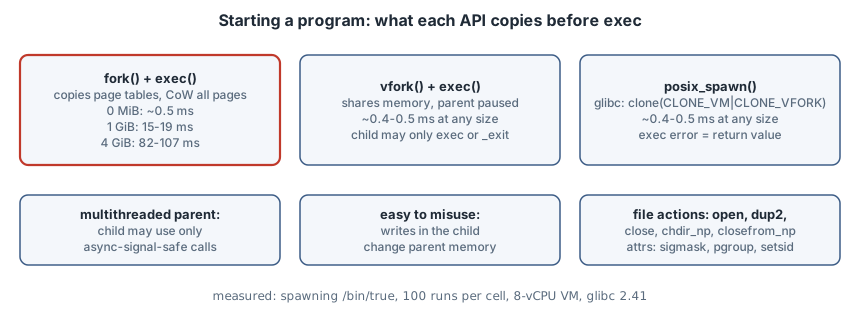
Everything was run with GCC 14.2.0 and glibc 2.41 on Linux 6.12, on an 8-vCPU x86-64 VM with 16 GB of RAM.
The three APIs
fork() + exec() |
vfork() + exec() |
posix_spawn() |
|
|---|---|---|---|
| Child’s memory | copy-on-write duplicate | shared with the parent | shared (glibc ≥ 2.24) |
| Parent during the gap | keeps running | suspended until exec/_exit |
suspended until exec |
What the child may do before exec |
anything (single-threaded parent); only async-signal-safe calls (multithreaded parent) | only exec or _exit |
nothing: you describe it with file actions and attributes |
| Exec failure reported as | child exit status you invent | child exit status you invent | return value |
| Standard | POSIX | removed from POSIX.1-2008 | POSIX |
According to the posix_spawn(3) man page, “since glibc 2.24, the posix_spawn() function commences by calling clone(2) with CLONE_VM and CLONE_VFORK flags.” In other words, glibc does the vfork trick for you, on a separate stack and with the dangerous parts handled.
Measurement: cost versus parent memory
The parent maps and touches a heap of 0, 1 or 4 GiB, then starts /bin/true 100 times with each method and waits for every child. The heap is mmaped and the program calls madvise on it. The 4k argument asks for no transparent huge pages, and the default asks for them. AnonHuge reports how much of the heap actually received huge pages.
// spawn.c: cost of starting /bin/true from a parent with a large resident heap
#define _GNU_SOURCE
#include <spawn.h>
#include <stdio.h>
#include <stdlib.h>
#include <string.h>
#include <sys/mman.h>
#include <sys/wait.h>
#include <time.h>
#include <unistd.h>

extern char **environ;
static char *argv_true[] = {"/bin/true", NULL};

static pid_t via_fork(void) {
    pid_t pid = fork();
    if (pid == 0) { execv(argv_true[0], argv_true); _exit(127); }
    return pid;
}
static pid_t via_vfork(void) {
    pid_t pid = vfork();
    if (pid == 0) { execv(argv_true[0], argv_true); _exit(127); }
    return pid;
}
static pid_t via_spawn(void) {
    pid_t pid;
    int e = posix_spawn(&pid, argv_true[0], NULL, NULL, argv_true, environ);
    return e ? -1 : pid;
}

static long anon_huge_kib(void) {
    FILE *f = fopen("/proc/self/smaps_rollup", "r");
    char line[256]; long kib = -1;
    while (f && fgets(line, sizeof line, f))
        if (sscanf(line, "AnonHugePages: %ld kB", &kib) == 1) break;
    if (f) fclose(f);
    return kib;
}

static double bench(pid_t (*start)(void), int n) {
    struct timespec a, b;
    clock_gettime(CLOCK_MONOTONIC, &a);
    for (int i = 0; i < n; i++) {
        int st; pid_t p = start();
        if (p < 0 || waitpid(p, &st, 0) < 0 || !WIFEXITED(st) || WEXITSTATUS(st)) {
            fprintf(stderr, "spawn failed\n"); exit(1);
        }
    }
    clock_gettime(CLOCK_MONOTONIC, &b);
    return ((b.tv_sec - a.tv_sec) * 1e9 + (b.tv_nsec - a.tv_nsec)) / n / 1e3;
}

int main(int argc, char **argv) {
    size_t mib = argc > 1 ? strtoul(argv[1], NULL, 10) : 0;
    int small_pages = argc > 2 && strcmp(argv[2], "4k") == 0;
    char *heap = NULL;
    if (mib) {
        heap = mmap(NULL, mib << 20, PROT_READ | PROT_WRITE, MAP_PRIVATE | MAP_ANONYMOUS, -1, 0);
        if (heap == MAP_FAILED) { perror("mmap"); return 1; }
        madvise(heap, mib << 20, small_pages ? MADV_NOHUGEPAGE : MADV_HUGEPAGE);
        memset(heap, 1, mib << 20);           /* make it resident */
    }
    int n = 100;
    printf("heap %5zu MiB %s (AnonHuge %7ld MiB):  fork+exec %8.1f us   vfork+exec %6.1f us   posix_spawn %6.1f us\n",
           mib, small_pages ? "4K " : "THP", anon_huge_kib() >> 10, bench(via_fork, n), bench(via_vfork, n), bench(via_spawn, n));
    if (heap) munmap(heap, mib << 20);
    return 0;
}
$ gcc -std=c23 -O2 -Wall -Wextra spawn.c -o spawn
$ for m in 0 1024 4096; do ./spawn $m; ./spawn $m 4k; done
heap 0 MiB THP (AnonHuge 0 MiB): fork+exec 545.7 us vfork+exec 397.4 us posix_spawn 382.8 us
heap 0 MiB 4K (AnonHuge 0 MiB): fork+exec 546.3 us vfork+exec 414.8 us posix_spawn 434.7 us
heap 1024 MiB THP (AnonHuge 178 MiB): fork+exec 15299.9 us vfork+exec 441.4 us posix_spawn 474.0 us
heap 1024 MiB 4K (AnonHuge 0 MiB): fork+exec 19366.4 us vfork+exec 475.4 us posix_spawn 493.9 us
heap 4096 MiB THP (AnonHuge 178 MiB): fork+exec 106975.3 us vfork+exec 499.0 us posix_spawn 521.3 us
heap 4096 MiB 4K (AnonHuge 0 MiB): fork+exec 82345.9 us vfork+exec 437.6 us posix_spawn 492.1 usfork+execgrows with resident memory: about 0.55 ms with no heap, 15–19 ms with 1 GiB and 82–107 ms with 4 GiB. That is two orders of magnitude slower for the same/bin/true.vforkandposix_spawnstay flat at 0.38–0.52 ms at every heap size, because they never copy the address space.- The THP rows show only 178 MiB of huge pages actually allocated, so this run tells you nothing about huge pages either way. The 4 KiB rows are the clean comparison.
The cost isn’t only time. A fork from a 4 GiB process also briefly commits another 4 GiB of copy-on-write memory, which can fail outright under vm.overcommit_memory=2 even though the child is about to exec (fork(2) lists ENOMEM).
Errors and child setup
// errs.c: how each API reports "the program does not exist", plus file actions
#define _GNU_SOURCE
#include <errno.h>
#include <fcntl.h>
#include <spawn.h>
#include <stdio.h>
#include <string.h>
#include <sys/wait.h>
#include <unistd.h>

extern char **environ;

int main(void) {
    char *bad[] = {"/no/such/program", NULL};

    /* fork + exec: the error happens in the child; the parent sees only a status */
    pid_t pid = fork();
    if (pid == 0) { execv(bad[0], bad); _exit(127); }
    int st; waitpid(pid, &st, 0);
    printf("fork+exec:   fork() succeeded, child exit status %d\n", WEXITSTATUS(st));

    /* posix_spawn: glibc reports the exec failure as the return value */
    int e = posix_spawn(&pid, bad[0], NULL, NULL, bad, environ);
    printf("posix_spawn: returned %d (%s)\n", e, strerror(e));

    /* file actions: run `pwd` in /tmp with stdout redirected to a file */
    posix_spawn_file_actions_t fa;
    posix_spawn_file_actions_init(&fa);
    posix_spawn_file_actions_addopen(&fa, STDOUT_FILENO, "/tmp/spawn-out.txt",
                                     O_WRONLY | O_CREAT | O_TRUNC, 0644);
    posix_spawn_file_actions_addchdir_np(&fa, "/tmp");
    char *pwd[] = {"pwd", NULL};
    e = posix_spawnp(&pid, "pwd", &fa, NULL, pwd, environ);
    posix_spawn_file_actions_destroy(&fa);
    waitpid(pid, &st, 0);
    printf("posix_spawnp(pwd): returned %d, child status %d\n", e, WEXITSTATUS(st));
    return 0;
}
$ gcc -std=c23 -O2 -Wall -Wextra errs.c -o errs && ./errs && cat /tmp/spawn-out.txt
fork+exec: fork() succeeded, child exit status 127
posix_spawn: returned 2 (No such file or directory)
posix_spawnp(pwd): returned 0, child status 0
/tmpWith fork+exec, the parent learns only that the child exited with 127, the conventional “command not found” code that this program chose itself. To get the real errno you need a close-on-exec pipe so the child can send it back. posix_spawn returns ENOENT (2) directly.
The child is configured with file actions, which are applied in order in the child before exec. Here they open a file as stdout and chdir to /tmp. The available actions are addopen, adddup2, addclose, and the glibc extensions addchdir_np (glibc 2.29) and addclosefrom_np (glibc 2.34). Attributes (posix_spawnattr_*) set the signal mask, default signal dispositions, process group and session. These cover most of what people write between fork and exec.
When to use which
- Starting a program:
posix_spawn/posix_spawnp. It is fast at any heap size, reports errors properly and is safe in multithreaded programs. forkwithoutexec: prefork servers, snapshotting (RedisBGSAVE), sandboxes that fork a template. In these cases the copy is the point. Remember that in a multithreaded parent the child may only use async-signal-safe functions until it callsexec, because other threads’ locks (including malloc’s) may be held forever (POSIXfork).vfork: almost never directly. The child shares the parent’s memory and stack. Any write other than callingexecor_exit, including returning from the function that calledvfork, corrupts the parent (vfork(2)).posix_spawngives you the same speed safely.- Needs
posix_spawncan’t express (seccomp filters, namespaces,setrlimitin the child): useclone3/pidfd-based helpers or a small exec-wrapper program. Aforkfrom a large process is the expensive option here too.
Pitfalls
system()andpopen()use a shell. glibc runs them through/bin/sh -c. They cost an extra exec and bring shell quoting bugs. Useposix_spawnpwith an argv array.- Descriptor leaks. The spawned child inherits every descriptor that isn’t close-on-exec. Create descriptors with
O_CLOEXEC, or addaddclosefrom_np, before spawning. posix_spawnpsearchesPATH;posix_spawndoesn’t. Pass an absolute path toposix_spawn.- Exit status 127 is just a convention. In a
fork+execerror path it is ambiguous with a real program that exits 127. Prefer an errno pipe orposix_spawn.
Takeaways
fork+execcost grows with the parent’s resident memory: 0.55 ms → about 19 ms (1 GiB) → about 82 ms (4 GiB) here.posix_spawnstayed at about 0.5 ms.- glibc’s
posix_spawnis a safevfork:clone(CLONE_VM | CLONE_VFORK)on its own stack. - It returns exec errors directly and configures the child with file actions and attributes.
- Use
forkwhen you want the copy, andposix_spawnwhen you want a new program.
Sources
- Linux man-pages,
posix_spawn(3),fork(2),vfork(2) - POSIX.1-2024,
fork(async-signal-safe rule in multithreaded processes) - Baumann, Appavoo, Krieger, Roscoe, A fork() in the road, HotOS 2019 (PDF)