math.integer (PEP 791): Exact Integer Functions Leave math
math.integer (PEP 791): Exact Integer Functions Leave math
Thesis
For years the math docs opened with “access to the mathematical functions defined by the C standard” and “except when explicitly noted otherwise, all return values are floats.” Neither sentence survived contact with math.comb, math.factorial, math.gcd, math.isqrt, math.lcm and math.perm. Those six functions take integers (or __index__ objects), return exact integers, and have nothing to do with libm. PEP 791 (Final, Python 3.15) moves them into a new submodule, math.integer, and leaves soft-deprecated aliases on math. New code imports the submodule. Old code keeps working. That is the whole change, and it is the right place to put the next integer function too.
Version note: every listing was run on CPython 3.15.0. import math.integer raises ModuleNotFoundError on 3.14.8.
Mental model
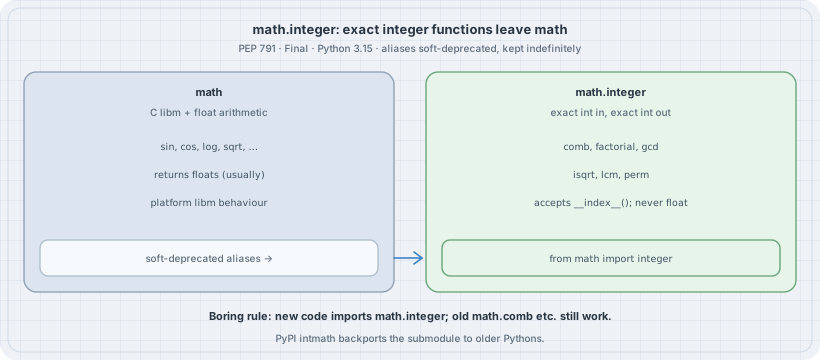
| Question | Answer |
|---|---|
| What moved? | comb, factorial, gcd, isqrt, lcm, perm |
Are the math.* names gone? |
No. Soft-deprecated aliases, kept indefinitely, same objects |
| What do they accept? | int and anything with __index__() — not float |
| What do they return? | Exact integers |
| Older Pythons? | The intmath package on PyPI backports the submodule |
Worked examples
Case 1: The tour
# mathint_tour.py
import math
import math.integer as mi
import sys
import warnings

print(sys.version.split()[0])
print("math.integer functions:", sorted(x for x in dir(mi) if not x.startswith("_")))
print()
print("aliases are the same objects:")
for name in ("comb", "factorial", "gcd", "isqrt", "lcm", "perm"):
    print(f"  math.{name} is math.integer.{name}: {getattr(math, name) is getattr(mi, name)}")

print()
print("exact integer results:")
print(f"  comb(100, 50) = {mi.comb(100, 50)}")
print(f"  factorial(20) = {mi.factorial(20)}")
print(f"  isqrt(10**40) = {mi.isqrt(10**40)}")
print(f"  ceiling isqrt for n=10 via 1+isqrt(n-1) = {1 + mi.isqrt(10 - 1)}")
print(f"  gcd(48, 18, 30) = {mi.gcd(48, 18, 30)}")
print(f"  lcm(4, 6, 8) = {mi.lcm(4, 6, 8)}")
print(f"  perm(10, 3) = {mi.perm(10, 3)};  perm(10) = {mi.perm(10)}")

class Idx:
    def __index__(self):
        return 7

print()
print(f"accepts __index__: factorial(Idx()) = {mi.factorial(Idx())}")

print()
print("rejects floats (not __index__):")
for label, call in [
    ("comb(5.0, 2)", lambda: mi.comb(5.0, 2)),
    ("factorial(5.0)", lambda: mi.factorial(5.0)),
    ("isqrt(5.0)", lambda: mi.isqrt(5.0)),
]:
    try:
        call()
    except TypeError as e:
        print(f"  {label}: TypeError: {e}")

print()
print("rejects negatives where required:")
for label, call in [
    ("factorial(-1)", lambda: mi.factorial(-1)),
    ("isqrt(-1)", lambda: mi.isqrt(-1)),
    ("comb(5, -1)", lambda: mi.comb(5, -1)),
]:
    try:
        call()
    except ValueError as e:
        print(f"  {label}: ValueError: {e}")

print()
with warnings.catch_warnings(record=True) as w:
    warnings.simplefilter("always")
    _ = math.comb(5, 2)
    print(f"warnings from math.comb(5, 2) under catch_warnings: {len(w)}")
python3.15 mathint_tour.pyOutput:
3.15.0
math.integer functions: ['comb', 'factorial', 'gcd', 'isqrt', 'lcm', 'perm']

aliases are the same objects:
  math.comb is math.integer.comb: True
  math.factorial is math.integer.factorial: True
  math.gcd is math.integer.gcd: True
  math.isqrt is math.integer.isqrt: True
  math.lcm is math.integer.lcm: True
  math.perm is math.integer.perm: True

exact integer results:
  comb(100, 50) = 100891344545564193334812497256
  factorial(20) = 2432902008176640000
  isqrt(10**40) = 100000000000000000000
  ceiling isqrt for n=10 via 1+isqrt(n-1) = 4
  gcd(48, 18, 30) = 6
  lcm(4, 6, 8) = 24
  perm(10, 3) = 720;  perm(10) = 3628800

accepts __index__: factorial(Idx()) = 5040

rejects floats (not __index__):
  comb(5.0, 2): TypeError: 'float' object cannot be interpreted as an integer
  factorial(5.0): TypeError: 'float' object cannot be interpreted as an integer
  isqrt(5.0): TypeError: 'float' object cannot be interpreted as an integer

rejects negatives where required:
  factorial(-1): ValueError: factorial() not defined for negative values
  isqrt(-1): ValueError: isqrt() argument must be nonnegative
  comb(5, -1): ValueError: k must be a non-negative integer

warnings from math.comb(5, 2) under catch_warnings: 0
Three facts from that run:
- The aliases are the same objects.
math.comb is math.integer.combisTruefor all six names.help(math.comb)already saysbuilt-in function comb in module math.integer. Soft deprecation here means “prefer the new home in new code”, not “aDeprecationWarningfires today” — zero warnings undercatch_warnings. - Results are exact.
comb(100, 50)is the full 30-digit integer, not a float approximation. That is the contrast the PEP draws withscipy.special.factorial, which returns a float by default. - The contract is
__index__, not “number-like”. An object with__index__works; afloatis rejected withTypeError: 'float' object cannot be interpreted as an integer. Negatives that are out of domain raiseValueError.
Case 2: Where to put new code
# mathint_import.py
import sys

try:
    from math import integer as mi          # 3.15+
except ImportError:                         # 3.14 and earlier
    import intmath as mi                    # pip install intmath

print(sys.version.split()[0], "→", mi.comb(10, 3), mi.isqrt(99))
python3.15 mathint_import.py
python3.14 -c "import math.integer" 2>&1 | tail -1Output:
3.15.0 → 120 9
ModuleNotFoundError: No module named 'math.integer'; 'math' is not a package
On 3.15, math becomes a package (a built-in package exposing the integer submodule). On 3.14 it is still a plain built-in module, so import math.integer fails. Libraries that want one source tree for 3.14 and 3.15 should use the try/except above, or depend on intmath which re-exports the same names.
Case 3: Why the split helps
The six functions share a contract that math.sin does not: exact integer in, exact integer out, no libm. Putting them under math.integer means:
- The
mathdocs can honestly say “float functions, C standard” again. - Tab completion on
math.integer.lists only the integer API. - Future additions the PEP floated (
c_div/n_divfor ceiling and nearest integer division,gcdext,isqrt_rem,ilog,fibonacci) have a home that does not collide with float names likemath.ceil.
None of those extensions shipped in 3.15.0. The submodule’s job in this release is the move and the contract.
The trap
Importing math.integer and then calling math.comb anyway. Soft deprecation does not warn. A codebase can “migrate” by adding the import and never changing a call site. Grep for math\.(comb|factorial|gcd|isqrt|lcm|perm)\b in new modules, or make the try/except import the only binding you use (mi.comb, not math.comb).
Assuming isqrt is rounding. isqrt(n) is \(\lfloor\sqrt{n}\rfloor\). The docs give the ceiling form for positive n: 1 + isqrt(n - 1). Case 1 prints 4 for \(n=10\), which is \(\lceil\sqrt{10}\rceil\). Off-by-one bugs here show up in block-size and page-size calculations.
The boring rule
- On 3.15+, write
from math import integer(orimport math.integer as mi) for combinatorial and number-theoretic helpers. - Treat
math.comband friends as compatibility aliases. Do not use them in new code. - Pass integers or
__index__objects. Do not pass floats and do not cast withint(x)unless you mean to truncate. - For 3.14 support, depend on PyPI
intmathor gate the import. - Prefer this submodule over rolling your own binomial coefficient that overflows a float at
comb(100, 50).
Try this
- Time
mi.factorial(n)against a pure-Python loop for \(n\) up to a few thousand. Where does the C implementation pull away? - Implement ceiling division as discussed in the PEP’s motivation (
-(-a // b)vs(a + b - 1) // bfor positive operands) and list the sign cases that go wrong. That is why the PEP wantsc_divin this submodule later. - Write a tiny
binomial_row(n)that builds row \(n\) of Pascal’s triangle withmi.comb. Checksum(binomial_row(n)) == 2**n. - On a 3.14 interpreter,
pip install intmathand confirm the try/except import from Case 2 returns the samecomb(10, 3).
Sources
- PEP 791 — math.integer (Final; Python 3.15; Serhiy Storchaka et al.; soft-deprecated aliases, no breaking change)
math.integer— integer-specific mathematics functions (3.15 documentation)- What’s New in Python 3.15: New modules — math.integer (gh-81313)
intmathon PyPI (backport for older Pythons)