Blocking the Event Loop: Finding Sync Calls in Async Code and Moving Them Off the Loop
Blocking the Event Loop: Finding Sync Calls in Async Code and Moving Them Off the Loop
Thesis
asyncio runs every coroutine of a program on one thread. A task gives the loop back only at an await that actually suspends. Any code between two such points, a time.sleep(), a synchronous database driver, a large json.dumps(), a checksum over an upload, runs while every other task waits. Nothing crashes and nothing is logged by default. The symptom is latency: requests that do no work themselves take a second, and only sometimes.
This chapter makes that cost visible and then fixes it, in four steps:
- Measure the loop’s lateness with a 10 ms heartbeat, and the effect on real requests with a ping client that runs outside the loop.
- Name the task with asyncio’s debug mode (
-X devorPYTHONASYNCIODEBUG=1) andslow_callback_duration. - Name the line with a small watchdog thread that prints the loop thread’s stack when the loop stalls. Unlike debug mode, it is cheap enough to leave on.
- Move the work:
asyncio.to_threadfor blocking I/O and for C code that releases the GIL, a process or interpreter pool for pure-Python CPU work, and a dedicated executor when the shared default pool becomes the bottleneck.
Version note: every listing was run on CPython 3.15.0 (released 2026-10-09) and CPython 3.14.8, both from uv (python-build-standalone, Linux x86-64, standard GIL builds), on a shared 8-core machine. Results are the same on both versions within noise; where only one version’s output is shown, the other matched. Timings vary between runs on a shared box, so compare the orders of magnitude, not the decimals. Free-threaded builds are not covered here.
Mental model
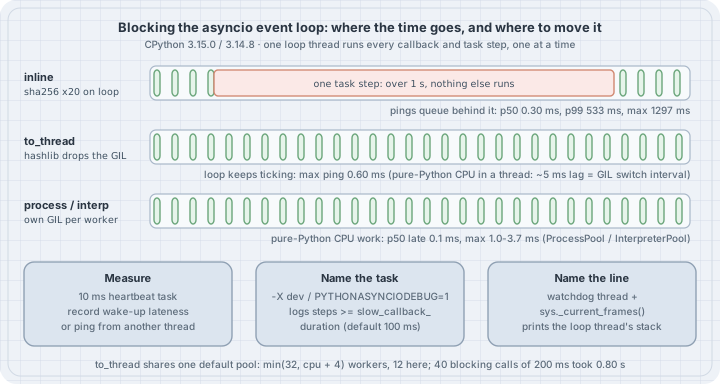
- The loop runs one thing at a time.
BaseEventLoop._run_once()pops each ready handle (a callback, or the next step of a task) and calls it. A task step runs from one suspension point to the next. While a step runs, timers do not fire, sockets are not read, and no other task makes progress. awaitis not a yield point by itself. Awaiting a coroutine runs it inline. Only awaiting something that is not ready yet (a sleeping timer, a socket with no data, a pending future) suspends the task and returns control to the loop.- Debug mode times every step. With debug enabled,
_run_once()measures eachhandle._run()and logsExecuting <handle> took N secondswhen it reachesloop.slow_callback_duration(default0.1). It tells you which task step was slow, not which line inside it. to_threadmoves a call, not the GIL.asyncio.to_thread(f, *args)runsfin the loop’s defaultThreadPoolExecutorand propagates the currentcontextvars.Context. The loop stays free only to the extent thatflets go of the GIL. Blocking system calls and many C functions (hashlib on buffers over 2047 bytes, zlib, file and socket I/O) do. A pure-Python loop does not; the interpreter then switches threads everysys.getswitchinterval()(5 ms).- Executors are shared and bounded. The default pool has
min(32, os.process_cpu_count() + 4)threads. Everyto_threadandrun_in_executor(None, ...)in the process queues on it.
Worked examples
All scripts live in one directory (/tmp/aioblock on the test machine, which is why that path appears in tracebacks) and need nothing outside the standard library.
Case 1: Measure the loop with a heartbeat
A heartbeat task sleeps for 10 ms in a loop and records how late each wake-up is. Another task does five rounds of 200 ms of blocking work, in six different ways:
# lag_probe.py: how late does the event loop run a 10 ms timer while a
# task does 5 x 200 ms of blocking work, done six different ways?
import asyncio
import concurrent.futures as cf
import sys
import time


async def heartbeat(lates, stop):
    """Sleep 10 ms at a time and record how late each wake-up is (ms)."""
    while not stop.is_set():
        t0 = time.perf_counter()
        await asyncio.sleep(0.010)
        lates.append((time.perf_counter() - t0 - 0.010) * 1000)


def busy(seconds):
    """Pure-Python CPU work for about `seconds`."""
    end = time.perf_counter() + seconds
    n = 0
    while time.perf_counter() < end:
        n += 1
    return n


async def work(mode, pool):
    loop = asyncio.get_running_loop()
    for _ in range(5):
        match mode:
            case "sleep-in-loop":
                time.sleep(0.2)                              # blocks the loop
            case "sleep-to-thread":
                await asyncio.to_thread(time.sleep, 0.2)
            case "cpu-in-loop":
                busy(0.2)                                    # blocks the loop
            case "cpu-to-thread":
                await asyncio.to_thread(busy, 0.2)           # shares the GIL
            case "cpu-to-process" | "cpu-to-interp":
                await loop.run_in_executor(pool, busy, 0.2)  # own GIL


async def main(mode):
    pool = None
    if mode == "cpu-to-process":
        pool = cf.ProcessPoolExecutor(max_workers=1)
    elif mode == "cpu-to-interp":
        pool = cf.InterpreterPoolExecutor(max_workers=1)     # 3.14+
    if pool:  # start the worker before measuring
        await asyncio.get_running_loop().run_in_executor(pool, busy, 0)
    lates, stop = [], asyncio.Event()
    hb = asyncio.create_task(heartbeat(lates, stop))
    await asyncio.sleep(0.05)                                # let it settle
    t0 = time.perf_counter()
    await work(mode, pool)
    elapsed = time.perf_counter() - t0
    stop.set()
    await hb
    if pool:
        pool.shutdown()
    lates.sort()
    print(f"{mode:16} {elapsed:4.2f}s  ticks={len(lates):3}  "
          f"p50 late={lates[len(lates) // 2]:6.1f} ms  max late={lates[-1]:6.1f} ms")


if __name__ == "__main__":
    for mode in sys.argv[1:]:
        asyncio.run(main(mode))
$ M="sleep-in-loop sleep-to-thread cpu-in-loop cpu-to-thread cpu-to-process cpu-to-interp"
$ python3.15 lag_probe.py $M
sleep-in-loop 1.00s ticks= 5 p50 late= 0.1 ms max late=1000.7 ms
sleep-to-thread 1.01s ticks=104 p50 late= 0.1 ms max late= 7.8 ms
cpu-in-loop 1.00s ticks= 5 p50 late= 0.1 ms max late=1000.3 ms
cpu-to-thread 1.00s ticks= 71 p50 late= 5.2 ms max late= 7.1 ms
cpu-to-process 1.01s ticks=104 p50 late= 0.1 ms max late= 1.3 ms
cpu-to-interp 1.00s ticks=104 p50 late= 0.1 ms max late= 1.3 ms
$ python3.14 lag_probe.py $M
sleep-in-loop 1.00s ticks= 5 p50 late= 0.2 ms max late=1000.8 ms
sleep-to-thread 1.00s ticks=104 p50 late= 0.1 ms max late= 2.1 ms
cpu-in-loop 1.00s ticks= 5 p50 late= 0.1 ms max late=1000.2 ms
cpu-to-thread 1.00s ticks= 69 p50 late= 5.2 ms max late= 13.8 ms
cpu-to-process 1.00s ticks=104 p50 late= 0.1 ms max late= 3.7 ms
cpu-to-interp 1.00s ticks=104 p50 late= 0.1 ms max late= 1.0 msRead the in-loop rows carefully. The work loop never awaits anything between its five rounds, so it is one task step of a full second. The heartbeat got 4 ticks before the work started and 1 after; its single late wake-up was 1000 ms late. The median looks perfect, which is why medians hide this problem. Look at the maximum, or at a high percentile.
The to-thread rows split by what the thread does:
time.sleepreleases the GIL, so the loop keeps its full ~104 ticks with sub-millisecond medians.- A pure-Python
busy()loop keeps the GIL. The loop thread gets it back only at the interpreter’s switch interval, so every wake-up is about 5 ms late (p50 late=5.2 ms) and a third of the ticks are lost. Better than a 1 s stall, but not free.
A ProcessPoolExecutor or an InterpreterPoolExecutor (3.14+, one interpreter with its own GIL per worker) takes the CPU work off the loop’s GIL completely. Both pools are started before the measurement, because creating a process or interpreter is itself slow.
Case 2: What the stall does to other requests
A heartbeat measures the loop. Users measure requests. This server answers ping immediately and computes a SHA-256 chain over a 40 MB upload. The clients are plain blocking sockets in their own threads, so they keep sending while the server’s loop is busy:
# server_demo.py: one asyncio TCP server, two kinds of request. Clients run
# in their own threads (not on the server's loop), so they keep sending
# while the loop is blocked: one uploads, one pings every 20 ms.
import asyncio
import hashlib
import socket
import statistics
import sys
import threading
import time

MODE = sys.argv[1]  # "inline" or "to_thread"


def checksum(data: bytes) -> str:
    for _ in range(20):  # hashlib releases the GIL for large buffers
        data = hashlib.sha256(data).digest() + data[32:]
    return hashlib.sha256(data).hexdigest()[:12]


async def handle(reader, writer):
    while line := await reader.readline():
        if line == b"upload\n":
            payload = bytes(40 * 1024 * 1024)
            if MODE == "inline":
                digest = checksum(payload)
            else:
                digest = await asyncio.to_thread(checksum, payload)
            writer.write(f"ok {digest}\n".encode())
        else:
            writer.write(b"pong\n")
        await writer.drain()
    writer.close()


def pinger(port, rtts, n=60):
    with socket.create_connection(("127.0.0.1", port)) as s, s.makefile("rwb") as f:
        for _ in range(n):
            t0 = time.perf_counter()
            f.write(b"ping\n")
            f.flush()
            f.readline()
            rtts.append((time.perf_counter() - t0) * 1000)
            time.sleep(0.02)


def uploader(port, out):
    with socket.create_connection(("127.0.0.1", port)) as s, s.makefile("rwb") as f:
        time.sleep(0.2)  # let some pings through first
        f.write(b"upload\n")
        f.flush()
        out.append(f.readline().decode().strip())


async def main():
    server = await asyncio.start_server(handle, "127.0.0.1", 0)
    port = server.sockets[0].getsockname()[1]
    rtts, reply = [], []
    clients = [threading.Thread(target=pinger, args=(port, rtts)),
               threading.Thread(target=uploader, args=(port, reply))]
    async with server:
        for t in clients:
            t.start()
        while any(t.is_alive() for t in clients):
            await asyncio.sleep(0.01)
    q = statistics.quantiles(rtts, n=100, method="inclusive")
    print(f"{MODE:9} {reply[0]}  ping p50={q[49]:7.2f} ms  "
          f"p99={q[98]:7.2f} ms  max={max(rtts):7.2f} ms")


asyncio.run(main())
$ python3.15 server_demo.py inline
inline ok d8365e844786 ping p50= 0.30 ms p99= 532.72 ms max=1296.88 ms
$ python3.15 server_demo.py to_thread
to_thread ok d8365e844786 ping p50= 0.28 ms p99= 0.57 ms max= 0.60 ms
$ python3.14 server_demo.py inline
inline ok d8365e844786 ping p50= 0.28 ms p99= 571.21 ms max=1392.28 ms
$ python3.14 server_demo.py to_thread
to_thread ok d8365e844786 ping p50= 0.32 ms p99= 0.55 ms max= 0.57 msOne upload request made an unrelated ping wait 1.3 seconds. The server did nothing wrong by its own measure: the upload finished and returned the right digest. Moving checksum to a thread brought the worst ping down by more than three orders of magnitude, and here the thread really does run in parallel, because hashlib releases the GIL while it hashes large buffers.
Case 3: Let debug mode name the slow task
Debug mode is off by default. Turn it on with python -X dev, PYTHONASYNCIODEBUG=1, asyncio.run(..., debug=True) or loop.set_debug(True). This program has one task that blocks for over a second and one that blocks for 30 ms:
# debug_mode.py: let asyncio's debug mode name the code that blocked the loop.
import asyncio
import hashlib
import sys
import time


def checksum(data: bytes) -> str:
    # Looks harmless; on 40 MB it takes a while, and it runs on the loop.
    for _ in range(20):
        data = hashlib.sha256(data).digest() + data[32:]
    return hashlib.sha256(data).hexdigest()[:12]


async def handle_upload(n):
    payload = bytes(40 * 1024 * 1024)
    return f"upload {n}: {checksum(payload)}"


async def handle_ping():
    time.sleep(0.03)  # 30 ms: under the 100 ms default threshold
    return "pong"


async def main():
    loop = asyncio.get_running_loop()
    if len(sys.argv) > 1:
        loop.slow_callback_duration = float(sys.argv[1])  # seconds
    print("debug:", loop.get_debug(), " slow_callback_duration:", loop.slow_callback_duration)
    async with asyncio.TaskGroup() as tg:
        tg.create_task(handle_upload(1))
        tg.create_task(handle_ping())


asyncio.run(main())  # debug mode comes from -X dev or PYTHONASYNCIODEBUG=1
$ python3.15 -u debug_mode.py
debug: False slow_callback_duration: 0.1
$ python3.15 -u -X dev debug_mode.py
debug: True slow_callback_duration: 0.1
Executing <Task finished name='Task-2' coro=<handle_upload() done, defined at /tmp/aioblock/debug_mode.py:15> result='upload 1: d8365e844786' created at /home/box/.local/share/uv/python/cpython-3.15.0-linux-x86_64-gnu/lib/python3.15/asyncio/taskgroups.py:220> took 1.628 seconds
$ PYTHONASYNCIODEBUG=1 python3.15 -u debug_mode.py 0.02
debug: True slow_callback_duration: 0.02
Executing <Task finished name='Task-2' coro=<handle_upload() done, defined at /tmp/aioblock/debug_mode.py:15> result='upload 1: d8365e844786' created at /home/box/.local/share/uv/python/cpython-3.15.0-linux-x86_64-gnu/lib/python3.15/asyncio/taskgroups.py:220> took 1.294 seconds
Executing <Task finished name='Task-3' coro=<handle_ping() done, defined at /tmp/aioblock/debug_mode.py:20> result='pong' created at /home/box/.local/share/uv/python/cpython-3.15.0-linux-x86_64-gnu/lib/python3.15/asyncio/taskgroups.py:220> took 0.030 secondsThe warning comes from the asyncio logger at WARNING level; with no logging configured, Python’s last-resort handler prints it to stderr. It names the coroutine and where it is defined. In debug mode tasks also remember where they were created, which here is inside TaskGroup.create_task rather than your code. The 30 ms time.sleep is invisible at the default 100 ms threshold and appears once the threshold is lowered.
Two limits. Debug mode times a whole step, so a task with many awaits is reported as “this task’s step took 1.2 s”, not “line 43”. And it is meant for development: it also records a traceback for every task and future it creates, checks for calls from the wrong thread, and reports coroutines that were never awaited, all of which cost time.
Case 4: A watchdog that names the line
For production, a cheaper detector is enough. The loop updates a timestamp every 50 ms. A normal thread checks it; when the timestamp is stale, the thread prints the loop thread’s current stack using sys._current_frames(), which works because the loop is stuck in that stack:
# watchdog.py: a production-safe detector. The loop touches a timestamp
# every 50 ms; a plain thread prints the loop thread's stack when the
# timestamp goes stale, so you see the blocking *line*, not just the task.
import asyncio
import sys
import threading
import time
import traceback


class LoopWatchdog:
    def __init__(self, threshold=0.25, tick=0.05):
        self.threshold, self.tick = threshold, tick
        self.last = time.monotonic()
        self.loop_thread = threading.get_ident()
        self._stop = threading.Event()

    async def run(self):
        threading.Thread(target=self._watch, daemon=True, name="loop-watchdog").start()
        try:
            while True:
                self.last = time.monotonic()
                await asyncio.sleep(self.tick)
        finally:
            self._stop.set()

    def _watch(self):
        reported = 0.0
        while not self._stop.wait(self.tick):
            stalled = time.monotonic() - self.last
            if stalled > self.threshold and self.last != reported:
                reported = self.last
                frame = sys._current_frames().get(self.loop_thread)
                stack = "".join(traceback.format_stack(frame, limit=4))
                print(f"[watchdog] loop blocked for {stalled * 1000:.0f} ms at:\n{stack}",
                      file=sys.stderr, flush=True)


def parse_report(text):
    total = 0
    for line in text.splitlines():  # pretend this is expensive parsing
        total += sum(int(x) for x in line.split(","))
        time.sleep(0.0001)
    return total


async def handler():
    await asyncio.sleep(0.1)
    report = "\n".join(",".join(str(i) for i in range(50)) for _ in range(4000))
    total = parse_report(report)          # the hidden blocker
    await asyncio.sleep(0.1)
    return total


async def main():
    dog = asyncio.create_task(LoopWatchdog().run())
    print("total:", await handler())
    dog.cancel()


asyncio.run(main())
$ python3.15 -u watchdog.py
[watchdog] loop blocked for 251 ms at:
File "/home/box/.local/share/uv/python/cpython-3.15.0-linux-x86_64-gnu/lib/python3.15/asyncio/events.py", line 94, in _run
self._context.run(self._callback, *self._args)
File "/tmp/aioblock/watchdog.py", line 57, in main
print("total:", await handler())
File "/tmp/aioblock/watchdog.py", line 50, in handler
total = parse_report(report) # the hidden blocker
File "/tmp/aioblock/watchdog.py", line 43, in parse_report
time.sleep(0.0001)
total: 4900000The report points at parse_report, called from handler, which is the line to fix. The watchdog costs one wake-up every 50 ms on each side and does nothing unless the loop stalls. Send its output to your logging system instead of stderr, and rate-limit it. sys._current_frames() is CPython-specific and documented as intended for debugging, which is exactly this use.
Case 6: Choosing where blocking work goes
| The blocking call is | Move it with | Why |
|---|---|---|
A blocking client library (sync DB driver, requests, SDK) |
Prefer an async library; otherwise to_thread or a dedicated ThreadPoolExecutor |
Waiting in a system call releases the GIL |
C code that releases the GIL (hashlib on large data, zlib, file I/O, many NumPy operations) |
to_thread |
Runs in parallel with the loop (Case 2) |
Pure-Python CPU work (parsing, big json.dumps, loops) |
ProcessPoolExecutor or InterpreterPoolExecutor |
A thread would still share the GIL (Case 1, cpu-to-thread) |
| Long CPU work you can split | Do it in chunks with await asyncio.sleep(0) between them |
Gives the loop a turn, but the total time is unchanged |
time.sleep(x) in a coroutine |
await asyncio.sleep(x) |
It was never meant to block |
The trap
- Measuring latency from inside the same loop. The first version of Case 2 ran its ping client as a coroutine on the server’s own loop. With the inline checksum it reported
ping p50= 0.08 ms ... max= 0.35 ms: the client could not send while the loop was blocked, so it never observed the stall it was meant to catch. Probes must run on another thread, in another process, or on another machine. Also report the maximum or p99, not the median (Case 1). to_threadfor pure-Python CPU work. It makes the stall smaller and longer instead of removing it: about 5 ms of lag on every tick, and a loop that does a third less work.- Leaving debug mode on in production. It names slow steps, but it adds per-task tracebacks and checks to every operation. Use the watchdog (Case 4) there, and debug mode in tests and development.
- A threshold that hides the problem. At the default 100 ms, a handler that blocks for 30 ms on every request is never reported, yet it caps the whole service at about 33 such requests per second.
- One shared executor for everything. A slow dependency that fills the default pool delays every other
to_threadcaller (Case 5).
The boring rule
Never call anything that might block from a coroutine without deciding where it runs. Keep a heartbeat or a watchdog in every long-running asyncio service and alert on loop lag. Run tests and local development with -X dev, and lower slow_callback_duration to the latency budget of one request. Move blocking I/O and GIL-releasing C calls to threads, pure-Python CPU work to processes or interpreters, and give each blocking dependency its own bounded executor.
Try this
- Run
lag_probe.py cpu-to-threadafter callingsys.setswitchinterval(0.001)at the top. What happens top50 lateand to the total time of the CPU work? - In
server_demo.py, replacehashlib.sha256inchecksumwith a pure-Python loop of similar duration and run theto_threadmode again. Then switch it to aProcessPoolExecutor. Compare the ping p99s. - Add the watchdog from Case 4 to
server_demo.pyand run theinlinemode. Does the reported stack point atchecksum? - Use
logging.basicConfig(level=logging.DEBUG)with-X devand callloop.getaddrinfo("localhost", 80). What does asyncio log, and in which thread does the lookup run? - Find one synchronous call in an async service you maintain (
grep -n "requests\.\|time\.sleep\|open(" -r app/), measure the request p99 with a ping client in another process, and move the call. Measure again.
Sources
- asyncio, “Developing with asyncio” (debug mode,
slow_callback_duration, running blocking code): https://docs.python.org/3/library/asyncio-dev.html asyncio.to_thread: https://docs.python.org/3/library/asyncio-task.html#asyncio.to_threadloop.run_in_executor,loop.set_default_executor,loop.slow_callback_duration: https://docs.python.org/3/library/asyncio-eventloop.htmlconcurrent.futures(ThreadPoolExecutordefaultmax_workers,ProcessPoolExecutor,InterpreterPoolExecutor): https://docs.python.org/3/library/concurrent.futures.html- Python Development Mode (
-X dev): https://docs.python.org/3/library/devmode.html PYTHONASYNCIODEBUG: https://docs.python.org/3/using/cmdline.html#envvar-PYTHONASYNCIODEBUGhashlib(GIL released for data larger than 2047 bytes): https://docs.python.org/3/library/hashlib.htmlsys.getswitchinterval,sys._current_frames: https://docs.python.org/3/library/sys.html- CPython source at the
v3.15.0tag:Lib/asyncio/base_events.py(_run_once, the slow-step warning, the default executor),Lib/asyncio/threads.py(to_thread),Lib/concurrent/futures/thread.py(default pool size): https://github.com/python/cpython/tree/v3.15.0/Lib/asyncio - What’s New in Python 3.15 (asyncio:
TaskGroup.cancel; no changes to debug mode): https://docs.python.org/3.15/whatsnew/3.15.html