Wheel Variants (PEP 825 and PEP 850): Labels, variant.json, Providers and the Selection Order
Wheel Variants (PEP 825 and PEP 850): Labels, variant.json, Providers and the Selection Order
Thesis
Platform tags (cp313, manylinux_2_28_x86_64) describe the interpreter, ABI and OS a wheel needs. They cannot say “built for AVX-512”, “built against CUDA 13” or “linked to MKL rather than OpenBLAS”. That is why projects such as PyTorch run their own per-CUDA indexes, and why projects with compiled code either target a conservative CPU baseline or carry their own runtime dispatch. Wheel variants fill that gap in two layers.
- PEP 825 (Provisional) is the format. A wheel filename may end in a variant label. The label indexes a
variant.jsonfile that maps it to properties writtennamespace :: feature :: value. PEP 825 also defines an exact algorithm that ranks the compatible variants. - PEP 825 does not say how an installer learns what the machine supports. PEP 850 (Draft) covers that. Each namespace is governed by a provider: a static list, a builtin, or a plugin package. A plugin package is never installed or run unless it is trusted or the user opts in.
This chapter builds a small installer front end with nothing but the standard library. It reads the machine’s x86-64 level from /proc/cpuinfo, filters a mock index and ranks it the way both PEPs specify. Read the ordering rule carefully. It is lexicographic over sort keys, so “more properties” does not mean “more preferred”. Version note: both PEPs are still under discussion (PEP 825 was created 17 February 2026, PEP 850 on 15 October 2026). Field names may change before the PEPs are final, and no released pip can install variant wheels yet.
Mental model
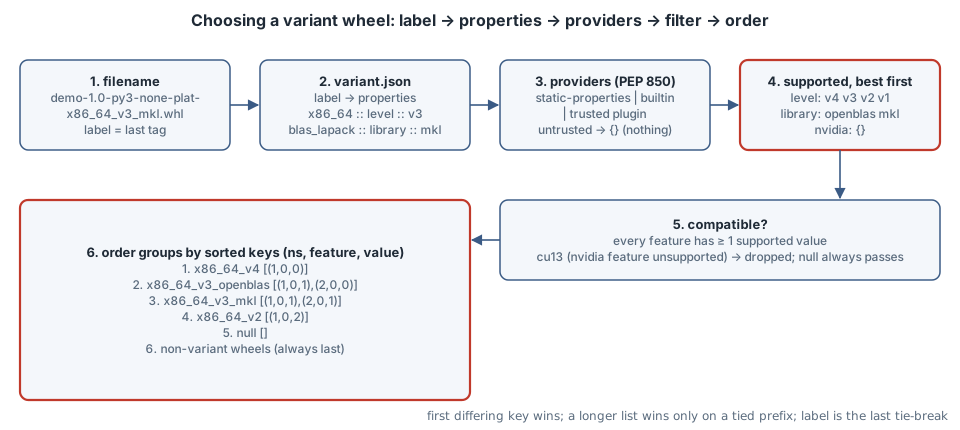
Five rules carry the whole design.
- The filename. The PEP 825 filename is
{dist}-{ver}(-{build})?-{py}-{abi}-{plat}(-{label})?.whl. Labels match^[0-9a-z_.]+$. A six-part name is ambiguous: it has either a build tag or a label. PEP 825 settles this with the existing rule that a build tag starts with a digit and adds that the Python tag MUST NOT start with a digit. The labelnullis reserved for the null variant, a wheel with zero properties. It is the fallback a variant-aware installer picks when nothing better fits. variant.json. A file at*.dist-info/variant.jsonhas three keys.default-priorities.namespaceorders the namespaces.variantsmaps label → namespace → feature → a lexically sorted list of values.providers(added by PEP 850) says how each namespace is answered. An index may also serve a{name}-{version}-variants.jsonfile that combines the metadata of all of that release’s wheels. Tools SHOULD prefer it, because it lets an installer rank variants before downloading any wheel.- The providers’ answer. For every namespace, the installer gets an ordered list of supported values for each feature, most preferred first. PEP 850 fixes the order of checks:
- a user override
optional(disabled by default)builtinstatic-properties- a trusted implementation of the plugin named by
requires/plugin-api - otherwise only explicitly trusted, installed plugins.
- Compatibility. A variant is compatible if every feature it names has at least one supported value. A property list is an AND over features and an OR over the values of one feature. The null variant is always compatible.
- Ordering. Each property gets a key (namespace index, feature index, value index), using the best supported value of each feature. Each variant’s keys are sorted, and variants are compared lexicographically:
- The first differing key wins.
- If one list is a prefix of the other, the longer list wins.
- If the lists are identical, the label decides.
Worked example
The script below is a toy installer front end. It has no network and no real wheels: the index is eight filenames plus index-level variant.json. The x86_64 provider is a local reimplementation of a plugin’s get_supported_configs(), which is what PEP 850 calls a trusted reimplementation. It derives the x86-64 micro-architecture level (psABI v2/v3/v4) from the CPU flags Linux reports. The nvidia namespace names a plugin package the tool does not trust, and blas_lapack uses static-properties.
variants.py
"""A toy installer front end for wheel variants (PEP 825 format + PEP 850 providers).

No network and no real wheels: the "index" is a list of filenames plus the
index-level variant metadata. The x86_64 provider is a local reimplementation
that reads /proc/cpuinfo, which is what PEP 850 calls a trusted reimplementation.
"""
import re
from dataclasses import dataclass

LABEL_RE = re.compile(r"^[0-9a-z_.]+$")
NAME_RE = re.compile(r"^[a-z0-9_]+$")
VALUE_RE = re.compile(r"^[a-z0-9_.]+$")

def parse_wheel(fn: str):
    """Split a wheel filename; return (dist, version, build, py, abi, plat, label)."""
    parts = fn.removesuffix(".whl").split("-")
    if len(parts) == 5:
        return (*parts[:2], None, *parts[2:], None)
    if len(parts) == 6:
        # PEP 825: the Python tag MUST NOT start with a digit, a build tag MUST.
        if parts[2][0].isdigit():
            return (*parts[:3], *parts[3:], None)
        label = parts[5]
        return (*parts[:2], None, *parts[2:5], label)
    if len(parts) == 7:
        return tuple(parts)
    raise ValueError(f"not a wheel filename: {fn}")

# ---- providers (PEP 850) ----------------------------------------------------
@dataclass
class VariantFeatureConfig:
    name: str
    values: list[str]
    multi_value: bool

LEVELS = {  # x86-64 psABI micro-architecture levels, as Linux /proc/cpuinfo flag names
    "v2": {"cx16", "lahf_lm", "popcnt", "pni", "sse4_1", "sse4_2", "ssse3"},
    "v3": {"avx", "avx2", "bmi1", "bmi2", "f16c", "fma", "abm", "movbe", "xsave"},
    "v4": {"avx512f", "avx512bw", "avx512cd", "avx512dq", "avx512vl"},
}

def x86_64_get_supported_configs() -> list[VariantFeatureConfig]:
    flags = set()
    for line in open("/proc/cpuinfo"):
        if line.startswith("flags"):
            flags = set(line.split(":", 1)[1].split())
            break
    ok = ["v1"]
    for lvl in ("v2", "v3", "v4"):
        if LEVELS[lvl] <= flags:
            ok.append(lvl)
        else:
            break
    return [VariantFeatureConfig("level", ok[::-1], multi_value=False)]  # best first

TRUSTED_PLUGINS = {"provider_variant_x86_64": x86_64_get_supported_configs}

def supported(namespace: str, info: dict) -> dict[str, list[str]]:
    """PEP 850's provider algorithm, steps 2-7 (no user override in step 1)."""
    if info.get("optional", False):
        return {}                                            # step 2: disabled by default
    if "builtin" in info:
        return {}                                            # step 3: we know no builtins
    if "static-properties" in info:                          # step 4
        sp = info["static-properties"]
        order = info.get("feature-order", list(sp))
        return {f: sp[f] for f in order}
    api = info.get("plugin-api") or re.split(r"[ ;<>=!~\[]", info["requires"][0])[0].lower().replace("-", "_")
    plugin = TRUSTED_PLUGINS.get(api)                        # step 5: trusted reimplementation?
    if plugin is None:
        return {}                                            # steps 6-7: untrusted -> nothing compatible
    return {c.name: c.values for c in plugin()}

# ---- the index ----------------------------------------------------------------
INDEX_FILES = [
    "demo-1.0-py3-none-manylinux_2_28_x86_64-x86_64_v4.whl",
    "demo-1.0-py3-none-manylinux_2_28_x86_64-x86_64_v3_openblas.whl",
    "demo-1.0-py3-none-manylinux_2_28_x86_64-x86_64_v3_mkl.whl",
    "demo-1.0-py3-none-manylinux_2_28_x86_64-x86_64_v2.whl",
    "demo-1.0-py3-none-manylinux_2_28_x86_64-cu13.whl",
    "demo-1.0-py3-none-manylinux_2_28_x86_64-null.whl",
    "demo-1.0-py3-none-manylinux_2_28_x86_64.whl",
    "demo-1.0-1-py3-none-manylinux_2_28_x86_64.whl",
]
VARIANTS_JSON = {  # the index-level metadata (combined variant.json of all wheels)
    "default-priorities": {"namespace": ["nvidia", "x86_64", "blas_lapack"]},
    "providers": {
        "nvidia": {"requires": ["nvidia-variant-provider >=0.1"]},
        "x86_64": {"requires": ["provider-variant-x86-64 >=0.0.1"]},
        "blas_lapack": {"static-properties": {"library": ["openblas", "mkl"]}},
    },
    "variants": {
        "x86_64_v4": {"x86_64": {"level": ["v4"]}},
        "x86_64_v3_openblas": {"x86_64": {"level": ["v3"]}, "blas_lapack": {"library": ["openblas"]}},
        "x86_64_v3_mkl": {"x86_64": {"level": ["v3"]}, "blas_lapack": {"library": ["mkl"]}},
        "x86_64_v2": {"x86_64": {"level": ["v2"]}},
        "cu13": {"nvidia": {"cuda_version_lower_bound": ["13.0"]}, "x86_64": {"level": ["v2"]}},
        "null": {},
    },
}

# ---- validation (PEP 825) -----------------------------------------------------
for label, props in VARIANTS_JSON["variants"].items():
    assert LABEL_RE.match(label), label
    for ns, feats in props.items():
        assert NAME_RE.match(ns) and ns in VARIANTS_JSON["default-priorities"]["namespace"]
        for f, vals in feats.items():
            assert NAME_RE.match(f) and all(VALUE_RE.match(v) for v in vals)
            assert vals == sorted(vals), "feature values are stored sorted lexically"

# ---- what this machine supports ------------------------------------------------
namespace_order = VARIANTS_JSON["default-priorities"]["namespace"]
sup = {ns: supported(ns, VARIANTS_JSON["providers"][ns]) for ns in namespace_order}
print("supported properties on this machine:")
for ns in namespace_order:
    print(f"  {ns:12} {sup[ns] or '{}  (no compatible features)'}")

feature_order = {ns: list(sup[ns]) for ns in namespace_order}
value_order = sup

def compatible(props) -> bool:
    """Every feature needs at least one value the system supports; null always passes."""
    return all(any(v in sup[ns].get(f, []) for v in vals)
               for ns, feats in props.items() for f, vals in feats.items())

def property_key(p):
    ns, f, v = p
    return (namespace_order.index(ns), feature_order[ns].index(f), value_order[ns][f].index(v))

def sorted_best(props):
    best = [(ns, f, next(v for v in value_order[ns][f] if v in vals))
            for ns, feats in props.items() for f, vals in feats.items()]
    return sorted(best, key=property_key)

class Group:
    def __init__(self, label, props):
        self.label, self.props = label, sorted_best(props)
    def __lt__(self, other):  # PEP 825 step 7
        for a, b in zip(self.props, other.props):
            if a != b:
                return property_key(a) < property_key(b)
        if len(self.props) != len(other.props):
            return len(self.props) > len(other.props)
        return self.label < other.label

print("\nwheels on the index:")
groups, non_variant = {}, []
for fn in INDEX_FILES:
    *_, build, py, abi, plat, label = parse_wheel(fn)
    if label is None:
        non_variant.append(fn)
        print(f"  {fn:62} non-variant" + (f" (build tag {build})" if build else ""))
        continue
    props = VARIANTS_JSON["variants"][label]
    ok = compatible(props)
    print(f"  {fn:62} label={label:18} {'compatible' if ok else 'INCOMPATIBLE'}")
    if ok:
        groups.setdefault(label, []).append(fn)

order = sorted(Group(l, VARIANTS_JSON["variants"][l]) for l in groups)
print("\npreference order (best first):")
for k, g in enumerate(order, 1):
    keys = [property_key(p) for p in g.props]
    print(f"  {k}. {g.label:18} best props {[' :: '.join(p) for p in g.props]}  keys {keys}")
print(f"  {len(order) + 1}. non-variant group: {non_variant}")
print("\nselected:", groups[order[0].label][0])
Output on an 8-core x86-64 Linux box (CPython 3.13.5), verbatim:
supported properties on this machine:
  nvidia       {}  (no compatible features)
  x86_64       {'level': ['v4', 'v3', 'v2', 'v1']}
  blas_lapack  {'library': ['openblas', 'mkl']}

wheels on the index:
  demo-1.0-py3-none-manylinux_2_28_x86_64-x86_64_v4.whl          label=x86_64_v4          compatible
  demo-1.0-py3-none-manylinux_2_28_x86_64-x86_64_v3_openblas.whl label=x86_64_v3_openblas compatible
  demo-1.0-py3-none-manylinux_2_28_x86_64-x86_64_v3_mkl.whl      label=x86_64_v3_mkl      compatible
  demo-1.0-py3-none-manylinux_2_28_x86_64-x86_64_v2.whl          label=x86_64_v2          compatible
  demo-1.0-py3-none-manylinux_2_28_x86_64-cu13.whl               label=cu13               INCOMPATIBLE
  demo-1.0-py3-none-manylinux_2_28_x86_64-null.whl               label=null               compatible
  demo-1.0-py3-none-manylinux_2_28_x86_64.whl                    non-variant
  demo-1.0-1-py3-none-manylinux_2_28_x86_64.whl                  non-variant (build tag 1)

preference order (best first):
  1. x86_64_v4          best props ['x86_64 :: level :: v4']  keys [(1, 0, 0)]
  2. x86_64_v3_openblas best props ['x86_64 :: level :: v3', 'blas_lapack :: library :: openblas']  keys [(1, 0, 1), (2, 0, 0)]
  3. x86_64_v3_mkl      best props ['x86_64 :: level :: v3', 'blas_lapack :: library :: mkl']  keys [(1, 0, 1), (2, 0, 1)]
  4. x86_64_v2          best props ['x86_64 :: level :: v2']  keys [(1, 0, 2)]
  5. null               best props []  keys []
  6. non-variant group: ['demo-1.0-py3-none-manylinux_2_28_x86_64.whl', 'demo-1.0-1-py3-none-manylinux_2_28_x86_64.whl']

selected: demo-1.0-py3-none-manylinux_2_28_x86_64-x86_64_v4.whl
As a cross-check, glibc’s dynamic loader agrees on the CPU level. /lib64/ld-linux-x86-64.so.2 --help on the same machine prints x86-64-v4 (supported, searched), x86-64-v3 (supported, searched) and x86-64-v2 (supported, searched).
Reading it
- The provider answers.
x86_64came from the trusted reimplementation. It reports['v4', 'v3', 'v2', 'v1'], best first, as PEP 850 requires ofget_supported_configs().blas_lapackcame straight fromstatic-properties. This is PEP 850’s case for non-platform variants: every variant that was built is installable, and the list order is just the default preference.nvidianamesnvidia-variant-providerunderrequires. The tool has no trusted implementation and the user did not opt in, so step 7 applies: assume nothing is compatible. The installer did not fetch or run anything.
- Compatibility.
cu13needsnvidia :: cuda_version_lower_bound, which is unsupported, so the whole variant is out. Itsx86_64 :: level :: v2property would have matched, but every feature must match.nullhas no features, so it passes.
- The two six-part names.
demo-1.0-py3-none-manylinux_2_28_x86_64-null.whlanddemo-1.0-1-py3-none-manylinux_2_28_x86_64.whlboth have six dash-separated parts. The parser separates them with one test: a build tag starts with a digit, and the Python tag cannot. Without that new constraint in PEP 825, the parse would be ambiguous. - The ordering. The namespace order
["nvidia", "x86_64", "blas_lapack"]givesx86_64index 1 andblas_lapackindex 2.x86_64_v4→[(1,0,0)]beatsx86_64_v3_openblas→[(1,0,1),(2,0,0)]on the first key. Having two properties does not help, because the CPU level is the more important namespace.- The two v3 builds tie on
(1,0,1). The second key decides: openblas(2,0,0)comes before mkl(2,0,1), because the static list puts openblas first. x86_64_v2follows.null(an empty list) comes after every compatible variant, and both non-variant wheels come last.
- The prefix rule. It matters for a pair like
x86_64_v3againstx86_64_v3_openblas: the keys are[(1,0,1)]against[(1,0,1),(2,0,0)]. The prefix ties, so the longer list wins. A more specific build beats a less specific one only when they agree on everything the shorter one says.
Pitfalls
- Treating more properties as better. Comparison is lexicographic on sorted keys, so one property in a high-priority namespace beats any number in lower ones. If you want BLAS choice to dominate CPU level, put
blas_lapackfirst indefault-priorities.namespace, or override it in the installer (PEP 825 allows tools to do that). - Expecting an unknown plugin to just work. Under PEP 850, a namespace whose plugin is untrusted yields no compatible features, so every variant that uses it is skipped. That is the security design, not a bug. Ship a
nullvariant or a non-variant wheel so these users still get something. Otherwise the resolver falls back to an older release or the sdist. - Forgetting the AND. A variant with properties in two namespaces needs both to be supported. Adding a CPU-level property to a GPU build (
cu13above) narrows it. It does not widen it. - Unsorted or uppercase values. Values in
variantsare sets, stored as lexically sorted lists. Names match^[a-z0-9_]+$and values match^[a-z0-9_.]+$. The script asserts both, so"V3"or["v3", "v2"]would fail validation. - Simplified CPU detection. The flag sets in
LEVELSfollow the x86-64 psABI level definitions using Linux flag names (pniis SSE3,abmcovers LZCNT). A real provider also checks OS support for the wider register state (OSXSAVE/XGETBV), and handles macOS, Windows and virtual machines that hide flags. Use a maintained provider, not this toy. - Assuming installers support this today. Both PEPs are under discussion, and the
$schemaURL and field names may still change. Treatvariant.jsonproduced by experimental tooling as unstable.
Try this
- Reorder
default-priorities.namespaceto["nvidia", "blas_lapack", "x86_64"]and re-run. Predict the new top choice before you look (hint:x86_64_v3_openblasnow has the key(1,0,0)). - Add a variant
x86_64_v3with only{"x86_64": {"level": ["v3"]}}, and add its wheeldemo-1.0-py3-none-manylinux_2_28_x86_64-x86_64_v3.whltoINDEX_FILES(the script only ranks labels that have a wheel). Confirm that it sorts after both v3 BLAS variants (prefix rule) and beforex86_64_v2. - Make
nvidiatrusted by adding a fake plugin toTRUSTED_PLUGINSthat returnscuda_version_lower_bound = ["13.0", "12.8"]. Nowcu13is compatible. Where does it land, and why does thenvidianamespace’s index 0 put it first? - Mark
blas_lapack"optional": trueand explain why both v3 BLAS builds disappear whilex86_64_v4is unaffected.
Sources
- PEP 825: Wheel Variants: Package Format. Covers the filename and label rules, the
variant.jsonstructure, the compatibility rule and the ordering algorithm (steps 1–7 with reference pseudocode). - PEP 850: Wheel Variants: Providers. Covers the provider resolution steps, the
providerskeys (requires,plugin-api,static-properties,feature-order,builtin,optional), the plugin APIget_supported_configs()and the trust model. Discussion thread. - Binary distribution format (wheel) specification. Covers the existing filename convention and build-tag rule.
- Platform compatibility tags. Explains what tags can and cannot express.
- x86-64 psABI. Gives the definitions of the x86-64-v2/v3/v4 micro-architecture levels.
- glibc 2.33 NEWS. Introduces the glibc-hwcaps subdirectories
x86-64-v2/v3/v4and the dynamic linker’s--helpoption used for the cross-check.
Inspiration: Pycoder’s Weekly on PEP 850.