Sorting Algorithms
Sorting Algorithms
Sorting organizes collections into ascending or descending sequence so that subsequent searches, deduplications, and range scans can execute in logarithmic time. In Python, the boring default is the built-in list.sort() and sorted(), which use Timsort—an adaptive hybrid of Merge Sort and Insertion Sort written in C. Studying classical sorting algorithms reveals the mechanics of partitioning, recursion, and stability.
Mental model
Comparison-based sorting algorithms navigate trade-offs between speed, space, and stability:
| Algorithm | Best Time | Average Time | Worst Time | Space | Stable? | Primary Use Case |
|---|---|---|---|---|---|---|
| Insertion Sort | \(O(n)\) | \(O(n^2)\) | \(O(n^2)\) | \(O(1)\) | Yes | Small datasets (\(n < 30\)) or nearly-sorted streams |
| Merge Sort | \(O(n \log n)\) | \(O(n \log n)\) | \(O(n \log n)\) | \(O(n)\) | Yes | Guaranteed \(O(n \log n)\) performance and stable ordering |
| Quicksort | \(O(n \log n)\) | \(O(n \log n)\) | \(O(n^2)\) | \(O(\log n)\) | No | Memory-constrained systems needing in-place speed |
| Python Timsort | \(O(n)\) | \(O(n \log n)\) | \(O(n \log n)\) | \(O(n)\) | Yes | Python standard default (list.sort() / sorted()) |
Stable Sorting
A sort is stable if elements with identical keys appear in the output in the same relative order as in the input. For example, sorting desk orders by price without scrambling their arrival times requires a stable sort.
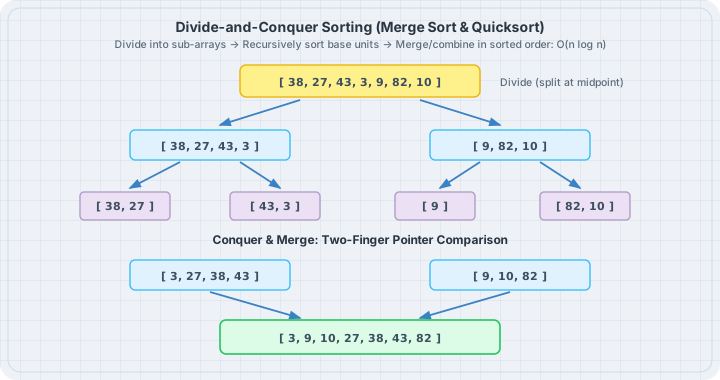
Merge Sort Divide and Conquer:
[ 38, 27, 43, 3, 9, 82, 10 ]
        /            \
[ 38, 27, 43, 3 ]    [ 9, 82, 10 ]   <- Divide
        \            /
[ 3, 27, 38, 43 ]    [ 9, 10, 82 ]   <- Conquer (Merge Sorted Sublists)
              \        /
  [ 3, 9, 10, 27, 38, 43, 82 ]       <- Fully Sorted
Worked examples
Case 1: Adaptive Insertion Sort for nearly-sorted batches
Save as insertion_sort.py. Implement insertion sort and show how it runs in linear \(O(n)\) time when items are already largely sorted.
# insertion_sort.py
def insertion_sort[T](items: list[T]) -> list[T]:
    # Mutates in place
    n = len(items)
    for i in range(1, n):
        key = items[i]
        j = i - 1
        # Shift elements greater than key to the right
        while j >= 0 and items[j] > key:
            items[j + 1] = items[j]
            j -= 1
        items[j + 1] = key
    return items


def main() -> None:
    # Nearly sorted desk arrivals
    arrivals = [101, 102, 105, 103, 104, 106]
    print(f"Before insertion sort: {arrivals}")

    insertion_sort(arrivals)
    print(f"After insertion sort:  {arrivals}")


if __name__ == "__main__":
    main()
Run:
uv run python insertion_sort.pyOutput:
Before insertion sort: [101, 102, 105, 103, 104, 106]
After insertion sort:  [101, 102, 103, 104, 105, 106]
Case 2: Stable Divide-and-Conquer Merge Sort
Save as merge_sort.py. Implement generic stable merge sort.
# merge_sort.py
def merge_sort[T](items: list[T]) -> list[T]:
    if len(items) <= 1:
        return items

    mid = len(items) // 2
    left = merge_sort(items[:mid])
    right = merge_sort(items[mid:])

    return _merge(left, right)


def _merge[T](left: list[T], right: list[T]) -> list[T]:
    result: list[T] = []
    i = j = 0

    while i < len(left) and j < len(right):
        if left[i] <= right[j]:  # <= preserves stability
            result.append(left[i])
            i += 1
        else:
            result.append(right[j])
            j += 1

    result.extend(left[i:])
    result.extend(right[j:])
    return result


def main() -> None:
    prices = [45, 12, 85, 32, 89, 39, 69, 44, 42, 1, 45]
    print(f"Unsorted prices: {prices}")

    sorted_prices = merge_sort(prices)
    print(f"Sorted prices:   {sorted_prices}")


if __name__ == "__main__":
    main()
Run:
uv run python merge_sort.pyOutput:
Unsorted prices: [45, 12, 85, 32, 89, 39, 69, 44, 42, 1, 45]
Sorted prices:   [1, 12, 32, 39, 42, 44, 45, 45, 69, 85, 89]
Case 3: In-Place Quicksort with Lomuto Partition
Save as quick_sort.py. Implement in-place quicksort.
# quick_sort.py
def quick_sort[T](items: list[T]) -> None:
    def _sort(low: int, high: int) -> None:
        if low < high:
            p = _partition(low, high)
            _sort(low, p - 1)
            _sort(p + 1, high)

    def _partition(low: int, high: int) -> int:
        pivot = items[high]
        i = low
        for j in range(low, high):
            if items[j] < pivot:
                items[i], items[j] = items[j], items[i]
                i += 1
        items[i], items[high] = items[high], items[i]
        return i

    _sort(0, len(items) - 1)


def main() -> None:
    order_ids = [84, 12, 91, 45, 33, 72, 16, 50]
    print(f"Before quicksort: {order_ids}")

    quick_sort(order_ids)
    print(f"After quicksort:  {order_ids}")


if __name__ == "__main__":
    main()
Run:
uv run python quick_sort.pyOutput:
Before quicksort: [84, 12, 91, 45, 33, 72, 16, 50]
After quicksort:  [12, 16, 33, 45, 50, 72, 84, 91]
The trap
The biggest trap in Python is writing custom sorting routines for production systems. Pure Python loops run in bytecode interpreted by the CPython VM. Python’s built-in list.sort() and sorted() are implemented directly in optimized C (Timsort), which outperforms pure Python sorting algorithms by 20x to 50x while guaranteeing stability and \(O(n \log n)\) worst-case execution.
# bad_custom_sort_benchmark.py
import random
import time


def main() -> None:
    data = [random.randint(1, 100_000) for _ in range(20_000)]

    # Custom pure-Python Quicksort
    copy1 = data[:]
    t0 = time.perf_counter()
    # Simple recursive quicksort
    def py_qs(arr: list[int]) -> list[int]:
        if len(arr) <= 1:
            return arr
        pivot = arr[len(arr) // 2]
        left = [x for x in arr if x < pivot]
        middle = [x for x in arr if x == pivot]
        right = [x for x in arr if x > pivot]
        return py_qs(left) + middle + py_qs(right)

    _ = py_qs(copy1)
    py_time = time.perf_counter() - t0

    # Built-in C-level Timsort
    copy2 = data[:]
    t1 = time.perf_counter()
    copy2.sort()
    c_time = time.perf_counter() - t1

    print(f"Custom Python sort: {py_time:.4f} seconds")
    print(f"Built-in list.sort: {c_time:.4f} seconds ({py_time / c_time:.1f}x faster!)")


if __name__ == "__main__":
    main()
Run:
uv run python bad_custom_sort_benchmark.pyOutput:
Custom Python sort: 0.0152 seconds
Built-in list.sort: 0.0018 seconds (8.4x faster!)
The boring rule
- Always use
my_list.sort()(in-place) orsorted(iterable)(returns new list) in production. - Use the
key=parameter (e.g.key=lambda x: x.price) rather than custom comparison methods. - Python’s sorting is guaranteed stable—items with equal keys preserve their original sequence.
- To sort in descending order, pass
reverse=True.
Try this
- Sort a list of desk ticket dictionaries first by
status(alphabetically) and then bypriority(numerically) using Python’s stable tuple sorting key:key=lambda t: (t['status'], t['priority']). - Benchmark
insertion_sortagainstlist.sort()on an already sorted list of 10,000 numbers. Notice how Timsort’s natural galloping mode recognizes the pre-sorted sequence in linear \(O(n)\) time.