Small Writes in TCP: Nagle’s Algorithm, Delayed ACKs, and the 40 ms Stall
Small Writes in TCP: Nagle’s Algorithm, Delayed ACKs, and the 40 ms Stall
Two TCP features that each save packets can together add a fixed 40 ms to every request. Nagle’s algorithm (sender side) holds a small segment while an earlier small segment is still unacknowledged. Delayed ACK (receiver side) waits, up to a timer, before acknowledging, hoping to piggyback the ACK on a reply. When a client sends one request as two small writes and then waits for the answer, the server cannot reply (it has only half the request), so it delays its ACK; the client cannot send the second half until that ACK arrives. Both sides wait for the timer. Nothing is lost, nothing is retransmitted, CPU is idle, and p50 latency is 40 ms on a link with a 20 µs RTT. This chapter reproduces the stall on loopback, catches it in ss, and measures every fix, including the one people reach for first (TCP_NODELAY) and what it costs.
Learning goals
- State Nagle’s rule (RFC 896, RFC 9293 §3.7.4) and Linux’s Minshall variant, and the delayed-ACK rule (RFC 9293 §3.8.6.3)
- Recognise the write-write-read pattern and predict the stall from it
- Read
ato,unackedandnotsentinss -tiwhile the stall is happening - Compare the fixes: one write (
writev/sendmsg),TCP_CORK,MSG_MORE,TCP_NODELAYandTCP_QUICKACK, and say which side each one acts on - Explain what Nagle protects against, and measure what
TCP_NODELAYcosts in segments
Lab platform: Linux 6.12, iproute2 6.15 (ss, nstat), Python 3.13.5, run as an unprivileged user over 127.0.0.1. No namespaces, no tc, no root. Every listing output below is pasted from those runs. Kernel behaviour is quoted from include/net/tcp.h and net/ipv4/tcp_output.c in Linux 6.12; the same constants and tcp_nagle_check() are unchanged in Linux 7.2, the current stable series.
Mental model
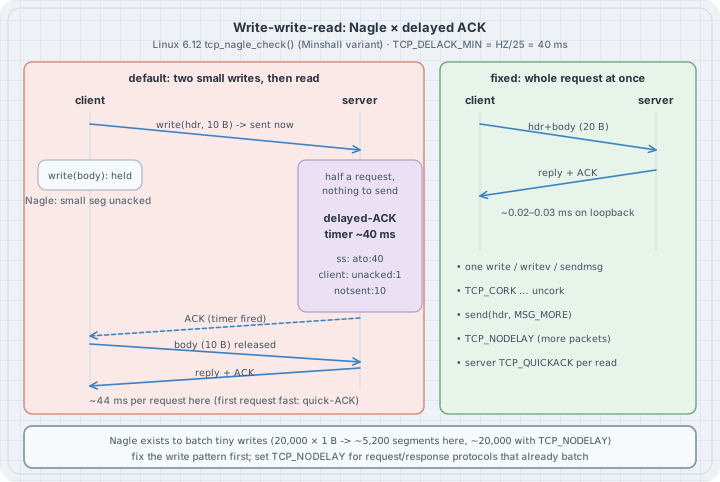
 client                                       server
   │ write(hdr, 10 B) ── sent: nothing unacked ──►│  has half a request
   │ write(body, 10 B)                             │  nothing to send yet
   │   Nagle: a small segment is unacked → HOLD    │  delayed ACK: wait (ato 40 ms)
   │                     ... up to ~40 ms ...      │
   │◄──────────── bare ACK (delack timer) ─────────│
   │ body released ───────────────────────────────►│  full request → reply
   │◄──────────────── reply (+ ACK) ───────────────│
The two rules:
| Rule | Where | What it says | Linux |
|---|---|---|---|
| Nagle (RFC 896; RFC 9293 §3.7.4, SHLD-7, with a per-connection off switch, MUST-17) | Sender | While data is unacknowledged, buffer small writes until the ACK arrives or a full MSS is ready | tcp_nagle_check() with Minshall’s variant (RFC 9293 App. A.3): hold a sub-MSS segment only while a previous sub-MSS segment is unacknowledged |
| Delayed ACK (RFC 1122 §4.2.3.2; RFC 9293 §3.8.6.3, SHLD-18/19, MUST-40) | Receiver | ACK at least every second full-sized segment; otherwise wait (less than 0.5 s) to piggyback the ACK on data | TCP_DELACK_MIN = TCP_ATO_MIN = HZ/25 = 40 ms, TCP_DELACK_MAX = HZ/5 = 200 ms; a new connection starts in quick-ACK mode (up to TCP_MAX_QUICKACKS = 16 immediate ACKs) |
Neither rule is a bug. Together they deadlock until the timer fires, whenever all of these hold:
- The sender writes one logical message as two or more sub-MSS writes.
- The receiver cannot respond until it has the whole message.
- The sender waits for the response before writing more.
HTTP/1.x clients that write headers and body separately, RPC frameworks that write a length prefix and then the payload, database drivers, Redis/memcached clients and SSH-like interactive protocols all fit this pattern unless they batch their writes or set TCP_NODELAY.
Concepts — the knobs
| Knob | Side | Scope | Effect |
|---|---|---|---|
One write: build the message in user space, or writev()/sendmsg() with an iovec |
Sender | Per message | The message leaves as one segment; Nagle has nothing to hold. Portable. |
TCP_CORK (Linux) |
Sender | Until cleared | Hold partial segments; clearing it sends them now. 200 ms ceiling. Overrides TCP_NODELAY. |
MSG_MORE flag on send() (Linux) |
Sender | One call | Same as TCP_CORK for that call: “more is coming”; the next send without the flag pushes. |
TCP_NODELAY |
Sender | Socket | Disable Nagle: every write is sent as soon as cwnd/rwnd allow. Portable (RFC 9293 MUST-17). |
TCP_QUICKACK (Linux) |
Receiver | Not sticky | Enter quick-ACK mode now. The stack drops back to delayed ACKs on its own (tcp(7): “This flag is not permanent”). |
net.ipv4.tcp_autocorking (default 1) |
Sender | Host | Coalesce small writes while an earlier packet is still queued in the host. Counter TcpExtTCPAutoCorking. |
ip route ... quickack 1 |
Receiver | Route | Quick-ACK for every connection on that route (needs root; not run here). |
Lab — reproduce the stall and measure the fixes
# nagle_lab.py — write-write-read over loopback: the Nagle x delayed-ACK stall, and the ways out
# usage: python3 nagle_lab.py [REQUESTS]
import socket, statistics, struct, sys, threading, time

HDR, BODY = b"H" * 10, b"B" * 10          # one request, sent as two small writes
REQ, RESP = len(HDR) + len(BODY), b"R" * 20
N = int(sys.argv[1]) if len(sys.argv) > 1 else 50

def data_segs_out(s):                     # struct tcp_info -> tcpi_data_segs_out
    f = struct.unpack("8B24I4Q6I", s.getsockopt(socket.IPPROTO_TCP, socket.TCP_INFO, 160))
    return f[41]

def recv_exact(s, n):
    buf = b""
    while len(buf) < n:
        chunk = s.recv(n - len(buf))
        if not chunk:
            raise ConnectionError("peer closed")
        buf += chunk
    return buf

def server(lsock, quickack):
    c, _ = lsock.accept()
    if quickack == "once":
        c.setsockopt(socket.IPPROTO_TCP, socket.TCP_QUICKACK, 1)
    for _ in range(N):
        if quickack == "every read":      # not sticky: re-arm before every read
            c.setsockopt(socket.IPPROTO_TCP, socket.TCP_QUICKACK, 1)
        recv_exact(c, REQ)
        c.sendall(RESP)
    c.close()

def run(mode):
    lsock = socket.create_server(("127.0.0.1", 0))
    quickack = {"QUICKACK once": "once", "QUICKACK every read": "every read"}.get(mode)
    t = threading.Thread(target=server, args=(lsock, quickack))
    t.start()
    s = socket.create_connection(lsock.getsockname())
    if mode == "TCP_NODELAY":
        s.setsockopt(socket.IPPROTO_TCP, socket.TCP_NODELAY, 1)
    lat = []
    for _ in range(N):
        t0 = time.perf_counter()
        if mode == "one write":
            s.sendall(HDR + BODY)
        elif mode == "TCP_CORK":
            s.setsockopt(socket.IPPROTO_TCP, socket.TCP_CORK, 1)
            s.sendall(HDR); s.sendall(BODY)
            s.setsockopt(socket.IPPROTO_TCP, socket.TCP_CORK, 0)   # uncork = send now
        elif mode == "MSG_MORE":
            s.send(HDR, socket.MSG_MORE); s.sendall(BODY)
        else:                             # default, TCP_NODELAY, server-side QUICKACK
            s.sendall(HDR); s.sendall(BODY)
        recv_exact(s, len(RESP))
        lat.append((time.perf_counter() - t0) * 1e3)
    segs = data_segs_out(s)
    s.close(); t.join(); lsock.close()
    first = " ".join(f"{x:.2f}" for x in lat[:3])
    lat.sort()
    print(f"{mode:19} first3 [{first}]  median {statistics.median(lat):6.3f} ms"
          f"  p90 {lat[int(0.9 * N)]:6.3f} ms  total {sum(lat):6.1f} ms  data segs {segs:3}")

print(f"{N} requests of {REQ} bytes (two writes of 10), {len(RESP)}-byte reply, 127.0.0.1")
for mode in ("Nagle (default)", "TCP_NODELAY", "one write", "TCP_CORK", "MSG_MORE",
             "QUICKACK once", "QUICKACK every read"):
    run(mode)
nstat -n # reset the nstat history for this network namespace
python3 nagle_lab.py
nstat TcpExtDelayedACKs # delayed ACKs sent since the reset50 requests of 20 bytes (two writes of 10), 20-byte reply, 127.0.0.1
Nagle (default) first3 [0.26 42.26 44.12] median 44.014 ms p90 44.163 ms total 2154.4 ms data segs 100
TCP_NODELAY first3 [0.43 0.38 0.49] median 0.031 ms p90 0.070 ms total 2.9 ms data segs 100
one write first3 [0.25 0.04 0.06] median 0.029 ms p90 0.032 ms total 1.7 ms data segs 50
TCP_CORK first3 [0.10 0.04 0.03] median 0.031 ms p90 0.034 ms total 1.6 ms data segs 50
MSG_MORE first3 [0.08 0.04 0.03] median 0.030 ms p90 0.033 ms total 1.6 ms data segs 50
QUICKACK once first3 [0.10 40.85 43.98] median 43.990 ms p90 44.201 ms total 2152.9 ms data segs 100
QUICKACK every read first3 [0.10 0.06 0.04] median 0.036 ms p90 0.039 ms total 1.9 ms data segs 100
#kernel
TcpExtDelayedACKs 134 0.0Read it line by line:
- Nagle (default): the first request takes 0.26 ms: the connection is fresh and in quick-ACK mode, so the server ACKs the header at once. From the second request on, every request takes about 44 ms: the 40 ms minimum delayed-ACK timeout plus a few milliseconds of timer granularity. Fifty requests take 2.15 s instead of 2 ms. The client sent 100 data segments: header and body separately.
- TCP_NODELAY: same two writes, same 100 segments, but the body is not held: median 31 µs.
- one write / TCP_CORK / MSG_MORE: the request leaves as one segment (50 data segments for 50 requests) and the stall is gone. This is the best result: fast and half the packets.
- QUICKACK once: setting
TCP_QUICKACKon the server right afteraccept()does nothing useful. The connection is already in quick-ACK mode then, and it leaves that mode by itself after a few exchanges: the stall starts at request two, exactly like the default. - QUICKACK every read: re-arming it before every
recv()fixes the stall from the receiver side, with 100 segments. That works when you own the server but not the client; it is also Linux-only and costs a system call per read. TcpExtDelayedACKscounted 134: about 98 from the two stalling runs (49 stalled requests each), and the rest from other traffic in this shared network namespace.nstatcounters are per network namespace, not per process.
Lab — catch the stall in ss
# catch_stall.py — freeze the moment of the stall and look at both sockets with ss -ti
import socket, subprocess, threading, time

lsock = socket.create_server(("127.0.0.1", 0))
port = lsock.getsockname()[1]
ready = threading.Event()

def server():
    c, _ = lsock.accept()
    for _ in range(3):                    # warm up: leave the initial quick-ACK phase
        c.recv(20); c.sendall(b"R" * 20)
    ready.set()
    c.recv(10)                            # got the header, still waiting for the body
    time.sleep(0.2); c.close()

t = threading.Thread(target=server); t.start()
s = socket.create_connection(("127.0.0.1", port))
for _ in range(3):
    s.sendall(b"Q" * 20); s.recv(20)
ready.wait()
s.sendall(b"H" * 10)                      # goes out at once: nothing unacknowledged
s.sendall(b"B" * 10)                      # Nagle holds this: a small segment is unacked
time.sleep(0.005)                         # 5 ms into the up-to-40 ms wait
out = subprocess.run(["ss", "-tniH", "state", "established", f"( sport = :{port} or dport = :{port} )"],
                     capture_output=True, text=True).stdout
keep = ("ato", "mss", "unacked", "notsent", "lastsnd", "lastack", "bytes_sent", "bytes_received")
lines = out.splitlines()
for addrs, info in zip(lines[0::2], lines[1::2]):
    local, peer = addrs.split()[2:4]
    who = "server" if local.endswith(f":{port}") else "client"
    print(f"{who}  {local} -> {peer}")
    print("        " + " ".join(w for w in info.split() if w.split(":")[0] in keep))
s.close(); t.join()
python3 catch_stall.pyserver 127.0.0.1:45499 -> 127.0.0.1:45560
ato:40 mss:32768 bytes_sent:60 bytes_received:70 lastsnd:8 lastack:8
client 127.0.0.1:45560 -> 127.0.0.1:45499
ato:40 mss:32768 bytes_sent:70 bytes_received:60 lastsnd:8 lastack:8 unacked:1 notsent:10Eight milliseconds into the stall the evidence is in two fields. On the client: unacked:1 (the header segment is in flight, unacknowledged) and notsent:10 (the 10-byte body is in the send queue and Nagle has not sent it). On the server: ato:40, the delayed-ACK timeout, and nothing to send. bytes_sent:70 on the client is three 20-byte warm-up requests plus the header; the body is not counted until it leaves. In production, ss -tni showing a small, persistent notsent on a request/response socket whose peer shows ato:40 is the stall. A packet capture shows it as a 40 ms gap between a bare ACK from the server and the client’s next small segment.
Lab — what Nagle is for
# tiny_writes.py — what Nagle is FOR: 20,000 one-byte writes, counted in segments on the wire
import socket, struct, threading, time

WRITES = 20_000

def data_segs_out(s):
    f = struct.unpack("8B24I4Q6I", s.getsockopt(socket.IPPROTO_TCP, socket.TCP_INFO, 160))
    return f[41]

def drain(lsock, got):
    c, _ = lsock.accept()
    n = 0
    while chunk := c.recv(65536):
        n += len(chunk)
    got.append(n); c.close()

for nodelay in (0, 1, 0, 1):
    lsock = socket.create_server(("127.0.0.1", 0)); got = []
    t = threading.Thread(target=drain, args=(lsock, got)); t.start()
    s = socket.create_connection(lsock.getsockname())
    s.setsockopt(socket.IPPROTO_TCP, socket.TCP_NODELAY, nodelay)
    t0 = time.perf_counter()
    for _ in range(WRITES):
        s.send(b"x")
    dt = time.perf_counter() - t0
    segs = data_segs_out(s)
    s.close(); t.join(); lsock.close()
    print(f"TCP_NODELAY={nodelay}  {WRITES} writes -> {segs:6} data segments"
          f"  ({WRITES / segs:5.1f} bytes/segment)  {dt * 1e3:6.1f} ms  received {got[0]}")
python3 tiny_writes.pyTCP_NODELAY=0 20000 writes -> 5418 data segments ( 3.7 bytes/segment) 36.4 ms received 20000
TCP_NODELAY=1 20000 writes -> 19135 data segments ( 1.0 bytes/segment) 79.1 ms received 20000
TCP_NODELAY=0 20000 writes -> 5175 data segments ( 3.9 bytes/segment) 39.8 ms received 20000
TCP_NODELAY=1 20000 writes -> 20000 data segments ( 1.0 bytes/segment) 81.4 ms received 20000An application that writes one byte at a time (unbuffered logging, keystrokes, a naive serializer) is what Nagle was designed for in 1984. With Nagle on, 20,000 writes left as about 5,200–5,400 segments; with TCP_NODELAY as 19,135–20,000 segments (the few merges come from autocorking). Each segment carries 40+ bytes of IP and TCP headers for 1 byte of data. On loopback the ACK comes back in microseconds, so Nagle can only batch about 4 bytes per segment. On a real path with a 20 ms RTT Nagle allows at most one small segment in flight per round trip, so the same loop (about 40 ms of writes) would leave as a handful of segments, each carrying everything written during one round trip (not run here: adding delay needs tc netem, see Try this). That is the cost of setting TCP_NODELAY everywhere without also batching writes: more packets, more interrupts, more per-packet CPU on every hop, and on lossy or metered links (cellular, satellite, IoT) a visible bill.
Case — choosing the fix
| Situation | Fix |
|---|---|
| You own the sender code | Build the whole message and write it once (writev/sendmsg, a buffered writer you flush per message). Then decide on TCP_NODELAY separately. |
| Request/response protocol whose library already writes each message once (gRPC, HTTP/2, most modern RPC and DB drivers) | TCP_NODELAY on. Most such libraries already set it: Go’s net package sets it on every TCP connection by default; Node.js http.createServer defaults to noDelay: true since v18, while a raw net.Socket still starts with Nagle on. Check yours. |
Header + sendfile() body (static file servers) |
TCP_CORK around the header write and the sendfile(), then uncork. Or MSG_MORE on the header. |
| Bulk transfer (backups, replication streams) | Nothing: writes are ≥ MSS, Nagle never holds them. |
| You own only the receiver and cannot change clients | TCP_QUICKACK before every read, or a quickack 1 route for those clients’ prefix. Treat it as a workaround. |
| Interactive byte streams (terminals) | Depends on what matters more: latency (SSH sets TCP_NODELAY for interactive sessions) or packet count. |
The trap
Trap: “it’s the network.” The stall is entirely host-side: no loss, no retransmission, no queueing. Pings are fast, ss shows a tiny RTT (tens of microseconds on loopback), yet requests take 40 ms. The tell is latency that clusters at ~40 ms (or ~200 ms on stacks whose delayed-ACK timer is 200 ms) regardless of path RTT or load.
Trap: “TCP_NODELAY everywhere.” It removes the stall but not the cause, two writes per message. You now send twice the packets (100 vs 50 data segments in the first lab), and a chatty writer can send one packet per byte (third lab). Batch first; then TCP_NODELAY is cheap.
Trap: “set TCP_QUICKACK once.” It is not a mode you turn on; it is a nudge. The first lab shows “QUICKACK once” stalls exactly like the default.
Trap: “TCP_CORK and forget.” A corked socket holds partial data up to 200 ms. Forgetting to uncork turns a 40 ms stall into a 200 ms one. MSG_MORE cannot be forgotten: it applies to one call.
Trap: “the first request was fast, so we’re fine.” Quick-ACK mode at connection start hides the stall for the first exchange. Benchmarks that open a new connection per request never see it; connection pools see it on every request.
The boring rule
Write each message with one system call. Then turn on TCP_NODELAY for request/response protocols, and leave Nagle on for streams of tiny writes you cannot batch. When latency clusters at 40 ms, look for notsent on the sender and ato:40 on the receiver before you look at the network.
Try this
- Change
HDRto 1,000 bytes andBODYto 70,000 bytes innagle_lab.py. Does the default still stall? Why does a body larger than one MSS change the answer? - Make the server write its reply as two 10-byte writes too. Which side stalls now, and does client-side
TCP_NODELAYstill fix it? - Run
nagle_lab.pywithN=200and plot the latency of each request. How many fast requests do you get before the stall starts on this kernel? - With a capture tool (
tcpdump -ni lo port PORT) where one is available, find the bare ACK and the body segment around each 40 ms gap. - On a machine you control, add a 20 ms delay to a test interface (
tc qdisc add dev IF root netem delay 20ms, as root or in a network namespace) and re-runtiny_writes.py. How many bytes per segment does Nagle batch now?
Next
Verification
- Run unprivileged on this box: Debian 13, Linux 6.12.94+, iproute2 6.15.0 (
ss,nstat), Python 3.13.5,tcp_congestion_control=cubic,tcp_autocorking=1, loopback MTU 65536. All outputs above are pasted from those runs; timings vary by a few percent between runs. - Kernel constants and logic checked in Linux 6.12 source:
TCP_DELACK_MIN/TCP_ATO_MIN=HZ/25,TCP_DELACK_MAX=HZ/5,TCP_MAX_QUICKACKS= 16 (include/net/tcp.h);tcp_nagle_check()andtcp_minshall_check()(net/ipv4/tcp_output.c), and re-checked unchanged in thelinux-7.2.ytree. Linux 7.2.11 is current stable (kernel.org, 2026-10-18). - Not run:
tcpdump(not installed; nothing was installed for this chapter), theip route ... quickack 1route attribute andtc netemdelay (both need root or a separate network namespace, which this run did not use). These are described fromip-route(8),tc-netem(8)and the kernel source. nstatcounters are per network namespace; the delta above includes unrelated traffic in a shared namespace, as noted.- No packages installed, no
sudo, no sysctl changed.
Sources
- RFC 896 — Congestion Control in IP/TCP Internetworks (Nagle, 1984)
- RFC 9293 — Transmission Control Protocol: §3.7.4 Nagle Algorithm (SHLD-7, MUST-17), §3.8.6.3 Delayed Acknowledgments (SHLD-18, SHLD-19, MUST-40), Appendix A.3 Nagle Modification
- RFC 1122 — Requirements for Internet Hosts §4.2.3.2 (delayed ACK), §4.2.3.4 (Nagle)
- RFC 5681 — TCP Congestion Control §4.2 (generating acknowledgments)
- G. Minshall, A Suggested Modification to Nagle’s Algorithm (Internet-Draft, 1998), reference [68] in RFC 9293
- Linux 6.12
include/net/tcp.handnet/ipv4/tcp_output.c(tcp_nagle_check,tcp_minshall_check): https://git.kernel.org/pub/scm/linux/kernel/git/stable/linux.git/tree/net/ipv4/tcp_output.c?h=linux-6.12.y - Kernel docs — IP sysctl:
tcp_autocorking - man7 —
tcp(7)(TCP_NODELAY,TCP_CORK,TCP_QUICKACK,TCP_INFO),send(2)(MSG_MORE),ss(8),ip-route(8)(quickack) - Go —
net.TCPConn.SetNoDelay(“The default is true (no delay)”); Node.js —http.createServernoDelay,net.SocketnoDelay