BGP Route Reflectors: Escaping the iBGP Full Mesh
BGP Route Reflectors: Escaping the iBGP Full Mesh
iBGP has one rule that shapes every large network: a router does not pass a route learned from one iBGP neighbour on to another iBGP neighbour (RFC 4271 §9.2). That rule stops loops inside an AS, where AS_PATH can’t, because AS_PATH doesn’t change inside the AS. The price is a full mesh: every BGP router in the AS needs a session with every other, n(n−1)/2 sessions in all. Route reflection (RFC 4456) relaxes the rule on chosen routers, the route reflectors, and adds two attributes, ORIGINATOR_ID and CLUSTER_LIST, so the relaxed rule can’t loop. It also changes what the clients can see: a reflector passes on only its own best path, picked from its own place in the IGP. This chapter counts the sessions, runs the reflection rules in a small model where every path is visible, and then builds the same network as a netlab lab on FRR.
Learning goals
- Explain why iBGP needs a full mesh, and count the sessions it costs
- State the RFC 4456 reflection rules: client, non-client and eBGP routes
- Read ORIGINATOR_ID and CLUSTER_LIST on a reflected route, and say which loop each one stops
- Place ORIGINATOR_ID and CLUSTER_LIST length in the BGP decision process
- Predict path hiding: when a client’s exit choice differs from a full mesh, and fix it with add-path (RFC 7911) or optimal route reflection (RFC 9107)
- Choose between one shared cluster ID and one per reflector, knowing what each costs
- Build a two-reflector lab with netlab, and verify it with
netlab validate
Lab platform: Python 3.13.5 for the session count and the reflection model, run unprivileged on this box. netlab 26.10 in a Python venv for netlab create, which compiles the topology and renders the FRR configuration without starting anything. Starting the lab (netlab up, containerlab, FRR 10.7.1 containers) needs root and a container runtime, so that part was not run here: it is written from the netlab and FRR documentation and marked where it applies.
Thesis
A route reflector is a router that is allowed to break the iBGP split-horizon rule for its clients. That turns n(n−1)/2 sessions into about two per client. What you give up is visibility: a full mesh shows every router every exit; a reflector shows each client one exit, the one that is best from the reflector’s seat in the IGP. When reflectors sit where their clients are (RFC 4456 §11), nothing changes. When they sit somewhere else, typically a pair of control-plane-only reflectors in one data centre, distant clients start using the reflector’s nearest exit instead of their own. That is how a network gets “hot-potato routing that isn’t”. Know where your reflectors sit, and send more than one path when they can’t sit everywhere.
Mental model
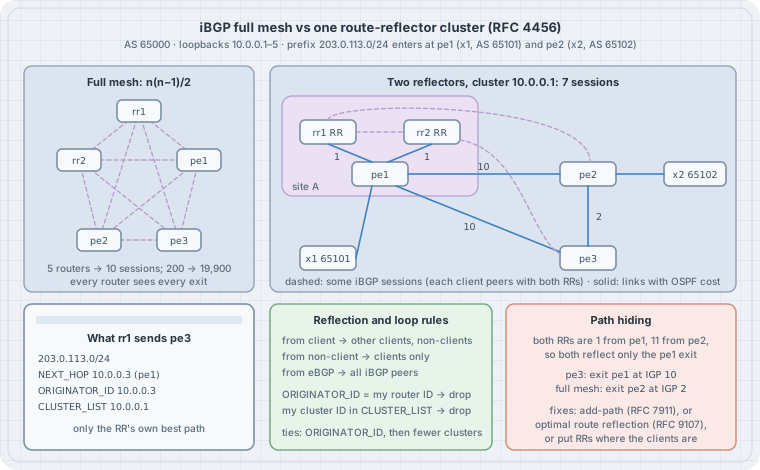
           full mesh                               route reflection (one cluster)
  every router ── every router            client ── RR (both RRs)      RR ── RR (non-clients)
  n(n-1)/2 sessions                        ≈ k sessions per client, k = number of RRs

  a reflected route carries:
     ORIGINATOR_ID  router ID of the client that injected it into the AS   (set once, never changed)
CLUSTER_LIST cluster IDs of every reflector it passed, newest first (prepended per reflection)| Term | RFC 4456 | Meaning |
|---|---|---|
| Route reflector (RR) | §5 | iBGP speaker allowed to re-advertise iBGP-learned routes to its clients |
| Client | §5 | iBGP peer the RR is configured to reflect to (route-reflector-client in FRR). The client itself needs no special config |
| Non-client | §5 | Any other iBGP peer of the RR, typically the other RRs. Non-clients must still be fully meshed with each other |
| Cluster | §5, §7 | An RR and its clients. Several RRs can share one CLUSTER_ID; by default an RR uses its router ID |
| ORIGINATOR_ID | §8, type code 9 | Optional non-transitive, 4 bytes: the router ID of the route’s originator in this AS. Created by the first RR, never overwritten |
| CLUSTER_LIST | §8, type code 10 | Optional non-transitive list of CLUSTER_IDs. Every RR prepends its own when it reflects |
Concepts
The reflection rules (RFC 4456 §6)
After an RR selects its best path, it sends it on according to where it came from:
| Best path learned from | Sent to |
|---|---|
| A non-client iBGP peer | All clients |
| A client | All non-clients and all clients (“Hence the Client peers are not required to be fully meshed”). In practice not back to the client it came from |
| An eBGP peer | All iBGP peers, as ordinary BGP (RFC 4271) |
Nothing else about the route changes: §10 says an RR SHOULD NOT modify NEXT_HOP, AS_PATH, LOCAL_PREF or MED when it reflects. In particular the NEXT_HOP stays the exit router’s address, so every client must be able to reach every exit through the IGP. FRR follows this: next-hop-self on an RR’s client sessions doesn’t touch reflected routes unless you add force.
Two loop checks
- ORIGINATOR_ID: “A router that recognizes the ORIGINATOR_ID attribute SHOULD ignore a route received with its BGP Identifier as the ORIGINATOR_ID.” This catches a route coming back to the router that injected it.
- CLUSTER_LIST: “If the local CLUSTER_ID is found in the CLUSTER_LIST, the advertisement received SHOULD be ignored.” This catches a route coming back to a cluster it has already passed through, including a route from the other RR of the same cluster.
Route selection (RFC 4456 §9)
Two changes to the RFC 4271 §9.1.2.2 tie-breaks: in step f), the lowest BGP Identifier, a reflected route is compared by its ORIGINATOR_ID instead of the router ID of the peer that sent it; and a new step between f) and g) prefers the shorter CLUSTER_LIST. Both come late. Everything before them, including step e), the lowest IGP cost to the NEXT_HOP, is computed by each router from its own position. On a reflector, that position is the reflector’s, and that’s where path hiding comes from.
One cluster ID or two?
| Both RRs share one CLUSTER_ID (netlab’s default) | Each RR its own CLUSTER_ID | |
|---|---|---|
| What an RR does with the other RR’s reflection of a client route | Drops it (its own ID is in CLUSTER_LIST) | Keeps it as an extra path |
| RR memory | One copy per client path | About two copies per client path |
| If a client loses its session to one RR | That RR no longer has the client’s routes. Other clients still get them from the second RR | Each RR still learns the client’s routes via the other RR |
| Typical use | Clients always peer with both RRs | Clients that may peer with only one RR, or RRs in different places |
Both are correct. Pick one on purpose; Lab 2 shows the difference in Adj-RIB-In.
Lab 1: what the full mesh costs
# sessions.py — iBGP sessions: full mesh vs one cluster with k route reflectors
for n in (5, 10, 50, 200, 1000):
    mesh = n * (n - 1) // 2
    row = [f"{n:5} routers  full mesh {mesh:7}"]
    for k in (2, 4):
        rr = k * (n - k) + k * (k - 1) // 2         # every client to every RR, plus an RR mesh
        row.append(f"{k} RRs {rr:5} (busiest client {k}, each RR {n - 1})")
    print("  ".join(row))
python3 sessions.py 5 routers full mesh 10 2 RRs 7 (busiest client 2, each RR 4) 4 RRs 10 (busiest client 4, each RR 4)
10 routers full mesh 45 2 RRs 17 (busiest client 2, each RR 9) 4 RRs 30 (busiest client 4, each RR 9)
50 routers full mesh 1225 2 RRs 97 (busiest client 2, each RR 49) 4 RRs 190 (busiest client 4, each RR 49)
200 routers full mesh 19900 2 RRs 397 (busiest client 2, each RR 199) 4 RRs 790 (busiest client 4, each RR 199)
1000 routers full mesh 499500 2 RRs 1997 (busiest client 2, each RR 999) 4 RRs 3990 (busiest client 4, each RR 999)The full mesh grows with the square of the number of routers; with two RRs it grows linearly. The busiest client keeps one session per RR however large the AS gets. The RRs carry the load: each has a session with every other BGP router, so the RRs, not the PEs, are where you size CPU, memory and update-processing capacity. The full mesh hurts operationally before it hurts in numbers: adding one router means touching the config of every other one.
Lab 2: reflection rules in a model you can see all of
The network from the diagram, in plain Python: five routers in AS 65000, OSPF costs on five links, and one prefix, 203.0.113.0/24, learned over eBGP at pe1 and at pe2. The model computes IGP distances with Dijkstra, applies the RFC 4271 decision steps from “prefer eBGP” on (LOCAL_PREF, AS_PATH, ORIGIN and MED are equal here) with the RFC 4456 §9 changes, and re-advertises until nothing changes. It runs four designs: a full mesh, two RRs sharing a cluster ID, two RRs with their own cluster IDs, and RRs that choose per client (RFC 9107).
# rr_model.py — iBGP full mesh vs route reflection (RFC 4456) for one prefix, by brute force
# usage: python3 rr_model.py [mesh] [rr] [rr-two-clusters] [rr-orr]
import heapq, itertools, sys

# IGP (OSPF costs): both RRs sit next to pe1 in site A; pe3 is in site B, next to pe2
LINKS = {("rr1", "pe1"): 1, ("rr2", "pe1"): 1, ("pe1", "pe2"): 10, ("pe1", "pe3"): 10, ("pe2", "pe3"): 2}
RID = {"rr1": "10.0.0.1", "rr2": "10.0.0.2", "pe1": "10.0.0.3", "pe2": "10.0.0.4", "pe3": "10.0.0.5"}
EXITS = {"pe1": "x1", "pe2": "x2"}         # both learn 203.0.113.0/24 over eBGP (AS65101, AS65102)
ROUTERS = list(RID)

def spf(src):                               # Dijkstra: IGP distance from src to every router
    adj = {r: [] for r in ROUTERS}
    for (a, b), c in LINKS.items():
        adj[a].append((b, c)); adj[b].append((a, c))
    dist, todo = {src: 0}, [(0, src)]
    while todo:
        d, n = heapq.heappop(todo)
        for m, c in adj[n]:
            if d + c < dist.get(m, 1e9):
                dist[m] = d + c; heapq.heappush(todo, (d + c, m))
    return dist
IGP = {r: spf(r) for r in ROUTERS}

def best(router, paths, position=None):
    """RFC 4271 9.1.2.2 from step d) on (LOCAL_PREF, AS_PATH, ORIGIN and MED are equal here):
    d) eBGP over iBGP, e) lowest IGP cost to NEXT_HOP, f) lowest BGP Identifier, where RFC 4456
    section 9 uses ORIGINATOR_ID if present, then the RFC 4456 step: shorter CLUSTER_LIST.
    position != router models RFC 9107 optimal route reflection (IGP cost from the client)."""
    pos = position or router
    def rank(p):
        ident = p["originator"] or RID[p["sender"]]
        return (p["ebgp"] is False, IGP[pos][p["nh"]], tuple(map(int, ident.split("."))),
                len(p["cluster_list"]))
    return min(paths, key=rank) if paths else None

def run(mode):
    reflectors = set() if mode == "mesh" else {"rr1", "rr2"}
    cluster_id = {"rr1": "10.0.0.1", "rr2": "10.0.0.2" if mode == "rr-two-clusters" else "10.0.0.1"}
    if reflectors:   # clients peer with every RR; the RRs peer with each other (non-clients)
        sessions = {(rr, c) for rr in sorted(reflectors) for c in ROUTERS if c not in reflectors}
        sessions |= set(itertools.combinations(sorted(reflectors), 2))
    else:
        sessions = set(itertools.combinations(ROUTERS, 2))
    peers = {r: sorted({b for a, b in sessions if a == r} | {a for a, b in sessions if b == r})
             for r in ROUTERS}
    rib_in = {r: {} for r in ROUTERS}        # rib_in[router][neighbour] = path learned from it
    for pe, x in EXITS.items():               # next-hop-self on the PEs: NH = exit PE loopback
        rib_in[pe][x] = {"nh": pe, "ebgp": True, "originator": None, "cluster_list": [], "sender": pe}
    loop_drops = set()                        # (receiver, sender) pairs rejected by a loop check
    for _ in range(20):                       # re-advertise until nothing changes
        changed = False
        for r, peer in itertools.product(ROUTERS, ROUTERS):
            if peer not in peers[r]:
                continue
            pos = r if (mode == "rr-orr" and peer in reflectors) else None
            b = best(peer, list(rib_in[peer].values()), pos)
            learned_from = [n for n, p in rib_in[peer].items() if p is b][0] if b else None
            send = b is not None and learned_from != r
            if send and not b["ebgp"]:                     # an iBGP-learned best path
                if peer not in reflectors:
                    send = False                           # RFC 4271: no iBGP -> iBGP re-advertising
                else:                                      # RFC 4456 section 6
                    send = learned_from not in reflectors or r not in reflectors
            new = None
            if send:
                new = dict(b, ebgp=False, sender=peer)
                if peer in reflectors and not b["ebgp"]:   # reflected: set/keep ORIGINATOR_ID,
                    new["originator"] = b["originator"] or RID[learned_from]   # prepend cluster
                    new["cluster_list"] = [cluster_id[peer]] + b["cluster_list"]
                if new["originator"] == RID[r] or (r in reflectors and cluster_id[r] in new["cluster_list"]):
                    loop_drops.add((r, peer)); new = None  # RFC 4456 section 8 loop checks
            if rib_in[r].get(peer) != new:
                if new is None: rib_in[r].pop(peer, None)
                else: rib_in[r][peer] = new
                changed = True
        if not changed:
            break
    print(f"== {mode}: {len(sessions)} iBGP sessions, rejected by loop checks: {sorted(loop_drops) or 0}")
    for r in ROUTERS:
        b = best(r, list(rib_in[r].values()))
        via = [n for n, p in rib_in[r].items() if p is b][0]
        seen = ", ".join(f"{n}:{p['nh']}" + (f"[{' '.join(p['cluster_list'])}]" if p["cluster_list"] else "")
                         for n, p in sorted(rib_in[r].items()))
        print(f"  {r}  exit {b['nh']}  IGP {IGP[r][b['nh']]:2}  via {via:3}  | Adj-RIB-In {seen}")

for m in sys.argv[1:] or ["mesh", "rr", "rr-two-clusters", "rr-orr"]:
    run(m)
python3 rr_model.py== mesh: 10 iBGP sessions, rejected by loop checks: 0
rr1 exit pe1 IGP 1 via pe1 | Adj-RIB-In pe1:pe1, pe2:pe2
rr2 exit pe1 IGP 1 via pe1 | Adj-RIB-In pe1:pe1, pe2:pe2
pe1 exit pe1 IGP 0 via x1 | Adj-RIB-In pe2:pe2, x1:pe1
pe2 exit pe2 IGP 0 via x2 | Adj-RIB-In pe1:pe1, x2:pe2
pe3 exit pe2 IGP 2 via pe2 | Adj-RIB-In pe1:pe1, pe2:pe2
== rr: 7 iBGP sessions, rejected by loop checks: [('rr1', 'rr2'), ('rr2', 'rr1')]
rr1 exit pe1 IGP 1 via pe1 | Adj-RIB-In pe1:pe1, pe2:pe2
rr2 exit pe1 IGP 1 via pe1 | Adj-RIB-In pe1:pe1, pe2:pe2
pe1 exit pe1 IGP 0 via x1 | Adj-RIB-In x1:pe1
pe2 exit pe2 IGP 0 via x2 | Adj-RIB-In rr1:pe1[10.0.0.1], rr2:pe1[10.0.0.1], x2:pe2
pe3 exit pe1 IGP 10 via rr1 | Adj-RIB-In rr1:pe1[10.0.0.1], rr2:pe1[10.0.0.1]
== rr-two-clusters: 7 iBGP sessions, rejected by loop checks: 0
rr1 exit pe1 IGP 1 via pe1 | Adj-RIB-In pe1:pe1, pe2:pe2, rr2:pe1[10.0.0.2]
rr2 exit pe1 IGP 1 via pe1 | Adj-RIB-In pe1:pe1, pe2:pe2, rr1:pe1[10.0.0.1]
pe1 exit pe1 IGP 0 via x1 | Adj-RIB-In x1:pe1
pe2 exit pe2 IGP 0 via x2 | Adj-RIB-In rr1:pe1[10.0.0.1], rr2:pe1[10.0.0.2], x2:pe2
pe3 exit pe1 IGP 10 via rr1 | Adj-RIB-In rr1:pe1[10.0.0.1], rr2:pe1[10.0.0.2]
== rr-orr: 7 iBGP sessions, rejected by loop checks: [('rr1', 'rr2'), ('rr2', 'rr1')]
rr1 exit pe1 IGP 1 via pe1 | Adj-RIB-In pe1:pe1, pe2:pe2
rr2 exit pe1 IGP 1 via pe1 | Adj-RIB-In pe1:pe1, pe2:pe2
pe1 exit pe1 IGP 0 via x1 | Adj-RIB-In x1:pe1
pe2 exit pe2 IGP 0 via x2 | Adj-RIB-In x2:pe2
pe3 exit pe2 IGP 2 via rr1 | Adj-RIB-In rr1:pe2[10.0.0.1], rr2:pe2[10.0.0.1]Read it design by design:
- mesh: 10 sessions.
pe3has both exits in its Adj-RIB-In and pickspe2at IGP cost 2. This is the reference answer. - rr: 7 sessions, and
pe3now exits viape1at IGP cost 10. Both reflectors are 1 away frompe1and 11 away frompe2, so both pickpe1and reflect only that path.pe3never learns thepe2exit: that is path hiding. Traffic from site B to203.0.113.0/24now crosses the core to site A and back. Every reflected copy carriesCLUSTER_LIST 10.0.0.1, and the RRs reject each other’s reflections,('rr1', 'rr2'), ('rr2', 'rr1'), because their own cluster ID is already in the list. - rr-two-clusters: same session count, no loop rejections, and each RR now holds a third path, the other RR’s reflection (
rr2:pe1[10.0.0.2]inrr1’s Adj-RIB-In). Path hiding is unchanged: more copies of the same best path don’t add a different exit. - rr-orr: the reflectors compute the best path from each client’s IGP position, which is what RFC 9107 optimal route reflection does.
pe3gets thepe2exit and is back to IGP cost 2 with 7 sessions. Note whatpe2lost: the best path forpe2is its own, which isn’t sent back to it, sope2now has no backup path throughpe1. Add-path (RFC 7911) is the other fix: the RR advertises more than one path, so the client gets both exits and decides itself.
The model makes two simplifications, both noted in its code: it doesn’t send a route back to the neighbour it was learned from (as real implementations don’t), and it doesn’t model the final tie-break on peer address, which is why via rr1 wins over an identical path from rr2.
Lab 3: the same network in netlab (FRR)
netlab compiles a high-level topology into containerlab files and per-device configuration. The BGP module builds the iBGP design for you: nodes listed under rr become reflectors, every other member of the AS becomes a client of all of them, and the reflectors are meshed with each other (bgp.rr_mesh, default true). All reflectors in an AS get the same cluster ID by default, the lowest router ID among them (bgp.rr_cluster_id overrides it).
# topology.yml — two route reflectors next to pe1, a distant pe3, two exits (netlab 26.10, FRR)
---
provider: clab
defaults.device: frr
module: [ ospf, bgp ]

bgp.as_list:
  65000:
    members: [ rr1, rr2, pe1, pe2, pe3 ]
    rr: [ rr1, rr2 ]              # same cluster ID by default: the lowest RR router ID
  65101:
    members: [ x1 ]
  65102:
    members: [ x2 ]

nodes:                            # order sets the loopbacks: rr1 10.0.0.1 … x2 10.0.0.7
  rr1:
  rr2:
  pe1:
  pe2:
  pe3:
  x1:
    module: [ bgp ]             # external routers run BGP only
    bgp.originate: [ 203.0.113.0/24 ]
  x2:
    module: [ bgp ]
    bgp.originate: [ 203.0.113.0/24 ]

links:
- rr1:
  pe1:
  ospf.cost: 1
- rr2:
  pe1:
  ospf.cost: 1
- pe1:
  pe2:
  ospf.cost: 10
- pe1:
  pe3:
  ospf.cost: 10
- pe2:
  pe3:
  ospf.cost: 2
- pe1-x1
- pe2-x2

validate:
  rr_sessions:
    description: pe3 has Established IPv4 sessions with both route reflectors
    wait: 60
    nodes: [ pe3 ]
    devices: [ frr ]
    show: bgp summary json
    valid: >-
      {% for n in bgp.neighbors if n.type == 'ibgp' %}
      ipv4Unicast.peers["{{ n.ipv4 }}"].state == "Established" and
      {% endfor %} True
  reflected:
    description: pe3 has 203.0.113.0/24 only as reflected copies of pe1's path
    wait: 30
    nodes: [ pe3 ]
    devices: [ frr ]
    show: bgp ipv4 unicast 203.0.113.0/24 json
    valid: >-
      len(paths) == 2 and
      all(p.originatorId == "{{ nodes.pe1.loopback.ipv4.split('/')[0] }}" for p in paths)
A custom configuration template for the add-path fix, deployed later with netlab config. netlab picks frr.j2 from the addpath/ directory for FRR nodes:
{# addpath/frr.j2 — on a route reflector: send every path to iBGP neighbours (RFC 7911) #}
router bgp {{ bgp.as }}
 address-family ipv4 unicast
{% for n in bgp.neighbors if n.type == 'ibgp' and n.ipv4 is defined %}
  neighbor {{ n.ipv4 }} addpath-tx-all-paths
{% endfor %}
 exit-address-family
Compile it (run here)
netlab create checks the topology, plans addresses, and renders every device’s configuration. It needs no root and starts nothing:
python3 -m venv netlab-venv && netlab-venv/bin/pip install networklab==26.10
mkdir lab && cp -r topology.yml addpath lab/ && cd lab
../netlab-venv/bin/netlab create
[CONFIG] rr1: initial,ospf,bgp,daemons,hosts
[CONFIG] rr2: initial,ospf,bgp,daemons,hosts (shared)
[CONFIG] pe1: initial,ospf,bgp,daemons,hosts (shared)
[CONFIG] pe2: initial,ospf,bgp,daemons,hosts (shared)
[CONFIG] pe3: initial,ospf,bgp,daemons,hosts (shared)
[CONFIG] x1: initial,routing,bgp,daemons,hosts (shared)
[CONFIG] x2: initial,routing,bgp,daemons,hosts (shared)
Created provider configuration file: clab.yml
Created pickled transformed topology data into netlab.snapshot.pickle
Created group_vars for all
Created group_vars for modules
Created group_vars for frr
Created host_vars for rr1, rr2, pe1, pe2, pe3, x1, x2
Created minimized Ansible inventory hosts.yml
Created Ansible configuration file: ansible.cfgThe rendered FRR configuration for rr1, filtered to the lines that make it a reflector:
grep -E 'router bgp|router-id|cluster-id|neighbor 10\.0\.0\.[0-9]+ (remote-as|route-reflector-client)' node_files/rr1/bgprouter bgp 65000
bgp router-id 10.0.0.1
bgp cluster-id 10.0.0.1
neighbor 10.0.0.2 remote-as 65000
neighbor 10.0.0.3 remote-as 65000
neighbor 10.0.0.4 remote-as 65000
neighbor 10.0.0.5 remote-as 65000
neighbor 10.0.0.3 route-reflector-client
neighbor 10.0.0.4 route-reflector-client
neighbor 10.0.0.5 route-reflector-clientrr2’s file has bgp router-id 10.0.0.2 but the same bgp cluster-id 10.0.0.1. pe3’s has only two neighbours, 10.0.0.1 and 10.0.0.2, and no reflector lines at all: being a client needs no client configuration. The generated clab.yml uses the quay.io/frrouting/frr:10.7.1 image. A first draft of this topology failed netlab create with “Validation test rr_sessions does not include any valid device”: tests whose show/valid are plain strings need devices: [ frr ].
Start it and verify (not run here)
The next steps need root (containerlab creates network namespaces and veth pairs) and a container runtime, so they were not run on this box. They are written from the netlab and FRR documentation; the expected results come from the model in Lab 2 and the rendered configuration above.
netlab up                  # containerlab deploy + push the rendered configs (needs root)
netlab validate            # runs the two tests in topology.yml
netlab connect pe3 vtysh -c "show bgp ipv4 unicast 203.0.113.0/24"
What to look for:
netlab validateshould pass both tests:pe3has two Established sessions, and two paths for203.0.113.0/24, both withoriginatorId10.0.0.3(pe1).- In the
show bgpoutput onpe3, each path should showOriginator: 10.0.0.3, Cluster list: 10.0.0.1(FRR prints this line for reflected routes), and the next hop should be10.0.0.3, not the reflector’s address. show bgp ipv4 unicast 203.0.113.0/24onrr1should list both thepe1and thepe2paths, withpe1best.- Apply the fix and check again:
netlab config addpath -l rr1,rr2    # renders addpath/frr.j2 per node and pushes it
netlab connect pe3 vtysh -c "show bgp ipv4 unicast 203.0.113.0/24"
netlab validate                     # 'reflected' should now FAIL: pe3 sees pe2's path too
With addpath-tx-all-paths on the reflectors, pe3 should receive both exits from each RR and pick the pe2 path (originator 10.0.0.4) on IGP cost, as the full mesh did. Failing the reflected test is the expected result: it was written to prove path hiding. netlab down --cleanup removes the lab.
Case: placing reflectors
| Situation | Design |
|---|---|
| Small AS (a handful of routers), stable | Full mesh is fine. Each new router is one more session on every other router |
| PoPs with a core, RRs in the forwarding path at the PoP/core boundary | One cluster per PoP, the PoP’s routers as clients. RFC 4456 §11’s conditions keep results equal to a full mesh |
| Control-plane-only RRs in one or two locations (common for Internet and VPN routes) | Expect path hiding for distant clients. Turn on add-path towards clients, or optimal route reflection (RFC 9107) where your implementations support it, and check memory on the RRs |
| Clients that may lose one RR session (single-homed sites) | Separate cluster IDs per RR, so each RR still learns those clients’ routes via the other |
| EVPN / VPN overlays with RRs | Same rules, per address family. Next hops stay the PE loopbacks, so loopback reachability is the first thing to check |
The trap
Trap: “the RR is just a hub, it doesn’t change routing.” It changes which exits the clients can see. In Lab 2 the only difference between mesh and rr is the session design, and pe3’s exit cost went from 2 to 10. Nothing is broken, no alarm fires, and traceroutes from site B quietly cross the core.
Trap: “add more RRs for more paths.” Two reflectors at the same place pick the same best path. Lab 2’s rr-two-clusters adds copies of the same path, not a different exit.
Trap: “set next-hop-self on the RR.” RFC 4456 §10 says a reflector should not change NEXT_HOP. With next-hop-self force on an out-of-path reflector, every client sends the traffic to the reflector, which then needs a forwarding path and capacity it was never sized for.
Trap: “clients don’t need to be configured, so they can’t be misconfigured.” Clients still need IGP reachability to every exit’s loopback (the NEXT_HOP), and sessions to every RR. A client that peers with only one RR, in a cluster where both RRs share an ID, has a single point of failure that the “two RRs” diagram hides.
Trap: “ORIGINATOR_ID and CLUSTER_LIST are just diagnostics.” They are in the decision process (§9). Filtering them, or a box that strips them, removes loop protection and changes tie-breaks.
The boring rule
Use a full mesh while it is small enough to configure without thinking; after that, use two route reflectors per cluster, with every client peered to both. Leave NEXT_HOP alone on reflected routes. Decide whether the RRs share a cluster ID and write the reason down. If the reflectors don’t sit where the clients’ exits are, assume path hiding until show bgp on a distant client proves otherwise, and fix it with add-path or optimal route reflection, not with more reflectors in the same place.
Try this
- In
rr_model.py, moverr2next tope3(replace("rr2", "pe1"): 1with("rr2", "pe3"): 1). Doesrrmode still hide thepe2exit frompe3? Which of RFC 4456 §11’s conditions did you just satisfy? - Add a sixth router
pe4far from both exits. How many sessions domeshandrruse now, and which exit doespe4pick in each? - In
sessions.py, add a column for a two-level hierarchy: 4 top-level RRs, 20 second-level RRs as their clients, and 50 PEs per second-level RR pair. Count the sessions. - In the netlab topology, set
bgp.rr_cluster_idonrr2to10.0.0.2, runnetlab create, and confirm the renderedcluster-idchanges. If you can run the lab, compareshow bgp ipv4 unicast 203.0.113.0/24onrr1before and after. - Replace
addpath-tx-all-pathswithaddpath-tx-bestpath-per-ASinaddpath/frr.j2. Why does it givepe3the same two exits in this topology, and with fewer paths in general?
Next
Verification
- Run here:
sessions.pyandrr_model.pywith Python 3.13.5 on Debian 13 (Linux 6.12.94+), unprivileged. Output blocks are pasted from those runs; the model is deterministic. - Run here:
netlab createwith netlab 26.10 (networklabfrom PyPI, installed in a Python venv under the working directory; no system packages). It compiled the topology, rendered the FRR configuration shown above, and wroteclab.ymlwithquay.io/frrouting/frr:10.7.1. Theaddpath/frr.j2template was also rendered bynetlab createwithconfig: [ addpath ]on both RRs; it producedneighbor 10.0.0.2 … 10.0.0.5 addpath-tx-all-pathsunderaddress-family ipv4 unicastforrr1. - Not run:
netlab up,netlab validate,netlab connect,netlab configandnetlab down. They need root and a container runtime (containerlab), which this run does not use. The expected results are stated as expectations, not as output. The FRR JSON keys used in the validation test (paths,originatorId) and theOriginator: …, Cluster list: …text line were checked in FRR’sbgpd/bgp_route.c. - Current versions on 2026-10-19: netlab 26.10, FRR 10.7.1 (latest release), containerlab 0.81.1.
- No
sudo, no system packages, no containers started.
Sources
- RFC 4456 — BGP Route Reflection: An Alternative to Full Mesh Internal BGP (IBGP): §5 terminology and concepts, §6 operation, §7 redundant RRs, §8 ORIGINATOR_ID and CLUSTER_LIST, §9 route selection, §10 attributes not to modify, §11 deployment
- RFC 4271 — A Border Gateway Protocol 4 (BGP-4): §9.1.2.2 breaking ties, §9.2 update-send process (iBGP split horizon)
- RFC 7911 — Advertisement of Multiple Paths in BGP
- RFC 9107 — BGP Optimal Route Reflection (BGP ORR)
- netlab — BGP configuration module (
bgp.as_list,rr,bgp.rr_cluster_id,bgp.rr_mesh,bgp.originate), OSPF module (ospf.cost), Lab validation tests,netlab config - containerlab — documentation (the provider netlab drives with
provider: clab) - FRR — BGP user guide (route reflection,
next-hop-self force,addpath-tx-all-paths,addpath-tx-bestpath-per-AS);bgpd/bgp_route.cfor the JSON and text output of reflected paths: https://github.com/FRRouting/frr/blob/master/bgpd/bgp_route.c