IPv4 Routes over IPv6 Next Hops: BGP Extended Next Hop (RFC 8950)
IPv4 Routes over IPv6 Next Hops: BGP Extended Next Hop (RFC 8950)
A BGP route says two things: where (the prefix) and through whom (the next hop). For years the address family of the prefix fixed the family of the next hop: IPv4 prefixes got IPv4 next hops. RFC 8950 (which replaced RFC 5549 in 2020) breaks that link. An IPv4 prefix can carry an IPv6 next hop, so a link, or a whole core, can run with IPv6 addresses only and still forward IPv4. This is what makes “BGP unnumbered” fabrics work. Two routers peer over IPv6 link-local addresses and swap IPv4 routes, and nobody hands out a /31 per link. This chapter encodes the two wire pieces by hand: the Extended Next Hop Encoding capability and an MP_REACH_NLRI with a 32-octet next hop. It then builds the forwarding result in a Linux network namespace, an IPv4 route via inet6, and shows that the kernel finds the next hop’s MAC address with IPv6 neighbour discovery, not ARP. Last comes the FRR configuration for a two-router containerlab lab.
Learning goals
- Say why a next hop’s address family doesn’t have to match the prefix’s
- Encode and decode capability code 5 and its
<NLRI AFI, NLRI SAFI, Nexthop AFI>triples - Read an MP_REACH_NLRI and use the next-hop length to decide whether the next hop is IPv4, IPv6 or VPN-IPv6
- Know what changed from RFC 5549: VPN next hops are 24 or 48 octets with a zero RD, and IPv4 multicast VPN (1/129) is allowed
- Install and inspect an IPv4 route with an IPv6 gateway on Linux, and see neighbour discovery resolve it
- Configure FRR for extended next hop, on both interface (link-local) peers and global-address peers
Thesis
A next hop is not a destination. It is a neighbour to hand the frame to. A router forwarding an IPv4 packet needs only a layer-2 address for that neighbour, and IPv6 neighbour discovery gives one as well as ARP does. RFC 8950 is the BGP half of that idea: a way to say “IPv6 next hop” for IPv4 routes, and a capability that makes sure the peer understands it before you say it.
Mental model
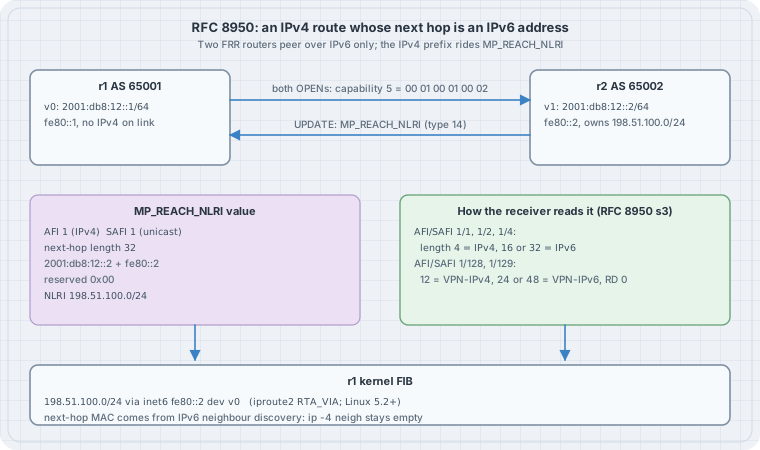
Keep three layers apart:
- Negotiation. In OPEN, each speaker lists the NLRI families for which it accepts an IPv6 next hop. No capability, no IPv6 next hop: RFC 8950 §4 says a speaker MUST NOT send one until the peer has advertised support for that AFI/SAFI.
- Encoding. The IPv4 route moves out of the classic IPv4-only UPDATE fields into the multiprotocol attribute MP_REACH_NLRI (RFC 4760). That attribute has its own next-hop field with an explicit length.
- Forwarding. The RIB entry
198.51.100.0/24 via fe80::2needs a data plane that can resolve an IPv6 gateway for an IPv4 route. On Linux, that is theRTA_VIAroute attribute.
Concepts
Why the classic NEXT_HOP can’t do it
The original BGP-4 UPDATE (RFC 4271) carries IPv4 prefixes in its NLRI field and the next hop in the NEXT_HOP path attribute, type 3. That attribute is exactly four octets: an IPv4 address. There is no room for 16 octets. Multiprotocol BGP (RFC 4760) added MP_REACH_NLRI, type 14. It carries AFI, SAFI, length of next hop, next hop, reserved octet, NLRI, so any family can say any next hop as long as the receiver knows how to read the length. RFC 8950 uses MP_REACH_NLRI with AFI 1 (IPv4) and says which lengths are legal.
The length rule (RFC 8950 §3)
The receiver decides the next hop’s family from the Length of Next Hop Address field:
| NLRI AFI/SAFI | Length | Next hop is |
|---|---|---|
| 1/1 unicast, 1/2 multicast, 1/4 labeled | 4 | IPv4 (the old case) |
| 1/1, 1/2, 1/4 | 16 | IPv6 global |
| 1/1, 1/2, 1/4 | 32 | IPv6 global, then IPv6 link-local |
| 1/128 VPN, 1/129 VPN multicast | 12 | VPN-IPv4 (8-octet RD + IPv4) |
| 1/128, 1/129 | 24 | VPN-IPv6, RD set to zero |
| 1/128, 1/129 | 48 | VPN-IPv6 global + VPN-IPv6 link-local, RDs zero |
The 32-octet form follows RFC 2545 §3, the same rule IPv6 BGP uses: global address first, link-local second. A router that shares the link uses the link-local address to forward.
What changed from RFC 5549
RFC 8950 §2 lists two changes. First, for VPN-IPv4 (1/128), RFC 5549 had said the next hop was a plain 16- or 32-octet IPv6 address. Deployed code actually sent a VPN-IPv6 address, 24 or 48 octets with a zero route distinguisher, matching how VPNv4 over IPv4 and VPNv6 over IPv6 already worked (erratum 5253). RFC 8950 writes down what the implementations did. Second, IPv4 multicast VPN (1/129) gets the same treatment. Plain IPv4 unicast didn’t change, so a 5549-era unicast speaker and an 8950 speaker interoperate.
The capability (RFC 8950 §4)
Capability code 5, Extended Next Hop Encoding, rides in the OPEN message’s Capabilities optional parameter (RFC 5492). Its value is a list of 6-octet triples:
+--------------------+---------------------+-----------------------+
| NLRI AFI (2 octets)| NLRI SAFI (2 octets)| Nexthop AFI (2 octets)|  ...repeated
+--------------------+---------------------+-----------------------+
RFC 8950 allows only NLRI AFI 1, NLRI SAFI 1, 2, 4, 128 or 129, and Nexthop AFI 2. The capability doesn’t enable an address family. That is still the job of the Multiprotocol Extensions capability (code 1). It only says how a family that is already enabled may encode its next hop. It isn’t meant for families that already allow both next-hop types. IPv6 prefixes with IPv4 next hops, for instance, have their own older mechanism (RFC 4798, RFC 4659).
Route reflectors and mixed peers (RFC 8950 §5)
A route reflector passes the next hop on unchanged, and RFC 8950 says its encoding MUST NOT change. If one client can’t take IPv6 next hops (it didn’t send capability 5 for that family), the reflector can’t send it that route at all. It doesn’t translate. In practice, every client of a reflector that carries RFC 8950 routes needs the capability.
Lab 1: the bytes, by hand (run here)
enh.py builds the capability and an MP_REACH_NLRI for two IPv4 prefixes with a global + link-local IPv6 next hop. It then decodes them the way a receiver would, using only the length to pick the next-hop family. It is plain Python 3, standard library only.
"""Encode and decode the RFC 8950 pieces of a BGP session by hand."""
import ipaddress, struct

AFI = {1: "IPv4", 2: "IPv6"}
SAFI = {1: "unicast", 2: "multicast", 4: "labeled", 128: "VPN", 129: "VPN multicast"}

def ext_nh_capability(triples):
    """Capability code 5: a list of <NLRI AFI, NLRI SAFI, Nexthop AFI>, 2 octets each."""
    value = b"".join(struct.pack("!HHH", a, s, n) for a, s, n in triples)
    return struct.pack("!BB", 5, len(value)) + value

def decode_capability(blob):
    code, length = blob[0], blob[1]
    assert code == 5, code
    out = []
    for i in range(2, 2 + length, 6):
        a, s, n = struct.unpack("!HHH", blob[i:i + 6])
        out.append(f"NLRI {AFI[a]}/{SAFI[s]} may use an {AFI[n]} next hop")
    return out

def mp_reach_ipv4_unicast(next_hops, prefixes):
    """MP_REACH_NLRI (type 14) for AFI 1 / SAFI 1 with one or two IPv6 next hops."""
    nh = b"".join(ipaddress.IPv6Address(h).packed for h in next_hops)
    nlri = b""
    for p in prefixes:
        net = ipaddress.IPv4Network(p)
        nbytes = (net.prefixlen + 7) // 8
        nlri += bytes([net.prefixlen]) + net.network_address.packed[:nbytes]
    value = struct.pack("!HBB", 1, 1, len(nh)) + nh + b"\x00" + nlri
    # flags 0x80 = optional, non-transitive; type code 14
    return struct.pack("!BBB", 0x80, 14, len(value)) + value

def decode_mp_reach(attr):
    flags, typ, length = attr[0], attr[1], attr[2]
    v = attr[3:3 + length]
    afi, safi, nhlen = struct.unpack("!HBB", v[:4])
    nh = v[4:4 + nhlen]
    pos = 4 + nhlen + 1          # skip the reserved octet
    prefixes = []
    while pos < len(v):
        plen = v[pos]; nbytes = (plen + 7) // 8
        raw = v[pos + 1:pos + 1 + nbytes] + b"\x00" * (4 - nbytes)
        prefixes.append(f"{ipaddress.IPv4Address(raw)}/{plen}")
        pos += 1 + nbytes
    # RFC 8950 section 3: the length alone says which protocol the next hop is
    kinds = {4: "IPv4", 16: "IPv6 global", 32: "IPv6 global + link-local",
             12: "VPN-IPv4", 24: "VPN-IPv6 (RD 0)", 48: "VPN-IPv6 global + link-local"}
    hops = []
    if nhlen in (16, 32):
        hops = [str(ipaddress.IPv6Address(nh[i:i + 16])) for i in range(0, nhlen, 16)]
    return {"afi/safi": f"{afi}/{safi}", "nh length": nhlen,
            "nh kind": kinds.get(nhlen, "invalid for this AFI/SAFI"),
            "next hops": hops, "nlri": prefixes}

if __name__ == "__main__":
    cap = ext_nh_capability([(1, 1, 2), (1, 128, 2)])
    print("capability bytes:", cap.hex(" "))
    for line in decode_capability(cap):
        print("  ", line)

    attr = mp_reach_ipv4_unicast(["2001:db8:12::2", "fe80::2"],
                                 ["198.51.100.0/24", "203.0.113.128/25"])
    print("MP_REACH_NLRI bytes:", attr.hex(" "))
    for k, val in decode_mp_reach(attr).items():
        print(f"   {k:10} {val}")

    single = mp_reach_ipv4_unicast(["2001:db8:12::2"], ["10.0.0.0/8"])
    d = decode_mp_reach(single)
    print("global-only next hop:", d["nh length"], "octets ->", d["nh kind"], d["next hops"])
$ python3 enh.py
capability bytes: 05 0c 00 01 00 01 00 02 00 01 00 80 00 02
NLRI IPv4/unicast may use an IPv6 next hop
NLRI IPv4/VPN may use an IPv6 next hop
MP_REACH_NLRI bytes: 80 0e 2e 00 01 01 20 20 01 0d b8 00 12 00 00 00 00 00 00 00 00 00 02 fe 80 00 00 00 00 00 00 00 00 00 00 00 00 00 02 00 18 c6 33 64 19 cb 00 71 80
afi/safi 1/1
nh length 32
nh kind IPv6 global + link-local
next hops ['2001:db8:12::2', 'fe80::2']
nlri ['198.51.100.0/24', '203.0.113.128/25']
global-only next hop: 16 octets -> IPv6 global ['2001:db8:12::2']Read the capability bytes left to right: 05 is the code, 0c the length (12 octets, two triples), then 00 01 00 01 00 02 (IPv4 unicast may use an IPv6 next hop) and 00 01 00 80 00 02 (VPN-IPv4, SAFI 128 = 0x80). In the attribute, 80 0e 2e is flags (optional, non-transitive), type 14, and a value length of 46. Then come AFI 00 01 and SAFI 01, and 20, the next-hop length: 32. After it sit the two 16-octet addresses, the reserved 00, and the NLRI: 18 c6 33 64 is /24 198.51.100 and 19 cb 00 71 80 is /25 203.0.113.128. Nothing in the attribute says “IPv6” outright. The length of 32 is the whole signal.
Lab 2: an IPv4 route with an IPv6 gateway (run here, no sudo)
This is what bgpd hands the kernel once it accepts such a route. unshare -rn gives an unprivileged user a private network namespace in which they’re root, so the lab touches nothing on the host. A veth pair stands in for the link, and v0 gets no IPv4 address at all. (A dummy interface would be simpler, but loading its kernel module needs real root, so a veth pair it is.) nh.py sends one UDP datagram to 198.51.100.7 and listens on the far end, v1, for whatever v0 sends to find the next hop.
#!/bin/sh
# Run as: unshare -rn sh lab.sh   (a private network namespace, no sudo)
ip link add v0 type veth peer name v1
ip link set lo up; ip link set v0 up; ip link set v1 up
ip addr add 192.0.2.1/32 dev lo            # a source address for our own packets
ip -6 addr add 2001:db8:12::1/64 dev v0 nodad
ip route add 198.51.100.0/24 via inet6 2001:db8:12::2 dev v0
echo "--- ipv4 routes";  ip -4 route show
echo "--- route lookup"; ip -4 route get 198.51.100.7
echo "--- ipv4 addresses on v0"; ip -4 addr show dev v0
sleep 1
python3 nh.py                              # send one UDP datagram, watch v1
echo "--- ipv6 neighbours on v0"; ip -6 neigh show dev v0
echo "--- ipv4 neighbours on v0"; ip -4 neigh show dev v0
"""Send one IPv4 datagram to 198.51.100.7 and report how v0 resolves the next hop."""
import socket, struct
cap = socket.socket(socket.AF_PACKET, socket.SOCK_RAW, socket.htons(0x0003)) # all frames
cap.bind(("v1", 0)) # the far end of the veth pair sees what v0 transmits
cap.settimeout(3)
socket.socket(socket.AF_INET, socket.SOCK_DGRAM).sendto(b"hello", ("198.51.100.7", 9))
while True:
try:
f = cap.recv(2048)
except socket.timeout:
print("nothing seen"); break
src, ethertype = f[6:12], struct.unpack("!H", f[12:14])[0]
if ethertype == 0x0806:
print(f"{src.hex(':')} sent an ARP request"); break
# IPv6 (0x86dd), next header 58 = ICMPv6, ICMPv6 type 135 = neighbour solicitation
if ethertype == 0x86dd and len(f) >= 78 and f[20] == 58 and f[54] == 135:
target = socket.inet_ntop(socket.AF_INET6, f[62:78])
if not target.startswith("fe80"): # skip the link-local DAD noise
print(f"{src.hex(':')} -> {f[:6].hex(':')} ICMPv6 neighbour solicitation"
f" for {target}")
break$ unshare -rn sh lab.sh
--- ipv4 routes
198.51.100.0/24 via inet6 2001:db8:12::2 dev v0
--- route lookup
198.51.100.7 via inet6 2001:db8:12::2 dev v0 src 192.0.2.1 uid 0
cache
--- ipv4 addresses on v0
ce:c8:07:ce:15:7e -> 33:33:ff:00:00:02 ICMPv6 neighbour solicitation for 2001:db8:12::2
--- ipv6 neighbours on v0
2001:db8:12::2 INCOMPLETE
--- ipv4 neighbours on v0Three things to notice:
ip routetakesvia inet6 <addr>on an IPv4 route. iproute2 sends this as theRTA_VIAattribute, and Linux has accepted IPv6 gateways for IPv4 routes since kernel 5.2. This run used kernel 6.12 with iproute2 6.15.- v0 has no IPv4 address, and the lookup still works. The source address, 192.0.2.1, comes from the loopback, the way a router uses its loopback /32 in an unnumbered fabric.
- To send the IPv4 datagram, the kernel sent an ICMPv6 neighbour solicitation to the solicited-node multicast group of 2001:db8:12::2 (
33:33:ff:00:00:02). The IPv4 neighbour table stays empty, because no ARP is involved. (INCOMPLETEis expected: nobody owns ::2 on this veth.)
In a real fabric, bgpd installs the link-local form, via inet6 fe80::2 dev eth1. A link-local gateway is only meaningful together with the interface, which is why the route always names the device.
Lab 3: two FRR routers in containerlab (from the docs, not run here)
Running containers needs a container runtime and root, which this book’s build box doesn’t have. The topology below follows the containerlab topology-file format, and the FRR commands come from the FRR BGP documentation. Run it yourself and compare against the checks below.
rfc8950.clab.yml:
name: rfc8950
topology:
  nodes:
    r1:
      kind: linux
      image: quay.io/frrouting/frr:10.2.1
      binds:
        - r1/daemons:/etc/frr/daemons
        - r1/frr.conf:/etc/frr/frr.conf
    r2:
      kind: linux
      image: quay.io/frrouting/frr:10.2.1
      binds:
        - r2/daemons:/etc/frr/daemons
        - r2/frr.conf:/etc/frr/frr.conf
  links:
    - endpoints: ["r1:eth1", "r2:eth1"]
r1/daemons sets bgpd=yes (zebra always runs). r1/frr.conf, an interface peer with no addresses on eth1 at all:
frr defaults datacenter
!
interface lo
 ip address 192.0.2.1/32
!
router bgp 65001
 bgp router-id 192.0.2.1
 no bgp ebgp-requires-policy
 neighbor eth1 interface remote-as external
 !
 address-family ipv4 unicast
  network 192.0.2.1/32
 exit-address-family
!
r2 is the same with AS 65002, router ID and loopback 198.51.100.1, and network 198.51.100.0/24 backed by a static ip route 198.51.100.0/24 blackhole.
What FRR does for you here, per its documentation:
neighbor eth1 interfacepeers over the IPv6 link-local address it learns from the other side’s router advertisements. bgpd asks zebra to send RAs on that interface (thebgp ipv6-auto-rabehaviour, on by default).- On a link-local peering, FRR turns
capability extended-nexthopon automatically. For a peer reached by a global IPv6 address you set it yourself:neighbor 2001:db8:12::2 capability extended-nexthop. That’s what lets bgpd install IPv4 routes with IPv6 next hops when the interfaces have no IPv4.
Checks to run after containerlab deploy -t rfc8950.clab.yml:
docker exec clab-rfc8950-r1 vtysh -c "show bgp neighbors eth1"   # look for the Extended nexthop line: advertised and received, IPv4 Unicast
docker exec clab-rfc8950-r1 vtysh -c "show ip route bgp"         # 198.51.100.0/24 via fe80::..., eth1
docker exec clab-rfc8950-r1 ip -4 route show proto bgp           # ... via inet6 fe80::... dev eth1
docker exec clab-rfc8950-r1 ip -4 neigh show dev eth1            # empty: no ARP on this link
If the neighbour output shows the capability advertised but not received, the peer won’t accept IPv6 next hops for IPv4, and per RFC 8950 §4 your router must not send them. On a global-address peer, the usual cause is a missing capability extended-nexthop on the far side.
Case: an unnumbered leaf-spine
A leaf-spine fabric with 64 leaves and 4 spines has 256 links. Numbered with IPv4 /31s, that’s 256 /31s to allocate, document and keep consistent in two configs per link. With RFC 8950 and interface peering, each switch needs one IPv4 /32 on its loopback (for sourcing and management) and nothing on its links: IPv6 link-local addresses come up on their own. The price is a hard dependency on IPv6 being enabled on every fabric port. You also have to watch three things:
- Traceroute replies come from the loopback (or whatever the vendor picks), because the link has no IPv4 address to answer from.
- Out-of-band tools that assume an IPv4 next hop in BGP (old collectors, some BMP pipelines) may print the IPv6 next hop oddly, or drop the route.
- Every reflector client needs the capability (RFC 8950 §5), so one old box can quietly miss routes.
The trap
“The session is up, so the routes will be fine.” Capability 5 is negotiated per family, and only if both sides advertise it. A global-address IPv6 session with IPv4 unicast activated, but no capability extended-nexthop on one end, comes up fine and exchanges IPv6 routes. The IPv4 routes then fail to install, or are never sent. Check the capability line in the neighbour output, not just Established.
Second trap: the 32-octet next hop is global then link-local. A hand-built decoder, or a filter that reads only the first 16 octets, gets the global address. That’s fine for a multihop peer, but on a shared link the router actually forwards to the link-local one.
The boring rule
Peer over interfaces where you can, so the capability is on automatically. Turn it on explicitly for global-address IPv6 peers that carry IPv4. Then verify three things: capability received, the IPv4 route installed via inet6, and the IPv4 neighbour table empty on the link.
Try this
- Change
mp_reach_ipv4_unicastinenh.pyto send a 24-octet next hop for AFI/SAFI 1/1. What doesdecode_mp_reachcall it? What should a real receiver do with it? (RFC 8950 §3 and RFC 7606 on malformed attributes.) - Add a third triple,
(2, 1, 1): IPv6 unicast with an IPv4 next hop. Why does RFC 8950 §4 rule it out? - In Lab 2, add
2001:db8:12::2/64on v1 and re-run. What changes inip -6 neigh, and why doesnh.pynow see a different frame? - Re-run Lab 2 with
fe80::2as the gateway. Why doesip route add 198.51.100.0/24 via inet6 fe80::2fail withoutdev v0?
Next
Use this with route reflectors (RFC 8950 §5): a reflector won’t translate next-hop encodings for a client that lacks the capability.
Verification
enh.pywas run with Python 3 (standard library only). The capability and MP_REACH_NLRI bytes and decodes shown are its real output.- Lab 2 (
lab.sh+nh.py) was run unprivileged withunshare -rnon Linux 6.12 with iproute2 6.15. The routes, the lookup, the neighbour-solicitation capture and the neighbour tables are genuine output. MAC addresses are random per run. - Lab 3 (containerlab + FRR) was not run: it needs a container runtime and root. It is written from the containerlab and FRR documentation, and the expected output is described, not pasted.
Sources
- RFC 8950, Advertising IPv4 Network Layer Reachability Information (NLRI) with an IPv6 Next Hop: https://www.rfc-editor.org/rfc/rfc8950. §2 changes from RFC 5549, §3 next-hop lengths, §4 capability, §5 operations.
- RFC 4760, Multiprotocol Extensions for BGP-4 (MP_REACH_NLRI): https://www.rfc-editor.org/rfc/rfc4760
- RFC 5492, Capabilities Advertisement with BGP-4: https://www.rfc-editor.org/rfc/rfc5492
- RFC 2545, Use of BGP-4 Multiprotocol Extensions for IPv6 Inter-Domain Routing (global + link-local next hop): https://www.rfc-editor.org/rfc/rfc2545
- RFC 4271, A Border Gateway Protocol 4 (NEXT_HOP attribute): https://www.rfc-editor.org/rfc/rfc4271
- IANA, BGP Capability Codes (code 5): https://www.iana.org/assignments/capability-codes/
- FRR documentation, BGP (
capability extended-nexthop, interface peers,bgp ipv6-auto-ra): https://docs.frrouting.org/en/latest/bgp.html - containerlab documentation, topology definition: https://containerlab.dev/manual/topo-def-file/
- iproute2
ip-route(8)(via [ FAMILY ] ADDRESS): https://man7.org/linux/man-pages/man8/ip-route.8.html