AsRef, Borrow and Deref: Same Signature, Different Promises
AsRef, Borrow and Deref: Same Signature, Different Promises
Thesis
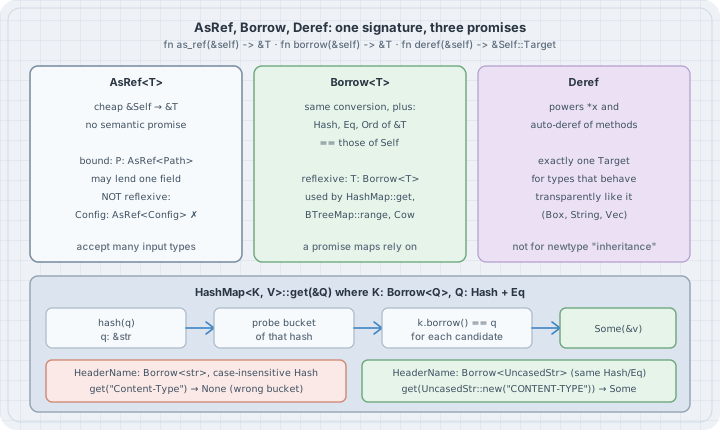
Three standard traits all turn &Self into &T:
pub trait AsRef<T: ?Sized>  { fn as_ref(&self) -> &T; }
pub trait Borrow<T: ?Sized> { fn borrow(&self) -> &T; }
pub trait Deref             { type Target: ?Sized; fn deref(&self) -> &Self::Target; }
They are not interchangeable. The difference is what each one promises to the code that uses it.
AsRef<T>promises only a cheap conversion. Use it as a generic bound, such asP: AsRef<Path>, to accept many input types.Borrow<T>promises the same conversion and that “Eq,OrdandHashmust be equivalent for borrowed and owned values” (std docs). That promise is the only reasonHashMap<String, V>::getcan take a&str. The map hashes the&stryou pass and trusts it to land in the same bucket as theStringit stored.Derefdrives the*operator and auto-deref method lookup. The std docs reserve it for types that “transparently behave like a value of the target type”.
The compiler checks the signatures of all three. It doesn’t check the promises. This chapter shows each trait doing its job, then breaks Borrow’s contract on purpose. The result is a map that compiles, passes a lowercase-only test, and loses "Content-Type".
Mental model
AsRef<T> |
Borrow<T> |
Deref |
|
|---|---|---|---|
| What it promises | a cheap &T |
a cheap &T whose Hash/Eq/Ord match Self’s |
*x and method calls go to Target |
Reflexive (T: Trait<T>)? |
no | yes (blanket impl<T> Borrow<T> for T) |
n/a |
| Several targets per type? | yes (String: AsRef<str>, AsRef<[u8]>, AsRef<Path>, AsRef<OsStr>) |
yes, if each keeps the contract | no, exactly one |
| May lend just one field? | yes | no (the field’s Hash/Eq would differ) |
not recommended |
| Typical user | fn open<P: AsRef<Path>>(p: P) |
HashMap::get, BTreeMap::range, Cow/ToOwned |
Box<T>, String, Vec<T>, guards |
Worked examples
Built and run with rustc/cargo 1.85.1 (the distro toolchain on the box), edition 2024. The current stable Rust is 1.99.1. Every API used here has been stable since well before 1.85, and its documentation is unchanged. The project has no dependencies.
cargo new --vcs none conv && cd conv
rm src/main.rs && mkdir -p src/bin
# Cargo.toml
[package]
name = "conv"
version = "0.1.0"
edition = "2024"
rust-version = "1.85"
[dependencies]Case 1: How HashMap<String, V> answers a &str
// src/bin/lookup.rs — why HashMap<String, V>::get accepts a &str
use std::borrow::Borrow;
use std::collections::{BTreeMap, HashMap};
use std::hash::{BuildHasher, RandomState};
use std::ops::Bound::{Excluded, Included};

fn main() {
    let mut ports: HashMap<String, u16> = HashMap::new();
    ports.insert("http".to_string(), 80);
    ports.insert("https".to_string(), 443);

    // get<Q: ?Sized>(&self, k: &Q) where String: Borrow<Q>, Q: Hash + Eq
    let key: &str = "https";
    println!("get(&str)    -> {:?}", ports.get(key));
    println!("get(&String) -> {:?}", ports.get(&"http".to_string()));

    // The contract that makes it sound: hashing the owned key and the borrowed key agree.
    let s = RandomState::new();
    let owned = String::from("https");
    let borrowed: &str = owned.borrow();
    println!("hash(String) == hash(&str)? {}", s.hash_one(&owned) == s.hash_one(borrowed));

    // Ordered maps use the same trick with Ord: range queries by &str over String keys.
    let mut users: BTreeMap<String, u32> = BTreeMap::new();
    for (name, id) in [("alice", 1), ("bob", 2), ("carol", 3), ("dave", 4)] {
        users.insert(name.to_string(), id);
    }
    // `"b".."d"` is a Range<&str>, which is not RangeBounds<str>; spell the bounds out instead.
    let picked: Vec<_> = users
        .range::<str, _>((Included("b"), Excluded("d")))
        .map(|(k, v)| (k.as_str(), *v))
        .collect();
    println!("range(b..d)  -> {picked:?}");
}
$ cargo run -q --bin lookup
get(&str) -> Some(443)
get(&String) -> Some(80)
hash(String) == hash(&str)? true
range(b..d) -> [("bob", 2), ("carol", 3)]HashMap::get is declared as get<Q: ?Sized>(&self, k: &Q) -> Option<&V> where K: Borrow<Q>, Q: Hash + Eq. With K = String and Q = str, the map hashes the &str, finds the bucket, and compares each candidate with key.borrow() == q. No String is allocated for the lookup. The hash_one line shows the property that makes this correct: String and str produce the same hash, because String’s Hash forwards to str’s. BTreeMap uses the same bound with Ord for get and range. (The range call needs its bounds spelled out, because "b".."d" is a Range<&str>, not a RangeBounds<str>.)
Case 2: AsRef as an “accept anything” bound
// src/bin/asref.rs — AsRef as a cheap "accept anything that can lend me a &T" bound
use std::ffi::OsString;
use std::path::{Path, PathBuf};

fn describe<P: AsRef<Path>>(p: P) -> String {
    let p = p.as_ref(); // one conversion, then work with &Path
    format!("{:<18} file_name={:?} ext={:?}", p.display().to_string(), p.file_name(), p.extension())
}

fn checksum<B: AsRef<[u8]>>(data: B) -> u32 {
    data.as_ref().iter().fold(0u32, |a, &b| a.rotate_left(5) ^ b as u32)
}

fn main() {
    println!("{}", describe("notes/today.md"));
    println!("{}", describe(String::from("Cargo.toml")));
    println!("{}", describe(PathBuf::from("/etc/hosts")));
    println!("{}", describe(Path::new("archive.tar.gz")));
    println!("{}", describe(OsString::from("README")));

    // The same bound works for every byte container.
    println!("checksum: {} {} {} {}",
        checksum("abc"), checksum(String::from("abc")), checksum(b"abc"), checksum(vec![b'a', b'b', b'c']));
}
$ cargo run -q --bin asref
notes/today.md file_name=Some("today.md") ext=Some("md")
Cargo.toml file_name=Some("Cargo.toml") ext=Some("toml")
/etc/hosts file_name=Some("hosts") ext=None
archive.tar.gz file_name=Some("archive.tar.gz") ext=Some("gz")
README file_name=Some("README") ext=None
checksum: 100387 100387 100387 100387AsRef<Path> is implemented for str, String, OsStr, OsString, Path, PathBuf and more, and &T forwards to T. One generic signature accepts all of them, and .as_ref() happens once at the top of the function. This is the pattern std::fs::File::open uses. AsRef makes no promise about hashing or equality, so a type is free to implement it for several targets, or to lend out just one of its fields. Borrow can’t do either of those.
Case 3: Break the Borrow contract and the map loses keys
HTTP header names are case-insensitive. A natural first attempt is a newtype with case-insensitive Eq and Hash, plus Borrow<str> so that lookups by &str “just work”:
// src/bin/broken_borrow.rs — a case-insensitive key that implements Borrow<str> (wrongly)
use std::borrow::Borrow;
use std::collections::HashMap;
use std::hash::{Hash, Hasher};

#[derive(Debug, Clone)]
struct HeaderName(String);

impl PartialEq for HeaderName {
    fn eq(&self, other: &Self) -> bool {
        self.0.eq_ignore_ascii_case(&other.0)
    }
}
impl Eq for HeaderName {}

impl Hash for HeaderName {
    fn hash<H: Hasher>(&self, state: &mut H) {
        for b in self.0.bytes() {
            state.write_u8(b.to_ascii_lowercase()); // hash the lowercase form
        }
        state.write_u8(0xff);
    }
}

// Compiles fine. Breaks the contract: str's Hash/Eq are case-SENSITIVE and hash differently.
impl Borrow<str> for HeaderName {
    fn borrow(&self) -> &str {
        &self.0
    }
}

fn main() {
    let mut h: HashMap<HeaderName, &str> = HashMap::new();
    h.insert(HeaderName("Content-Type".into()), "text/html");

    println!("get(&HeaderName(\"content-type\")) -> {:?}", h.get(&HeaderName("content-type".into())));
    println!("get(\"content-type\")              -> {:?}", h.get("content-type"));
    println!("get(\"Content-Type\")              -> {:?}", h.get("Content-Type"));
    println!("contains_key(\"Content-Type\")     -> {}", h.contains_key("Content-Type"));

    // Why tests often miss it: an all-lowercase key hashes the same both ways.
    h.insert(HeaderName("accept".into()), "*/*");
    println!("get(\"accept\")                    -> {:?}", h.get("accept"));
}
$ cargo run -q --bin broken_borrow
get(&HeaderName("content-type")) -> Some("text/html")
get("content-type") -> None
get("Content-Type") -> None
contains_key("Content-Type") -> false
get("accept") -> Some("*/*")It compiles without a warning, and it is wrong in a way that is easy to miss:
- Lookups by
&HeaderNamework, in any case. - Lookups by
&strgo throughstr’sHash, which is case-sensitive."content-type"and even the exact"Content-Type"hash into a different bucket from the stored key, so the lookup returnsNone. - For an all-lowercase key, both hashes see the same bytes. std’s
strhash writes the bytes followed by0xff, and so does thisHeaderNameimpl. (That is an implementation detail of the defaultHasher::write_strand std’s SipHasher, not a guarantee.) Soget("accept")succeeds. A test suite that only uses lowercase names passes.
The std docs are explicit that this is a logic error, not undefined behaviour. HashMap stays memory-safe, but its results stop meaning anything. That is why Borrow is a safe trait, and also why the compiler can’t help you here.
Case 4: The correct shape: borrow as a type with the same Hash and Eq
The fix is to borrow as a type whose Hash and Eq really are the key’s. Here that is an unsized, case-insensitive view of str, built the same way std builds Path over OsStr:
// src/bin/uncased.rs — the correct shape: borrow as a str-like type with the SAME Hash/Eq
use std::borrow::Borrow;
use std::collections::HashMap;
use std::hash::{Hash, Hasher};

/// A borrowed, case-insensitive view of a `str` (an unsized type, like `Path` over `OsStr`).
#[repr(transparent)]
#[derive(Debug)]
struct UncasedStr(str);

impl UncasedStr {
    fn new(s: &str) -> &UncasedStr {
        // SAFETY: UncasedStr is #[repr(transparent)] over str, so &str and &UncasedStr have
        // the same layout and metadata; this is the pattern std uses for Path::new.
        unsafe { &*(s as *const str as *const UncasedStr) }
    }
}

impl PartialEq for UncasedStr {
    fn eq(&self, other: &Self) -> bool {
        self.0.eq_ignore_ascii_case(&other.0)
    }
}
impl Eq for UncasedStr {}

impl Hash for UncasedStr {
    fn hash<H: Hasher>(&self, state: &mut H) {
        for b in self.0.bytes() {
            state.write_u8(b.to_ascii_lowercase());
        }
        state.write_u8(0xff);
    }
}

/// The owned key. Its Hash/Eq simply delegate to the borrowed form, so they agree by construction.
#[derive(Debug, Clone)]
struct HeaderName(String);

impl Borrow<UncasedStr> for HeaderName {
    fn borrow(&self) -> &UncasedStr {
        UncasedStr::new(&self.0)
    }
}
impl PartialEq for HeaderName {
    fn eq(&self, other: &Self) -> bool {
        Borrow::<UncasedStr>::borrow(self) == Borrow::<UncasedStr>::borrow(other)
    }
}
impl Eq for HeaderName {}
impl Hash for HeaderName {
    fn hash<H: Hasher>(&self, state: &mut H) {
        Borrow::<UncasedStr>::borrow(self).hash(state)
    }
}

fn main() {
    let mut h: HashMap<HeaderName, &str> = HashMap::new();
    h.insert(HeaderName("Content-Type".into()), "text/html");

    for probe in ["content-type", "CONTENT-TYPE", "Content-Type", "Content-Length"] {
        println!("get(UncasedStr::new({probe:?})) -> {:?}", h.get(UncasedStr::new(probe)));
    }
}
$ cargo run -q --bin uncased
get(UncasedStr::new("content-type")) -> Some("text/html")
get(UncasedStr::new("CONTENT-TYPE")) -> Some("text/html")
get(UncasedStr::new("Content-Type")) -> Some("text/html")
get(UncasedStr::new("Content-Length")) -> NoneNow the owned key’s Hash and Eq delegate to the borrowed form, so they agree by construction, and every case of the name finds the entry. The single unsafe line is the standard #[repr(transparent)] reference cast that Path::new and OsStr::new use. Miri was not run on it here, because there is no nightly toolchain on the box. If you’d rather avoid the cast, lowercase the key on insert and look it up with a lowercased &str. That costs an allocation, or a check, per lookup.
Case 5: Borrow is reflexive, AsRef is not
// src/bin/reflexive.rs — Borrow<T> holds for T itself; AsRef<T> does not
use std::borrow::Borrow;

#[derive(Debug)]
struct Config {
    name: String,
}

fn by_borrow<C: Borrow<Config>>(c: C) -> usize {
    c.borrow().name.len()
}

fn by_asref<C: AsRef<Config>>(c: C) -> usize {
    c.as_ref().name.len()
}

fn main() {
    let cfg = Config { name: "prod".into() };
    println!("by_borrow(&cfg) = {}", by_borrow(&cfg)); // impl Borrow<T> for &T
    println!("by_borrow(cfg)  = {}", by_borrow(cfg)); //  impl Borrow<T> for T
    let cfg = Config { name: "dev".into() };
    println!("by_asref(&cfg)  = {}", by_asref(&cfg));
}
$ cargo build --bin reflexive
Compiling conv v0.1.0 (/tmp/borrow/conv)
error[E0277]: the trait bound `Config: AsRef<Config>` is not satisfied
--> src/bin/reflexive.rs:22:48
|
22 | println!("by_asref(&cfg) = {}", by_asref(&cfg));
| -------- ^^^ the trait `AsRef<Config>` is not implemented for `Config`
| |
| required by a bound introduced by this call
|
= note: required for `&Config` to implement `AsRef<Config>`
note: required by a bound in `by_asref`
--> src/bin/reflexive.rs:13:16
|
13 | fn by_asref<C: AsRef<Config>>(c: C) -> usize {
| ^^^^^^^^^^^^^ required by this bound in `by_asref`
For more information about this error, try `rustc --explain E0277`.
error: could not compile `conv` (bin "reflexive") due to 1 previous errorby_borrow accepts both cfg and &cfg. The blanket impls impl<T> Borrow<T> for T and impl<T> Borrow<T> for &T cover both. by_asref(&cfg) fails: &T: AsRef<U> only forwards when T: AsRef<U>, and nothing makes Config: AsRef<Config>. The AsRef docs explain that a reflexive blanket impl “is currently not provided due to technical restrictions of Rust’s type system (it would be overlapping with another existing blanket implementation for &T…)”. If you want generic code that accepts “a T or a &T”, write C: Borrow<T>. Use AsRef for “anything that can lend me a &T”.
Case 6: ToOwned is Borrow run backwards, and Cow stands on both
// src/bin/cow.rs — ToOwned is Borrow run backwards, and Cow is built on both
use std::borrow::Cow;

/// Normalise a header value: trim it, and collapse internal runs of spaces.
/// Allocates only when the input actually needs changing.
fn normalize(v: &str) -> Cow<'_, str> {
    let t = v.trim();
    if !t.contains("  ") {
        return Cow::Borrowed(t); // zero-copy: a slice of the caller's string
    }
    let mut out = String::with_capacity(t.len());
    for word in t.split(' ').filter(|w| !w.is_empty()) {
        if !out.is_empty() {
            out.push(' ');
        }
        out.push_str(word);
    }
    Cow::Owned(out)
}

fn main() {
    for input in ["text/html", "  text/html ", "text/html;  charset=utf-8"] {
        let n = normalize(input);
        let kind = match &n {
            Cow::Borrowed(_) => "borrowed",
            Cow::Owned(_) => "owned (allocated)",
        };
        println!("{input:<28} -> {n:<26} {kind}");
    }

    // <str as ToOwned>::Owned = String, and String: Borrow<str>: the pair Cow<str> relies on.
    let owned: String = "abc".to_owned();
    let back: &str = std::borrow::Borrow::borrow(&owned);
    println!("to_owned -> {owned:?}, borrow -> {back:?}");

    // into_owned() allocates only if it still has to.
    let c: Cow<'_, str> = normalize("plain");
    let s: String = c.into_owned();
    println!("into_owned -> {s:?}");
}
$ cargo run -q --bin cow
text/html -> text/html borrowed
text/html -> text/html borrowed
text/html; charset=utf-8 -> text/html; charset=utf-8 owned (allocated)
to_owned -> "abc", borrow -> "abc"
into_owned -> "plain"Cow<'a, B> requires B: ToOwned, and ToOwned requires Self::Owned: Borrow<Self>. That pair lets a Cow<str> hold either a &str or a String and deref to &str either way. normalize allocates only for the input that needs rewriting. The other two return a slice of the caller’s string.
The trap
The trap is treating Borrow as “AsRef with a better name for maps”, and implementing it whenever you want get(&str) to compile. Case 3 compiles and passes a lowercase test, and in production it returns None for "Content-Type". The same class of bug appears whenever Borrow<T> lends a form whose Hash, Eq or Ord differ from the owner’s:
- a struct that borrows as one of its fields (
User: Borrow<u64>returning&self.id, whileUser’sEqcompares every field); - a float wrapper with a total order that borrows as
f64(whosePartialOrddisagrees for NaN); - a path-like key that normalises on
Eqbut borrows as the raw string.
The related Deref trap is newtype “inheritance”: struct Email(String) with Deref<Target = String> so that email.len() works. Every String method becomes part of the Email API, email.to_uppercase() silently returns a plain String, and the std docs’ conditions (“transparently behaves like a value of the target type”, “will not be surprised by any deref coercion behavior”) no longer hold. Implement AsRef<str> and a few explicit methods instead.
The boring rule
Use
AsRef<T>for generic parameters that just need to read a&T(paths, bytes, strings). ImplementBorrow<T>only whenT’sHash,EqandOrdagree exactly withSelf’s, and get there by delegatingSelf’s impls to the borrowed form. If they can’t agree (case-insensitive, normalised or partial keys), borrow as a dedicated#[repr(transparent)]view type, or normalise the key before you store it. ImplementDerefonly for smart-pointer-like types, never to inherit methods. Test map lookups with keys in more than one form.
Try this
- Add
impl AsRef<Config> for Config { fn as_ref(&self) -> &Config { self } }toreflexive.rs. Doesby_asref(&cfg)compile now? Doesby_asref(cfg)? - In
broken_borrow.rs, replaceHashMapwithBTreeMap, giveHeaderNamea case-insensitiveOrd, and keepBorrow<str>. Which lookups fail now, and why is the failure different from the hash-based one? - Write
fn total_len<I, S>(items: I) -> usize where I: IntoIterator<Item = S>, S: AsRef<str>and call it with aVec<String>, a[&str; 3], and aHashSet<Box<str>>. - Change
normalizeincow.rsto lowercase the value too. How many inputs are stillBorrowed? Usestr::bytes().any(|b| b.is_ascii_uppercase())so that it only allocates when needed. - Find
impl Borrow<str> for Stringandimpl Hash for Stringin the std source. Confirm thatStringhashes exactly as itsstrdoes, and explain why that equality is the whole contract.
Sources
- Rust standard library,
std::borrow::Borrow(theHash/Eq/Ordequivalence requirement and theHashMapexample): https://doc.rust-lang.org/std/borrow/trait.Borrow.html - Rust standard library,
std::convert::AsRef(“Relation toBorrow”, “Reflexivity”): https://doc.rust-lang.org/std/convert/trait.AsRef.html - Rust standard library,
std::ops::Deref(“When to implementDereforDerefMut”): https://doc.rust-lang.org/std/ops/trait.Deref.html - Rust standard library,
HashMap::getandBTreeMap::rangesignatures: https://doc.rust-lang.org/std/collections/struct.HashMap.html#method.get, https://doc.rust-lang.org/std/collections/struct.BTreeMap.html#method.range - Rust standard library,
std::borrow::ToOwnedandCow: https://doc.rust-lang.org/std/borrow/trait.ToOwned.html, https://doc.rust-lang.org/std/borrow/enum.Cow.html - Rust standard library,
Path::new(the#[repr(transparent)]unsized-view pattern): https://doc.rust-lang.org/std/path/struct.Path.html#method.new - Rust source,
core::hash(Hasher::write_strwrites the bytes then0xff): https://github.com/rust-lang/rust/blob/master/library/core/src/hash/mod.rs - The Rust Reference, type layout:
#[repr(transparent)]: https://doc.rust-lang.org/reference/type-layout.html#the-transparent-representation - Rust API Guidelines, C-DEREF (“Only smart pointers implement
Deref”): https://rust-lang.github.io/api-guidelines/predictability.html#c-deref - Rust release channel manifest (stable 1.99.1, 2026-10-13): https://static.rust-lang.org/dist/channel-rust-stable.toml