build.rs Runs As You: Build Scripts and the Supply Chain
build.rs Runs As You: Build Scripts and the Supply Chain
Thesis
Adding a dependency doesn’t just add code to your binary. It adds code that runs on your machine at build time. The Cargo reference puts it plainly: placing a file named build.rs in a package root “will cause Cargo to compile that script and execute it just before building the package” (Build Scripts). Procedural macros are the same: they are compiler plugins that run inside rustc. Neither is sandboxed. They run with your user, your environment, your files and your network.
That is why typosquatting works so well against Rust developers: a crate named almost like proc-macro2 only has to be built to act. This chapter shows exactly when that code runs, using a harmless look-alike crate, and what a simple sandbox does and doesn’t stop.
A harmless look-alike
proc-macro-two is a local path crate. Its build.rs does what a malicious one would do first, but only reports it: it counts environment variables (where CI tokens live), counts entries in ~/.ssh, tries an outbound TCP connection, and writes a file outside target/.
#!/bin/sh
# An app that depends on a look-alike crate. Its build.rs is harmless, but it
# shows what any build script can do: read your environment and files, write
# outside target/, and open network connections, all before main() exists.
set -e
rm -rf app proc-macro-two /tmp/buildrs-was-here
cargo new -q --lib proc-macro-two
cat > proc-macro-two/build.rs <<'RS'
use std::{env, fs, net::TcpStream, time::Duration};
fn main() {
    let home = env::var("HOME").unwrap_or_default();
    let ssh = fs::read_dir(format!("{home}/.ssh")).map(|d| d.count()).unwrap_or(0);
    let vars = env::vars().count();
    let net = match "1.1.1.1:443".parse() {
        Ok(a) => match TcpStream::connect_timeout(&a, Duration::from_secs(2)) {
            Ok(_) => "network: connected to 1.1.1.1:443".to_string(),
            Err(e) => format!("network: {e}"),
        },
        Err(_) => unreachable!(),
    };
    let report = format!("build.rs ran as uid {}: saw {vars} env vars, {ssh} entries in ~/.ssh; {net}\n",
        fs::read_to_string("/proc/self/status").unwrap_or_default()
            .lines().find(|l| l.starts_with("Uid:")).unwrap_or("").split_whitespace().nth(1).unwrap_or("?"));
    fs::write("/tmp/buildrs-was-here", &report).unwrap();
    println!("cargo::warning={}", report.trim());
}
RS
cargo new -q app
cd app
cargo add -q --path ../proc-macro-two
When it runs
#!/bin/sh
cd "$(dirname "$0")/app"
set -x
cargo metadata --format-version 1 --offline > /dev/null; ls /tmp/buildrs-was-here
cargo check --offline 2>&1 | grep -v "^ *Finished\|^ *Checking\|^ *Compiling"
cat /tmp/buildrs-was-here
rm -f /tmp/buildrs-was-here; cargo clean -q
unshare -rn cargo check --offline 2>&1 | grep -v "^ *Finished\|^ *Checking\|^ *Compiling"
cat /tmp/buildrs-was-here
Output with cargo 1.99.1 on Linux:
+ cargo metadata --format-version 1 --offline
+ ls /tmp/buildrs-was-here
ls: cannot access '/tmp/buildrs-was-here': No such file or directory
+ cargo check --offline
+ grep -v ^ *Finished\|^ *Checking\|^ *Compiling
warning: proc-macro-two@0.1.0: build.rs ran as uid 1000: saw 111 env vars, 0 entries in ~/.ssh; network: connected to 1.1.1.1:443
+ cat /tmp/buildrs-was-here
build.rs ran as uid 1000: saw 111 env vars, 0 entries in ~/.ssh; network: connected to 1.1.1.1:443
+ rm -f /tmp/buildrs-was-here
+ cargo clean -q
+ unshare -rn cargo check --offline
+ grep -v ^ *Finished\|^ *Checking\|^ *Compiling
warning: proc-macro-two@0.1.0: build.rs ran as uid 0: saw 111 env vars, 0 entries in ~/.ssh; network: Network is unreachable (os error 101)
+ cat /tmp/buildrs-was-here
build.rs ran as uid 0: saw 111 env vars, 0 entries in ~/.ssh; network: Network is unreachable (os error 101)
What happened:
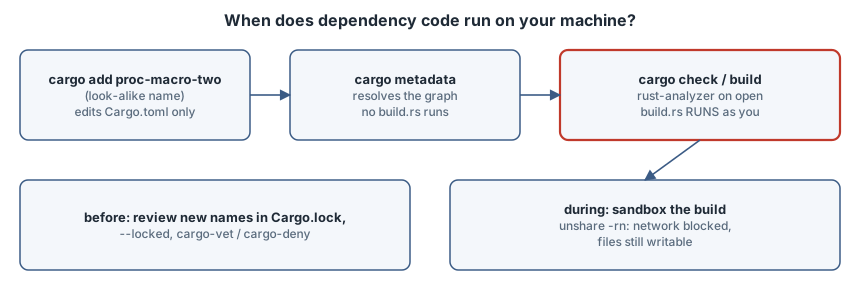
cargo metadatadidn’t run it. Resolving the dependency graph is safe, so the marker file doesn’t exist yet.cargo checkran it, even thoughcheckproduces no binary. The build script ran as uid 1000 (the developer), saw all 111 environment variables, reached1.1.1.1:443on the internet, and wrote/tmp/buildrs-was-here. A real attack would have sent the variables instead of counting them.- Editors do the same. rust-analyzer’s
rust-analyzer.cargo.buildScripts.enabledefaults totrue(“Run build scripts (build.rs) for more precise code analysis”), and proc-macro support implies it (configuration). Opening a cloned repository in your editor can be enough. - A namespace sandbox is partial. Under
unshare -rn(a new user namespace mapping you to uid 0, plus an empty network namespace), the connection fails withNetwork is unreachable. The script still read the environment and still wrote to/tmpon the host. To contain the filesystem too, you need a container or VM with only the source tree mounted, or a dedicated build user.
Defences, in order of payoff
- Watch what enters
Cargo.lock. Most attacks need a new package name: a typo, a look-alike, or a dependency confusion. Review lockfile diffs in PRs like code, and build in CI withcargo build --lockedso nothing is resolved silently. - Audit before you trust. cargo-vet records which crate versions “have been audited by a trusted entity” and fails CI for unaudited ones. cargo-deny can ban crates, restrict sources to crates.io or known git hosts, and check RustSec advisories.
- Vendor for hermetic builds.
cargo vendorplus--offlinemakes the build use exactly the reviewed sources. - Sandbox untrusted builds, including the first build of a cloned repository and any editor session in one. Cut both the network and the host filesystem, as the namespace experiment above shows.
- Keep secrets out of build environments. A build job that doesn’t need a publish token shouldn’t have one. Everything in
env::vars()is readable by every build script in the graph.
Takeaways
build.rsand proc macros run at build time, as you, with full access.cargo checkand your editor trigger them, whilecargo metadatadoesn’t.- A look-alike name is the whole attack. Lockfile review,
--locked, and cargo-vet or cargo-deny stop it before it builds. - Sandboxes have to cover the network and the filesystem:
unshare -rnalone left the host file write intact.
Sources
- Cargo reference: Build Scripts (including
cargo::warning=MESSAGE),cargo vendor,--locked - rust-analyzer configuration
- cargo-vet, cargo-deny
unshare(1): https://man7.org/linux/man-pages/man1/unshare.1.html