async fn in Traits vs dyn Trait: Desugaring, Send Bounds and Boxing
async fn in Traits vs dyn Trait: Desugaring, Send Bounds and Boxing
Thesis
Since Rust 1.75 you can write async fn directly inside a trait. That works well for static dispatch. It stops working at two points that every library author eventually reaches:
dyn Trait. A trait with anasync fnis not dyn compatible, soBox<dyn Store>is a compile error.Send. The future thatasync fnreturns has a hidden type, and callers can’t add+ Sendto it. Generic code that spawns onto a multi-threaded runtime therefore can’t prove the future is thread-safe.
Both problems come from the same desugaring: async fn get(&self) -> u32 means fn get(&self) -> impl Future<Output = u32>. Each implementor returns its own, differently sized state machine. A vtable can’t hold “a function returning some unknown-size type”, and a bound you never wrote can’t be assumed.
This chapter reproduces all three compiler diagnostics on rustc 1.99.1 and fixes them with two moves: desugar by hand to add + Send, then add a boxed, dyn-compatible twin trait. The dynosaur and async-trait crates automate the same boxing. Everything here uses only std, including a ten-line block_on, so you can run it without Tokio.
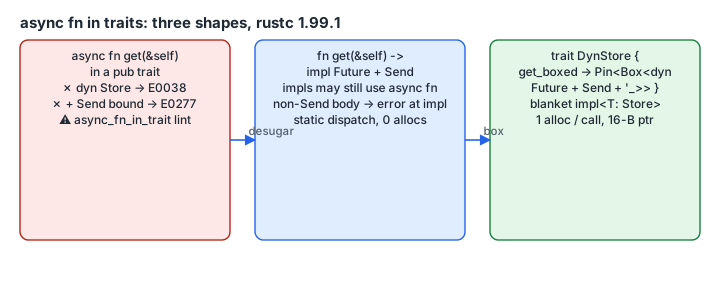
Failure 1: dyn Store is rejected
pub trait Store {
    async fn get(&self, key: u32) -> u32;
}
struct Mem;
impl Store for Mem {
    async fn get(&self, key: u32) -> u32 { key * 2 }
}
fn main() {
    let stores: Vec<Box<dyn Store>> = vec![Box::new(Mem)];
    let _ = stores;
}
rustc --edition 2024 dynfail.rs gives:
error[E0038]: the trait `Store` is not dyn compatible
 --> dynfail.rs:9:29
  |
9 |     let stores: Vec<Box<dyn Store>> = vec![Box::new(Mem)];
  |                             ^^^^^ `Store` is not dyn compatible
  |
note: for a trait to be dyn compatible it needs to allow building a vtable
      for more information, visit <https://doc.rust-lang.org/reference/items/traits.html#dyn-compatibility>
 --> dynfail.rs:2:14
  |
1 | pub trait Store {
  |           ----- this trait is not dyn compatible...
2 |     async fn get(&self, key: u32) -> u32;
  |              ^^^ ...because method `get` is `async`
  = help: consider moving `get` to another trait
  = help: only type `Mem` implements `Store` within this crate; consider using it directly instead.
The reference’s dyn-compatibility rules list “not an async fn” among the requirements for a dispatchable method, and also exclude methods that return impl Trait. Every method in a vtable has to have one concrete signature. Mem::get returns one anonymous future type and another implementor returns a different one with a different size, so no single function-pointer type fits both.
Failure 2: callers can’t require Send
use std::future::Future;
pub trait Store { async fn get(&self, key: u32) -> u32; }
fn require_send<F: Future + Send>(f: F) -> F { f }
async fn use_any<S: Store + Sync>(s: &S) -> u32 { require_send(s.get(1)).await }
error[E0277]: `impl Future<Output = u32>` cannot be sent between threads safely
--> sendfail.rs:4:64
|
4 | async fn use_any<S: Store + Sync>(s: &S) -> u32 { require_send(s.get(1)).await }
| ------------ ^^^^^^^^ `impl Future<Output = u32>` cannot be sent between threads safely
| |
| required by a bound introduced by this call
|require_send stands in for tokio::spawn, which demands F: Send + 'static. Even though S: Sync, the trait never promised that get’s future is Send, and the compiler won’t infer it for an unknown S. Concrete calls such as Mem.get(1) do pass, because there the compiler can see the actual future type. That is why this bug tends to appear only once the code becomes generic.
The compiler’s own warning
Compiling the same trait as a library makes the compiler warn you before any caller hits the problem:
warning: use of `async fn` in public traits is discouraged as auto trait bounds cannot be specified
 --> lint.rs:2:5
  |
2 |     async fn get(&self, key: u32) -> u32;
  |     ^^^^^
  |
  = note: you can suppress this lint if you plan to use the trait only in your own code, or do not care about auto traits like `Send` on the `Future`
  = note: `#[warn(async_fn_in_trait)]` on by default
help: you can alternatively desugar to a normal `fn` that returns `impl Future` and add any desired bounds such as `Send`, but these cannot be relaxed without a breaking API change
  |
2 -     async fn get(&self, key: u32) -> u32;
2 +     fn get(&self, key: u32) -> impl std::future::Future<Output = u32> + Send;
  |
The async_fn_in_trait lint fires only for public traits, because the problem belongs to downstream users. The suggestion it prints is fix number one.
Fix 1: desugar and promise Send
pub trait Store {
    fn get(&self, key: u32) -> impl Future<Output = u32> + Send;
}
impl Store for Mem {
    async fn get(&self, key: u32) -> u32 { key * 2 }   // still allowed
}
The trait author writes the return-position impl Trait (RPITIT) form. Implementors can keep writing async fn, which the stabilisation announcement explicitly allows. The Send promise is now enforced at the impl. An implementor that holds an Rc across an .await gets an error at its own definition, not somewhere far away in a caller:
error: future cannot be sent between threads safely
  --> notsend.rs:30:38
   |
30 |     async fn get(&self, key: u32) -> u32 {
   |                                      ^^^ future returned by `get` is not `Send`
   |
   = help: within `impl Future<Output = u32>`, the trait `Send` is not implemented for `Rc<u32>`
note: future is not `Send` as this value is used across an await
  --> notsend.rs:32:32
   |
31 |         let rc = std::rc::Rc::new(key);
   |             -- has type `Rc<u32>` which is not `Send`
32 |         std::future::ready(()).await;
   |                                ^^^^^ await occurs here, with `rc` maybe used later
The lint’s note is worth taking seriously: this is a one-way door. Adding + Send later breaks implementors whose futures aren’t Send. Removing it later breaks callers that relied on it. Decide before you publish 1.0. If you need both flavours, the announcement post points to the trait-variant crate, which generates a Send variant from a local trait.
Fix 2: a boxed, dyn-compatible twin
To get dynamic dispatch, give the vtable a single concrete return type. Boxing the future as a Pin<Box<dyn Future>> does exactly that:
pub type BoxFut<'a, T> = Pin<Box<dyn Future<Output = T> + Send + 'a>>;
pub trait DynStore: Send + Sync {
    fn get_boxed(&self, key: u32) -> BoxFut<'_, u32>;
}
// Blanket impl: every Store is automatically a DynStore.
impl<T: Store + Send + Sync> DynStore for T {
    fn get_boxed(&self, key: u32) -> BoxFut<'_, u32> {
        Box::pin(self.get(key))
    }
}
The blanket impl means implementors write impl Store only once, and every Store becomes a DynStore for free. dynosaur automates the same boxing from an attribute such as #[dynosaur::dynosaur(DynStore = dyn(box) Store)], though it generates a wrapper type rather than a twin trait. async-trait takes the older route of rewriting the original trait so that every method returns a boxed future, which means it allocates even under static dispatch.
Running it with nothing but std
The futures in this example never return Pending, so a busy-poll loop with Waker::noop is a complete executor for them. It is not a real runtime. It only keeps the example free of dependencies.
// Static dispatch: zero boxing, monomorphised per S.
async fn sum_static<S: Store>(s: &S) -> u32 { s.get(1).await + s.get(2).await }

// Dynamic dispatch: one heap allocation per call.
async fn sum_dyn(stores: &[Box<dyn DynStore>]) -> u32 {
    let mut total = 0;
    for s in stores { total += s.get_boxed(10).await; }
    total
}

fn require_send<F: Future + Send>(f: F) -> F { f }

// Minimal executor: these futures never pend, so a no-op waker is enough.
fn block_on<F: Future>(f: F) -> F::Output {
    let mut f = std::pin::pin!(f);
    let mut cx = Context::from_waker(Waker::noop());
    loop {
        if let Poll::Ready(v) = f.as_mut().poll(&mut cx) { return v; }
    }
}

fn main() {
    println!("static Mem: {}", block_on(sum_static(&Mem)));
    let stores: Vec<Box<dyn DynStore>> = vec![Box::new(Mem), Box::new(Offset(5))];
    println!("dyn [Mem, Offset(5)]: {}", block_on(sum_dyn(&stores)));
    // The Send bound now holds for generic callers and across threads:
    let h = std::thread::spawn(move || block_on(require_send(sum_dyn(&stores))));
    println!("dyn on another thread: {}", h.join().unwrap());
    println!("size_of BoxFut = {} bytes (fat pointer)", std::mem::size_of::<BoxFut<'static, u32>>());
}
rustc --edition 2024 -O fixed.rs && ./fixed on rustc 1.99.1:
static Mem: 6
dyn [Mem, Offset(5)]: 35
dyn on another thread: 35
size_of BoxFut = 16 bytes (fat pointer)
All three paths work, including handing the whole Vec<Box<dyn DynStore>> to another thread through require_send. The 16 bytes are the box’s data pointer plus its vtable pointer.
Choosing between them
| Need | Use | Cost |
|---|---|---|
| Private trait, static dispatch only | plain async fn (silence the lint) |
none |
| Public trait used with multi-threaded runtimes | fn … -> impl Future + Send |
locks in Send for all implementors |
Heterogeneous collections, plugins, dyn |
boxed twin trait by hand, or dynosaur |
one heap allocation and an indirect call per invocation |
| Pre-1.75 compiler, or every method boxed anyway | async-trait |
allocates even with static dispatch |
The boxing cost is a heap allocation per call, not per object. In an I/O-bound service that is noise next to a syscall. In a tight loop of in-memory lookups it may not be, so measure it before building the hot path on dyn. I didn’t benchmark it here.
Takeaways
async fnin a trait is sugar for-> impl Future. Both its dyn incompatibility and its missingSendfollow directly from that hidden, per-impl return type.- For public traits, write the desugared form with
+ Send. That moves the error to the implementor that caused it. - Get
dynby boxing the future in a second trait with a blanket impl, and keep the zero-cost trait for generic code. - The
+ Senddecision is part of your semver contract.