The Newtype Pattern: Zero-Cost Type Safety, Validated Values and the Orphan Rule
The Newtype Pattern: Zero-Cost Type Safety, Validated Values and the Orphan Rule
Thesis
A newtype is a tuple struct with one field: struct AccountId(u64);. It costs nothing at runtime, because it has the same size and alignment as what it wraps, but it is a different type to the compiler. That one property gives you three tools:
- Values with the same representation can no longer be mixed up. Account IDs, amounts, metres and seconds all stop being “just a
u64”. - A private field plus a validating constructor means that holding the type is proof the value was checked.
- A local wrapper lets you implement a foreign trait for a foreign type, which the orphan rule otherwise forbids.
This chapter demonstrates each one with compiler output from rustc 1.99.1, and shows where #[repr(transparent)] becomes necessary rather than optional.
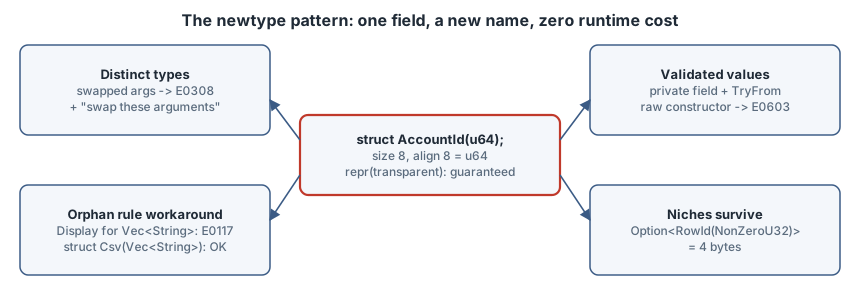
All listings come from one Cargo package (edition 2024). Each one is a binary under src/bin/. The *_bug.rs files fail to compile on purpose.
1. The swapped-argument bug
// Two IDs with the same representation: the compiler cannot tell them apart.
fn transfer(from_account: u64, to_account: u64, cents: u64) {
    println!("move {cents} cents from {from_account} to {to_account}");
}

#[derive(Clone, Copy, Debug, PartialEq, Eq, Hash)]
struct AccountId(u64);
#[derive(Clone, Copy, Debug, PartialEq, Eq, Hash)]
struct Cents(u64);

fn transfer_typed(from: AccountId, to: AccountId, amount: Cents) {
    println!("move {} cents from {} to {}", amount.0, from.0, to.0);
}

fn main() {
    let (alice, bob) = (1001_u64, 2002_u64);
    transfer(alice, 500, bob); // compiles; bob's id is now the amount

    let (alice, bob) = (AccountId(1001), AccountId(2002));
    transfer_typed(alice, bob, Cents(500));
}
$ cargo run -q --bin swapped
move 2002 cents from 1001 to 500
move 500 cents from 1001 to 2002The first call moves 2002 cents to account 500. Every argument is a u64, so nothing could catch the mistake. Here is the same mistake with newtypes:
#[derive(Clone, Copy, Debug)]
struct AccountId(u64);
#[derive(Clone, Copy, Debug)]
struct Cents(u64);

fn transfer_typed(from: AccountId, to: AccountId, amount: Cents) {
    println!("{from:?} {to:?} {amount:?}");
}

fn main() {
    let (alice, bob) = (AccountId(1001), AccountId(2002));
    transfer_typed(alice, Cents(500), bob);
}
$ cargo build -q --bin swapped_typed_bug
error[E0308]: arguments to this function are incorrect
--> src/bin/swapped_typed_bug.rs:12:5
|
12 | transfer_typed(alice, Cents(500), bob);
| ^^^^^^^^^^^^^^ ---------- --- expected `Cents`, found `AccountId`
| |
| expected `AccountId`, found `Cents`
|
note: function defined here
--> src/bin/swapped_typed_bug.rs:6:4
|
6 | fn transfer_typed(from: AccountId, to: AccountId, amount: Cents) {
| ^^^^^^^^^^^^^^
help: swap these arguments
|
12 - transfer_typed(alice, Cents(500), bob);
12 + transfer_typed(alice, bob, Cents(500));
|The compiler rejects the call and even suggests the fix. Deriving Clone, Copy, Debug, PartialEq, Eq, Hash keeps IDs as convenient as plain integers in hash maps and comparisons. Leave out Add and the other arithmetic traits unless the operation makes sense: adding two account IDs never does. The Rust API Guidelines list this as C-NEWTYPE: “Newtypes provide static distinctions”.
2. Zero cost, and what repr(transparent) adds
use std::mem::{align_of, size_of};

#[allow(dead_code)]
struct Meters(f64);
#[allow(dead_code)]
#[repr(transparent)]
struct UserId(u32);
#[allow(dead_code)]
struct RowId(std::num::NonZeroU32);

fn main() {
    println!("f64: size {} align {}", size_of::<f64>(), align_of::<f64>());
    println!("Meters: size {} align {}", size_of::<Meters>(), align_of::<Meters>());
    println!("Option<u32>: size {}", size_of::<Option<u32>>());
    println!("Option<UserId>: size {}", size_of::<Option<UserId>>());
    println!("Option<std::num::NonZeroU32>: size {}", size_of::<Option<std::num::NonZeroU32>>());
    println!("Option<RowId>: size {}", size_of::<Option<RowId>>());
    println!("[UserId; 1000]: size {}", size_of::<[UserId; 1000]>());
}
$ cargo run -q --bin zero_cost
f64: size 8 align 8
Meters: size 8 align 8
Option<u32>: size 8
Option<UserId>: size 8
Option<std::num::NonZeroU32>: size 4
Option<RowId>: size 4
[UserId; 1000]: size 4000Metershas the same size and alignment asf64, and an array of 1000UserIds is exactly 4000 bytes. There is no header and no tag.- Niches survive the wrapper.
Option<RowId>is 4 bytes becauseRowIdwrapsNonZeroU32, and the compiler reuses the forbidden zero asNone.Option<UserId>over a plainu32has no niche, so it needs the extra discriminant and is 8 bytes.
What you measure for a default-representation (repr(Rust)) struct is not a promise. The Reference’s type-layout chapter gives repr(Rust) very few guarantees. #[repr(transparent)] is the attribute that guarantees “the same layout and ABI as the only non-size 0 non-alignment 1 field”. You need it whenever unsafe code or FFI depends on the layout:
// #[repr(transparent)] guarantees UserId has the same layout and ABI as u32,
// so a &[u32] from storage or FFI can be viewed as &[UserId] without copying.
#[derive(Debug, Clone, Copy, PartialEq, Eq)]
#[repr(transparent)]
struct UserId(u32);

fn as_user_ids(raw: &[u32]) -> &[UserId] {
    // SAFETY: UserId is repr(transparent) over u32, so size, alignment and
    // validity are identical; the lifetime is carried over from `raw`.
    unsafe { std::slice::from_raw_parts(raw.as_ptr().cast::<UserId>(), raw.len()) }
}

fn main() {
    let raw = vec![7_u32, 42, 99];
    let ids = as_user_ids(&raw);
    println!("{ids:?}");
    println!("same address: {}", raw.as_ptr() as usize == ids.as_ptr() as usize);
}
$ cargo run -q --bin transparent
[UserId(7), UserId(42), UserId(99)]
same address: trueWithout #[repr(transparent)], this cast would be relying on layout the language doesn’t promise. With it, a &[u32] from a file, a database page or a C library becomes a typed &[UserId] with no copy (same address: true). The Nomicon describes the same rule for passing newtypes across extern "C" boundaries.
3. Validated values: parse, don’t re-check
// A newtype whose only constructor validates: holding an Email *proves* it was checked.
mod email {
    #[derive(Debug, Clone, PartialEq, Eq)]
    pub struct Email(String); // private field: no Email("junk".into()) outside this module

    #[derive(Debug)]
    pub struct InvalidEmail(pub String);

    impl TryFrom<String> for Email {
        type Error = InvalidEmail;
        fn try_from(s: String) -> Result<Self, Self::Error> {
            match s.split_once('@') {
                Some((user, host)) if !user.is_empty() && host.contains('.') => {
                    Ok(Email(s.to_ascii_lowercase()))
                }
                _ => Err(InvalidEmail(s)),
            }
        }
    }

    impl AsRef<str> for Email {
        fn as_ref(&self) -> &str {
            &self.0
        }
    }
}

use email::Email;

fn send_welcome(to: &Email) {
    println!("sending to {}", to.as_ref());
}

fn main() {
    for raw in ["Ada@Example.org", "no-at-sign", "@example.org", "bob@localhost"] {
        match Email::try_from(raw.to_string()) {
            Ok(e) => send_welcome(&e),
            Err(err) => println!("rejected: {:?}", err.0),
        }
    }
}
$ cargo run -q --bin validated
sending to ada@example.org
rejected: "no-at-sign"
rejected: "@example.org"
rejected: "bob@localhost"The field is private, so outside mod email the only way to get an Email is TryFrom, which validates it and normalises it to lower case. send_welcome(&Email) has no reason to check again. Trying to bypass the constructor fails:
mod email {
    #[derive(Debug)]
    pub struct Email(String);
}

fn main() {
    let e = email::Email("not an email".to_string());
    println!("{e:?}");
}
$ cargo build -q --bin validated_bug
error[E0603]: tuple struct constructor `Email` is private
--> src/bin/validated_bug.rs:7:20
|
3 | pub struct Email(String);
| ------ a constructor is private if any of the fields is private
...
7 | let e = email::Email("not an email".to_string());
| ^^^^^ private tuple struct constructor
|
note: the tuple struct constructor `Email` is defined here
--> src/bin/validated_bug.rs:3:5
|
3 | pub struct Email(String);
| ^^^^^^^^^^^^^^^^^^^^^^^^^
help: consider making the field publicly accessible
|
3 | pub struct Email(pub String);
| +++The compiler’s help suggests pub String. In this case that is the wrong fix, because it would let anyone build an unvalidated Email. The privacy is the whole point.
The validation here is deliberately small. Real email validation belongs in a dedicated crate. The pattern stays the same whatever rule you plug in.
4. Getting around the orphan rule
You can’t implement a trait from another crate (Display) for a type from another crate (Vec<String>):
use std::fmt;

impl fmt::Display for Vec<String> {
    fn fmt(&self, f: &mut fmt::Formatter<'_>) -> fmt::Result {
        write!(f, "{}", self.join(","))
    }
}

fn main() {}
$ cargo build -q --bin orphan_bug
error[E0117]: only traits defined in the current crate can be implemented for types defined outside of the crate
--> src/bin/orphan_bug.rs:3:1
|
3 | impl fmt::Display for Vec<String> {
| ^^^^^^^^^^^^^^^^^^^^^^-----------
| |
| `Vec` is not defined in the current crate
|
= note: impl doesn't have any local type before any uncovered type parameters
= note: for more information see https://doc.rust-lang.org/reference/items/implementations.html#orphan-rules
= note: define and implement a trait or new type insteadThe last note gives the fix, “define and implement a trait or new type instead”:
use std::fmt;

// impl fmt::Display for Vec<String> { ... }  // E0117: only traits defined in
// the current crate can be implemented for types defined outside of the crate

struct Csv(Vec<String>);

impl fmt::Display for Csv {
    fn fmt(&self, f: &mut fmt::Formatter<'_>) -> fmt::Result {
        write!(f, "{}", self.0.join(","))
    }
}

fn main() {
    let row = Csv(vec!["id".into(), "name".into(), "email".into()]);
    println!("{row}");
}
$ cargo run -q --bin orphan
id,name,emailThe Book presents exactly this use. The orphan rules exist so that two crates can never provide conflicting impls of the same trait for the same type.
Pitfalls
Derefas inheritance.impl Deref<Target = String> for Emailmakesemail.len()work, but it also adds everyStringmethod to theEmailAPI, andemail.to_uppercase()quietly returns a plainString. ImplementAsRef<str>and the few methods you actually mean.DerefMutbreaks validation. It lets callers write*email = "junk".into()and skipTryFromaltogether.pubfields remove validation the same way (section 3).- Boilerplate. Each trait you want, such as
Display,FromStr,serde, or arithmetic for units, has to be derived or forwarded.#[derive]covers the standard traits, and#[serde(transparent)]serialises the newtype as its inner value. Write impls by hand where the semantics differ, as withCents * Cents.
Takeaways
- A single-field tuple struct is a new type at compile time and nothing at runtime: same size and alignment, and niches are preserved.
- Use newtypes for IDs and units so that swapped arguments become
E0308errors. - A private field plus
TryFromturns “was this validated?” into a type-level fact. - Add
#[repr(transparent)]as soon asunsafecode or FFI relies on the layout. - A wrapper is the standard answer to
E0117.
Sources
- The Rust Book, Using the Newtype Pattern to Implement External Traits and Advanced Types
- Rust API Guidelines, C-NEWTYPE
- The Rust Reference, Type layout: the transparent representation and Orphan rules
- The Rustonomicon, Alternative representations
- std docs,
NonZeroandOptionrepresentation