Cancel Safety: Dropping a Future Is Cancelling It
Cancel Safety: Dropping a Future Is Cancelling It
Thesis
Async Rust has one universal cancellation protocol, and it is very easy to trigger: drop the future. A future is an inert state machine that only advances when it is polled. Once it is dropped it never runs again, and it stops at whichever .await it was parked on. You don’t need to call drop yourself. tokio::select! drops every branch that loses, tokio::time::timeout drops the future when the deadline fires, and try_join! drops the siblings of the first error. Because parents own their children, cancellation propagates down the whole call tree.
That makes two different questions worth asking about every .await:
- Cancel safety is a local property of one future: if I drop it before it completes and create it again, is that a no-op?
mpsc::Receiver::recvpasses.read_exactandSender::send(msg)fail. - Cancel correctness is a property of the whole system: if this future is dropped here, is any invariant, message, or cleanup lost? Dropping a cancel-unsafe future is a bug only when it breaks something you care about. Losing a half-read frame during shutdown is fine. Losing it in a
select!loop is not.
This chapter reproduces the four bug shapes behind most production cancellation incidents and fixes each one. The fixes follow Rain’s “Cancelling Async Rust” (RustConf 2025) and Tokio’s own cancel-safety documentation.
Mental model
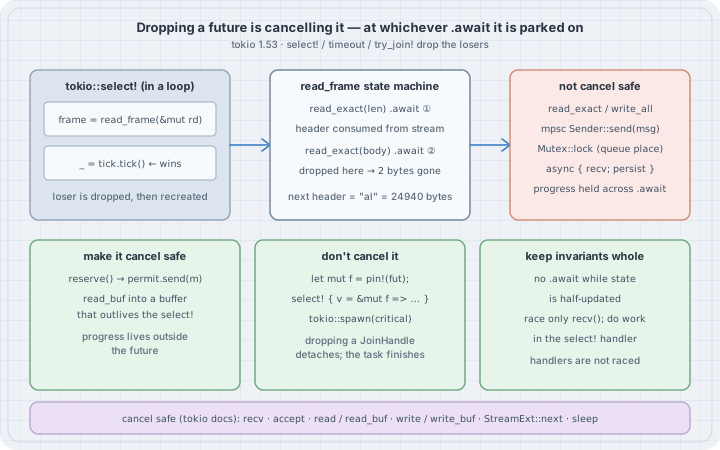
A future can only be cancelled at an .await, because that is the only place it gives control back. So the audit question for any async fn is concrete: at each .await, what has this future already done that would be lost or left half-done if it never resumed?
| Operation (Tokio 1.53) | Cancel safe? | What a drop loses |
|---|---|---|
mpsc::Receiver::recv, broadcast::Receiver::recv, watch::Receiver::changed |
yes | nothing |
TcpListener::accept, AsyncReadExt::read / read_buf, AsyncWriteExt::write / write_buf |
yes | nothing (no data was read or written) |
tokio::time::sleep, StreamExt::next |
yes | nothing |
AsyncReadExt::read_exact, read_to_end, read_to_string |
no | bytes already read into the future’s buffer |
AsyncWriteExt::write_all |
no | how much was written |
mpsc::Sender::send(msg) |
no | msg itself, which moved into the future |
Mutex::lock, RwLock::read/write, Semaphore::acquire, Notify::notified, Sender::reserve |
partially | your place in a fair queue |
async { a.await; b.await } built from cancel-safe parts |
no | whatever a produced |
Worked examples
Everything below was built and run with rustc/cargo 1.85.1 (the distro toolchain on the box) and Tokio 1.53.3, the current release on crates.io, with edition 2024. The current stable Rust is 1.99.1. Nothing in this chapter changes between the two. Each case uses Tokio’s paused clock (start_paused = true, from the test-util feature), so timers fire in virtual time and every run prints the same thing.
cargo new --vcs none cancel && cd cancel
rm src/main.rs && mkdir -p src/bin
# Cargo.toml
[package]
name = "cancel"
version = "0.1.0"
edition = "2024"
rust-version = "1.85"
[dependencies]
tokio = { version = "1.53.3", features = ["rt", "macros", "time", "sync", "io-util", "test-util"] }Case 1: A future is a value, and dropping it cancels it
// src/bin/case1.rs — a future is a value; dropping it is cancelling it.
use std::time::Duration;
use tokio::time::{sleep, timeout};

struct Guard(&'static str);
impl Drop for Guard {
    fn drop(&mut self) {
        println!("  drop: {}", self.0);
    }
}

async fn three_steps() -> &'static str {
    let _g = Guard("three_steps locals");
    println!("  step 1");
    sleep(Duration::from_millis(10)).await;
    println!("  step 2");
    sleep(Duration::from_millis(10)).await; // cancelled while parked here
    println!("  step 3");
    "done"
}

#[tokio::main(flavor = "current_thread", start_paused = true)]
async fn main() {
    println!("create the future:");
    let fut = three_steps(); // nothing runs yet: futures are inert
    println!("  (nothing printed: not polled)");

    println!("await with a 15 ms timeout:");
    match timeout(Duration::from_millis(15), fut).await {
        Ok(v) => println!("  finished: {v}"),
        Err(_) => println!("  timed out: future was dropped at an .await"),
    }
}
cargo run -q --bin case1create the future:
(nothing printed: not polled)
await with a 15 ms timeout:
step 1
step 2
drop: three_steps locals
timed out: future was dropped at an .awaitCreating the future ran nothing. timeout polled it through step 1, through the first sleep, and into step 2. At 15 ms it dropped the future while it was parked on the second sleep. Locals are dropped normally (the Guard runs), but step 3 and everything after it never happen. No exception or error reaches the future. It is simply never polled again.
Case 2: send under a timeout loses the message, reserve does not
The channel holds one message, and the consumer needs 25 ms per message. The producer gives each send 10 ms.
// src/bin/case2.rs — `send` under a timeout loses the message; `reserve` doesn't.
use std::time::Duration;
use tokio::sync::mpsc;
use tokio::time::{sleep, timeout};

struct Msg {
    id: u32,
    delivered: bool,
}
fn msg(id: u32) -> Msg {
    Msg { id, delivered: false }
}
impl Drop for Msg {
    fn drop(&mut self) {
        if !self.delivered {
            println!("    (Msg {} dropped undelivered)", self.id);
        }
    }
}

/// A consumer that takes 25 ms per message; the channel holds one.
fn slow_consumer(mut rx: mpsc::Receiver<Msg>) -> tokio::task::JoinHandle<Vec<u32>> {
    tokio::spawn(async move {
        let mut got = Vec::new();
        while let Some(mut m) = rx.recv().await {
            m.delivered = true;
            got.push(m.id);
            sleep(Duration::from_millis(25)).await;
        }
        got
    })
}

#[tokio::main(flavor = "current_thread", start_paused = true)]
async fn main() {
    println!("send(msg) inside timeout(10 ms):");
    let (tx, rx) = mpsc::channel::<Msg>(1);
    let consumer = slow_consumer(rx);
    for i in 1..=4 {
        match timeout(Duration::from_millis(10), tx.send(msg(i))).await {
            Ok(Ok(())) => println!("  sent {i}"),
            Ok(Err(_)) => return,
            Err(_) => println!("  timeout on {i}"),
        }
    }
    drop(tx);
    let got: Vec<u32> = consumer.await.unwrap();
    println!("  consumer received {got:?}");

    println!("reserve() inside timeout(10 ms), message built after:");
    let (tx, rx) = mpsc::channel::<Msg>(1);
    let consumer = slow_consumer(rx);
    let mut next = 1;
    while next <= 4 {
        match timeout(Duration::from_millis(10), tx.reserve()).await {
            Ok(Ok(permit)) => {
                permit.send(msg(next)); // synchronous, cannot be cancelled
                println!("  sent {next}");
                next += 1;
            }
            Ok(Err(_)) => return,
            Err(_) => println!("  timeout waiting for a slot; {next} still ours"),
        }
    }
    drop(tx);
    let got: Vec<u32> = consumer.await.unwrap();
    println!("  consumer received {got:?}");
}
cargo run -q --bin case2send(msg) inside timeout(10 ms):
sent 1
sent 2
(Msg 3 dropped undelivered)
timeout on 3
(Msg 4 dropped undelivered)
timeout on 4
consumer received [1, 2]
reserve() inside timeout(10 ms), message built after:
sent 1
sent 2
timeout waiting for a slot; 3 still ours
timeout waiting for a slot; 3 still ours
sent 3
timeout waiting for a slot; 4 still ours
timeout waiting for a slot; 4 still ours
sent 4
consumer received [1, 2, 3, 4]tx.send(msg) takes the message by value, so the message lives inside the send future. When timeout drops that future, the message is dropped with it. Tokio documents exactly this: “the message was not sent. However, in that case, the message is dropped and will be lost.” Messages 3 and 4 disappear, and nothing reports an error.
reserve() splits the operation in two. Waiting for capacity is the only .await, and it holds no message. permit.send(msg) is a synchronous call that cannot be cancelled. The message is built after the slot is secured, so a timeout leaves it in the producer’s hands, and all four arrive. (reserve is not perfectly cancel safe: dropping it gives up your place in the channel’s FIFO queue of waiting senders. If that matters, pin the reserve future and poll it by &mut, as in Case 3b.)
Case 3: A select! loop over read_exact corrupts a framed stream
A peer sends length-prefixed frames, and the header and body arrive 15 ms apart. The reader also wants a 10 ms tick, so it uses select! in a loop. That is the shape Tokio’s documentation warns about.
// src/bin/case3.rs — a select! loop over read_exact loses bytes mid-frame;
// a persistent buffer filled by the cancel-safe read_buf does not.
use std::time::Duration;
use tokio::io::{AsyncRead, AsyncReadExt, AsyncWriteExt, DuplexStream, duplex};
use tokio::time::{interval, sleep};

/// Peer: 2-byte big-endian length, then payload, with a pause in between.
async fn peer(mut w: DuplexStream) {
    for word in ["alpha", "bravo", "charlie"] {
        w.write_all(&(word.len() as u16).to_be_bytes()).await.unwrap();
        sleep(Duration::from_millis(15)).await; // header and body arrive apart
        w.write_all(word.as_bytes()).await.unwrap();
    }
}

/// Not cancel safe: two read_exact calls, two places to be dropped.
async fn read_frame<R: AsyncRead + Unpin>(r: &mut R) -> std::io::Result<String> {
    let mut len = [0u8; 2];
    r.read_exact(&mut len).await?;
    let n = u16::from_be_bytes(len) as usize;
    println!("    header says {n} bytes");
    let mut body = vec![0u8; n];
    r.read_exact(&mut body).await?;
    Ok(String::from_utf8_lossy(&body).into_owned())
}

/// Pop one complete frame from the front of `buf`, if there is one.
fn parse_frame(buf: &mut Vec<u8>) -> Option<String> {
    if buf.len() < 2 {
        return None;
    }
    let n = u16::from_be_bytes([buf[0], buf[1]]) as usize;
    if buf.len() < 2 + n {
        return None;
    }
    let body: Vec<u8> = buf.drain(..2 + n).skip(2).collect();
    Some(String::from_utf8_lossy(&body).into_owned())
}

#[tokio::main(flavor = "current_thread", start_paused = true)]
async fn main() {
    println!("select! {{ read_frame(), tick }}:");
    let (mut rd, wr) = duplex(64);
    tokio::spawn(peer(wr));
    let mut tick = interval(Duration::from_millis(10));
    for _ in 0..8 {
        tokio::select! {
            f = read_frame(&mut rd) => match f {
                Ok(s) => println!("  frame {s:?}"),
                Err(e) => { println!("  error: {e}"); break; }
            },
            _ = tick.tick() => println!("  tick"),
        }
    }

    println!("select! {{ read_buf(&mut buf), tick }} + parse:");
    let (mut rd, wr) = duplex(64);
    tokio::spawn(peer(wr));
    let mut tick = interval(Duration::from_millis(10));
    let mut buf = Vec::with_capacity(64); // survives every cancellation
    let mut frames = 0;
    while frames < 3 {
        tokio::select! {
            n = rd.read_buf(&mut buf) => {
                if n.unwrap() == 0 { break; }
                while let Some(s) = parse_frame(&mut buf) {
                    println!("  frame {s:?}");
                    frames += 1;
                }
            }
            _ = tick.tick() => println!("  tick ({} bytes buffered)", buf.len()),
        }
    }
}
cargo run -q --bin case3select! { read_frame(), tick }:
tick
header says 5 bytes
tick
header says 24940 bytes
tick
tick
header says 25202 bytes
tick
header says 25448 bytes
error: early eof
select! { read_buf(&mut buf), tick } + parse:
tick (0 bytes buffered)
tick (2 bytes buffered)
frame "alpha"
tick (2 bytes buffered)
tick (2 bytes buffered)
frame "bravo"
tick (2 bytes buffered)
frame "charlie"In the first loop, read_frame gets past read_exact(&mut len), consuming the two header bytes from the stream, and is then parked on the body. The tick wins, so select! drops read_frame, and those two bytes go with it. The next iteration starts a new read_frame, which reads the first two body bytes "al" as a length: 0x616c = 24940. From there the stream is permanently out of sync. No frame is ever delivered, and the reader dies with early eof.
The second loop keeps its progress outside the future. read_buf is cancel safe (if it loses the race, no data was read). The bytes it does read land in buf, which lives in the loop, not in a future, and frames are parsed out of buf synchronously. A tick can interrupt as often as it likes, and the buffered bytes stay put (2 bytes buffered is a header waiting for its body).
Case 3b: Or don’t cancel at all: poll one future by &mut
The other remedy is to stop recreating the future. Pin one read_frame future outside the loop, race &mut frame against the tick, and only replace it once it has completed. Dropping a &mut reference cancels nothing. The function owns the reader and hands it back, so the finished future can be swapped for a new one with Pin::set.
// src/bin/case3b.rs — the other fix: don't cancel. Keep one frame future
// alive across loop iterations and poll it by `&mut`.
use std::pin::pin;
use std::time::Duration;
use tokio::io::{AsyncReadExt, AsyncWriteExt, DuplexStream, duplex};
use tokio::time::{interval, sleep};

async fn peer(mut w: DuplexStream) {
    for word in ["alpha", "bravo", "charlie"] {
        w.write_all(&(word.len() as u16).to_be_bytes()).await.unwrap();
        sleep(Duration::from_millis(15)).await;
        w.write_all(word.as_bytes()).await.unwrap();
    }
}

/// Owns the reader and hands it back, so a finished future can be replaced.
async fn read_frame(mut r: DuplexStream) -> (DuplexStream, std::io::Result<String>) {
    let mut len = [0u8; 2];
    if let Err(e) = r.read_exact(&mut len).await {
        return (r, Err(e));
    }
    let mut body = vec![0u8; u16::from_be_bytes(len) as usize];
    let res = r.read_exact(&mut body).await;
    (r, res.map(|_| String::from_utf8_lossy(&body).into_owned()))
}

#[tokio::main(flavor = "current_thread", start_paused = true)]
async fn main() {
    let (rd, wr) = duplex(64);
    tokio::spawn(peer(wr));
    let mut tick = interval(Duration::from_millis(10));
    let mut frame = pin!(read_frame(rd));
    let mut frames = 0;
    while frames < 3 {
        tokio::select! {
            (rd, f) = &mut frame => {
                println!("  frame {:?}", f.unwrap());
                frames += 1;
                frame.set(read_frame(rd)); // start the next one only now
            }
            _ = tick.tick() => println!("  tick (frame future kept)"),
        }
    }
}
cargo run -q --bin case3b tick (frame future kept)
tick (frame future kept)
frame "alpha"
tick (frame future kept)
tick (frame future kept)
frame "bravo"
tick (frame future kept)
frame "charlie"The same read_exact code that corrupted the stream in Case 3 is correct here, because it is never dropped mid-frame.
Case 4: Cancel correctness: an invariant broken across an .await
This is the shape of a real Oxide production bug. Shared state sits behind a Tokio mutex. An operation takes the value out (Option::take, leaving None), awaits some I/O, and puts the new value back. The invariant is “the slot is Some whenever the lock is free”.
// src/bin/case4.rs — cancel correctness: an invariant broken across an .await.
use std::sync::Arc;
use std::time::Duration;
use tokio::sync::Mutex;
use tokio::time::{sleep, timeout};

#[derive(Debug)]
struct Sled {
    generation: u32,
}

/// Invariant: `slot` is Some whenever the lock is not held.
type Shared = Arc<Mutex<Option<Sled>>>;

async fn upgrade(shared: Shared) {
    let mut slot = shared.lock().await;
    let sled = slot.take().expect("invariant: slot is Some");
    sleep(Duration::from_millis(20)).await; // talk to the sled: an .await
    *slot = Some(Sled { generation: sled.generation + 1 });
}

#[tokio::main(flavor = "current_thread", start_paused = true)]
async fn main() {
    println!("timeout(10 ms, upgrade()):");
    let shared: Shared = Arc::new(Mutex::new(Some(Sled { generation: 1 })));
    let r = timeout(Duration::from_millis(10), upgrade(shared.clone())).await;
    println!("  result: {}", if r.is_ok() { "done" } else { "timed out" });
    println!("  slot now: {:?}", *shared.lock().await);

    println!("timeout(10 ms, spawned upgrade task):");
    let shared: Shared = Arc::new(Mutex::new(Some(Sled { generation: 1 })));
    let task = tokio::spawn(upgrade(shared.clone()));
    let r = timeout(Duration::from_millis(10), task).await; // drops the JoinHandle
    println!("  result: {}", if r.is_ok() { "done" } else { "timed out (task keeps running)" });
    println!("  slot now: {:?}", *shared.lock().await); // waits for the task's guard
}
cargo run -q --bin case4timeout(10 ms, upgrade()):
result: timed out
slot now: None
timeout(10 ms, spawned upgrade task):
result: timed out (task keeps running)
slot now: Some(Sled { generation: 2 })The timeout dropped upgrade while it was parked on sleep, holding the lock with the slot empty. The guard’s destructor released the lock correctly. That made things worse, because the next caller can acquire it and find None, which panics on expect or silently forgets the sled. Every individual piece here is “safe”. The bug is in the composition.
The fix is to not let the caller cancel the critical section. tokio::spawn makes the runtime drive the work instead of the caller. The timeout around the JoinHandle still gives the caller its deadline. When the JoinHandle is dropped, the task is detached, not cancelled, so it runs to completion and restores the invariant (generation: 2). The structural fix is just as valid: don’t hold a half-updated state across an .await. Compute the new value first, then swap it in under the lock without awaiting.
The trap
Cancel-safe pieces don’t compose into a cancel-safe branch. recv() is on Tokio’s cancel-safe list, so a select! branch that “just receives and stores” looks fine:
// src/bin/trap.rs — cancel-safe pieces do not compose into a cancel-safe branch.
use std::time::Duration;
use tokio::sync::mpsc;
use tokio::time::{interval, sleep};

async fn persist(id: u32, log: &mut Vec<u32>) {
    sleep(Duration::from_millis(15)).await; // write to disk, say
    log.push(id);
}

async fn run(composite: bool) -> Vec<u32> {
    let (tx, mut rx) = mpsc::channel(8);
    for id in 1..=3 {
        tx.send(id).await.unwrap();
    }
    drop(tx);
    let mut log = Vec::new();
    let mut tick = interval(Duration::from_millis(10));
    tick.tick().await; // skip the immediate first tick
    loop {
        if composite {
            tokio::select! {
                // recv() is cancel safe; recv-then-persist is not.
                done = async {
                    let Some(id) = rx.recv().await else { return true };
                    persist(id, &mut log).await;
                    false
                } => if done { break },
                _ = tick.tick() => println!("  tick"),
            }
        } else {
            tokio::select! {
                // Only the cancel-safe recv races; the handler body is not raced.
                id = rx.recv() => match id {
                    Some(id) => persist(id, &mut log).await,
                    None => break,
                },
                _ = tick.tick() => println!("  tick"),
            }
        }
    }
    log
}

#[tokio::main(flavor = "current_thread", start_paused = true)]
async fn main() {
    println!("branch = async {{ recv().await; persist().await }}:");
    println!("  persisted {:?}", run(true).await);
    println!("branch = recv(), persist() in the handler:");
    println!("  persisted {:?}", run(false).await);
}
cargo run -q --bin trapbranch = async { recv().await; persist().await }:
tick
tick
tick
persisted []
branch = recv(), persist() in the handler:
tick
tick
tick
tick
persisted [1, 2, 3]The async { recv; persist } block is a new future with two .awaits. Once recv returns, the message lives inside that block, and the tick that wins during persist drops it. All three messages are received and none are persisted. The loop exits cleanly with an empty log. In the fixed version only rx.recv() races. select! handler bodies (the code after =>) are not raced against anything, so persist runs to completion. The tick is just delayed.
The same trap appears wherever you build a future and hand it to something that may drop it:
timeout(d, async { ... several awaits ... })try_join!(a(), b()), where one error drops the other mid-way (Oxide’s “stop all services” bug)- an HTTP framework that drops the handler future when the client disconnects
let _ = some_async_fn();without.await. The future is dropped immediately. Clippy’slet_underscore_futurelint catches this.
The boring rule
Treat every .await as a place where your future may stop forever. Race only cancel-safe operations in select! and timeout, and do the real work in the handler body. Keep progress (buffers, messages, half-built state) outside the future that might be dropped. Use reserve + permit.send, read_buf into a persistent buffer, or a future pinned outside the loop and polled by &mut. Never hold a broken invariant across an .await. Code that must finish goes in a tokio::spawned task, because dropping a JoinHandle detaches the task and doesn’t cancel it.
Try this
- In Case 2, replace
timeout(..., tx.reserve())with areservefuture pinned outside the loop and polled by&mutin aselect!against a 10 ms tick. Show that the producer keeps its place in the queue. - Rewrite Case 3’s reader as a task that owns the stream and sends complete frames over an
mpscchannel. Theselect!loop then races onlyrecv(), which is cancel safe. - In Case 4, keep the direct
upgradecall (nospawn) but restructure it so that the.awaithappens beforetake(). Does the timeout still break the invariant? - Wrap
write_allin atimeoutagainst aduplex(8)stream whose reader is slow. How many bytes did the peer receive when the timeout fired? Then switch towrite_all_bufwith aCursorthat outlives the timeout, and resume. - Audit one async fn in a codebase you own: list every
.awaitand write down what would be lost if the future stopped there.
Sources
- Tokio,
select!documentation, “Cancellation safety” (the lists in this chapter’s table): https://docs.rs/tokio/latest/tokio/macro.select.html#cancellation-safety - Tokio,
mpsc::Sender::sendandSender::reservecancel-safety notes: https://docs.rs/tokio/latest/tokio/sync/mpsc/struct.Sender.html - Tokio,
JoinHandle(“detaches the associated task when it is dropped”): https://docs.rs/tokio/latest/tokio/task/struct.JoinHandle.html - Tokio,
AsyncReadExt::read_bufandAsyncWriteExt::write_all_buf: https://docs.rs/tokio/latest/tokio/io/trait.AsyncReadExt.html, https://docs.rs/tokio/latest/tokio/io/trait.AsyncWriteExt.html - Tokio tutorial,
select!, “Cancellation” and “Resuming an async operation”: https://tokio.rs/tokio/tutorial/select - Rain (Oxide Computer Company), “Cancelling async Rust”, written version of the RustConf 2025 talk: https://sunshowers.io/posts/cancelling-async-rust/
- Oxide RFD 400, “Dealing with cancel safety in async Rust”: https://rfd.shared.oxide.computer/rfd/0400
- Rust standard library,
std::pin::pin!andPin::set: https://doc.rust-lang.org/std/pin/macro.pin.html, https://doc.rust-lang.org/std/pin/struct.Pin.html#method.set - Clippy lint
let_underscore_future: https://rust-lang.github.io/rust-clippy/master/index.html#let_underscore_future - Rust release channel manifest (stable 1.99.1, 2026-10-13): https://static.rust-lang.org/dist/channel-rust-stable.toml