Life before main: .init_array, #[used], and why LazyLock is usually the answer
Rust’s stated model is that nothing of yours runs before main. The platform disagrees. On ELF systems (Linux, the BSDs), the dynamic linker calls every function pointer stored in the .init_array section before control reaches the language runtime’s entry point. C++ static constructors and __attribute__((constructor)) use this mechanism, and the ctor crate brings it to Rust. This chapter does the same thing by hand in about 20 lines so you can see exactly what the crate is hiding. It also shows the one attribute whose absence makes the whole trick silently do nothing.
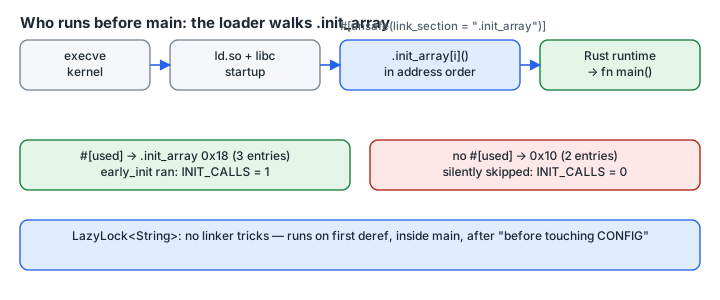
The mechanism, from the ELF spec
The System V gABI defines SHT_INIT_ARRAY as “an array of pointers to initialization functions”. Its dynamic-section chapter says those functions are executed by the dynamic linker in the order their addresses appear in the array. The .fini_array entries run in reverse order. So a constructor is nothing more than one pointer-sized value that lands in that section.
Rust gives you the two tools you need:
link_section“specifies the section of the object file that a function or static’s content will be placed into.”used“forces a static to be kept in the output object file … even if it’s never used or referenced by any other item in the crate.”
The whole program
// Life before main without crates: a function pointer placed in .init_array.
use std::sync::atomic::{AtomicU32, Ordering};

static INIT_CALLS: AtomicU32 = AtomicU32::new(0);

extern "C" fn early_init() {
    INIT_CALLS.fetch_add(1, Ordering::Relaxed);
    // Only use things that need no runtime setup: raw write(2) to stdout.
    let msg = b"[early_init] running before main\n";
    unsafe { libc_write(1, msg.as_ptr().cast(), msg.len()) };
}

unsafe extern "C" {
    #[link_name = "write"]
    fn libc_write(fd: i32, buf: *const core::ffi::c_void, n: usize) -> isize;
}

#[used]
#[unsafe(link_section = ".init_array")]
static EARLY_INIT: extern "C" fn() = early_init;

// A lazily-initialised alternative that needs no linker tricks.
static CONFIG: std::sync::LazyLock<String> = std::sync::LazyLock::new(|| {
    println!("[LazyLock] initialising on first use");
    "mode=fast".to_string()
});

fn main() {
    println!("main: INIT_CALLS = {}", INIT_CALLS.load(Ordering::Relaxed));
    println!("main: before touching CONFIG");
    println!("main: CONFIG = {}", *CONFIG);
    println!("main: CONFIG again = {}", *CONFIG);
}
Notes on the choices:
early_initisextern "C"because the loader calls it with the platform C ABI, not Rust’s ABI.- It calls only
write(2). Thectordocs give the rule plainly: constructor code “should be careful to limit itself to libc functions and code that does not rely on Rust’s stdlib services.”println!takes the stdout lock and touches a lazily set-upStdout. That happens to work on glibc today, but nothing promises it, so the constructor avoids it. - The
writedeclaration uses*const core::ffi::c_void. My first draft used*const u8, and rustc warned that this was a “suspicious definition of the runtimewritesymbol”, because it clashes with std’s own declaration of the same symbol. Match the C prototype exactly.
Real output (rustc 1.99.1, x86_64 Linux, glibc 2.41)
$ rustc --edition 2024 -O before.rs -o before && ./before
[early_init] running before main
main: INIT_CALLS = 1
main: before touching CONFIG
[LazyLock] initialising on first use
main: CONFIG = mode=fast
main: CONFIG again = mode=fast
The constructor ran once, before main’s first line. The LazyLock ran once, inside main, on first dereference, and not again on the second.
Drop #[used] and it silently disappears
Here is the same file with only the #[used] line removed:
$ rustc --edition 2024 -O nouse.rs -o nouse
warning: function `early_init` is never used
warning: static `EARLY_INIT` is never used
warning: function `libc_write` is never used
warning: 3 warnings emitted
$ ./nouse
main: INIT_CALLS = 0
main: before touching CONFIG
[LazyLock] initialising on first use
main: CONFIG = mode=fast
main: CONFIG again = mode=fast
It still compiles, it still runs, and the constructor is gone. The section headers show why:
$ readelf -S before | grep -A1 init_array
  [22] .init_array       INIT_ARRAY       0000000000050e48  0004ee48
       0000000000000018  0000000000000000 WAo       0     0     8
$ readelf -S nouse | grep -A1 init_array
  [22] .init_array       INIT_ARRAY       0000000000050db8  0004edb8
       0000000000000010  0000000000000000 WAo       0     0     8
Without #[used] the array holds 0x10 bytes (two 8-byte pointers that were already there, contributed by the C startup objects and the standard library — I did not trace which is which). With it, the array holds 0x18 bytes, so our entry is the third pointer. Nothing references EARLY_INIT, so the compiler treats it as dead and drops it. The only clue is the dead-code warning. If you treat warnings as noise, or #![allow(dead_code)] is set at crate level, nothing tells you.
Two more details from the reference: #[used] only keeps the item in the object file, and “the linker, however, is still free to remove it.” In this binary the linker kept it, because .init_array is a section the linker preserves. With a custom section name and --gc-sections, you would need to check again.
If you dump the raw bytes with readelf -x .init_array before, they are all zeros. This is a position-independent executable, so the pointers are filled in at load time by R_X86_64_RELATIVE relocations, not stored in the file. Don’t conclude the entry is missing from the hex dump; count the section size instead.
Edition 2024: link_section is an unsafe attribute
In the 2024 edition, export_name, link_section and no_mangle must be written as unsafe(...). These attributes control linking in a global symbol namespace, and getting them wrong can cause UB from otherwise safe code. The plain spelling is a hard error:
$ rustc --edition 2024 plain.rs
error: unsafe attribute used without unsafe
  --> plain.rs:19:3
   |
19 | #[link_section = ".init_array"]
   |   ^^^^^^^^^^^^ usage of unsafe attribute
   |
help: wrap the attribute in `unsafe(...)`
Under --edition 2021 the same file builds, and the constructor runs ([early_init] running before main). Migrating to 2024 adds the unsafe(...) marker; it doesn’t change what the attribute does.
The unsafe marker is honest. Code in .init_array runs:
- before
stdhas finished setting up its runtime (for example, the main thread’s name and the stack-overflow handlers on Unix); - in an order you only partly control, across crates and shared libraries;
- with no way to catch a panic. Unwinding out of an
extern "C" fnaborts the process.
What to do instead, most of the time
std::sync::LazyLock (stable since 1.80) covers almost every “I need a global initialised once” case:
- it runs on first access, inside
main, with the full standard library available; - it is thread-safe;
- it needs no linker, unsafe attribute, or platform-specific section name.
The output above shows the difference in timing: before touching CONFIG prints before the initialiser does.
Reach for a real constructor only when something has to happen before any user code. Examples include registering with a plugin host that dlopens your cdylib, or self-registering test cases or types across crates, which is what inventory-style crates are for. Even then, use ctor rather than the hand-rolled version. It knows each platform’s section name (its docs show .init_array on Linux, __DATA,__mod_init_func on Apple, .CRT$XCU on Windows), and in its 1.x API it makes you write #[ctor(unsafe)] to acknowledge the same caveats.
Checklist
#[used]on the static, or it is silently removed.#[unsafe(link_section = ".init_array")]on edition 2024.extern "C" fn()signature, with no arguments and no panics.- Body uses only libc-level calls and atomics: no
println!, allocation-heavy work, or thread spawning. - Verified by section size (
readelf -S), not by the zero-filled hex dump. - Asked first whether
LazyLocksolves it, and the answer is usually yes.