Fast Float Reductions: Algebraic Operations vs Explicit Lanes
Fast Float Reductions: Algebraic Operations vs Explicit Lanes
After this page you can explain why iter().map(|(x, y)| x * y).sum() over f32 runs as a slow scalar loop even at -O3, speed it up with the algebraic_* float methods stabilized in Rust 1.98, and decide when to write explicit accumulator lanes instead. Both run at about the same speed, but only the lanes give the same bits on every build.
Thesis
IEEE 754 addition isn’t associative, so (a + b) + c and a + (b + c) can round differently. Rust’s + on floats promises the exact IEEE result of the expression as written. That forbids the reordering a vectorizer needs, so a float reduction becomes one long dependency chain. f32::algebraic_add/algebraic_mul (and _sub, _div, _rem, likewise on f64) lift that promise per operation. The standard library docs say they “allow the compiler to optimize floating point operations using all the usual algebraic properties of real numbers,” and also that “algebraic operations are non-deterministic.” You get the speed and give up reproducibility. Writing the reassociation yourself gets you the speed and keeps reproducibility.
Mental model
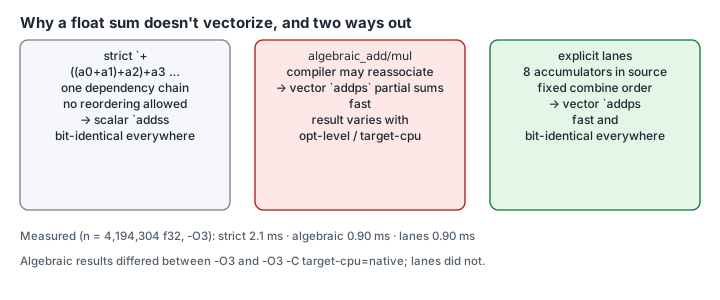
The docs’ own example is that a.algebraic_add(b).algebraic_add(c).algebraic_add(d) may be computed as written or as (a + c) + (b + d). The rewrites allowed are deliberately unspecified. Typically they include reassociation, contraction into fused multiply-add, replacing division with reciprocal multiplication, and ignoring the sign of zero. NaN, ±Inf and -0.0 “may behave in unexpected ways.” The results are always valid floats and never undefined behavior, but unsafe code must not depend on any property of them.
Worked example: three dot products
use std::hint::black_box;
use std::time::Instant;

#[inline(never)]
pub fn dot_strict(a: &[f32], b: &[f32]) -> f32 {
    a.iter().zip(b).fold(0.0, |acc, (x, y)| acc + x * y)
}

#[inline(never)]
pub fn dot_algebraic(a: &[f32], b: &[f32]) -> f32 {
    a.iter()
        .zip(b)
        .fold(0.0, |acc, (x, y)| acc.algebraic_add(x.algebraic_mul(*y)))
}

/// Deterministic alternative: eight explicit accumulators, combined in a
/// fixed order. Same result at every opt level and target; still vectorizes.
#[inline(never)]
pub fn dot_lanes(a: &[f32], b: &[f32]) -> f32 {
    let mut acc = [0.0f32; 8];
    let (ca, cb) = (a.chunks_exact(8), b.chunks_exact(8));
    let tail: f32 = ca.remainder().iter().zip(cb.remainder()).map(|(x, y)| x * y).sum();
    for (xa, xb) in ca.zip(cb) {
        for i in 0..8 {
            acc[i] += xa[i] * xb[i];
        }
    }
    ((acc[0] + acc[4]) + (acc[1] + acc[5])) + ((acc[2] + acc[6]) + (acc[3] + acc[7])) + tail
}

#[inline(never)]
pub fn dot_f64(a: &[f32], b: &[f32]) -> f64 {
    a.iter().zip(b).fold(0.0, |acc, (x, y)| acc + (*x as f64) * (*y as f64))
}

pub fn time(name: &str, f: impl Fn() -> f32, reference: f64) {
    let mut best = f64::MAX;
    let mut r = 0.0;
    for _ in 0..20 {
        let t = Instant::now();
        r = black_box(f());
        best = best.min(t.elapsed().as_secs_f64());
    }
    println!(
        "{name:<10} {r:>14.6}  rel.err {:>9.2e}  best {:>7.3} ms",
        ((r as f64 - reference) / reference).abs(),
        best * 1e3
    );
}

fn main() {
    let n = 1 << 22;
    // Deterministic pseudo-random data in [0, 1).
    let mut s: u32 = 12345;
    let mut next = || {
        s = s.wrapping_mul(1664525).wrapping_add(1013904223);
        (s >> 8) as f32 / (1u32 << 24) as f32
    };
    let a: Vec<f32> = (0..n).map(|_| next()).collect();
    let b: Vec<f32> = (0..n).map(|_| next()).collect();
    let reference = dot_f64(&a, &b);
    println!("n = {n}, f64 reference = {reference:.6}");
    time("strict", || dot_strict(black_box(&a), black_box(&b)), reference);
    time("algebraic", || dot_algebraic(black_box(&a), black_box(&b)), reference);
    time("lanes", || dot_lanes(black_box(&a), black_box(&b)), reference);
}
Verified with rustc 1.99.1 (58cf8f9c3 2026-10-13) on x86-64 (Intel(R) Xeon(R) Processor, 8 vCPUs). The same program was built three ways:
for o in "-C opt-level=0" "-C opt-level=3" "-C opt-level=3 -C target-cpu=native"; do
  echo "== rustc $o"; rustc $o --edition 2024 dot.rs -o dotx && ./dotx | tail -3
done
== rustc -C opt-level=0
strict 1046494.187500 rel.err 1.92e-3 best 40.257 ms
algebraic 1046494.187500 rel.err 1.92e-3 best 38.999 ms
lanes 1048457.937500 rel.err 4.60e-5 best 29.115 ms
== rustc -C opt-level=3
strict 1046494.187500 rel.err 1.92e-3 best 2.100 ms
algebraic 1048457.937500 rel.err 4.60e-5 best 0.899 ms
lanes 1048457.937500 rel.err 4.60e-5 best 0.901 ms
== rustc -C opt-level=3 -C target-cpu=native
strict 1046494.187500 rel.err 1.92e-3 best 2.100 ms
algebraic 1048502.125000 rel.err 3.84e-6 best 1.003 ms
lanes 1048457.937500 rel.err 4.60e-5 best 1.010 msHere’s what that shows:
- At
-O3the algebraic version is ~2.3× faster than strict and as fast as the hand-written lanes. (Timings are best of 20 on a shared VM, so treat them as ratios, not absolutes.) - The algebraic result depends on the build. Unoptimized, it matches strict bit for bit. At
-O3it happens to match the 8-lane order. Withtarget-cpu=native(AVX-capable here) the compiler picked a different reduction tree and produced a third value. All three are “correct” under the docs’ rules. - The lanes result is the same in all three builds, because the combine order is written in the source and
+may not be reordered. - Here, reassociation also made the result more accurate. A single accumulator grows to about 10⁶ and then adds terms near 0.25, losing their low bits. Several smaller partial sums lose less. That’s a property of this data (all positive), not a guarantee. With cancelling terms, a reordered sum can just as easily be worse.
The assembly confirms the vectorization (--crate-type=lib --emit asm, then counting arithmetic instructions in each function body):
rustc -C opt-level=3 --edition 2024 --crate-type=lib -A dead_code --emit asm -o dot.s dot.rsdot_strict addss=5 mulss=5
dot_algebraic addps=4 addss=1 mulps=2 mulss=1
dot_lanes addps=7 addss=11 mulps=6 mulss=7ss is scalar single precision and ps is packed. The strict loop is unrolled five times but is still one scalar addss chain. The other two run packed addps loops, and their remaining scalar instructions are the tail and the final horizontal sum.
Choosing between them
| Need | Use |
|---|---|
| Bit-identical results across builds, targets and runs (tests with exact expectations, consensus, replay, deterministic simulation) | strict +, or explicit lanes when you need speed |
| Fastest reduction in a hot loop, tolerance-based checks, results that may differ between machines | algebraic_* |
| A specific vector width or FMA on purpose | explicit lanes, or f32::mul_add (which is exact fused multiply-add, not “maybe”) |
The algebraic methods are opt-in per operation. Unlike C’s -ffast-math, they don’t change the semantics of every float operation in the crate, and they don’t add -ffinite-math-only’s assumption that NaNs and infinities never occur, the assumption that lets a compiler delete isnan checks. Only the operations you mark can be rewritten.
Things that bite
assert_eq!on an algebraic result is a flaky test. The docs say two evaluations of the same expression may differ “even within a single program run.” Compare with a tolerance, or test the strict reference.- It’s all or nothing per chain. One strict
+in the middle of the fold restores the dependency chain at that point. Both the add and the multiply in the fold above are algebraic. Iterator::sumstays strict. There’s no algebraicsum(), so write thefold(or the lanes) yourself.constcontexts work too (the methods areconstsince 1.98), but the docs promise nothing more about their compile-time results either.
Try this
- Change the data generator to produce values in
[-1, 1). Does the algebraic sum stay more accurate than strict, and does lanes? - Make only the multiply algebraic (
acc + x.algebraic_mul(*y)). Does it still vectorize? Check the asm counts. - Change
dot_lanesto 16 accumulators and compare-O3with-O3 -C target-cpu=native. Does the result change between builds? Why not?
Sources
f32algebraic operators andalgebraic_add(stable since 1.98.0): https://doc.rust-lang.org/std/primitive.f32.html#algebraic-operatorsf64::algebraic_add: https://doc.rust-lang.org/std/primitive.f64.html#method.algebraic_addf32::mul_add: https://doc.rust-lang.org/std/primitive.f32.html#method.mul_addstd::hint::black_box: https://doc.rust-lang.org/std/hint/fn.black_box.htmlslice::chunks_exact: https://doc.rust-lang.org/std/primitive.slice.html#method.chunks_exact- Rust 1.98.0 release notes: https://doc.rust-lang.org/beta/releases.html