CPU masks and lists: reading the kernel’s bitmaps
Overview
Thesis: every “which CPUs” or “which NUMA nodes” answer the kernel gives you is a bitmap: an array of unsigned long where bit n means CPU n (or node n). The kernel prints that one structure in two text forms. One is a list (0-1,3,8). The other is a mask of comma-separated 32-bit hex chunks (81,00000000,00000d0b). Know the two forms and the arithmetic behind them, and Cpus_allowed, taskset -p, smp_affinity, cpu/online and core_cpus all read the same way.
Typical jobs this chapter covers:
- Turn
Cpus_allowed: 3ainto “CPUs 1, 3, 4, 5” in your head, and back again. - Know why the same file says
ffon one box and00000000,000000ffon another. - Choose between the
*_listfile and the mask file in a script, and parse either one correctly. - Read kernel code that uses
DECLARE_BITMAP,set_bitandfor_each_set_bitwithout guessing.
uname -r
gcc --version | head -1
nproc
id -u
6.12.94+
gcc (Debian 14.2.0-19) 14.2.0
8
1000Every listing below ran on a Debian 13 host with kernel 6.12, x86_64, 8 vCPUs and one NUMA node, as an unprivileged user (uid=1000). Nothing needs root.
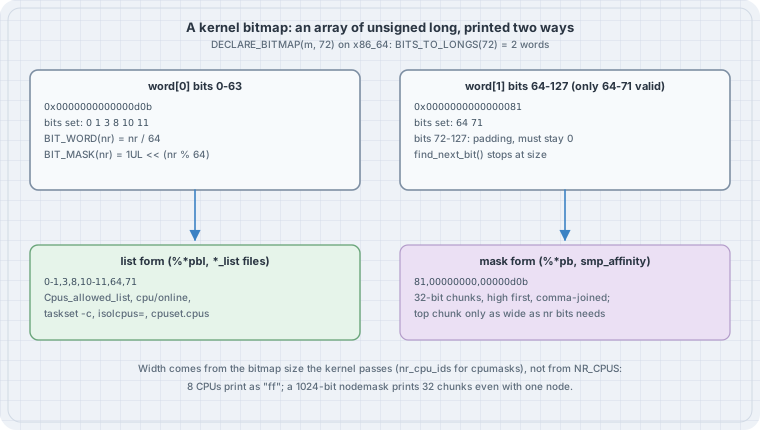
Mental model
  bitmap of N bits  =  unsigned long word[BITS_TO_LONGS(N)]
  bit nr lives in   word[nr / BITS_PER_LONG]   at   1UL << (nr % BITS_PER_LONG)

  printed as a list :  ranges, ascending, comma separated        0-1,3,8,10-11
  printed as a mask :  hex, 32 bits per chunk, high chunk first  81,00000000,00000d0b
                       the highest chunk is only as wide as N needs
Three facts carry the chapter:
- Bit number = CPU number. There is no other mapping. CPU 5 is bit 5, which is
0x20in the lowest chunk. - The width of a mask follows the bitmap’s size, not the number of set bits. For cpumasks that size is
nr_cpu_ids, the number of possible CPU ids on this boot. It is notNR_CPUS, the compile-time maximum. - Lists are for humans and for writing; masks are compact but width-dependent. For scripts, prefer the
*_listfile when one exists.
Case 1 — The same bits, two files
The kernel shows the calling task’s allowed CPUs and memory nodes in /proc/self/status, once as a mask and once as a list:
grep -E 'Cpus_allowed|Mems_allowed' /proc/self/statusCpus_allowed: ff
Cpus_allowed_list: 0-7
Mems_allowed: 00000000,00000000,00000000,00000000,00000000,00000000,00000000,00000000,00000000,00000000,00000000,00000000,00000000,00000000,00000000,00000000,00000000,00000000,00000000,00000000,00000000,00000000,00000000,00000000,00000000,00000000,00000000,00000000,00000000,00000000,00000000,00000001
Mems_allowed_list: 0Cpus_allowed is two hex digits because this boot has nr_cpu_ids = 8, so the bitmap is 8 bits wide. Mems_allowed is a nodemask sized by the kernel’s configured maximum number of nodes, here 1024 bits, which is 32 chunks. Only the lowest bit is set: node 0. The _list lines say the same thing in one token each.
Narrow the affinity with taskset and both forms follow:
taskset -p $$
taskset -c 0,2 grep Cpus_allowed /proc/self/status
taskset -c 0-7:2 sh -c 'grep Cpus_allowed_list /proc/self/status'
pid 1241299's current affinity mask: ff
Cpus_allowed: 05
Cpus_allowed_list: 0,2
Cpus_allowed_list: 0,2,4,605 is binary 0000 0101: bits 0 and 2. The last line shows the stride syntax first-last:step that util-linux accepts in taskset -c. The kernel accepts a related list syntax for boot parameters such as isolcpus= and nohz_full=. Its form is first-last:used/group; for example, 0-7:2/4 selects CPUs 0, 1, 4 and 5. It is described under “cpu lists” in the kernel parameters documentation.
Case 2 — Sysfs: lists and masks side by side
The CPU topology directory has both forms for many attributes:
cd /sys/devices/system/cpu
cat possible present online
for f in cpu0/topology/core_cpus cpu0/topology/core_cpus_list \
         cpu0/topology/package_cpus_list kernel_max; do
  printf '%-34s %s\n' "$f" "$(cat $f)"
done
cat /sys/devices/system/node/node0/cpumap /sys/devices/system/node/node0/cpulist
cat /proc/irq/default_smp_affinity
cat /proc/irq/*/smp_affinity_list | sort | uniq -c
0-7
0-7
0-7
cpu0/topology/core_cpus 01
cpu0/topology/core_cpus_list 0
cpu0/topology/package_cpus_list 0-7
kernel_max 63
ff
0-7
ff
21 0-7kernel_max is NR_CPUS - 1. This kernel was built for up to 64 CPUs, but the masks are two hex digits wide because the boot found 8 possible CPUs. Copy a mask from this box to a host with 96 possible CPUs and it has a different width and comma layout. Code that parses masks with a fixed width breaks there; code that reads the _list file does not.
core_cpus is 01 because each vCPU here is its own core, with no SMT sibling. On a bare-metal host with hyper-threading, core_cpus_list for CPU 0 typically reads something like 0,48.
Case 3 — The arithmetic, in user space
The kernel’s bitmap API lives in include/linux/bitmap.h and include/linux/bitops.h. The core idioms are short enough to copy into a user-space program. The point is to watch the words and the printed forms agree. Kernel code calls the real functions; it does not open-code them.
/* bitmap.c: a user-space copy of the kernel bitmap idioms (include/linux/bitmap.h) */
#define _GNU_SOURCE
#include <limits.h>
#include <sched.h>
#include <stdio.h>
#include <stdlib.h>
#include <string.h>

#define BITS_PER_LONG     (sizeof(long) * CHAR_BIT)
#define BITS_TO_LONGS(n)  (((n) + BITS_PER_LONG - 1) / BITS_PER_LONG)
#define DECLARE_BITMAP(name, bits) unsigned long name[BITS_TO_LONGS(bits)]
#define BIT_WORD(nr)      ((nr) / BITS_PER_LONG)
#define BIT_MASK(nr)      (1UL << ((nr) % BITS_PER_LONG))

static void set_bit(unsigned nr, unsigned long *a)   { a[BIT_WORD(nr)] |=  BIT_MASK(nr); }
static void clear_bit(unsigned nr, unsigned long *a) { a[BIT_WORD(nr)] &= ~BIT_MASK(nr); }
static int  test_bit(unsigned nr, const unsigned long *a) { return !!(a[BIT_WORD(nr)] & BIT_MASK(nr)); }

static unsigned find_next_bit(const unsigned long *a, unsigned size, unsigned off)
{
    while (off < size) {
        unsigned long w = a[BIT_WORD(off)] & (~0UL << (off % BITS_PER_LONG));
        if (w) {
            unsigned r = BIT_WORD(off) * BITS_PER_LONG + __builtin_ctzl(w);
            return r < size ? r : size;
        }
        off = (BIT_WORD(off) + 1) * BITS_PER_LONG;
    }
    return size;
}
#define for_each_set_bit(b, a, size) \
    for ((b) = find_next_bit((a), (size), 0); (b) < (size); (b) = find_next_bit((a), (size), (b) + 1))

static unsigned bitmap_weight(const unsigned long *a, unsigned size)
{
    unsigned w = 0;
    for (unsigned i = 0; i < BITS_TO_LONGS(size); i++)
        w += __builtin_popcountl(a[i]);
    return w;
}

/* "%*pbl" style: 0-3,8,10-11 */
static void print_list(const unsigned long *a, unsigned size)
{
    unsigned b, first = 1;
    for (b = find_next_bit(a, size, 0); b < size; ) {
        unsigned e = b;
        while (e + 1 < size && test_bit(e + 1, a)) e++;
        printf(first ? "%u" : ",%u", b);
        if (e > b) printf("-%u", e);
        first = 0;
        b = find_next_bit(a, size, e + 1);
    }
    printf("\n");
}

/* "%*pb" style: 32-bit hex words, most significant first, comma separated */
static void print_mask(const unsigned long *a, unsigned size)
{
    int words = (size + 31) / 32;
    int top = size % 32 ? (size % 32 + 3) / 4 : 8;   /* first chunk is only as wide as needed */
    for (int i = words - 1; i >= 0; i--) {
        unsigned long v = a[(i * 32) / BITS_PER_LONG] >> ((i * 32) % BITS_PER_LONG);
        if (i == words - 1) printf("%0*lx", top, v & 0xffffffffUL);
        else                printf(",%08lx", v & 0xffffffffUL);
    }
    printf("\n");
}

int main(void)
{
    enum { NBITS = 72 };            /* deliberately not a multiple of 64 */
    DECLARE_BITMAP(m, NBITS) = {0};
    unsigned b;

    printf("BITS_PER_LONG=%zu  BITS_TO_LONGS(%d)=%zu  sizeof(m)=%zu bytes\n",
           BITS_PER_LONG, NBITS, BITS_TO_LONGS(NBITS), sizeof(m));

    for (b = 0; b < 4; b++) set_bit(b, m);
    set_bit(8, m); set_bit(10, m); set_bit(11, m);
    set_bit(64, m); set_bit(71, m);
    clear_bit(2, m);

    printf("weight=%u  test_bit(3)=%d test_bit(2)=%d\n", bitmap_weight(m, NBITS),
           test_bit(3, m), test_bit(2, m));
    printf("for_each_set_bit:");
    for_each_set_bit(b, m, NBITS) printf(" %u", b);
    printf("\nlist: "); print_list(m, NBITS);
    printf("mask: "); print_mask(m, NBITS);
    printf("word[0]=%#018lx word[1]=%#018lx\n", m[0], m[1]);

    /* The same structure the scheduler hands back */
    cpu_set_t cs;
    CPU_ZERO(&cs);
    if (sched_getaffinity(0, sizeof(cs), &cs) != 0) { perror("sched_getaffinity"); return 1; }
    printf("cpu_set_t: %zu bytes (%zu bits), CPU_COUNT=%d\n",
           sizeof(cs), sizeof(cs) * CHAR_BIT, CPU_COUNT(&cs));
    printf("affinity list: "); print_list((unsigned long *)&cs, 8);
    printf("affinity mask: "); print_mask((unsigned long *)&cs, 8);
    return 0;
}
gcc -O2 -Wall -Wextra -o bitmap bitmap.c && ./bitmap
echo ---
taskset -c 1,3-5 ./bitmap | tail -2BITS_PER_LONG=64 BITS_TO_LONGS(72)=2 sizeof(m)=16 bytes
weight=8 test_bit(3)=1 test_bit(2)=0
for_each_set_bit: 0 1 3 8 10 11 64 71
list: 0-1,3,8,10-11,64,71
mask: 81,00000000,00000d0b
word[0]=0x0000000000000d0b word[1]=0x0000000000000081
cpu_set_t: 128 bytes (1024 bits), CPU_COUNT=8
affinity list: 0-7
affinity mask: ff
---
affinity list: 1,3-5
affinity mask: 3aRead the output against the diagram:
- 72 bits need two longs.
BITS_TO_LONGSrounds up, so bits 72 to 127 of word 1 are padding. The kernel’s helpers mask the last word withBITMAP_LAST_WORD_MASK(nbits), and every search takes asize, so padding bits never show up as CPUs. word[0] = 0xd0bis bits 0, 1, 3, 8, 10, 11 (1101 0000 1011). Bit 2 was set and then cleared.- The mask form splits the bitmap into 32-bit chunks, high chunk first. With 72 bits the top chunk holds 8 bits, so it prints as two digits (
81). That matches the kernel’s%*pboutput andCpus_allowed. for_each_set_bitis afind_next_bitloop. The search is word-at-a-time with count-trailing-zeros, so walking a sparse 4096-CPU mask costs about 64 word loads, not 4096 bit tests.- glibc’s
cpu_set_tis a 1024-bit bitmap laid out the same way. That is why the cast tounsigned long *works on Linux. Portable code should use theCPU_*macros instead.taskset -c 1,3-5gives mask3a=0011 1010= CPUs 1, 3, 4, 5.
Case 4 — Converting by hand and in a script
Mask to list, one chunk at a time (here 3a):
  hex  3    a
  bin  0011 1010
  bit  7654 3210   → bits 1,3,4,5  → list 1,3-5
For more than 32 CPUs, strip the commas, read the whole string as one hex number, and test bits from 0 upward. In bash, arithmetic is 64-bit, so a mask over 64 bits must be handled chunk by chunk. Usually the simplest correct script reads the list file instead:
# list → individual CPU ids, no width assumptions
expand_list() {
  local IFS=, part
  for part in $1; do
    if [[ $part == *-* ]]; then seq "${part%-*}" "${part#*-}"; else echo "$part"; fi
  done
}
expand_list "$(cat /sys/devices/system/cpu/online)" | paste -sd' '
expand_list "1,3-5" | paste -sd' '
0 1 2 3 4 5 6 7
1 3 4 5This helper handles the plain a-b and a,b forms that sysfs prints. It does not handle the :used/group stride syntax, which appears only on input, in boot parameters and taskset -c.
Where you will meet each form
| You see | Form | Typical files and tools |
|---|---|---|
0-3,8 |
list | /sys/devices/system/cpu/{possible,present,online,offline,isolated}, *_list topology files, Cpus_allowed_list, cgroup v2 cpuset.cpus, taskset -c, isolcpus=, nohz_full= |
ff, 00000000,000000ff |
mask | Cpus_allowed, Mems_allowed, taskset -p, /proc/irq/*/smp_affinity, /proc/irq/default_smp_affinity, topology core_cpus, node cpumap |
[0, 1, 3] |
JSON array | lscpu -J, not a kernel format |
When writing, IRQ affinity accepts both (smp_affinity takes a mask, smp_affinity_list takes a list). Writing either one needs root. The list form is harder to get wrong.
Gotchas
- Width differs between hosts. A mask is only meaningful together with its bitmap size. Never compare mask strings across machines; compare lists or sets of CPU ids.
- Empty is still a valid answer.
isolatedandofflineprint an empty line when no CPU is in the set. A parser must accept an empty string. - Possible is not online. Bitmaps are sized by possible CPUs. Hot-pluggable or offline CPUs keep their bit positions;
onlinetells you which are usable now. cpu_set_thas a ceiling. It is fixed at 1024 bits. On hosts with more possible CPUs, useCPU_ALLOCandCPU_ALLOC_SIZE, orsched_getaffinityfails withEINVAL, assched_setaffinity(2)documents.- Atomic vs non-atomic in kernel code.
set_bitandclear_bitare atomic read-modify-write operations.__set_bitand__clear_bitare the non-atomic variants for bitmaps that a lock already protects. The user-space copy above is non-atomic.
Quick reference
| Operation | Kernel API | Notes |
|---|---|---|
| Declare | DECLARE_BITMAP(name, nbits) |
unsigned long name[BITS_TO_LONGS(nbits)] |
| Set / clear / test | set_bit, clear_bit, test_bit |
atomic; __set_bit is the non-atomic form |
| Count | bitmap_weight(src, nbits) |
popcount over words |
| Iterate | for_each_set_bit(bit, addr, size) |
find_next_bit loop |
| Combine | bitmap_and, bitmap_or, bitmap_andnot |
word-wise |
%*pb (mask), %*pbl (list) |
width = number of bits | |
| Parse | bitmap_parselist, bitmap_parse |
list with :used/group, hex mask |
| CPU wrappers | cpumask_*, for_each_cpu, cpumask_pr_args() |
sized by nr_cpu_ids |
Sources
- Linux kernel documentation, “How to get printk format specifiers right”, bitmap section (
%*pb,%*pbl): https://docs.kernel.org/core-api/printk-formats.html - Linux kernel documentation, “Basic C Library Functions”: bitmap operations (
bitmap_parselist,bitmap_weight, …): https://docs.kernel.org/core-api/kernel-api.html - Linux kernel documentation, kernel parameters, “cpu lists” syntax: https://docs.kernel.org/admin-guide/kernel-parameters.html
- Linux kernel ABI,
/sys/devices/system/cpu/(possible, present, online, topology): https://docs.kernel.org/admin-guide/abi-stable.html and https://docs.kernel.org/admin-guide/cputopology.html - Kernel source,
include/linux/bitmap.h,include/linux/find.h,lib/bitmap-str.c: https://git.kernel.org/pub/scm/linux/kernel/git/torvalds/linux.git/tree/include/linux/bitmap.h proc_pid_status(5)(Cpus_allowed,Mems_allowed): https://man7.org/linux/man-pages/man5/proc_pid_status.5.htmlsched_setaffinity(2)andCPU_SET(3): https://man7.org/linux/man-pages/man2/sched_setaffinity.2.html, https://man7.org/linux/man-pages/man3/CPU_SET.3.htmltaskset(1), util-linux: https://man7.org/linux/man-pages/man1/taskset.1.html