Threads Are Just clone() Flags: What CLONE_VM, FILES, FS and SIGHAND Share
Threads Are Just clone() Flags: What CLONE_VM, FILES, FS and SIGHAND Share
Learning goals
- See that Linux has no separate “thread” object.
fork(),pthread_create()and container runtimes are allclone()with different sharing flags. - Prove what each of
CLONE_VM,CLONE_FILES,CLONE_FSandCLONE_SIGHANDshares, by changing state in a child and inspecting it in the parent. - Call
clone3()directly withstruct clone_args. - Read the exact flag set glibc passes for a pthread, and the kernel rules that stop nonsensical combinations.
Version note: run on Linux 6.12 with gcc 14.2 and glibc 2.41 (Debian 13), as an ordinary user. strace is not installed on the box, so the glibc flag set is quoted from source instead of traced.
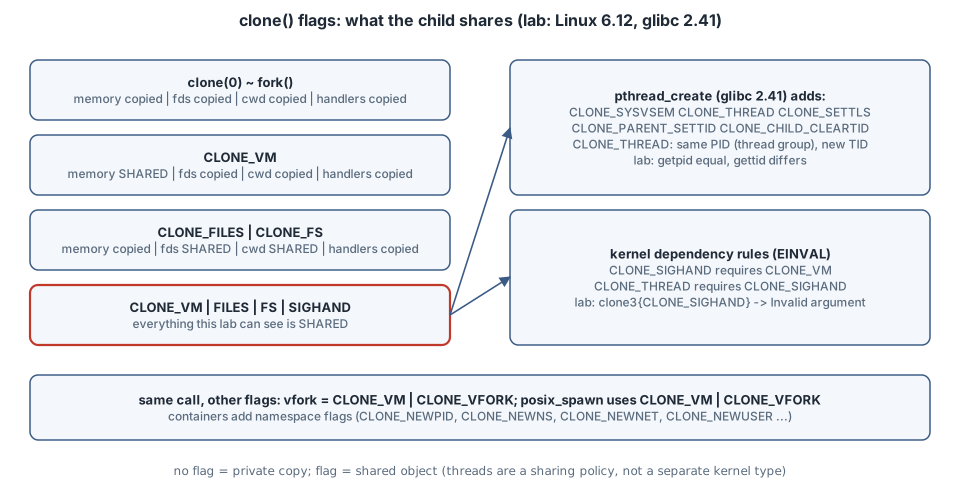
The flags in this lab
From clone(2):
| Flag | If set, the child shares the parent’s… |
|---|---|
CLONE_VM |
memory (same address space; writes are visible both ways) |
CLONE_FILES |
file-descriptor table (open/close in one affects the other) |
CLONE_FS |
filesystem info: root, cwd, umask |
CLONE_SIGHAND |
table of signal handlers (requires CLONE_VM) |
CLONE_THREAD |
thread group, so the same PID with a different TID (requires CLONE_SIGHAND) |
Without a flag, the child gets a copy of that resource, which is exactly what fork() gives you.
Lab 1: change it in the child, look in the parent
The child sets a global, closes an fd, chdirs to /tmp, and installs a SIGUSR1 handler. The parent then checks which of those changes it can see.
// What does a clone() child share with its parent? Try four flag sets.
#define _GNU_SOURCE
#include <fcntl.h>
#include <linux/sched.h>    /* struct clone_args */
#include <sched.h>
#include <signal.h>
#include <stdio.h>
#include <stdlib.h>
#include <string.h>
#include <sys/syscall.h>
#include <sys/wait.h>
#include <unistd.h>
#include <errno.h>

static int counter = 0;
static int fd = -1;
static void on_usr1(int s) { (void)s; }

static int child(void *arg) {
    (void)arg;
    counter = 42;                    /* memory   (CLONE_VM)      */
    close(fd);                       /* fd table (CLONE_FILES)   */
    chdir("/tmp");                   /* cwd      (CLONE_FS)      */
    signal(SIGUSR1, on_usr1);        /* handlers (CLONE_SIGHAND) */
    return 0;
}

static void report(const char *name, int flags) {
    counter = 0;
    fd = open("/dev/null", O_RDONLY);
    chdir("/");
    signal(SIGUSR1, SIG_DFL);

    size_t sz = 1 << 16;
    char *stack = malloc(sz);
    pid_t pid = clone(child, stack + sz, flags | SIGCHLD, NULL);
    waitpid(pid, NULL, 0);
    free(stack);

    char cwd[64]; getcwd(cwd, sizeof cwd);
    struct sigaction sa; sigaction(SIGUSR1, NULL, &sa);
    printf("%-34s memory:%-7s fds:%-7s cwd:%-7s sighand:%s\n", name,
           counter == 42 ? "shared" : "copied",
           fcntl(fd, F_GETFD) == -1 ? "shared" : "copied",
           strcmp(cwd, "/tmp") == 0 ? "shared" : "copied",
           sa.sa_handler == on_usr1 ? "shared" : "copied");
    if (fcntl(fd, F_GETFD) != -1) close(fd);
}

int main(void) {
    report("0 (like fork)", 0);
    report("CLONE_VM", CLONE_VM);
    report("CLONE_FILES|CLONE_FS", CLONE_FILES | CLONE_FS);
    report("CLONE_VM|FILES|FS|SIGHAND", CLONE_VM | CLONE_FILES | CLONE_FS | CLONE_SIGHAND);

    /* clone3: same idea, arguments in a struct; returns like fork(). */
    struct clone_args ca = { .flags = CLONE_FILES, .exit_signal = SIGCHLD };
    fd = open("/dev/null", O_RDONLY);
    long r = syscall(SYS_clone3, &ca, sizeof ca);
    if (r == 0) { close(fd); _exit(0); }
    waitpid(r, NULL, 0);
    printf("%-34s fds:%s (child closed fd %d)\n", "clone3 {.flags=CLONE_FILES}",
           fcntl(fd, F_GETFD) == -1 ? "shared" : "copied", fd);

    /* What pthread_create actually asks for: */
    printf("\nthread-like set rejected without CLONE_VM? ");
    struct clone_args bad = { .flags = CLONE_SIGHAND, .exit_signal = SIGCHLD };
    r = syscall(SYS_clone3, &bad, sizeof bad);
    if (r == 0) _exit(0);
    if (r > 0) { waitpid(r, NULL, 0); puts("no (accepted)"); }
    else printf("yes: %s\n", strerror(errno));
    return 0;
}
$ gcc -O0 -Wall -o shares shares.c && ./shares
0 (like fork) memory:copied fds:copied cwd:copied sighand:copied
CLONE_VM memory:shared fds:copied cwd:copied sighand:copied
CLONE_FILES|CLONE_FS memory:copied fds:shared cwd:shared sighand:copied
CLONE_VM|FILES|FS|SIGHAND memory:shared fds:shared cwd:shared sighand:shared
clone3 {.flags=CLONE_FILES} fds:shared (child closed fd 5)
thread-like set rejected without CLONE_VM? yes: Invalid argumentEach row matches the table. The four “thread-ish” flags together share everything this lab can see, which is what makes the child feel like a thread. clone3() takes the same flags in a struct clone_args, and the kernel enforces the dependency rules: CLONE_SIGHAND without CLONE_VM gives EINVAL (“Since Linux 2.6.0”, per clone(2)). A shared handler table over separate memory would point at handler addresses that mean nothing in the other address space.
Note that the glibc clone() wrapper needs a caller-allocated stack, here malloced, passed as its top because the stack grows down on x86-64. Raw clone3() with no stack behaves like fork() and uses a copy-on-write duplicate of the current stack. That is safe only because this example does not pass CLONE_VM.
Lab 2: what CLONE_THREAD adds
glibc 2.41, nptl/pthread_create.c:
const int clone_flags = (CLONE_VM | CLONE_FS | CLONE_FILES | CLONE_SYSVSEM
                         | CLONE_SIGHAND | CLONE_THREAD
                         | CLONE_SETTLS | CLONE_PARENT_SETTID
                         | CLONE_CHILD_CLEARTID
                         | 0);
Beyond Lab 1’s four flags:
CLONE_SYSVSEMshares System V semaphore undo lists.CLONE_SETTLSgives the thread its own thread-local storage.CLONE_PARENT_SETTID/CLONE_CHILD_CLEARTIDletpthread_joinfind out when the thread exits, through a futex on the TID word.CLONE_THREADmakes the child part of the same thread group:
// A pthread is a clone with CLONE_THREAD: same PID (thread group), new TID.
#define _GNU_SOURCE
#include <pthread.h>
#include <stdio.h>
#include <unistd.h>
#include <sys/wait.h>

static void *worker(void *arg) {
    (void)arg;
    printf("thread: getpid=%d gettid=%d\n", getpid(), gettid());
    return NULL;
}

int main(void) {
    printf("main:   getpid=%d gettid=%d\n", getpid(), gettid());
    pthread_t t;
    pthread_create(&t, NULL, worker, NULL);
    pthread_join(t, NULL);
    fflush(stdout);                 /* don't duplicate buffered output */
    pid_t c = fork();
    if (c == 0) { printf("fork:   getpid=%d gettid=%d\n", getpid(), gettid()); fflush(stdout); _exit(0); }
    waitpid(c, NULL, 0);
    return 0;
}
$ gcc -Wall -o thread thread.c && ./thread
main: getpid=1685152 gettid=1685152
thread: getpid=1685152 gettid=1685154
fork: getpid=1685155 gettid=1685155getpid() returns the thread-group ID, so it is the same for the main thread and the pthread, while gettid() differs. The forked child has a new PID that equals its TID. This is why ps shows one process and ps -L or /proc/PID/task/ shows the threads.
Where else these flags show up
- Containers use the same call with namespace flags (
CLONE_NEWPID,CLONE_NEWNS,CLONE_NEWNET,CLONE_NEWUSER, …) instead of, or alongside, sharing flags. That is the subject of the namespace chapters. vfork()isCLONE_VM | CLONE_VFORK: the child borrows the parent’s memory until itexecves.posix_spawnin glibc usesCLONE_VM | CLONE_VFORKinternally for speed.
Try this
- Add
CLONE_THREADto the lastreport()row. Why doeswaitpid()now fail, and what does clone(2) say about the exit signal of a thread? - Pass
CLONE_THREADwithoutCLONE_SIGHANDtoclone3()and confirm the secondEINVALrule. - Run
./threadwithsleep(30)in the worker and comparels /proc/<pid>/taskagainstps -o nlwp <pid>.
Sources
- clone(2), flags and
EINVALconditions: https://man7.org/linux/man-pages/man2/clone.2.html - glibc 2.41
nptl/pthread_create.c(clone_flags): https://sourceware.org/git/?p=glibc.git;a=blob;f=nptl/pthread_create.c;hb=refs/heads/release/2.41/master - gettid(2) and getpid(2): https://man7.org/linux/man-pages/man2/gettid.2.html
- vfork(2): https://man7.org/linux/man-pages/man2/vfork.2.html
- glibc 2.41
sysdeps/unix/sysv/linux/spawni.c(posix_spawn usesCLONE_VM | CLONE_VFORK): https://sourceware.org/git/?p=glibc.git;a=blob;f=sysdeps/unix/sysv/linux/spawni.c;hb=refs/heads/release/2.41/master - Linux
include/uapi/linux/sched.h(struct clone_args, flag values): https://git.kernel.org/pub/scm/linux/kernel/git/torvalds/linux.git/tree/include/uapi/linux/sched.h?h=v6.12