How programs get run: execve, binfmt_elf, PT_INTERP and the auxiliary vector
How programs get run: execve, binfmt_elf, PT_INTERP and the auxiliary vector
Overview
Thesis: when you type ./hello, the kernel does not “run main”. execve(2) asks a binary format handler to recognise the file, maps its PT_LOAD segments, and, for a dynamically linked program, also maps the interpreter named in PT_INTERP (the dynamic loader, ld-linux-x86-64.so.2 on x86-64 glibc). The kernel then jumps to the loader’s entry point and hands it a small table of facts, the auxiliary vector (auxv). The loader uses auxv to find the program, loads its libraries, runs constructors, and only then calls main.
| Step | Who | What you can inspect |
|---|---|---|
| Recognise the file | kernel: binfmt_script (#!), binfmt_elf, binfmt_misc |
head -c4 FILE, /proc/sys/fs/binfmt_misc/ |
| Map the program | kernel (binfmt_elf) |
readelf -lW FILE (LOAD rows) |
| Map the interpreter | kernel, from PT_INTERP |
readelf -lW FILE \| grep interpreter |
| Build the stack: argv, envp, auxv | kernel | LD_SHOW_AUXV=1 PROG, /proc/PID/auxv, getauxval(3) |
| Load libraries, relocate, run init | user space: ld.so |
/proc/PID/maps, LD_DEBUG=libs |
_start → __libc_start_main → main |
libc | your program |
Why it matters day to day: the famous “No such file or directory” for a file that plainly exists (a binary copied from another distro, an Alpine binary on glibc, a Nix-built binary outside Nix, a script with CRLF in its #! line) is the kernel failing to open the interpreter, not your file.
Mental model
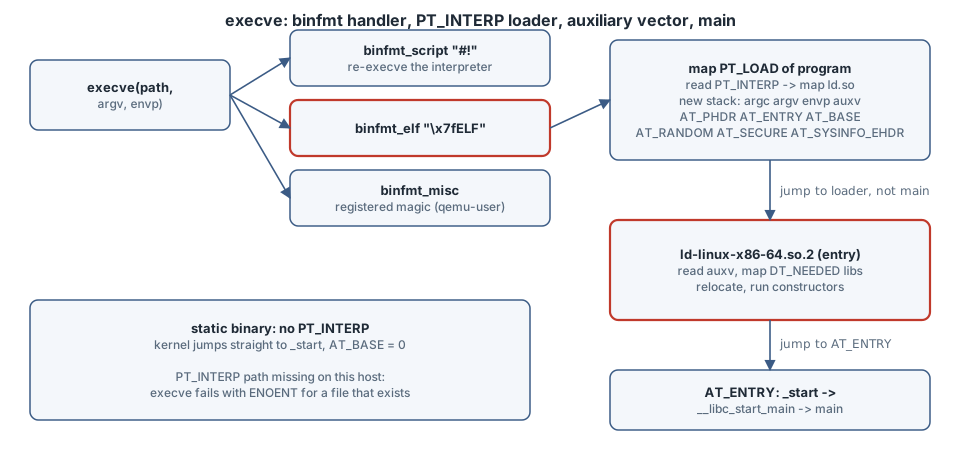
execve(path) ─► binfmt_script?  "#!interp arg"  → execve(interp, [interp, arg, path, ...])
             ─► binfmt_elf?     "\x7fELF"        → map PT_LOAD, map PT_INTERP, push argv/envp/auxv
             ─► binfmt_misc?    registered magic → e.g. qemu-user, wine, java
                                    │
                    jump to ld.so entry (or to _start if static)
                                    │
             ld.so: read auxv → map DT_NEEDED libs → relocate → init → jump AT_ENTRY → main
Three facts carry the chapter:
PT_INTERPis a path, baked into the binary. If it does not exist on this machine,execvefails withENOENT, even though the file you named exists.- The loader is just an ELF file you can run directly.
/lib64/ld-linux-x86-64.so.2 ./progloadsprogitself, which is howlddand Nix’spatchelf-free wrappers work. - auxv is the kernel→user-space handshake.
AT_PHDR/AT_ENTRYtell the loader where the program is,AT_BASEwhere the loader is,AT_RANDOMseeds the stack canary,AT_SECUREsays “setuid, ignoreLD_*variables”, andAT_SYSINFO_EHDRis the vDSO.
Syntax
#include <unistd.h>
int execve(const char *path, char *const argv[], char *const envp[]);
int execveat(int dirfd, const char *path, char *const argv[], char *const envp[], int flags);  // AT_EMPTY_PATH: exec an fd

#include <sys/auxv.h>
unsigned long getauxval(unsigned long type);   // AT_PHDR, AT_ENTRY, AT_BASE, AT_RANDOM, AT_SECURE, AT_EXECFN, ...
readelf -hW PROG # ELF header: Type (EXEC vs DYN = PIE) and entry point
readelf -lW PROG # program headers: INTERP, LOAD, DYNAMIC, GNU_STACK, GNU_RELRO
LD_SHOW_AUXV=1 PROG # glibc's loader prints the auxv it received, then runs PROG
od -An -tx8 /proc/PID/auxv # the raw (type, value) pairs of a running processSafety
- Everything here is read-only inspection of your own binaries and processes. No root is needed.
- The “broken interpreter” demo patches a copy of a binary in
/tmp. Never patch system binaries in place. LD_SHOW_AUXV,LD_DEBUGandLD_LIBRARY_PATHare ignored for setuid programs (AT_SECURE=1). That is a security feature, not a bug.
Examples with Explanations
1. A PIE, a static binary, and their program headers
A tiny C program prints a few auxv entries with getauxval(3):
#include <stdio.h>
#include <sys/auxv.h>
#include <elf.h>
#include <link.h>
int main(int argc, char **argv) {
    printf("main() reached, argv[0]=%s\n", argv[0]);
    printf("AT_PHDR   = %#lx (program headers of the executable)\n", getauxval(AT_PHDR));
    printf("AT_ENTRY  = %#lx (entry point of the executable)\n", getauxval(AT_ENTRY));
    printf("AT_BASE   = %#lx (load address of the interpreter)\n", getauxval(AT_BASE));
    printf("AT_PAGESZ = %lu\n", getauxval(AT_PAGESZ));
    printf("AT_SECURE = %lu\n", getauxval(AT_SECURE));
    printf("AT_EXECFN = %s\n", (char *)getauxval(AT_EXECFN));
    printf("AT_RANDOM = %#lx (16 random bytes for stack canary / pointer guard)\n", getauxval(AT_RANDOM));
    return 0;
}
$ gcc -O2 -Wall -o hello hello.c
$ gcc -O2 -Wall -static -o hello-static hello.c
$ readelf -hW hello | grep -E 'Type|Entry'
Type: DYN (Position-Independent Executable file)
Entry point address: 0x1140
$ readelf -lW hello | sed -n '/Program Headers/,/GNU_RELRO/p'
Program Headers:
Type Offset VirtAddr PhysAddr FileSiz MemSiz Flg Align
PHDR 0x000040 0x0000000000000040 0x0000000000000040 0x000310 0x000310 R 0x8
INTERP 0x000394 0x0000000000000394 0x0000000000000394 0x00001c 0x00001c R 0x1
[Requesting program interpreter: /lib64/ld-linux-x86-64.so.2]
LOAD 0x000000 0x0000000000000000 0x0000000000000000 0x000680 0x000680 R 0x1000
LOAD 0x001000 0x0000000000001000 0x0000000000001000 0x000235 0x000235 R E 0x1000
LOAD 0x002000 0x0000000000002000 0x0000000000002000 0x00023c 0x00023c R 0x1000
LOAD 0x002dd0 0x0000000000003dd0 0x0000000000003dd0 0x000250 0x000258 RW 0x1000
DYNAMIC 0x002de0 0x0000000000003de0 0x0000000000003de0 0x0001e0 0x0001e0 RW 0x8
NOTE 0x000350 0x0000000000000350 0x0000000000000350 0x000020 0x000020 R 0x8
NOTE 0x000370 0x0000000000000370 0x0000000000000370 0x000024 0x000024 R 0x4
NOTE 0x00221c 0x000000000000221c 0x000000000000221c 0x000020 0x000020 R 0x4
GNU_PROPERTY 0x000350 0x0000000000000350 0x0000000000000350 0x000020 0x000020 R 0x8
GNU_EH_FRAME 0x002148 0x0000000000002148 0x0000000000002148 0x00002c 0x00002c R 0x4
GNU_STACK 0x000000 0x0000000000000000 0x0000000000000000 0x000000 0x000000 RW 0x10
GNU_RELRO 0x002dd0 0x0000000000003dd0 0x0000000000003dd0 0x000230 0x000230 R 0x1Read it top to bottom:
Type: DYNis a position-independent executable. Its addresses start at 0 and the kernel picks a random base (ASLR).INTERPis 0x1c = 28 bytes: the 27-character path plus a NUL. That one string decides which loader runs.- Four
LOADsegments with flagsR,R E,R,RW: headers, code, read-only data, writable data. The kernelmmaps each with those permissions. GNU_STACKRW(noE) asks for a non-executable stack.GNU_RELROis a range the loader makes read-only after relocation.
Now run both:
$ ./hello
main() reached, argv[0]=./hello
AT_PHDR   = 0x55f3a870c040 (program headers of the executable)
AT_ENTRY  = 0x55f3a870d140 (entry point of the executable)
AT_BASE   = 0x7f42f153d000 (load address of the interpreter)
AT_PAGESZ = 4096
AT_SECURE = 0
AT_EXECFN = ./hello
AT_RANDOM = 0x7ffe54264479 (16 random bytes for stack canary / pointer guard)

$ ./hello-static
main() reached, argv[0]=./hello-static
AT_PHDR   = 0x400040 (program headers of the executable)
AT_ENTRY  = 0x4016a0 (entry point of the executable)
AT_BASE   = 0 (load address of the interpreter)
AT_PAGESZ = 4096
AT_SECURE = 0
AT_EXECFN = ./hello-static
AT_RANDOM = 0x7ffd0c796b29 (16 random bytes for stack canary / pointer guard)
$ readelf -hW hello-static | grep Type; readelf -lW hello-static | grep -c INTERP
  Type:                              EXEC (Executable file)
0
The PIE’s AT_BASE is where the kernel mapped ld-linux-x86-64.so.2. The static binary is EXEC at the fixed address 0x400000, has no INTERP header, and gets AT_BASE = 0: the kernel jumped straight to its _start. The addresses change on every run (ASLR); the 0x...040 offset of AT_PHDR and the ...140 offset of AT_ENTRY match readelf’s PHDR offset (0x40) and entry point (0x1140).
2. Everything the kernel told the loader: LD_SHOW_AUXV
$ LD_SHOW_AUXV=1 ./hello | head -22
AT_SYSINFO_EHDR:      0x7fa1b8fec000
AT_MINSIGSTKSZ:       11952
AT_HWCAP:             1fabfbff
AT_PAGESZ:            4096
AT_CLKTCK:            100
AT_PHDR:              0x55d1fe9a0040
AT_PHENT:             56
AT_PHNUM:             14
AT_BASE:              0x7fa1b8fee000
AT_FLAGS:             0x0
AT_ENTRY:             0x55d1fe9a1140
AT_UID:               1000
AT_EUID:              1000
AT_GID:               1000
AT_EGID:              1000
AT_SECURE:            0
AT_RANDOM:            0x7ffc82d7b3e9
AT_HWCAP2:            0x2
AT_EXECFN:            ./hello
AT_PLATFORM:          x86_64
AT_RSEQ_FEATURE_SIZE: 28
AT_RSEQ_ALIGN:        32
The entries worth knowing:
| Entry | Meaning |
|---|---|
AT_SYSINFO_EHDR |
address of the vDSO’s ELF header (how clock_gettime avoids a syscall) |
AT_HWCAP, AT_HWCAP2, AT_PLATFORM |
CPU feature bits; glibc uses them to pick optimised memcpy and glibc-hwcaps library directories |
AT_PHDR, AT_PHENT, AT_PHNUM |
where the program’s headers are, their size (56) and count (14, as readelf said) |
AT_BASE, AT_ENTRY |
the loader’s base and the program’s entry point |
AT_UID..AT_EGID, AT_SECURE |
real and effective IDs; AT_SECURE=1 for setuid/setgid/file-capability programs |
AT_RANDOM |
16 kernel-random bytes on the stack, used for the stack protector canary and pointer mangling |
AT_EXECFN |
the path passed to execve |
AT_MINSIGSTKSZ, AT_RSEQ_* |
newer entries: minimum signal stack for this CPU (AVX-512 state is big), restartable-sequences layout |
3. The loader is a program
$ ls -l /lib64/ld-linux-x86-64.so.2 | awk '{print $1, $(NF-2), $(NF-1), $NF}'
lrwxrwxrwx /lib64/ld-linux-x86-64.so.2 -> ../lib/x86_64-linux-gnu/ld-linux-x86-64.so.2
$ /lib64/ld-linux-x86-64.so.2 ./hello
main() reached, argv[0]=./hello
AT_PHDR   = 0x7fdc18bf1040 (program headers of the executable)
AT_ENTRY  = 0x7fdc18bf2140 (entry point of the executable)
AT_BASE   = 0 (load address of the interpreter)
AT_PAGESZ = 4096
AT_SECURE = 0
AT_EXECFN = ./hello
AT_RANDOM = 0x7ffd68b77d09 (16 random bytes for stack canary / pointer guard)
Run that way, the kernel executed ld-linux-x86-64.so.2 (so from the kernel’s point of view there is no interpreter: AT_BASE = 0), and the loader mapped ./hello itself. This is the escape hatch when PT_INTERP points somewhere that does not exist. It is not a way around noexec mounts for ELF files: the loader has to mmap the program with PROT_EXEC, and the kernel refuses that on a noexec mount. Script interpreters are different (python3 /mnt/noexec/x.py only reads the file), which is why noexec is a speed bump, not a sandbox.
Here is the result in a running process, filtered to the interesting mappings of a small program that prints its own /proc/self/maps:
$ ./maps | grep -E 'ld-linux|libc|vdso|stack|/maps' | awk '{print $1, $2, $6}'
560196c94000-560196c95000 r--p /tmp/execlab/maps
560196c95000-560196c96000 r-xp /tmp/execlab/maps
560196c96000-560196c97000 r--p /tmp/execlab/maps
560196c97000-560196c98000 r--p /tmp/execlab/maps
560196c98000-560196c99000 rw-p /tmp/execlab/maps
7f7411605000-7f741162d000 r--p /usr/lib/x86_64-linux-gnu/libc.so.6
7f741162d000-7f7411790000 r-xp /usr/lib/x86_64-linux-gnu/libc.so.6
7f7411790000-7f74117e6000 r--p /usr/lib/x86_64-linux-gnu/libc.so.6
7f74117e6000-7f74117ea000 r--p /usr/lib/x86_64-linux-gnu/libc.so.6
7f74117ea000-7f74117ec000 rw-p /usr/lib/x86_64-linux-gnu/libc.so.6
7f741180a000-7f741180c000 r-xp [vdso]
7f741180c000-7f741180d000 r--p /usr/lib/x86_64-linux-gnu/ld-linux-x86-64.so.2
7f741180d000-7f7411835000 r-xp /usr/lib/x86_64-linux-gnu/ld-linux-x86-64.so.2
7f7411835000-7f7411840000 r--p /usr/lib/x86_64-linux-gnu/ld-linux-x86-64.so.2
7f7411840000-7f7411842000 r--p /usr/lib/x86_64-linux-gnu/ld-linux-x86-64.so.2
7f7411842000-7f7411843000 rw-p /usr/lib/x86_64-linux-gnu/ld-linux-x86-64.so.2
7fff9b777000-7fff9b799000 rw-p [stack]
The program’s five mappings sit at a random 0x55... base, libc and the loader near the top of the address space, the [vdso] from AT_SYSINFO_EHDR, and [stack], where argv, envp and auxv were written.
4. “No such file or directory” for a file that exists
Copy the binary and change one byte-for-byte equal-length string in PT_INTERP, as if it came from a system with a different loader path:
$ readelf -lW hello-badinterp | grep interpreter
      [Requesting program interpreter: /lib64/ld-gonex-x86-64.so.2]
$ ls -l hello-badinterp
-rwxr-xr-x 16008 hello-badinterp
$ ./hello-badinterp
run.sh: line 4: ./hello-badinterp: cannot execute: required file not found
exit=127
$ python3 -c "import os; os.execv(\"./hello-badinterp\", [\"x\"])"
FileNotFoundError: [Errno 2] No such file or directory
$ head -1 s.sh; ./s.sh
#!/no/such/shell
run.sh: line 6: ./s.sh: cannot execute: required file not found
exit=127
The file is there and executable, yet execve returns ENOENT (bash 5.2 now words this as “required file not found”; older shells print the misleading “No such file or directory”). The missing file is /lib64/ld-gonex-x86-64.so.2. A #! line naming a missing interpreter fails the same way, because binfmt_script turns it into a second execve of the interpreter. A Windows-edited script whose first line is #!/bin/sh\r fails for the same reason: the interpreter it asks for is /bin/sh\r.
Fixes, in order of preference: install a build for this platform; run it through the right loader (/path/to/ld.so ./prog); or rewrite the header with patchelf --set-interpreter (on a copy).
The trap: ldd runs code
ldd is a shell script that runs the program’s loader with LD_TRACE_LOADED_OBJECTS=1. With a hostile or simply foreign binary, a custom PT_INTERP means “running ldd on it” executes an attacker-chosen loader. The ldd(1) man page says so. For untrusted files, read the headers instead: readelf -dW FILE | grep NEEDED and readelf -lW FILE | grep interpreter never execute anything.
Notes and pitfalls
- Order of handlers. The kernel tries the registered formats in turn.
binfmt_miscentries (/proc/sys/fs/binfmt_misc/, usually set up by systemd-binfmt) are howqemu-userlets an arm64 binary “just run” on x86-64. Inside containers that directory is often not mounted. #!limits. The kernel reads only the first line, up to 255 bytes (BINPRM_BUF_SIZE256), and passes at most one argument:#!/usr/bin/env python3 -upasses"python3 -u"as one word.env -Sexists to split it.- Static-PIE binaries (
-static-pie) areDYNwith noINTERP: they relocate themselves. - Executing from an fd.
execveat(fd, "", ..., AT_EMPTY_PATH)andfexecve(3)run a file you already opened, which is howmemfd_create+ exec works./proc/PID/exethen points at/memfd:.... - What
argv[0]is is entirely up to the caller ofexecve;AT_EXECFNand/proc/self/exeare the honest answers. - Setuid binaries get
AT_SECURE=1; the loader then ignoresLD_PRELOADpaths with slashes,LD_LIBRARY_PATHandLD_SHOW_AUXV.
The boring rule
When a binary “isn’t found”, run readelf -lW FILE | grep interpreter and check that path. Read auxv with LD_SHOW_AUXV=1 or getauxval, never by walking past envp yourself. Use readelf, not ldd, on files you do not trust.
Try this
- Run
LD_SHOW_AUXV=1 /bin/trueandLD_SHOW_AUXV=1 ./hello-static. Which one prints nothing, and why? - Run
LD_DEBUG=libs ./hello 2>&1 | headand find where the loader looks forlibc.so.6. - Compare
readelf -lWfor a binary built with-z execstackand without. What changes inGNU_STACK? - Write a script whose first line is
#!/usr/bin/env python3 -u. What error do you get, and how does#!/usr/bin/env -S python3 -ufix it?
Verification
hello.candmaps.cwere built with GCC (-O2 -Wall, no warnings) against glibc 2.41 (Debian 13) and run on Linux 6.12 x86-64. The bad-interpreter demo ran under bash 5.2.37 and Python 3.13.- All outputs above are unedited. Addresses differ from run to run because of ASLR; offsets, sizes, counts and error codes are stable.
Sources
- execve(2): https://man7.org/linux/man-pages/man2/execve.2.html
- getauxval(3): https://man7.org/linux/man-pages/man3/getauxval.3.html
- ld.so(8) (
LD_SHOW_AUXV,AT_SECURE, running the loader directly): https://man7.org/linux/man-pages/man8/ld.so.8.html - ldd(1), the security note: https://man7.org/linux/man-pages/man1/ldd.1.html
- elf(5): https://man7.org/linux/man-pages/man5/elf.5.html
- Kernel docs, binfmt_misc: https://docs.kernel.org/admin-guide/binfmt-misc.html
- Kernel source,
fs/binfmt_elf.c(load_elf_binary,create_elf_tables): https://github.com/torvalds/linux/blob/master/fs/binfmt_elf.c - LWN, “How programs get run” and “How programs get run: ELF binaries” (David Drysdale): https://lwn.net/Articles/630727/, https://lwn.net/Articles/631631/