Everything is an fd: signalfd, timerfd and eventfd in one epoll loop
Everything is an fd: signalfd, timerfd and eventfd in one epoll loop
Overview
Thesis: Linux can turn signals, timers, cross-thread wake-ups and process exits into file descriptors. Once they are fds, a single epoll_wait() loop handles all of them, in order, on one thread. You get no async-signal-safety rules, no EINTR storms from handlers, and no self-pipe trick. The price is a small contract you must know: you have to read each fd to clear it, and what you read is a count or a record, not one event per wake-up.
| Descriptor | Since | Replaces | read() returns |
|---|---|---|---|
signalfd |
2.6.22 | signal handlers, the self-pipe trick | one struct signalfd_siginfo (128 bytes) per pending signal |
timerfd |
2.6.25 | setitimer/SIGALRM, sleep-based ticks |
uint64_t expirations since the last read |
eventfd |
2.6.22 | a pipe used only to wake another thread | uint64_t counter, then reset to 0 (or 1 at a time with EFD_SEMAPHORE) |
pidfd |
5.3 (waitid(P_PIDFD) 5.4) |
SIGCHLD + waitpid |
not read: it becomes readable when the process exits |
Where you meet these: systemd’s sd-event loop is built on all four. libuv (uv_async_send) and Go’s netpoller use an eventfd on Linux to wake a sleeping loop. Seeing anon_inode:[eventfd] in ls -l /proc/PID/fd of a stuck service is far less mysterious once you have written this loop yourself. pidfds get their own chapter in this part; here they are just one more fd in the loop.
Mental model
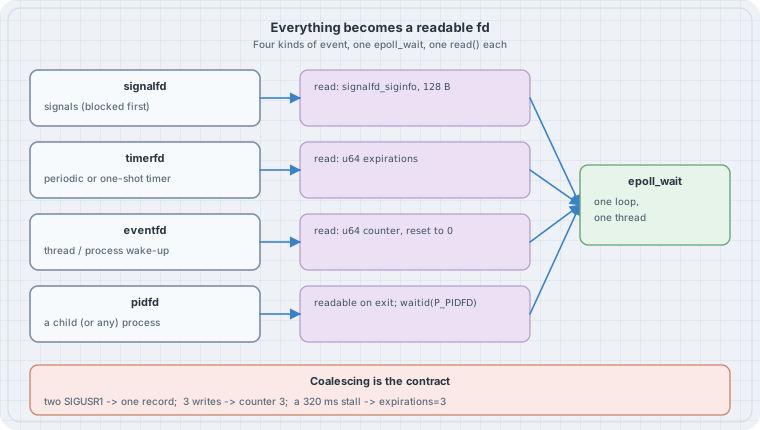
  sigprocmask(BLOCK) ─► signalfd ─┐
  timerfd_settime    ─► timerfd  ─┤
  write(efd, 1)      ─► eventfd  ─┼─► epoll_wait ─► read()/waitid() the ready fd
  fork / pidfd_open  ─► pidfd    ─┘
Three rules carry the chapter:
- Block before you signalfd. A signal that is not blocked is still delivered the old way (default action or handler). The signalfd only sees signals that stay pending.
- Read to clear. epoll is level-triggered by default. An fd you don’t drain is reported again on every
epoll_wait, and the loop spins. - Counts, not queues. Standard signals of the same number merge while pending. eventfd adds up writes. timerfd counts expirations you missed. Design handlers for “at least one happened”.
Syntax
#include <sys/signalfd.h>   // int signalfd(int fd, const sigset_t *mask, int flags);  SFD_NONBLOCK | SFD_CLOEXEC
#include <sys/timerfd.h>    // int timerfd_create(int clockid, int flags);              TFD_NONBLOCK | TFD_CLOEXEC
                            // int timerfd_settime(int fd, int flags, const struct itimerspec *new, struct itimerspec *old);
#include <sys/eventfd.h>    // int eventfd(unsigned int initval, int flags);           EFD_NONBLOCK | EFD_CLOEXEC | EFD_SEMAPHORE
#include <sys/epoll.h>      // epoll_create1, epoll_ctl(EPOLL_CTL_ADD), epoll_wait
// pidfd_open(pid, 0) via syscall(SYS_pidfd_open, ...) or glibc 2.36+ <sys/pidfd.h>
Python exposes os.eventfd (3.10+) and os.timerfd_create/os.timerfd_settime (3.13+). It has no signalfd; Python code uses signal.set_wakeup_fd for the same job.
Safety
- Everything here is unprivileged and only touches your own process and its children.
- Always pass the
*_CLOEXECflags. Otherwise every program youexecinherits your timers and counters. - Use
*_NONBLOCKand read untilEAGAINwhen several records may be queued, as with signalfd.
Examples with Explanations
Run on Linux 6.12, glibc, GCC and Python 3.13. All outputs are genuine.
1. One loop, four kinds of event
// fdloop.c: one epoll loop where signals, a timer, a thread's wake-ups and a
// child's exit all arrive as readable file descriptors.
// build: cc -O2 -Wall -pthread -o fdloop fdloop.c
#define _GNU_SOURCE
#include <errno.h>
#include <pthread.h>
#include <signal.h>
#include <stdint.h>
#include <stdio.h>
#include <stdlib.h>
#include <string.h>
#include <sys/epoll.h>
#include <sys/eventfd.h>
#include <sys/signalfd.h>
#include <sys/syscall.h>
#include <sys/timerfd.h>
#include <sys/wait.h>
#include <time.h>
#include <unistd.h>

static struct timespec t0;
static double ms(void) {
    struct timespec t; clock_gettime(CLOCK_MONOTONIC, &t);
    return (t.tv_sec - t0.tv_sec) * 1e3 + (t.tv_nsec - t0.tv_nsec) / 1e6;
}
static void die(const char *m) { perror(m); exit(1); }

static void *worker(void *arg) {          // posts three "jobs done" in a row
    int efd = *(int *)arg; uint64_t one = 1;
    usleep(50 * 1000);
    for (int i = 0; i < 3; i++)
        if (write(efd, &one, sizeof one) != sizeof one) die("eventfd write");
    return NULL;
}

static void show(const char *name, int fd) {
    char path[64], target[128];
    snprintf(path, sizeof path, "/proc/self/fd/%d", fd);
    ssize_t n = readlink(path, target, sizeof target - 1);
    target[n < 0 ? 0 : n] = 0;
    printf("  fd %d %-9s -> %s\n", fd, name, target);
}

int main(void) {
    clock_gettime(CLOCK_MONOTONIC, &t0);

    // 1. Signals: block them first, so they queue for the signalfd instead of
    //    running a handler. Blocking before creating threads makes every thread inherit it.
    sigset_t mask; sigemptyset(&mask);
    sigaddset(&mask, SIGUSR1); sigaddset(&mask, SIGTERM);
    if (sigprocmask(SIG_BLOCK, &mask, NULL)) die("sigprocmask");
    int sfd = signalfd(-1, &mask, SFD_CLOEXEC | SFD_NONBLOCK);

    // 2. A periodic timer: first expiry after 100 ms, then every 100 ms.
    int tfd = timerfd_create(CLOCK_MONOTONIC, TFD_CLOEXEC | TFD_NONBLOCK);
    struct itimerspec its = { .it_interval = {0, 100000000}, .it_value = {0, 100000000} };
    if (timerfd_settime(tfd, 0, &its, NULL)) die("timerfd_settime");

    // 3. A counter another thread can bump.
    int efd = eventfd(0, EFD_CLOEXEC | EFD_NONBLOCK);

    // 4. A child that exits with status 7 after 450 ms, watched through a pidfd.
    pid_t pid = fork();
    if (pid == 0) { usleep(450 * 1000); _exit(7); }
    int pfd = syscall(SYS_pidfd_open, pid, 0);
    if (sfd < 0 || tfd < 0 || efd < 0 || pfd < 0) die("creating fds");

    puts("what the descriptors are:");
    show("signalfd", sfd); show("timerfd", tfd); show("eventfd", efd); show("pidfd", pfd);

    int ep = epoll_create1(EPOLL_CLOEXEC);
    int fds[] = { sfd, tfd, efd, pfd };
    for (int i = 0; i < 4; i++) {
        struct epoll_event ev = { .events = EPOLLIN, .data.fd = fds[i] };
        if (epoll_ctl(ep, EPOLL_CTL_ADD, fds[i], &ev)) die("epoll_ctl");
    }

    pthread_t th; pthread_create(&th, NULL, worker, &efd);
    kill(getpid(), SIGUSR1); kill(getpid(), SIGUSR1);   // two of the same standard signal

    puts("event loop:");
    int ticks = 0;
    for (;;) {
        struct epoll_event evs[4];
        int n = epoll_wait(ep, evs, 4, -1);
        if (n < 0) { if (errno == EINTR) continue; die("epoll_wait"); }
        for (int i = 0; i < n; i++) {
            int fd = evs[i].data.fd;
            if (fd == tfd) {
                uint64_t exp; if (read(tfd, &exp, sizeof exp) != sizeof exp) die("read timerfd");
                printf("%7.1f ms  timerfd  expirations=%llu\n", ms(), (unsigned long long)exp);
                if (++ticks == 2) { usleep(320 * 1000); printf("%7.1f ms  (loop was busy for 320 ms)\n", ms()); }
            } else if (fd == efd) {
                uint64_t c; if (read(efd, &c, sizeof c) != sizeof c) die("read eventfd");
                printf("%7.1f ms  eventfd  counter=%llu (then reset to 0)\n", ms(), (unsigned long long)c);
            } else if (fd == pfd) {
                siginfo_t si = {0};
                if (waitid(P_PIDFD, pfd, &si, WEXITED)) die("waitid");
                printf("%7.1f ms  pidfd    child %d exited, status %d\n", ms(), si.si_pid, si.si_status);
                epoll_ctl(ep, EPOLL_CTL_DEL, pfd, NULL); close(pfd);
                kill(getpid(), SIGTERM);                       // ask ourselves to stop
            } else if (fd == sfd) {
                struct signalfd_siginfo si;
                while (read(sfd, &si, sizeof si) == sizeof si) {
                    printf("%7.1f ms  signalfd %s from pid %u\n", ms(), strsignal(si.ssi_signo), si.ssi_pid);
                    if (si.ssi_signo == SIGTERM) { pthread_join(th, NULL); puts("clean exit"); return 0; }
                }
            }
        }
    }
}
$ cc -O2 -Wall -pthread -o fdloop fdloop.c && ./fdloop
what the descriptors are:
fd 5 signalfd -> anon_inode:[signalfd]
fd 6 timerfd -> anon_inode:[timerfd]
fd 7 eventfd -> anon_inode:[eventfd]
fd 8 pidfd -> anon_inode:[pidfd]
event loop:
0.2 ms signalfd User defined signal 1 from pid 1582492
50.6 ms eventfd counter=3 (then reset to 0)
100.1 ms timerfd expirations=1
200.2 ms timerfd expirations=1
520.3 ms (loop was busy for 320 ms)
520.3 ms timerfd expirations=3
520.3 ms pidfd child 1582493 exited, status 7
520.3 ms signalfd Terminated from pid 1582492
clean exitLine by line:
/proc/self/fdshows every object as an anonymous inode named after its type. That is how you spot these in someone else’s process withls -l /proc/PID/fd. The exact link name for pidfds varies with kernel version and config.signalfd … from pid: twokill(SIGUSR1)calls produced one record. Standard signals are a pending bit, not a queue (real-time signals,SIGRTMIN+n, do queue). The record also carries the sender’s PID (ssi_pid), which a classic handler only gets throughSA_SIGINFO.eventfd counter=3: the worker wrote1three times before the loop woke. One wake-up, one read, total 3.timerfd expirations=3: the loop stalled for 320 ms after the second tick. The timer did not queue three events; it counted them, and one read returned3. A periodic job can use that number to catch up, or decide to skip.pidfd: the child’s exit made the pidfd readable.waitid(P_PIDFD)reaped it and returned status 7. NoSIGCHLDhandler was involved.- The process then sent itself
SIGTERM, which arrived as just another fd event. The loop shut down cleanly, joining the worker thread, instead of being killed half-way through.
2. The kernel’s view: /proc/self/fdinfo, and EFD_SEMAPHORE
# fdinfo.py: the kernel's view of an eventfd and a timerfd, and EFD_SEMAPHORE (Python 3.13+)
import os, time

def fdinfo(fd):
    lines = open(f"/proc/self/fdinfo/{fd}").read().splitlines()
    return [l for l in lines if not l.startswith(("pos:", "flags:", "mnt_id:", "ino:"))]

e = os.eventfd(0, os.EFD_CLOEXEC | os.EFD_NONBLOCK)
os.eventfd_write(e, 5)
print("eventfd after write(5):", fdinfo(e))
print("read ->", os.eventfd_read(e), "| read again ->", end=" ")
try: os.eventfd_read(e)
except BlockingIOError: print("EAGAIN (counter is 0)")

s = os.eventfd(3, os.EFD_SEMAPHORE | os.EFD_NONBLOCK)
got = []
while True:
    try: got.append(os.eventfd_read(s))
    except BlockingIOError: break
print("EFD_SEMAPHORE, initial 3: reads ->", got)

t = os.timerfd_create(time.CLOCK_MONOTONIC, flags=os.TFD_NONBLOCK)
os.timerfd_settime(t, initial=2.0, interval=0.5)
print("timerfd armed:", fdinfo(t))
$ python3 fdinfo.py
eventfd after write(5): ['eventfd-count: 5', 'eventfd-id: 117', 'eventfd-semaphore: 0']
read -> 5 | read again -> EAGAIN (counter is 0)
EFD_SEMAPHORE, initial 3: reads -> [1, 1, 1]
timerfd armed: ['clockid: 1', 'ticks: 0', 'settime flags: 00', 'it_value: (1, 999977754)', 'it_interval: (0, 500000000)']fdinfo is the debugging view for someone else’s process too (/proc/PID/fdinfo/FD, readable by the same user). It shows an eventfd’s pending count and a timerfd’s clock (1 = CLOCK_MONOTONIC), time to next expiry and interval. A plain eventfd hands the whole sum to one reader. With EFD_SEMAPHORE, each read takes 1, so N waiting workers can each claim one unit.
3. The trap: the blocked mask leaks into children
The mask you set for the signalfd is inherited across fork and execve. Anything you start from the loop begins life with those signals blocked:
# maskleak.py: a blocked signal mask survives fork+exec, so a child can't be stopped with SIGTERM
import signal, subprocess
signal.pthread_sigmask(signal.SIG_BLOCK, {signal.SIGTERM, signal.SIGUSR1})
out = subprocess.run(["grep", "SigBlk", "/proc/self/status"], capture_output=True, text=True).stdout
print("child", out.strip(), "(signal N is bit N-1: 0x200 = SIGUSR1, 0x4000 = SIGTERM)")
p = subprocess.Popen(["sleep", "30"]); p.terminate()
try: p.wait(timeout=1); print("sleep stopped by SIGTERM")
except subprocess.TimeoutExpired: print("sleep ignored SIGTERM for 1 s (blocked); killing"); p.kill(); p.wait()
$ python3 maskleak.py
child SigBlk: 0000000000004200 (signal N is bit N-1: 0x200 = SIGUSR1, 0x4000 = SIGTERM)
sleep ignored SIGTERM for 1 s (blocked); killingSigBlk in /proc/PID/status is a bitmask (signal N is bit N−1), and the child’s shows both signals still blocked. sleep never sees SIGTERM; only SIGKILL, which cannot be blocked, gets rid of it. This is a classic cause of “my service manager can’t stop the worker”, because the supervisor’s signalfd setup leaked into the workers. The fix is to unblock in the child between fork and exec (sigprocmask(SIG_SETMASK, &old, NULL)), or to use posix_spawn with posix_spawnattr_setsigmask.
The trap
Forgetting that threads have their own masks. Block the signals in main before creating any thread, as fdloop.c does, so every thread inherits the block. If one thread still has SIGTERM unblocked, the kernel may deliver the signal to that thread with its default action, killing the process, and the signalfd never sees it.
Notes & Pitfalls
- Reads must be the right size. eventfd and timerfd reads need an 8-byte buffer (
EINVALotherwise). signalfd needs room for at least one 128-bytesignalfd_siginfo. - eventfd writes of
0xfffffffffffffffffail withEINVAL. A write that would overflow the counter blocks, or returnsEAGAINwithEFD_NONBLOCK. CLOCK_MONOTONICvsCLOCK_REALTIME. Use monotonic for intervals. For wall-clock alarms use realtime withTFD_TIMER_ABSTIME, and addTFD_TIMER_CANCEL_ON_SETto hear about clock jumps (the read fails withECANCELED).CLOCK_BOOTTIMEkeeps counting through suspend. The*_ALARMclocks can wake the system, but they needCAP_WAKE_ALARM.- A signalfd sees only the signals in its mask that are pending for the process or for the reading thread. Signals aimed at another thread (
pthread_kill) stay with that thread. - epoll and fork. A child shares the parent’s epoll instance and its registrations. Create event loops after forking, not before.
The boring rule
Block signals first, before threads. Create every fd with CLOEXEC|NONBLOCK. Drain what epoll reports, and treat every read as “N things happened”. Restore the signal mask in children before exec.
Try this
- Change
fdloop.cto sendSIGRTMINtwice instead ofSIGUSR1(add it to the mask). How many signalfd records do you get now? - Comment out the
read()in the timerfd branch and run it undertimeout 1. Count how often the loop wakes. That is level triggering. - Create the eventfd with
EFD_SEMAPHOREand see what the loop prints for the worker’s three writes. - Find a long-running process on your machine (
systemd --user, a browser, an editor) and list which anonymous-inode fds it holds:ls -l /proc/PID/fd | grep anon_inode.
Verification
fdloop.cwas built with GCC (-Wall, no warnings) and run on Linux 6.12.fdinfo.pyandmaskleak.pywere run on Python 3.13.5 on the same machine. All outputs above are unedited.- Timings (50, 100, 200, 520 ms) are wall-clock and will vary slightly; the counts (1 SIGUSR1 record, counter 3, expirations 3, status 7) are deterministic.
- Kernel version numbers in the table come from the man pages listed below.
Sources
- signalfd(2): https://man7.org/linux/man-pages/man2/signalfd.2.html
- timerfd_create(2): https://man7.org/linux/man-pages/man2/timerfd_create.2.html
- eventfd(2): https://man7.org/linux/man-pages/man2/eventfd.2.html
- epoll(7): https://man7.org/linux/man-pages/man7/epoll.7.html
- pidfd_open(2) and waitid(2): https://man7.org/linux/man-pages/man2/pidfd_open.2.html, https://man7.org/linux/man-pages/man2/waitid.2.html
- signal(7), standard vs real-time signal queueing: https://man7.org/linux/man-pages/man7/signal.7.html
- proc_pid_fdinfo(5): https://man7.org/linux/man-pages/man5/proc_pid_fdinfo.5.html
- Python
osmodule, eventfd and timerfd: https://docs.python.org/3/library/os.html#os.eventfd