Day 2 — Variables, types & constants
Day 2 — Variables, types & constants
Stage I · ~3h (theory-heavy)
Goal: Internalize Go’s type rules—zero values, declarations, constants, and explicit conversions—then apply them in a small units CLI.
Why this day exists
Go’s type system is small but strict. The pain points are predictable:
- Expecting C-style implicit numeric promotions
- Treating zero values as “unset” without a separate signal
- Mixing typed and untyped constants incorrectly
- Using integer division for physical quantities
Mastering these early prevents mysterious bugs in later concurrency and API code.
Theory 1 — Types are sets of values + operations
A type answers:
- What values are allowed?
- What operations are legal?
- How is it represented (size/alignment)—later relevant for performance
Predeclared numeric types (selected)
| Type | Role |
|---|---|
int, uint |
Architecture-sized (at least 32-bit; typically 64 on modern desktops) |
int8…int64, uint8…uint64 |
Fixed width |
float32, float64 |
IEEE floats; prefer float64 unless constrained |
byte |
Alias of uint8 |
rune |
Alias of int32 (Unicode code point) |
complex64, complex128 |
Exist; rarely needed in this volume |
Example — representation matters for overflow theory
var u uint8 = 255
// u = u + 1  // wraps to 0 in Go (modular arithmetic for integers)
You will not exploit wrap in the units CLI—but you must know it exists.
Theory 2 — Zero values
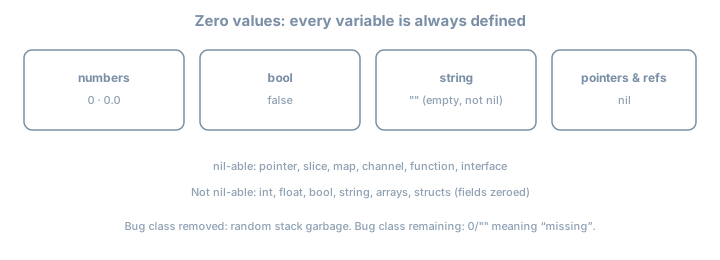
Law
Allocating a variable without initialization yields the zero value, not garbage.
Examples
var i int           // 0
var f float64       // 0
var b bool          // false
var s string        // ""
var p *int          // nil
var xs []int        // nil slice (len 0, cap 0, no array)
var m map[string]int // nil map (read-only safe; write panics)
Design consequence
APIs often cannot use 0 or "" to mean “missing.” Patterns later:
*Tpointer (nil = absent)
okboolean from maps
sql.Null*types
- custom option types
Example — zero value bug class
func average(nums []int) float64 {
    var sum int
    for _, n := range nums {
        sum += n
    }
    return float64(sum) / float64(len(nums)) // panics or Inf if len==0
}
Zero-length input is a domain problem; zero values did not cause it, but they encourage forgetting edge cases.
Theory 3 — Declaration forms
Four common shapes
var x int                 // zero value
var y int = 3             // explicit type + init
var z = 3                 // type inferred (int)
w := 3                    // short declare; function scope only
Multiple assignment
a, b := 1, 2
a, b = b, a               // swap
v, err := strconv.Atoi("42")
Redeclaration rule with :=
x, err := f()
x, err := g()   // ERROR if no new variable on left
x, err = g()    // OK: assignment
x, err2 := g()  // OK: err2 is new
Package-level vs function-level
var globalCounter int     // OK at package level
// count := 0             // ILLEGAL at package level
Example — prefer clarity
// Good when zero then fill
var buf []byte
if need {
    buf = make([]byte, 1024)
}

// Good when known init
name := "gopher"
Theory 4 — No implicit conversion between named types
var a int = 1
var b int64 = 2
// var c = a + b     // compile error
var c = int64(a) + b // explicit conversion
Conversion vs assertion (preview)
| Construct | Meaning |
|---|---|
T(x) |
Conversion when allowed (numerics, strings/bytes, etc.) |
x.(T) |
Type assertion on interfaces (later days) |
String ↔︎ numeric is not free
// n := int("42")           // illegal
n, err := strconv.Atoi("42") // decoding, can fail
s := strconv.Itoa(42)
Worked examples
var x int32 = 65
fmt.Println(string(rune(x))) // "A" — rune conversion intentional

b := []byte("hi")
s := string(b)               // copy of bytes as string
Caution: string(65) as string(rune(65)) is a code point, not decimal text "65".
Theory 5 — Constants: typed vs untyped
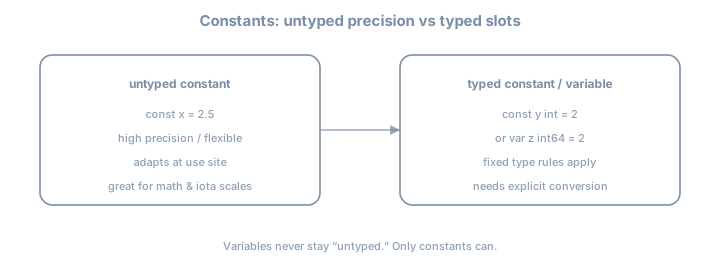
Untyped constants
const Pi = 3.14159265358979323846 // untyped floating
const Two = 2                     // untyped integer
They can be used in more contexts until they must become a concrete type:
var f32 float32 = Two   // OK
var i int = Two         // OK
var u uint = Two        // OK
Typed constants
const Max int = 100
// var u uint = Max     // error: cannot use Max (type int) as uint
var u uint = uint(Max)
iota — enumerator generator
const (
    KB = 1 << (10 * iota) // 1 << 0 = 1
    MB                    // 1 << 10
    GB                    // 1 << 20
)

const (
    StatusOK = iota // 0
    StatusFail      // 1
    StatusRetry     // 2
)
Example — skip values
const (
    _ = iota // 0 discarded
    Readable // 1
    Writable // 2
    Executable // 3
)
Constants must be compile-time
// const now = time.Now() // illegal — function call not constantTheory 6 — Integer division and mixed arithmetic
fmt.Println(5 / 2)          // 2
fmt.Println(5.0 / 2.0)      // 2.5
fmt.Println(float64(5) / 2) // 2.5
Physical quantities (metres, °C) should almost always use float64 for intermediate math in this course.
Temperature theory (for the lab)
- Fahrenheit from Celsius:
F = C * (9.0/5.0) + 32 - Celsius from Fahrenheit:
C = (F - 32) * (5.0/9.0)
Use float constants 9.0/5.0, not 9/5 (integer → 1).
Theory 7 — Conversion architecture for CLIs
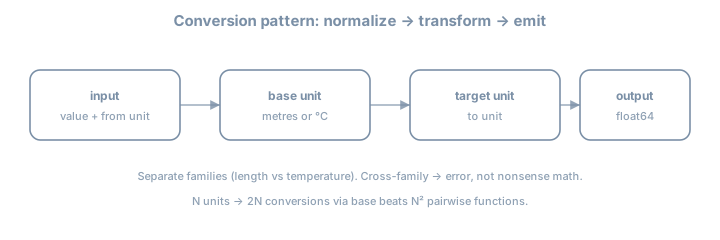
Why a base unit?
For N units, pairwise converters need on the order of N² functions. Via a base unit you only need about 2N (to-base and from-base).
Families
| Family | Base (suggested) | Members |
|---|---|---|
| Length | metre | m, km |
| Temperature | Celsius | c, f |
Cross-family conversion must error, not invent physics.
Error theory (preview of Day 11–13)
Return error as a value:
return 0, fmt.Errorf("unknown unit %q", unit)Do not panic for user input mistakes.
Worked examples bank (study these)
Example A — zero values print
var i int
var s string
var p *int
fmt.Printf("%d %q %v\n", i, s, p) // 0 "" <nil>
Example B — constant kind flexibility
const K = 1000
var a int = K
var b int64 = K
var c float64 = K
Example C — illegal mix
var x int = 1
var y int64 = 2
// fmt.Println(x + y) // must not compile
fmt.Println(int64(x) + y)
Example D — iota flags pattern (stretch theory)
const (
    FlagRead = 1 << iota // 1
    FlagWrite            // 2
    FlagExec             // 4
)
Lab 1 — Zeros and illegal conversions
mkdir -p ~/lab/90daysofx/go/day02
cd ~/lab/90daysofx/go/day02
go mod init example.com/day02
Write sandbox.go that prints zero values and contains a commented illegal int+int64 line. Uncomment once to read the error, then restore.
Lab 2 — Units CLI (application of theory)
Spec
units <value> <from> <to>Minimum units: m, km, c, f.
Skeleton (main)
package main

import (
    "fmt"
    "os"
    "strconv"
    "strings"
)

func main() {
    if len(os.Args) != 4 {
        fmt.Fprintf(os.Stderr, "usage: %s <value> <from> <to>\n", os.Args[0])
        os.Exit(2)
    }
    value, err := strconv.ParseFloat(os.Args[1], 64)
    if err != nil {
        fmt.Fprintf(os.Stderr, "invalid value: %v\n", err)
        os.Exit(2)
    }
    from := strings.ToLower(os.Args[2])
    to := strings.ToLower(os.Args[3])
    out, err := convert(value, from, to)
    if err != nil {
        fmt.Fprintf(os.Stderr, "%v\n", err)
        os.Exit(1)
    }
    fmt.Printf("%g %s\n", out, to)
}
Implement convert using base-unit normalization and const factors. Reject cross-family.
Test matrix
go build -o units .
./units 1 km m
./units 1000 m km
./units 0 c f
./units 32 f c
./units 1 m c      # error
./units 5 xyz m    # error
Expected theory checks in code review (self)
- No integer division in temperature formulas
- Explicit
float64parse path
- Clear errors (unknown unit / family mismatch)
- Constants for factors, not magic numbers only
Stretch theory
Add mi ↔︎ km with a documented constant approximation, still via metres as base.
Common gotchas
| Gotcha | Fix |
|---|---|
9/5 in temperature |
Use 9.0/5.0 |
:= redeclaration |
Introduce a new name or use = |
Float == |
Prefer printing; tests use epsilon later |
string(65) confusion |
Use strconv for decimal text |
| Nil map write | make before write |
Checkpoint
- Explain zero values for
int,string,*T,map
- Show compile error for
int + int64without conversion
- Explain untyped vs typed constants with an example
- Units CLI passes the test matrix
- Cross-family conversion fails clearly
Commit
git add .
git commit -m "day02: type theory + units CLI"
Tomorrow
Day 3 — Control flow: if, switch, and the many forms of for—with non-toy control problems and short-circuit theory.