Day 5 — Arrays, slices & append
Day 5 — Arrays, slices & append
Stage I · ~3h (theory-heavy)
Goal: Internalize the slice header (pointer, length, capacity), how append may reallocate, and how to avoid silent aliasing—then implement a growable buffer or ring buffer with deliberate capacity control.
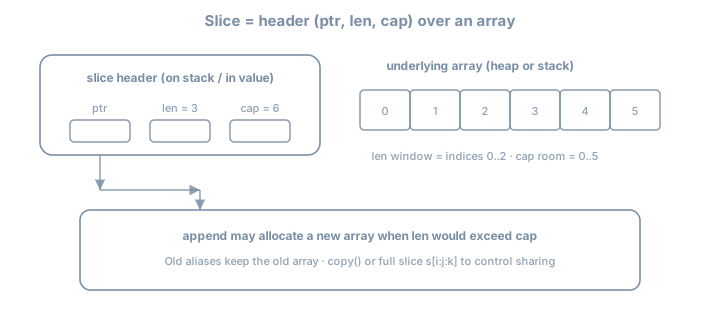
If you remember only one picture from Stage I: a slice is a small descriptor pointing at an array, not the array itself. Most production bugs around “I modified a copy” are header misunderstandings.
Why this day exists
Slices are the workhorse collection type:
- Function args, JSON arrays, HTTP body chunks, table-test cases—all slices
- Arrays exist and matter for size-in-type and some crypto/fixed buffers, but day-to-day code is slices
append, sub-slicing, and shared backing arrays create aliasing that looks like magic until the model is clear
Day 5 is theory you will reuse on every later day that touches data.
Theory 1 — Arrays: value types with fixed length
var a [3]int           // [0 0 0]
b := [3]int{1, 2, 3}
c := [...]int{4, 5, 6} // length inferred: [3]int
Length is part of the type
var x [3]int
var y [4]int
// x = y // compile error: different types
Assignment copies the entire array
a := [3]int{1, 2, 3}
b := a
b[0] = 99
fmt.Println(a[0]) // 1 — a unchanged
Arrays are rare in APIs because size is rigid. They appear in:
- SHA digest sizes (
[32]byte)
- Small fixed protocol headers
- Backing storage you then slice
Theory 2 — The slice header
A slice value is a header with three fields (conceptually):
| Field | Meaning |
|---|---|
| pointer | Address of element 0 of this slice view |
| length | Number of accessible elements (len) |
| capacity | Number of elements in the backing array from the pointer to the end (cap) |
s := make([]int, 3, 5) // len=3, cap=5
fmt.Println(len(s), cap(s)) // 3 5
Nil vs empty
var nilSlice []int          // nil: len=0, cap=0
empty := []int{}            // non-nil empty (usually)
empty2 := make([]int, 0)    // non-nil empty

fmt.Println(nilSlice == nil) // true
fmt.Println(empty == nil)    // false
Both have len == 0. Prefer len(s) == 0 over s == nil when checking “no elements,” unless you intentionally treat nil as a distinct signal (e.g., “unset” vs “empty list” in JSON can still both become nil depending on encoding—be careful).
Literal and make
s1 := []int{1, 2, 3}     // len=3, cap=3
s2 := make([]int, 10)    // len=10, cap=10, zeroed
s3 := make([]int, 0, 64) // len=0, cap=64 — pre-grow
Theory 4 — append growth
var s []int
s = append(s, 1)
s = append(s, 2, 3)
s = append(s, []int{4, 5}...)
Rules of thumb
- If
len < cap, append writes in place and returns a header withlen+n.
- If not enough capacity, runtime allocates a larger array, copies, returns a new header.
- Always assign the result:
s = append(s, x).
s = append(s, x) // correct
append(s, x)     // compile error: result unused (as of modern Go checks) — still: never ignore it
Capacity growth is implementation detail
Do not hard-code assumptions about exact growth factors across Go versions. For performance, preallocate when you know size:
out := make([]T, 0, len(in))
for _, v := range in {
    out = append(out, transform(v))
}
copy
dst := make([]int, 2)
src := []int{1, 2, 3}
n := copy(dst, src) // n=2; dst=[1 2]
copy copies min(len(dst), len(src)) elements and handles overlap correctly.
Theory 5 — Passing slices to functions
Slices are passed as headers by value. The header is copied; the backing array is shared.
func setFirst(s []int) {
    if len(s) > 0 {
        s[0] = 100 // visible to caller
    }
}

func appendLocal(s []int) {
    s = append(s, 9) // may not be visible: local header only
}

func appendReturn(s []int) []int {
    return append(s, 9) // caller must use returned header
}| Mutation | Visible to caller? |
|---|---|
Change s[i] |
Yes (shared array) |
append that fits in cap |
Maybe yes for elements, but caller’s len unchanged unless they use returned slice |
append that reallocates |
Caller still holds old header unless they assign return |
Idiom: functions that grow a slice return the new slice (or use a pointer to slice: *[]T, less common).
Theory 6 — Strings, bytes, and runes (slice-adjacent)
s := "Go"
b := []byte(s) // copy of bytes
r := []rune(s) // Unicode code points
s2 := string(b)stringis immutable; converting to[]byteor[]runecopies
- Prefer
rangeon string for runes; prefer[]bytefor I/O
bytes and strings packages share many APIs (Day 40). Today: do not mutate a []byte that aliases a string’s storage (you cannot get that alias safely without unsafe).
Worked examples bank
Example A — Header introspection
package main

import "fmt"

func header(name string, s []int) {
    fmt.Printf("%s len=%d cap=%d %v\n", name, len(s), cap(s), s)
}

func main() {
    a := make([]int, 3, 6)
    for i := range a {
        a[i] = i + 1
    }
    header("a", a)
    b := a[1:3]
    header("b", b)
    b = append(b, 9)
    header("b after append", b)
    header("a after b append", a) // may show a[3]==9 if capacity shared
}
Example B — Safe grow helper
func push(s []int, v int) []int {
    return append(s, v)
}

func pushAll(s []int, vs ...int) []int {
    return append(s, vs...)
}
Example C — Filter without aliasing pitfalls
func filterEven(in []int) []int {
    out := make([]int, 0, len(in))
    for _, v := range in {
        if v%2 == 0 {
            out = append(out, v)
        }
    }
    return out
}
Example D — In-place filter (same slice, careful)
func filterEvenInPlace(s []int) []int {
    n := 0
    for _, v := range s {
        if v%2 == 0 {
            s[n] = v
            n++
        }
    }
    return s[:n]
}
Still shares capacity with original; fine if you only use the returned header.
Example E — Ring buffer sketch
type Ring struct {
    buf  []int
    head int
    size int
}

func NewRing(cap int) *Ring {
    return &Ring{buf: make([]int, cap)}
}

func (r *Ring) Push(v int) {
    if r.size < len(r.buf) {
        r.size++
    } else {
        r.head = (r.head + 1) % len(r.buf)
    }
    idx := (r.head + r.size - 1) % len(r.buf)
    r.buf[idx] = v
}

func (r *Ring) Snapshot() []int {
    out := make([]int, r.size)
    for i := 0; i < r.size; i++ {
        out[i] = r.buf[(r.head+i)%len(r.buf)]
    }
    return out
}
Example F — Remove element without leaving garbage (slice tricks)
func deleteAt(s []int, i int) []int {
    // order-preserving
    return append(s[:i], s[i+1:]...)
}

func deleteAtUnordered(s []int, i int) []int {
    s[i] = s[len(s)-1]
    return s[:len(s)-1]
}
Know that append(s[:i], s[i+1:]...) can alias; if other headers still point into s, they may see surprising contents.
Labs
Suggested workspace: ~/lab/90daysofx/go/day05
Lab 1 — Prove aliasing
mkdir -p ~/lab/90daysofx/go/day05
cd ~/lab/90daysofx/go/day05
go mod init example.com/day05
Write a program that:
- Creates a slice with
len < cap
- Sub-slices it
appends into the sub-slice
- Prints parent and child before/after
Then fix the clobber with a full slice expression s[low:high:high] or an explicit copy.
Lab 2 — Growable buffer
Implement a line buffer type:
type Buffer struct {
    lines []string
}

func (b *Buffer) Add(line string) { /* append */ }
func (b *Buffer) Len() int
func (b *Buffer) Lines() []string // return a copy OR document that caller must not mutate
Decide and document: does Lines() return a defensive copy? Implement that choice.
CLI: read stdin, store lines, print count and last 5 lines.
Lab 3 — Ring buffer (stretch)
Implement fixed-capacity ring of the last N integers (or lines). On overflow, drop oldest. Print contents in chronological order.
go build -o ring .
echo -e "1\n2\n3\n4\n5" | ./ring -n 3
# expect 3 4 5
Common gotchas
| Gotcha | Fix |
|---|---|
Forgetting s = append(s, x) |
Always assign |
| Sub-slice append overwrites parent | Full slice expr or copy |
Assuming []T{} equals nil |
Compare with len for emptiness |
| Passing slice to grow in-place without return | Return new header |
| Using arrays when size varies | Use slices |
range copy of large array |
for i := range a avoids copying elements if you only need indices; ranging for i, v := range largeArray copies array to range over—prefer slice |
| Memory “leak” via large backing array | Copy to shrink if you keep a tiny sub-slice of a huge buffer |
Checkpoint
- Draw pointer/len/cap for a slice and a sub-slice
- Explain nil vs empty slice
- Demonstrate shared backing array mutation
- Prevent clobber with full slice expression or
copy
- Buffer or ring lab works
- Can explain why
appendsometimes reallocates
Commit
git add .
git commit -m "day05: slices, append, buffer/ring"
Tomorrow
Day 6 — Maps: make vs nil, comma-ok, delete, iteration randomness, and using maps as counters and simple caches without data races (single-goroutine rules for now).