Maths — volume overview
Volume 3: Maths for CS & programming
Role in the series: independent volume — from scratch through the discrete mathematics computer science and programming actually use.
Pacing: ~2–3h per day when you work every example and exercise; any calendar is fine.
Style: definitions · theorems · worked examples · exercises — no programming labs, no lab machines. Pen and paper is enough. Optional calculator/Python only to check arithmetic after hand work.
Who this volume is for
- Programmers rusty on foundations, or never taught them cleanly
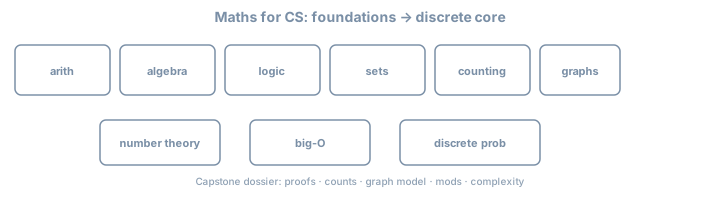
- Learners who need logic, sets, counting, graphs, modular arithmetic, asymptotics, and discrete probability for algorithms and systems
- Anyone who prefers understanding concepts over building software while learning math
What this volume is not
- A coding bootcamp with math sprinkled in
- Full calculus / real analysis / olympiad training
- A full linear-algebra or automata-theory course (we own \(2\times2\) matrix systems and discrete structures deeply; continua and machines are companions later)
- Production cryptography engineering (RSA/DH appear as math stories, not implementations)
Coverage at a glance
| Area | You will own |
|---|---|
| Arithmetic & bases | ℤ/ℚ fluency, primes, div/mod, binary/hex, error |
| Algebra | Equations, functions, \(\sum\), \(2\times2\) matrices |
| Logic & proofs | Boolean algebra, quantifiers, induction, invariants |
| Discrete structures | Sets, relations, posets, bijections, countability, pigeonhole |
| Combinatorics | Product/sum, \(P\)/\(C\), binomial, Catalan lite, IE, derangements, GF lite |
| Graphs | Trees, BFS/DFS, DAGs, shortest paths, bipartite/Hall, Euler/color |
| Number theory for CS | Euclid, mods, inverses, Fermat/Euler, CRT, hashing, RSA story |
| Asymptotics & probability | \(O/\Theta\), Master, expectation, variance, coupon collector |
Full contract: Maths syllabus.
What “done” looks like
- Algebra and number sense no longer block algorithms texts
- Read and write basic logic and short proofs (direct, contrapositive/contradiction, induction)
- Fluent with sets, relations, functions in discrete settings
- Count with justification (product/sum, \(P\)/\(C\), IE, simple recurrences)
- Model graphs (paths, trees, DAGs, bipartite awareness)
- Use modular arithmetic and gcd; explain what RSA relies on
- Read big-O / Θ / Ω and apply Master theorem cases
- Use expectation and indicator variables on finite spaces
- Capstone: a defensible written dossier (definitions, 3 proofs, 2 counts, graph model, modular problem, complexity note, retrospective)
How the volume is ordered
| Stage | Days | Theme |
|---|---|---|
| 0 | — | How to study (definitions, examples, exercises) |
| I | 1–10 | Number sense & arithmetic (incl. bases) |
| II | 11–22 | Algebra & functions (+ \(2\times2\) matrices) |
| III | 23–34 | Logic & proofs |
| IV | 35–46 | Sets, relations, functions |
| V | 47–58 | Combinatorics |
| VI | 59–70 | Graphs |
| VII | 71–80 | Number theory for CS |
| VIII | 81–90 | Asymptotics, discrete probability, capstone |
Gates sit at days 10, 22, 34, 46, 58, 70, 80. Fail a gate → retest that stage before advancing.
How to study
How to study maths for CS — definition cards, proof cards, error log, weekly review.
Optional study note
After big-O / graphs, you may re-read algorithm code in any language using this volume’s vocabulary. That is optional. This volume stands alone—no other monorepo book is required.
Companions (not required)
- Lehman, Leighton, Meyer — Mathematics for Computer Science
- Rosen — Discrete Mathematics and Its Applications
- Graham, Knuth, Patashnik — Concrete Mathematics (later depth)