Stacks, Queues, and Ring Buffers
Stacks, Queues, and Ring Buffers
A stack is a Last-In, First-Out (LIFO) structure used for state rollback, undo histories, and expression parsing. A queue is a First-In, First-Out (FIFO) pipeline used for scheduling orders, dispatching workers, and stream buffering. In Go, the boring default is an array-backed slice, but subtle traps lurk when dequeuing or popping pointers without zeroing their slots.
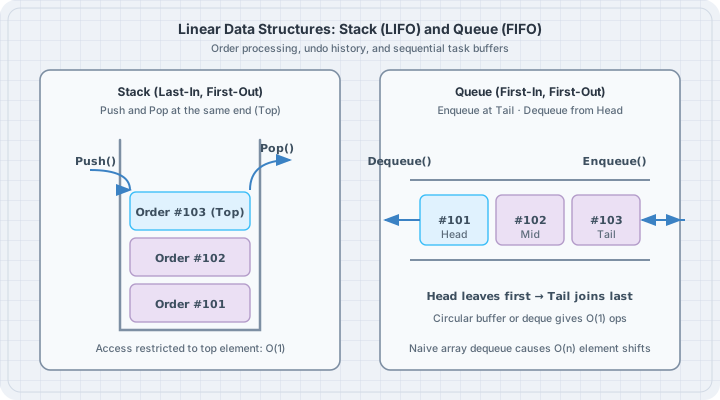
Mental model
In a stack, all activity happens at the top. Pushing appends to the end of a slice in \(O(1)\) amortized time. Popping shrinks the slice length by one in \(O(1)\) time.
Stack (LIFO)                   Queue (FIFO)
+-------------+
| Order #103  | <-- Top (Push/Pop)     Enqueue -> [ #103 | #102 | #101 ] -> Dequeue
+-------------+                         (Tail)                     (Head)
| Order #102  |
+-------------+
| Order #101  |
+-------------+
In a naive queue, calling queue = queue[1:] keeps the underlying array allocated. As elements are consumed, earlier slots become unreachable garbage that cannot be reclaimed by the garbage collector until the whole slice backing array is reallocated. For high-throughput dispatchers, a Ring Buffer (circular array) wraps read and write pointers around a fixed-size buffer using modulo arithmetic, giving true \(O(1)\) operations with zero garbage collector churn:
Ring Buffer (Capacity: 4)
           [0] Order-1
          /   \
  [3] Empty    [1] Order-2  <-- Read Head: 0, Write Tail: 3
          \   /
           [2] Order-3
Worked examples
Case 1: Generic LIFO Stack with Balanced Expression Check
Save as stack_undo.go. Implement a generic Stack[T] with Go generics and use it to validate whether desk formula brackets are balanced.
// stack_undo.go
package main

import (
    "fmt"
)

type Stack[T any] struct {
    items []T
}

func NewStack[T any]() *Stack[T] {
    return &Stack[T]{items: make([]T, 0, 8)}
}

func (s *Stack[T]) Push(val T) {
    s.items = append(s.items, val)
}

func (s *Stack[T]) Pop() (T, bool) {
    var zero T
    if len(s.items) == 0 {
        return zero, false
    }
    lastIdx := len(s.items) - 1
    item := s.items[lastIdx]
    s.items[lastIdx] = zero // Zero out slot to avoid memory leaks
    s.items = s.items[:lastIdx]
    return item, true
}

func (s *Stack[T]) Peek() (T, bool) {
    var zero T
    if len(s.items) == 0 {
        return zero, false
    }
    return s.items[len(s.items)-1], true
}

func (s *Stack[T]) Len() int {
    return len(s.items)
}

func isBalanced(expr string) bool {
    pairs := map[rune]rune{
        ')': '(',
        '}': '{',
        ']': '[',
    }
    openers := map[rune]bool{
        '(': true,
        '{': true,
        '[': true,
    }

    stack := NewStack[rune]()

    for _, ch := range expr {
        if openers[ch] {
            stack.Push(ch)
        } else if match, exists := pairs[ch]; exists {
            top, ok := stack.Pop()
            if !ok || top != match {
                return false
            }
        }
    }

    return stack.Len() == 0
}

func main() {
    expr1 := "TABLE_TOTAL([ITEM(12) + TAX{0.08}] * QTY(2))"
    expr2 := "TABLE_TOTAL([ITEM(12) + TAX{0.08)]" // Mismatched ) and }

    fmt.Printf("Expression 1 valid: %t\n", isBalanced(expr1))
    fmt.Printf("Expression 2 valid: %t\n", isBalanced(expr2))
}
Run:
go run stack_undo.goOutput:
Expression 1 valid: true
Expression 2 valid: false
Case 2: Ring Buffer FIFO Queue
Save as ring_buffer.go. Implement a fixed-capacity circular buffer queue for incoming orders that avoids repeated allocations.
// ring_buffer.go
package main

import (
    "errors"
    "fmt"
)

var (
    ErrBufferFull  = errors.New("ring buffer is full")
    ErrBufferEmpty = errors.New("ring buffer is empty")
)

type RingBuffer[T any] struct {
    buf   []T
    head  int // Read position
    tail  int // Write position
    count int
    cap   int
}

func NewRingBuffer[T any](capacity int) *RingBuffer[T] {
    return &RingBuffer[T]{
        buf:  make([]T, capacity),
        cap:  capacity,
        head: 0,
        tail: 0,
    }
}

func (r *RingBuffer[T]) Enqueue(item T) error {
    if r.count == r.cap {
        return ErrBufferFull
    }
    r.buf[r.tail] = item
    r.tail = (r.tail + 1) % r.cap
    r.count++
    return nil
}

func (r *RingBuffer[T]) Dequeue() (T, error) {
    var zero T
    if r.count == 0 {
        return zero, ErrBufferEmpty
    }
    item := r.buf[r.head]
    r.buf[r.head] = zero // Free slot reference
    r.head = (r.head + 1) % r.cap
    r.count--
    return item, nil
}

func (r *RingBuffer[T]) Len() int {
    return r.count
}

type Order struct {
    ID    int
    Table int
    Item  string
}

func main() {
    rb := NewRingBuffer[Order](3)

    fmt.Println("Enqueueing 3 orders...")
    _ = rb.Enqueue(Order{ID: 101, Table: 1, Item: "Tea"})
    _ = rb.Enqueue(Order{ID: 102, Table: 4, Item: "Soup"})
    _ = rb.Enqueue(Order{ID: 103, Table: 2, Item: "Salad"})

    err := rb.Enqueue(Order{ID: 104, Table: 5, Item: "Bread"})
    fmt.Printf("4th enqueue when full: %v\n", err)

    first, _ := rb.Dequeue()
    fmt.Printf("Dequeued head: ID=%d Item=%s\n", first.ID, first.Item)

    fmt.Println("Enqueueing Order 104 into vacated slot...")
    _ = rb.Enqueue(Order{ID: 104, Table: 5, Item: "Bread"})

    for rb.Len() > 0 {
        ord, _ := rb.Dequeue()
        fmt.Printf("Remaining queue order: ID=%d Table=%d Item=%s\n", ord.ID, ord.Table, ord.Item)
    }
}
Run:
go run ring_buffer.goOutput:
Enqueueing 3 orders...
4th enqueue when full: ring buffer is full
Dequeued head: ID=101 Item=Tea
Enqueueing Order 104 into vacated slot...
Remaining queue order: ID=102 Table=4 Item=Soup
Remaining queue order: ID=103 Table=2 Item=Salad
Remaining queue order: ID=104 Table=5 Item=Bread
The trap
The most common memory leak in Go stacks and queues is forgetting to zero out references before shrinking a slice. If the slice holds pointers ([]*Ticket), simply truncating s = s[:len(s)-1] leaves the pointer in the backing array. As long as the slice capacity exists, the GC will never free the referenced Ticket, causing an invisible memory leak.
// bad_pop.go
package main

import "fmt"

type HugePayload struct {
    Data [1024]byte
}

type BadStack struct {
    items []*HugePayload
}

func (b *BadStack) BadPop() *HugePayload {
    last := len(b.items) - 1
    item := b.items[last]
    b.items = b.items[:last] // TRAP: b.items[last] still holds the pointer!
    return item
}

func (b *BadStack) GoodPop() *HugePayload {
    last := len(b.items) - 1
    item := b.items[last]
    b.items[last] = nil // FIXED: Clear slot for garbage collector
    b.items = b.items[:last]
    return item
}

func main() {
    stack := &BadStack{items: []*HugePayload{{}, {}}}
    _ = stack.GoodPop()
    fmt.Printf("Good pop safely decremented length: %d\n", len(stack.items))
}
Run:
go run bad_pop.goOutput:
Good pop safely decremented length: 1The boring rule
- Use a plain slice
[]Tfor stacks. Append to push; slice off the end to pop. - Always overwrite the popped index with
var zero T(ornilfor pointers) before slicing down. - For small queues (\(< 1000\) operations), a slice with
queue = queue[1:]is fine, but periodic compaction or a two-index approach is necessary for long-running services. - For high-frequency streaming workloads, choose a fixed-size
RingBufferto eliminate GC allocation pressure entirely.
Try this
- Modify
stack_undo.goto implement anUndoHistorystruct withDo(action)andUndo()methods that revert desk ticket state changes. - Extend
RingBufferinring_buffer.goto automatically double its internal capacity when full rather than returningErrBufferFull.