Linked Lists
Linked Lists
A linked list arranges elements as independent heap nodes connected through pointers rather than contiguous memory slots. The boring default in Go is to use contiguous slices ([]T) for virtually every collection, but linked lists provide valuable insights into pointer semantics, bidirectional node manipulation, and \(O(1)\) insertions without memory shifting.
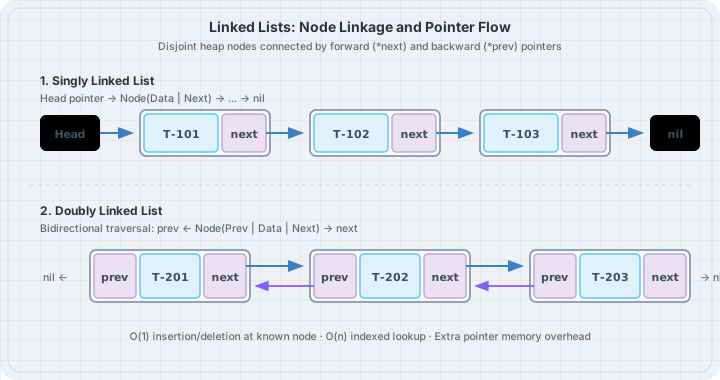
Mental model
In a singly linked list, each node holds a payload value and a single next pointer. In a doubly linked list, each node holds both next and prev pointers.
Singly Linked:
[Head] -> [Data: 101 | Next] -> [Data: 102 | Next] -> nil

Doubly Linked:
nil <- [Prev | Data: 101 | Next] <===> [Prev | Data: 102 | Next] -> nil
Slice vs Linked List: The Hardware Reality
Why is []T almost always faster in Go than a linked list?
| Feature | Go Slice ([]T) |
Doubly Linked List |
|---|---|---|
| Contiguity | Single continuous memory block | Scattered heap allocations |
| CPU Cache | Prefetched into L1/L2 cache lines | Cache miss on nearly every pointer hop |
| Memory Overhead | Zero extra bytes per element | 16–24 bytes of pointers per node |
| Insertion at Head | \(O(n)\) (shifts memory) | \(O(1)\) (rewires pointers) |
| Random Access | \(O(1)\) by index s[i] |
\(O(n)\) traversal from head/tail |
Use linked lists when you must splice elements into arbitrary positions without reallocating or copying large structures (such as an LRU cache).
Worked examples
Case 1: Singly linked list with in-place reversal
Save as singly_linked.go. Build a generic singly linked list for desk dispatch tickets and reverse it in place without allocating new nodes.
// singly_linked.go
package main

import "fmt"

type Node[T any] struct {
    Value T
    Next  *Node[T]
}

type SinglyList[T any] struct {
    Head *Node[T]
    len  int
}

func (l *SinglyList[T]) Prepend(val T) {
    newNode := &Node[T]{Value: val, Next: l.Head}
    l.Head = newNode
    l.len++
}

func (l *SinglyList[T]) Append(val T) {
    newNode := &Node[T]{Value: val}
    if l.Head == nil {
        l.Head = newNode
        l.len++
        return
    }
    curr := l.Head
    for curr.Next != nil {
        curr = curr.Next
    }
    curr.Next = newNode
    l.len++
}

func (l *SinglyList[T]) Reverse() {
    var prev *Node[T]
    curr := l.Head
    for curr != nil {
        next := curr.Next
        curr.Next = prev
        prev = curr
        curr = next
    }
    l.Head = prev
}

func (l *SinglyList[T]) Print() {
    curr := l.Head
    for curr != nil {
        fmt.Printf("[%v] -> ", curr.Value)
        curr = curr.Next
    }
    fmt.Println("nil")
}

func main() {
    list := &SinglyList[string]{}
    list.Append("Ticket-101")
    list.Append("Ticket-102")
    list.Append("Ticket-103")

    fmt.Print("Original list: ")
    list.Print()

    list.Reverse()
    fmt.Print("Reversed list: ")
    list.Print()
}
Run:
go run singly_linked.goOutput:
Original list: [Ticket-101] -> [Ticket-102] -> [Ticket-103] -> nil
Reversed list: [Ticket-103] -> [Ticket-102] -> [Ticket-101] -> nil
Case 2: Doubly linked list with O(1) removal
Save as doubly_linked.go. Implement a doubly linked list where any node can unlink itself in \(O(1)\) time.
// doubly_linked.go
package main

import "fmt"

type DNode[T any] struct {
    Value T
    Prev  *DNode[T]
    Next  *DNode[T]
}

type DoublyList[T any] struct {
    Head *DNode[T]
    Tail *DNode[T]
    len  int
}

func (l *DoublyList[T]) PushBack(val T) *DNode[T] {
    node := &DNode[T]{Value: val, Prev: l.Tail}
    if l.Tail != nil {
        l.Tail.Next = node
    } else {
        l.Head = node
    }
    l.Tail = node
    l.len++
    return node
}

func (l *DoublyList[T]) Remove(node *DNode[T]) {
    if node == nil {
        return
    }
    if node.Prev != nil {
        node.Prev.Next = node.Next
    } else {
        l.Head = node.Next
    }

    if node.Next != nil {
        node.Next.Prev = node.Prev
    } else {
        l.Tail = node.Prev
    }

    node.Next = nil
    node.Prev = nil
    l.len--
}

func (l *DoublyList[T]) PrintForward() {
    curr := l.Head
    for curr != nil {
        fmt.Printf("[%v] <-> ", curr.Value)
        curr = curr.Next
    }
    fmt.Println("nil")
}

func main() {
    list := &DoublyList[int]{}
    n1 := list.PushBack(101)
    n2 := list.PushBack(102)
    n3 := list.PushBack(103)

    fmt.Print("Initial: ")
    list.PrintForward()

    fmt.Printf("Removing middle node: %d\n", n2.Value)
    list.Remove(n2)
    list.PrintForward()

    fmt.Printf("Removing head node: %d\n", n1.Value)
    list.Remove(n1)
    list.PrintForward()

    fmt.Printf("Final tail: %d\n", list.Tail.Value)
    _ = n3
}
Run:
go run doubly_linked.goOutput:
Initial: [101] <-> [102] <-> [103] <-> nil
Removing middle node: 102
[101] <-> [103] <-> nil
Removing head node: 101
[103] <-> nil
Final tail: 103
The trap
The classic trap when modifying a linked list is accidentally dropping the head pointer before wiring the new node, or creating a circular pointer loop during reversal.
// bad_prepend.go
package main

import "fmt"

type ItemNode struct {
    ID   int
    Next *ItemNode
}

func badPrepend(head *ItemNode, id int) {
    // TRAP: In Go, arguments are passed by value.
    // Assigning head = newNode only changes the local copy of the pointer!
    newNode := &ItemNode{ID: id, Next: head}
    head = newNode
    _ = head
}

func goodPrepend(head **ItemNode, id int) {
    newNode := &ItemNode{ID: id, Next: *head}
    *head = newNode
}

func main() {
    var head *ItemNode
    badPrepend(head, 101)
    fmt.Printf("After badPrepend, head is still nil: %t\n", head == nil)

    goodPrepend(&head, 101)
    fmt.Printf("After goodPrepend, head ID: %d\n", head.ID)
}
Run:
go run bad_prepend.goOutput:
After badPrepend, head is still nil: true
After goodPrepend, head ID: 101
The boring rule
- Use slices (
[]T) by default. Slices beat linked lists in 95% of workloads because CPUs fetch contiguous cache lines in parallel. - If you need a linked list in Go, inspect the standard library’s
container/listbefore rolling your own. - When writing custom pointer-linked structures, encapsulate mutations inside methods on the list struct (
func (l *List) Push()) rather than passing raw node pointers across API boundaries. - When unlinking a node, clear its
NextandPrevreferences to assist garbage collection.
Try this
- Implement
Find(predicate func(T) bool) *Node[T]onSinglyListto locate tickets matching specific criteria. - Combine a
map[string]*DNode[Order]withDoublyListto build a 3-item Least-Recently-Used (LRU) cache for desk orders.