Sorting Algorithms
Sorting Algorithms
Sorting arranges data in a predictable order so that searches, aggregations, and deduplications can execute in logarithmic time. In modern Go (1.21+), the boring default is slices.Sort and slices.SortFunc, which implement an adaptive pattern-defeating quicksort (pdqsort). Understanding the classical algorithms—Insertion Sort, Merge Sort, and Quicksort—explains why standard libraries choose hybrid approaches and how to avoid catastrophic worst-case traps.
Mental model
Different sorting algorithms optimize for different constraints:
| Algorithm | Time (Best) | Time (Avg) | Time (Worst) | Memory | Stable? | Best Used When |
|---|---|---|---|---|---|---|
| Insertion Sort | \(O(n)\) | \(O(n^2)\) | \(O(n^2)\) | \(O(1)\) | Yes | Small slices (\(n < 24\)) or nearly-sorted data |
| Merge Sort | \(O(n \log n)\) | \(O(n \log n)\) | \(O(n \log n)\) | \(O(n)\) | Yes | Guaranteed predictable time and stable equality |
| Quicksort | \(O(n \log n)\) | \(O(n \log n)\) | \(O(n^2)\) | \(O(\log n)\) | No | General purpose, fast in-place cache locality |
Go slices.Sort |
\(O(n)\) | \(O(n \log n)\) | \(O(n \log n)\) | \(O(\log n)\) | No | Production default (pdqsort: hybrid quick+insertion+heap) |
Insertion Sort
Works like sorting cards in hand: pick element \(i\) and slide it backward into its sorted position among earlier cards.
Merge Sort
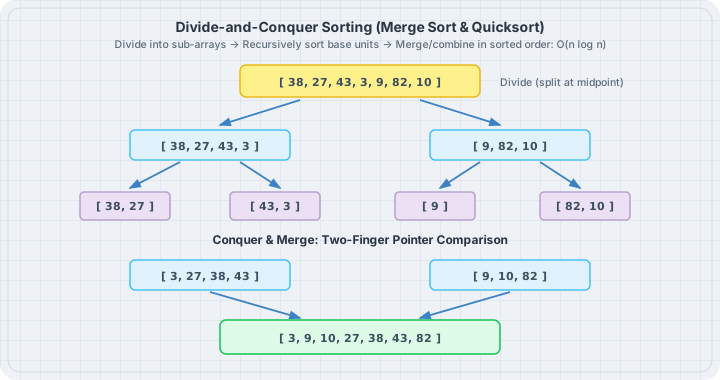
Divides the slice into two halves, recursively sorts them, then merges the two sorted lists using two pointer comparisons into an auxiliary buffer.
Quicksort
Picks a pivot element, partitions the slice so that all elements \(\le pivot\) move to the left and all elements \(> pivot\) move to the right, then recursively sorts both partitions in place.
Quicksort Partition step (Pivot: 25)
[ 14, 38, 10, 42, 25 ]
               ^ Pivot
After Partition:
[ 14, 10 ]  [ 25 ]  [ 38, 42 ]
 (<= 25)     Pivot     (> 25)
Worked examples
Case 1: Insertion Sort for Small/Nearly Sorted Batches
Save as insertion_sort.go. Implement generic insertion sort and demonstrate its linear speed on nearly sorted order streams.
// insertion_sort.go
package main

import (
    "cmp"
    "fmt"
)

func InsertionSort[T cmp.Ordered](items []T) {
    n := len(items)
    for i := 1; i < n; i++ {
        key := items[i]
        j := i - 1
        // Shift elements greater than key one position right
        for j >= 0 && items[j] > key {
            items[j+1] = items[j]
            j--
        }
        items[j+1] = key
    }
}

type DeskOrder struct {
    ID    int
    Table int
}

func main() {
    // Nearly sorted tickets (common when late arrivals append to queue)
    tickets := []int{101, 102, 105, 103, 104, 106}
    fmt.Println("Before InsertionSort:", tickets)

    InsertionSort(tickets)
    fmt.Println("After InsertionSort: ", tickets)
}
Run:
go run insertion_sort.goOutput:
Before InsertionSort: [101 102 105 103 104 106]
After InsertionSort:  [101 102 103 104 105 106]
Case 2: Stable Merge Sort
Save as merge_sort.go. Implement generic divide-and-conquer merge sort.
// merge_sort.go
package main

import (
    "cmp"
    "fmt"
)

func MergeSort[T cmp.Ordered](items []T) []T {
    if len(items) <= 1 {
        return items
    }

    mid := len(items) / 2
    left := MergeSort(items[:mid])
    right := MergeSort(items[mid:])

    return merge(left, right)
}

func merge[T cmp.Ordered](left, right []T) []T {
    result := make([]T, 0, len(left)+len(right))
    i, j := 0, 0

    for i < len(left) && j < len(right) {
        if left[i] <= right[j] { // <= preserves stability
            result = append(result, left[i])
            i++
        } else {
            result = append(result, right[j])
            j++
        }
    }

    // Append leftovers
    result = append(result, left[i:]...)
    result = append(result, right[j:]...)
    return result
}

func main() {
    prices := []int{45, 12, 85, 32, 89, 39, 69, 44, 42, 1, 45}
    fmt.Println("Unsorted prices:", prices)

    sorted := MergeSort(prices)
    fmt.Println("Sorted prices:  ", sorted)
}
Run:
go run merge_sort.goOutput:
Unsorted prices: [45 12 85 32 89 39 69 44 42 1 45]
Sorted prices:   [1 12 32 39 42 44 45 45 69 85 89]
Case 3: In-Place Quicksort with Lomuto Partition
Save as quick_sort.go. Implement in-place quicksort.
// quick_sort.go
package main

import (
    "cmp"
    "fmt"
)

func QuickSort[T cmp.Ordered](items []T) {
    if len(items) <= 1 {
        return
    }
    quickSortHelper(items, 0, len(items)-1)
}

func quickSortHelper[T cmp.Ordered](items []T, low, high int) {
    if low < high {
        p := partition(items, low, high)
        quickSortHelper(items, low, p-1)
        quickSortHelper(items, p+1, high)
    }
}

func partition[T cmp.Ordered](items []T, low, high int) int {
    // Pick median or last element as pivot
    pivot := items[high]
    i := low

    for j := low; j < high; j++ {
        if items[j] < pivot {
            items[i], items[j] = items[j], items[i]
            i++
        }
    }
    items[i], items[high] = items[high], items[i]
    return i
}

func main() {
    orderIDs := []int{84, 12, 91, 45, 33, 72, 16, 50}
    fmt.Println("Before QuickSort:", orderIDs)

    QuickSort(orderIDs)
    fmt.Println("After QuickSort: ", orderIDs)
}
Run:
go run quick_sort.goOutput:
Before QuickSort: [84 12 91 45 33 72 16 50]
After QuickSort:  [12 16 33 45 50 72 84 91]
The trap
The naive Quicksort trap is picking the first or last element as pivot without randomization or median-of-three sampling. When an array is already sorted, choosing the last element produces partitions of sizes \(n-1\) and \(0\). The recursion depth balloons from \(\log n\) to \(n\), causing \(O(n^2)\) execution time and stack overflow on slices with 100,000 items.
This is why Go standard library’s slices.Sort uses pattern-defeating quicksort, automatically falling back to HeapSort if recursion depth exceeds \(2 \log_2 n\).
The boring rule
- In real Go production code, always use
slices.Sort(s)for primitive values andslices.SortFunc(s, cmpFunc)for structs. - Never write a bespoke sorting algorithm unless you are operating under tight embedded memory constraints where zero stack frame allocation is mandatory.
- If your data is guaranteed to be nearly sorted (e.g. periodically inserting 2 items into a list of 5,000 sorted records), Insertion Sort runs in \(O(n)\) time and avoids quicksort setup overhead.
- If you need a stable sort (where elements with equal keys retain their relative order), use
sort.SliceStableor Merge Sort. Standardslices.Sortis not stable.
Try this
- Benchmark
InsertionSortagainstslices.Sorton small slices of length \(n = 8, 16, 32\). At what threshold doesslices.Sortpull ahead? - Implement median-of-three pivot selection in
quick_sort.go(comparinglow,mid, andhigh) to neutralize the sorted array trap.