The pkg.go.dev API: querying module metadata from Go programs
The pkg.go.dev API: querying module metadata from Go programs
After this page you can query pkg.go.dev from scripts and Go programs instead of scraping its HTML. That covers package and module metadata, version lists with deprecation and retraction flags, symbols, importers, search, and known vulnerabilities. You will build a small depaudit tool that checks every requirement in a go.mod, and handle the API’s four sharp edges: ambiguous package paths, opaque pagination tokens, server-side filters, and the rate limit.
Thesis
The API was announced on the Go blog in May 2026 under /v1beta, and the reference page now documents it under /v1. A request to a /v1beta path returns 301 Moved Permanently to the /v1 path, so new code should use /v1 directly:
curl -sI https://pkg.go.dev/v1beta/package/github.com/google/go-cmp/cmp | grep -iE '^(HTTP|location)'HTTP/2 301
location: /v1/package/github.com/google/go-cmp/cmpIt’s GET-only, stateless, and returns JSON (cached with Cache-Control: public, max-age=3600). The one design choice that will surprise you is “precision over convenience”: the web UI guesses which module you meant, and the API refuses to.
Mental model
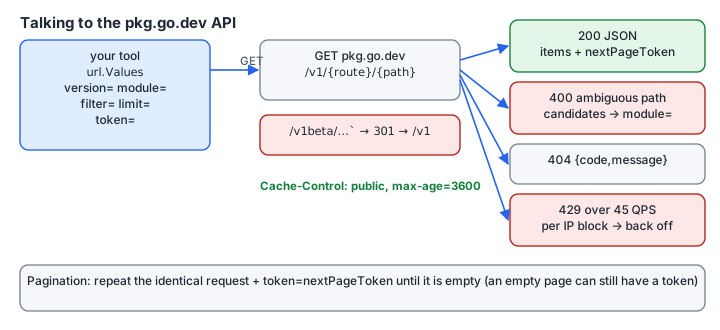
The routes are package, module, versions, packages, search, symbols, imported-by and vulns. Except for search, the rest of the URL is a module or package path. Everything else goes in query parameters:
version: a semantic version,latest, or the default branch namesmaster/main, which resolve to a pseudo-version. Other branch names aren’t accepted. Latest is the default.module: disambiguates a package path that more than one module provides.limitandtoken: pagination. To get the next page, send the same request plustoken=<nextPageToken>. Changing anything else may fail. A non-empty token means there’s another page, even if the current page is empty.filter: a small Go-expression language evaluated on the server (==, comparisons,contains,hasPrefix,hasSuffix,matches, and field selection such asimportedByCounts.packages).
Raw requests
A package, at latest and at the default branch:
curl -s https://pkg.go.dev/v1/package/github.com/google/go-cmp/cmp
curl -s "https://pkg.go.dev/v1/package/github.com/google/go-cmp/cmp?version=master"
{"modulePath":"github.com/google/go-cmp","version":"v0.7.0","isLatest":true,"isStandardLibrary":false,"goos":"all","goarch":"all","path":"github.com/google/go-cmp/cmp","name":"cmp","synopsis":"Package cmp determines equality of values.","isRedistributable":true}
{"modulePath":"github.com/google/go-cmp","version":"v0.7.1-0.20261029223239-5deca1c7dab7","isLatest":false,"isStandardLibrary":false,"goos":"all","goarch":"all","path":"github.com/google/go-cmp/cmp","name":"cmp","synopsis":"Package cmp determines equality of values.","isRedistributable":true}An ambiguous path. cloud.google.com/go/storage is a package in its own module and a directory path inside cloud.google.com/go:
curl -s https://pkg.go.dev/v1/package/cloud.google.com/go/storage
curl -s "https://pkg.go.dev/v1/package/cloud.google.com/go/storage?module=cloud.google.com/go/storage"
{"code":400,"message":"ambiguous package path","fixes":["retry the call with a 'module' query parameter specifying the desired module"],"candidates":[{"modulePath":"cloud.google.com/go/storage","packagePath":"cloud.google.com/go/storage"},{"modulePath":"cloud.google.com/go","packagePath":"cloud.google.com/go/storage"}]}
{"modulePath":"cloud.google.com/go/storage","version":"v1.70.0","isLatest":true,"isStandardLibrary":false,"goos":"all","goarch":"all","path":"cloud.google.com/go/storage","name":"storage","synopsis":"Package storage provides an easy way to work with Google Cloud Storage.","isRedistributable":true}A server-side filter that lists the commands in golang.org/x/tools. Filters must be percent-encoded:
f='name == "main" && hasPrefix(path, "golang.org/x/tools/cmd/")'
curl -s "https://pkg.go.dev/v1/packages/golang.org/x/tools?filter=$(python3 -c 'import sys,urllib.parse;print(urllib.parse.quote(sys.argv[1]))' "$f")&limit=3"
{"modulePath":"golang.org/x/tools","version":"v0.52.0","isStandardLibrary":false,"packages":{"items":[{"path":"golang.org/x/tools/cmd/benchcmp","name":"main","synopsis":"Deprecated: benchcmp is deprecated in favor of benchstat: golang.org/x/perf/cmd/benchstat","isRedistributable":true},{"path":"golang.org/x/tools/cmd/bisect","name":"main","synopsis":"Bisect finds changes responsible for causing a failure.","isRedistributable":true},{"path":"golang.org/x/tools/cmd/bundle","name":"main","synopsis":"Bundle creates a single-source-file version of a source package suitable for inclusion in a particular target package.","isRedistributable":true}],"total":27,"nextPageToken":"fb53686c18c7cfb764ec071f2c1821ef"}}The response shapes differ. versions, vulns and search return {"items", "total", "nextPageToken"} at the top level, while packages, symbols and imported-by wrap that page in a field (packages, symbols, importedBy) next to the module and version. A generic page decoder only fits the first group as-is.
A Go client: depaudit
The tool reads a go.mod with go mod edit -json, which parses the file without downloading anything. For each requirement, it asks the versions route for exactly that version, using a filter so the server picks the one row. That row carries latestVersion, deprecated and retracted. It then lists vulns at that version. It pages with an iter.Seq2, builds every query with url.Values as the API docs recommend, retries 429s with backoff, and decodes the JSON error body into a typed error. Verified with go1.27.2 linux/amd64 (errors.AsType needs Go 1.26+).
// depaudit reports, for each requirement in a go.mod, the latest version,
// deprecation/retraction status, and known vulnerabilities, using the
// pkg.go.dev API (https://pkg.go.dev/api).
package main

import (
    "context"
    "encoding/json"
    "errors"
    "fmt"
    "iter"
    "net/http"
    "net/url"
    "os"
    "os/exec"
    "strconv"
    "time"
)

const base = "https://pkg.go.dev/v1/"

// apiError is the JSON error body the API returns with non-2xx statuses.
type apiError struct {
    Status     int
    Code       int      `json:"code"`
    Message    string   `json:"message"`
    Fixes      []string `json:"fixes"`
    Candidates []struct {
        ModulePath  string `json:"modulePath"`
        PackagePath string `json:"packagePath"`
    } `json:"candidates"`
}

func (e *apiError) Error() string { return fmt.Sprintf("pkg.go.dev %d: %s", e.Status, e.Message) }

type client struct{ http *http.Client }

// get fetches base+route?q into v, retrying on 429 with backoff.
func (c *client) get(ctx context.Context, route string, q url.Values, v any) error {
    u := base + route + "?" + q.Encode()
    for attempt := 0; ; attempt++ {
        req, err := http.NewRequestWithContext(ctx, "GET", u, nil)
        if err != nil {
            return err
        }
        resp, err := c.http.Do(req)
        if err != nil {
            return err
        }
        if resp.StatusCode == http.StatusTooManyRequests && attempt < 4 {
            resp.Body.Close()
            wait := time.Duration(1<<attempt) * 250 * time.Millisecond
            if s, err := strconv.Atoi(resp.Header.Get("Retry-After")); err == nil {
                wait = time.Duration(s) * time.Second
            }
            select {
            case <-time.After(wait):
                continue
            case <-ctx.Done():
                return ctx.Err()
            }
        }
        defer resp.Body.Close()
        if resp.StatusCode != http.StatusOK {
            e := &apiError{Status: resp.StatusCode}
            json.NewDecoder(resp.Body).Decode(e)
            return e
        }
        return json.NewDecoder(resp.Body).Decode(v)
    }
}

type page[T any] struct {
    Items         []T    `json:"items"`
    NextPageToken string `json:"nextPageToken"`
}

// all walks every page of a paginated route. Per the API docs, the request is
// repeated verbatim with only "token" added, and an empty page with a
// non-empty token still means there is more.
func all[T any](ctx context.Context, c *client, route string, q url.Values) iter.Seq2[T, error] {
    return func(yield func(T, error) bool) {
        q := maps(q)
        for {
            var p page[T]
            if err := c.get(ctx, route, q, &p); err != nil {
                var zero T
                yield(zero, err)
                return
            }
            for _, it := range p.Items {
                if !yield(it, nil) {
                    return
                }
            }
            if p.NextPageToken == "" {
                return
            }
            q.Set("token", p.NextPageToken)
        }
    }
}

func maps(q url.Values) url.Values {
    out := url.Values{}
    for k, v := range q {
        out[k] = append([]string(nil), v...)
    }
    return out
}

type version struct {
    Version           string `json:"version"`
    LatestVersion     string `json:"latestVersion"`
    Deprecated        bool   `json:"deprecated"`
    DeprecationReason string `json:"deprecationReason"`
    Retracted         bool   `json:"retracted"`
    RetractionReason  string `json:"retractionReason"`
}

type vuln struct {
    ID      string `json:"id"`
    Details string `json:"details"`
}

type gomod struct {
    Require []struct {
        Path, Version string
        Indirect      bool
    }
}

func main() {
    if len(os.Args) != 2 {
        fmt.Fprintln(os.Stderr, "usage: depaudit path/to/go.mod")
        os.Exit(2)
    }
    out, err := exec.Command("go", "mod", "edit", "-json", os.Args[1]).Output()
    if err != nil {
        fmt.Fprintln(os.Stderr, "go mod edit:", err)
        os.Exit(1)
    }
    var mf gomod
    if err := json.Unmarshal(out, &mf); err != nil {
        fmt.Fprintln(os.Stderr, err)
        os.Exit(1)
    }
    ctx, cancel := context.WithTimeout(context.Background(), 60*time.Second)
    defer cancel()
    c := &client{http: &http.Client{Timeout: 20 * time.Second}}
    bad := 0
    for _, r := range mf.Require {
        // One exact item from the versions route, selected server-side by a filter.
        q := url.Values{"filter": {fmt.Sprintf("version == %q", r.Version)}, "limit": {"1"}}
        var info *version
        for v, err := range all[version](ctx, c, "versions/"+r.Path, q) {
            if err != nil {
                fmt.Printf("%-26s %-8s error: %v\n", r.Path, r.Version, err)
                break
            }
            info = &v
            break
        }
        if info == nil {
            bad++
            continue
        }
        var ids []string
        for v, err := range all[vuln](ctx, c, "vulns/"+r.Path, url.Values{"version": {r.Version}}) {
            if err != nil {
                ids = append(ids, "error: "+err.Error())
                break
            }
            ids = append(ids, v.ID)
        }
        status := "ok"
        switch {
        case info.Retracted:
            status = "RETRACTED: " + info.RetractionReason
        case info.Deprecated:
            status = "DEPRECATED: " + info.DeprecationReason
        }
        if info.Retracted || info.Deprecated || len(ids) > 0 {
            bad++
        }
        fmt.Printf("%-26s %-8s latest %-8s %s, %d vulns %v\n", r.Path, r.Version, info.LatestVersion, status, len(ids), first(ids, 3))
    }
    // Ambiguous package paths come back as 400 with candidates.
    var p map[string]any
    err = c.get(ctx, "package/cloud.google.com/go/storage", nil, &p)
    if ae, ok := errors.AsType[*apiError](err); ok {
        fmt.Printf("\npackage cloud.google.com/go/storage: %s; candidates:", ae.Message)
        for _, cand := range ae.Candidates {
            fmt.Printf(" %s", cand.ModulePath)
        }
        fmt.Println()
    }
    if bad > 0 {
        os.Exit(1)
    }
}

func first(s []string, n int) []string {
    if len(s) > n {
        return append(s[:n:n], "…")
    }
    return s
}
The go.mod under test:
module example.com/app

go 1.27

require (
    github.com/google/go-cmp v0.5.9
    github.com/google/uuid v1.6.0
    golang.org/x/net v0.20.0
    github.com/golang/protobuf v1.5.4
)
Run on 2026-10-31 (results change as modules release and the vulnerability database grows):
go vet . && go build -o depaudit . && ./depaudit sample.mod; echo "exit=$?"github.com/google/go-cmp v0.5.9 latest v0.7.0 ok, 0 vulns []
github.com/google/uuid v1.6.0 latest v1.6.0 ok, 0 vulns []
golang.org/x/net v0.20.0 latest v0.62.0 ok, 21 vulns [GO-2024-2687 GO-2024-3333 GO-2025-3503 …]
github.com/golang/protobuf v1.5.4 latest v1.5.4 DEPRECATED: Use the "google.golang.org/protobuf" module instead., 0 vulns []
package cloud.google.com/go/storage: ambiguous package path; candidates: cloud.google.com/go/storage cloud.google.com/go
exit=1The deprecation comes from the // Deprecated: comment in that module’s go.mod, and vulns reads from the Go vulnerability database (vuln.go.dev). go list -m -u can report upgrades and deprecations too, but it needs the module graph downloaded and doesn’t report vulnerabilities. Here a single go.mod file is enough.
Things that bite
- Ambiguity is an error, not a guess.
go mod tidyand the web UI use the longest matching module path. The API returns 400 withcandidates. A tool that already knows the module fromgo.modshould always sendmodule=. - Tokens are bound to the request. Change
limitorfilterbetween pages and the token may be rejected. Clone the query, then onlySet("token", …). vulnsdefaults to latest. Withoutversion=,golang.org/x/netreturned{"items":null,"total":0}in this run, because the latest release has no known vulnerabilities. Always pass the version you actually depend on.- Rate limit. 45 queries per second per IP block, after which the API returns 429. CI fleets behind one NAT share that budget, so cache responses (the server already marks them cacheable for an hour) and run requests one at a time or with a small limit.
- This is not
govulncheck. Thevulnsroute works at module and version level.govulncheckchecks whether your code actually reaches the vulnerable symbols. Use the API for inventory and triage, andgovulncheckfor the final decision.
Try this
- Add
-modulehandling todepaudit: on anapiErrorwith candidates, retry once with the candidate whosemodulePathappears ingo.mod. - Use
searchwithfilter=importedByCounts.packages > 100to find widely used alternatives to a deprecated module. - Put a file-backed cache in front of
client.getkeyed by the full URL, honouringmax-age, and confirm with a counter that a second run makes no network requests.
Sources
- Go blog, “Introducing the pkg.go.dev API” (21 May 2026): https://go.dev/blog/pkgsite-api
- pkg.go.dev API reference (routes, filters, pagination, rate limiting): https://pkg.go.dev/api
- OpenAPI specification: https://pkg.go.dev/v1/openapi.yaml
go mod edit -json: https://go.dev/ref/mod#go-mod-edit- Module deprecation and retraction: https://go.dev/ref/mod#go-mod-file-module-deprecation
- Go vulnerability database: https://vuln.go.dev, and
govulncheck: https://go.dev/doc/tutorial/govulncheck iterpackage: https://pkg.go.dev/iter