Shortest Paths (Dijkstra’s Algorithm)
Shortest Paths (Dijkstra’s Algorithm)
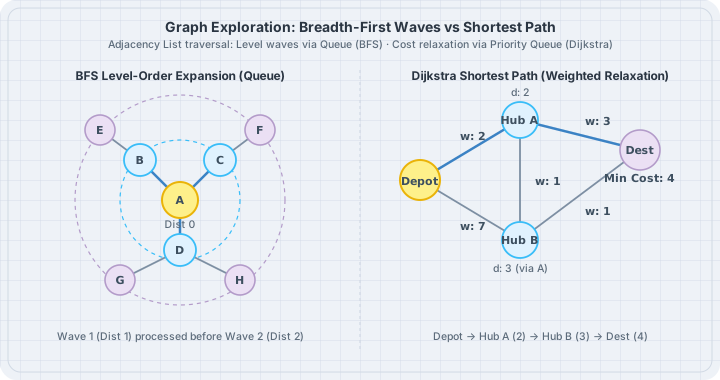
While Breadth-First Search finds the path with the fewest hops, real systems have weighted costs: network latencies, courier miles, fuel consumption, or processing fees. Dijkstra’s algorithm computes the single-source shortest path across a weighted graph with non-negative edge weights in \(O((V + E) \log V)\) time using a min-priority queue.
Mental model
Dijkstra maintains two maps: 1. dist[v]: The shortest known distance from the starting source to vertex \(v\) (initialized to \(\infty\), with dist[start] = 0). 2. prev[v]: The predecessor vertex on the optimal path.
At each step, the algorithm extracts the unvisited vertex \(u\) with the smallest known distance from a min-priority queue and relaxes all outgoing edges \((u, v, \text{weight})\):
\[\text{If } \text{dist}[u] + \text{weight} < \text{dist}[v] \implies \text{dist}[v] = \text{dist}[u] + \text{weight}\]
Relaxation Step:
(Depot) --[Known: 2]--> (Hub A) --[Weight: 3]--> (Dest)
                           \                        ^
                            \--[Weight: 1]-->(Hub B)-[Weight: 1]-/

Direct path: Depot -> Hub A -> Dest = 2 + 3 = 5
Relaxed path: Depot -> Hub A -> Hub B -> Dest = 2 + 1 + 1 = 4 (Optimal!)
Because edge weights are non-negative, the moment a vertex is popped from the min-priority queue, its calculated distance is permanently optimal.
Worked examples
Case 1: Complete Dijkstra implementation with path reconstruction
Save as dijkstra_delivery.go. Calculate the lowest-cost delivery route between warehouse dispatch points.
// dijkstra_delivery.go
package main

import (
    "container/heap"
    "fmt"
    "math"
)

type Edge struct {
    To     string
    Weight int
}

type WeightedGraph struct {
    adj map[string][]Edge
}

func NewWeightedGraph() *WeightedGraph {
    return &WeightedGraph{adj: make(map[string][]Edge)}
}

func (g *WeightedGraph) AddEdge(from, to string, weight int) {
    g.adj[from] = append(g.adj[from], Edge{To: to, Weight: weight})
    g.adj[to] = append(g.adj[to], Edge{To: from, Weight: weight}) // Undirected
}

// Priority Queue item
type Item struct {
    Node string
    Dist int
}

type PriorityQueue []Item

func (pq PriorityQueue) Len() int           { return len(pq) }
func (pq PriorityQueue) Less(i, j int) bool { return pq[i].Dist < pq[j].Dist } // Min-heap
func (pq PriorityQueue) Swap(i, j int)      { pq[i], pq[j] = pq[j], pq[i] }
func (pq *PriorityQueue) Push(x any)        { *pq = append(*pq, x.(Item)) }
func (pq *PriorityQueue) Pop() any {
    old := *pq
    n := len(old)
    x := old[n-1]
    *pq = old[0 : n-1]
    return x
}

type ShortestPathResult struct {
    Distance int
    Path     []string
}

func (g *WeightedGraph) Dijkstra(start, dest string) (ShortestPathResult, bool) {
    dist := make(map[string]int)
    prev := make(map[string]string)

    for node := range g.adj {
        dist[node] = math.MaxInt
    }
    dist[start] = 0

    pq := &PriorityQueue{}
    heap.Init(pq)
    heap.Push(pq, Item{Node: start, Dist: 0})

    for pq.Len() > 0 {
        top := heap.Pop(pq).(Item)
        u := top.Node
        currDist := top.Dist

        // Stale item check: if we found a shorter route to u already, skip
        if currDist > dist[u] {
            continue
        }

        if u == dest {
            break // Reached destination with optimal distance
        }

        for _, edge := range g.adj[u] {
            v := edge.To
            newDist := currDist + edge.Weight
            if newDist < dist[v] {
                dist[v] = newDist
                prev[v] = u
                heap.Push(pq, Item{Node: v, Dist: newDist})
            }
        }
    }

    if dist[dest] == math.MaxInt {
        return ShortestPathResult{}, false // Unreachable
    }

    // Reconstruct path
    var path []string
    curr := dest
    for curr != "" {
        path = append(path, curr)
        curr = prev[curr]
    }

    // Reverse path
    for i, j := 0, len(path)-1; i < j; i, j = i+1, j-1 {
        path[i], path[j] = path[j], path[i]
    }

    return ShortestPathResult{Distance: dist[dest], Path: path}, true
}

func main() {
    g := NewWeightedGraph()
    g.AddEdge("Main-Depot", "North-Hub", 4)
    g.AddEdge("Main-Depot", "South-Hub", 2)
    g.AddEdge("South-Hub", "North-Hub", 1)
    g.AddEdge("North-Hub", "Airport-Station", 7)
    g.AddEdge("South-Hub", "Midtown-Annex", 8)
    g.AddEdge("North-Hub", "Midtown-Annex", 3)
    g.AddEdge("Midtown-Annex", "Airport-Station", 1)

    res, found := g.Dijkstra("Main-Depot", "Airport-Station")
    if !found {
        fmt.Println("No route found")
        return
    }

    fmt.Printf("Lowest Delivery Latency: %d ms\n", res.Distance)
    fmt.Print("Optimal Route: ")
    for i, step := range res.Path {
        if i > 0 {
            fmt.Print(" -> ")
        }
        fmt.Print(step)
    }
    fmt.Println()
}
Run:
go run dijkstra_delivery.goOutput:
Lowest Delivery Latency: 7 ms
Optimal Route: Main-Depot -> South-Hub -> North-Hub -> Midtown-Annex -> Airport-Station
Notice that although Main-Depot -> North-Hub -> Airport-Station has fewer hops (2 hops, cost \(4+7 = 11\)), Dijkstra discovers the 4-hop route via South-Hub and Midtown-Annex with total cost \(2 + 1 + 3 + 1 = 7\)!
The trap
There are two primary traps when implementing Dijkstra’s algorithm:
- Negative Edge Weights: Dijkstra assumes that adding an edge can never decrease the total path cost. If a graph has negative edge weights, Dijkstra produces wrong answers or loops indefinitely. Graphs with negative weights require the Bellman-Ford algorithm.
- Stale Priority Queue Entries: In standard Go implementations, updating a node’s distance is achieved by pushing a new
Item{Node: v, Dist: newDist}into the heap. Without the checkif currDist > dist[u] { continue }, the algorithm wastes time re-exploring superseded paths, degrading performance.
The boring rule
- Use BFS for unweighted shortest path queries. Use Dijkstra when edges represent costs, times, distances, or latency.
- Always guard the main loop with
if currDist > dist[u] { continue }to drop stale heap items instantly. - Validate that all edge weights are \(\ge 0\).
- Stop the algorithm early when the target node is popped from the priority queue; its distance is provably finalized.
Try this
- Modify
Dijkstrato return all reachable destinations and their shortest paths fromstartin a single run. - Add a
MaxStopsparameter to restrict the search to routes with at most 3 intermediary transfers.