Error Boundaries: Wrap Inside, Translate at the Edge, Leak Nothing
Error Boundaries: Wrap Inside, Translate at the Edge, Leak Nothing
Thesis
Good Go error wrapping and safe Go error output pull in opposite directions. fmt.Errorf("query %q: %w", q, err) is exactly what you want in a log, and exactly what you must never send to a client: it carries SQL text, file paths, tenant names and sometimes credentials. You don’t fix this with less context. You fix it by making one boundary the only place where errors leave the trust zone. That boundary translates every error into a type whose Error() method is safe by construction, and sends the full detail only to the log, joined to the response by a request ID.
Mental model
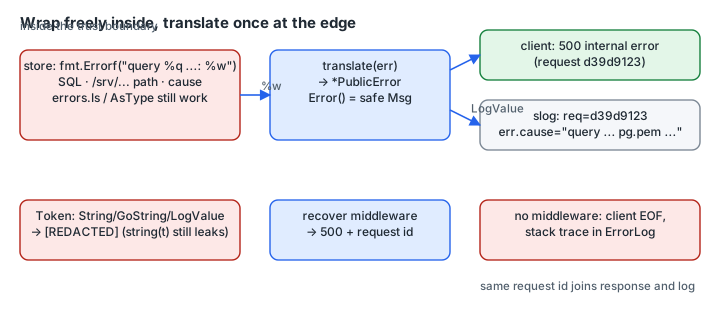
Each piece has a single job:
- Inside: wrap with
%wand add context freely.errors.Is/errors.AsTypekeep working through the chain. PublicError:Error()returns only the client-safe message, so an accidentalhttp.Error(w, err.Error(), …)is harmless.Unwrap()keeps the cause reachable for code inside the service, andLogValue()(slog.LogValuer) sends the cause to the log.- Secrets as types: a
Tokentype that formats itself as[REDACTED]through everyfmtverb and through slog. - Panics: a recover middleware, because the
net/httpdefault isn’t a response at all.
Worked example
One program runs all five cases against an httptest server and prints what the client sees, what the application log records, and what net/http writes to its own error log.
package main

import (
    "bytes"
    "context"
    "crypto/rand"
    "encoding/hex"
    "errors"
    "fmt"
    "io"
    "log"
    "log/slog"
    "net/http"
    "net/http/httptest"
    "os"
    "strings"
)

// ---- internal layer: rich, unsafe-to-show errors ----

var ErrNotFound = errors.New("not found")

type Token string

func (Token) String() string       { return "[REDACTED]" }
func (Token) GoString() string     { return `Token("[REDACTED]")` }
func (Token) LogValue() slog.Value { return slog.StringValue("[REDACTED]") }

func loadInvoice(id string, tok Token) error {
    const q = "SELECT * FROM invoices WHERE id = $1 AND tenant = 'acme'"
    if id == "404" {
        return fmt.Errorf("query %q (id=%s): %w", q, id, ErrNotFound)
    }
    cause := fmt.Errorf("open /srv/acme/secrets/pg.pem: permission denied")
    return fmt.Errorf("query %q with token %v: %w", q, tok, cause)
}

// ---- boundary type: Error() is safe; detail only via LogValue ----

type PublicError struct {
    Status int
    Msg    string // safe for clients
    err    error  // internal cause
}

func (e *PublicError) Error() string { return e.Msg }
func (e *PublicError) Unwrap() error { return e.err }
func (e *PublicError) LogValue() slog.Value {
    return slog.GroupValue(slog.Int("status", e.Status), slog.String("cause", e.err.Error()))
}

func translate(err error) *PublicError {
    if errors.Is(err, ErrNotFound) {
        return &PublicError{http.StatusNotFound, "invoice not found", err}
    }
    return &PublicError{http.StatusInternalServerError, "internal error", err}
}

func reqID() string { b := make([]byte, 4); rand.Read(b); return hex.EncodeToString(b) }

var logger *slog.Logger

// naive handler: what not to do
func naive(w http.ResponseWriter, r *http.Request) {
    if err := loadInvoice(r.URL.Query().Get("id"), "sk_live_9f8e7d"); err != nil {
        http.Error(w, err.Error(), http.StatusInternalServerError)
    }
}

// boundary handler
func safe(w http.ResponseWriter, r *http.Request) {
    if err := loadInvoice(r.URL.Query().Get("id"), "sk_live_9f8e7d"); err != nil {
        pe := translate(err)
        id := reqID()
        logger.ErrorContext(r.Context(), "load invoice", "req", id, "err", pe)
        http.Error(w, fmt.Sprintf("%s (request %s)", pe.Msg, id), pe.Status)
    }
}

func boom(w http.ResponseWriter, r *http.Request) {
    var m map[string]int
    m["x"] = 1 // panics
}

func recoverer(next http.Handler) http.Handler {
    return http.HandlerFunc(func(w http.ResponseWriter, r *http.Request) {
        defer func() {
            if v := recover(); v != nil {
                if v == http.ErrAbortHandler {
                    panic(v)
                }
                id := reqID()
                logger.Error("panic", "req", id, "value", fmt.Sprint(v))
                http.Error(w, "internal error (request "+id+")", http.StatusInternalServerError)
            }
        }()
        next.ServeHTTP(w, r)
    })
}

func get(url string) {
    resp, err := http.Get(url)
    if err != nil {
        fmt.Printf("  client error: %v\n", err)
        return
    }
    defer resp.Body.Close()
    b, _ := io.ReadAll(resp.Body)
    fmt.Printf("  %d %s", resp.StatusCode, b)
}

func main() {
    var logs bytes.Buffer
    logger = slog.New(slog.NewTextHandler(&logs, &slog.HandlerOptions{
        ReplaceAttr: func(_ []string, a slog.Attr) slog.Attr {
            if a.Key == slog.TimeKey {
                return slog.Attr{}
            }
            return a
        }}))
    var serverLog bytes.Buffer
    mux := http.NewServeMux()
    mux.HandleFunc("/naive", naive)
    mux.HandleFunc("/safe", safe)
    mux.HandleFunc("/boom", boom)
    mux.Handle("/boom-recovered", recoverer(http.HandlerFunc(boom)))
    ts := httptest.NewUnstartedServer(mux)
    ts.Config.ErrorLog = log.New(&serverLog, "", 0)
    ts.Start()
    defer ts.Close()

    for _, p := range []string{"/naive?id=7", "/safe?id=7", "/safe?id=404", "/boom", "/boom-recovered"} {
        fmt.Println("GET", p)
        get(ts.URL + p)
    }
    ts.Close()
    fmt.Println("\n--- application log (slog) ---")
    os.Stdout.Write(logs.Bytes())
    fmt.Println("\n--- net/http ErrorLog (first 3 lines) ---")
    lines := strings.SplitN(serverLog.String(), "\n", 4)
    for _, l := range lines[:3] {
        fmt.Println(l)
    }

    fmt.Println("\n--- formatting a Token ---")
    t := Token("sk_live_9f8e7d")
    fmt.Printf("%%v=%v %%s=%s %%#v=%#v %%q=%q string(t)=%s\n", t, t, t, t, string(t))

    fmt.Println("\n--- the chain still works inside the service ---")
    wrapped := fmt.Errorf("handler: %w", translate(loadInvoice("404", t)))
    pe, ok := errors.AsType[*PublicError](wrapped)
    fmt.Printf("AsType ok=%v status=%d msg=%q  errors.Is(wrapped, ErrNotFound)=%v\n", ok, pe.Status, pe.Msg, errors.Is(wrapped, ErrNotFound))
    _ = context.Background
}
go vet ./... && go build -o safeerr . && ./safeerrGET /naive?id=7
500 query "SELECT * FROM invoices WHERE id = $1 AND tenant = 'acme'" with token [REDACTED]: open /srv/acme/secrets/pg.pem: permission denied
GET /safe?id=7
500 internal error (request d9b5f5d4)
GET /safe?id=404
404 invoice not found (request f758d9f7)
GET /boom
client error: Get "http://127.0.0.1:42753/boom": EOF
GET /boom-recovered
500 internal error (request df661fd0)
--- application log (slog) ---
level=ERROR msg="load invoice" req=d9b5f5d4 err.status=500 err.cause="query \"SELECT * FROM invoices WHERE id = $1 AND tenant = 'acme'\" with token [REDACTED]: open /srv/acme/secrets/pg.pem: permission denied"
level=ERROR msg="load invoice" req=f758d9f7 err.status=404 err.cause="query \"SELECT * FROM invoices WHERE id = $1 AND tenant = 'acme'\" (id=404): not found"
level=ERROR msg=panic req=df661fd0 value="assignment to entry in nil map"
--- net/http ErrorLog (first 3 lines) ---
http: panic serving 127.0.0.1:37898: assignment to entry in nil map
goroutine 36 [running]:
net/http.(*conn).serve.func1()
--- formatting a Token ---
%v=[REDACTED] %s=[REDACTED] %#v=Token("[REDACTED]") %q="[REDACTED]" string(t)=sk_live_9f8e7d
--- the chain still works inside the service ---
AsType ok=true status=404 msg="invoice not found" errors.Is(wrapped, ErrNotFound)=trueReading it case by case:
/naiveshows the leak: the SQL text, the tenant'acme'and the path/srv/acme/secrets/pg.pemall reach the client in one line. The token printed as[REDACTED]only because its type redacts itself. A plainstringwould have gone out as is./safesends the clientinternal error (request …)orinvoice not found (request …). The log line with the same request ID carrieserr.cause=with the full chain.errors.Is(err, ErrNotFound)chose the 404 before any detail was dropped./boomshows thenet/httpdefault. TheHandlerdocs say the server “recovers the panic, logs a stack trace to the server error log, and either closes the network connection or sends an HTTP/2 RST_STREAM”. The client gotEOF, not a 500. The stack trace stays server-side, but the client gets no usable status, and goroutine dumps end up whereverErrorLogpoints./boom-recovered: the middleware converts the panic into a normal 500 with a request ID. It re-panics onhttp.ErrAbortHandler, which the same docs reserve for deliberately aborting a response “so the client sees an interrupted response but the server doesn’t log an error”.- Token formatting:
%v,%sand%qgo throughString(), while%#vgoes throughGoString(), as specified by thefmtrules. You need both methods, or%#vprints the raw field.string(t)is a conversion, not formatting, and no method can intercept it. - The chain:
errors.AsType[*PublicError](Go 1.26+, docs) finds the boundary error through an extra%wlayer, anderrors.Is(wrapped, ErrNotFound)is still true. Translating at the edge cost the service no introspection.
Choosing what Unwrap exposes
PublicError.Unwrap returning the cause is a choice. It is right when everything that sees a PublicError is your own code. If a PublicError crosses into code you don’t trust, such as a plugin, a client library returning errors to callers, or an RPC layer that serialises the chain, drop Unwrap. The chain then ends at the boundary, and nobody outside can probe for specific driver error types. The JetBrains article linked below calls this a firewall.
Things that bite
| Trap | What happens | Fix |
|---|---|---|
http.Error(w, err.Error(), 500) on a wrapped error |
SQL, paths and tenant names reach the client (/naive) |
Translate first, and make the boundary type’s Error() safe |
Secrets as plain string |
Printed by any %v and serialised by any logger |
A named type with String, GoString and LogValue |
Only String() implemented |
%#v prints the raw value |
Implement GoString() too |
string(tok) or []byte(tok) |
Redaction bypassed; no method can stop a conversion | Keep conversions in one audited function that hands the value to the HTTP client or driver |
| Relying on net/http’s panic recovery | Client sees EOF, the stack goes to ErrorLog |
Recover middleware; re-panic http.ErrAbortHandler |
Logging the PublicError with %v |
You log only the safe message and lose the cause | Log it as an slog attribute so LogValue runs, or log errors.Unwrap(pe) |
| Different messages for “no such user” and “wrong password” | Account enumeration | Map both to one public message at the boundary |
Try this
- Delete
GoString()fromTokenand rerun. Which verb now leaks the secret? - Remove
Unwrap()fromPublicError. What does the last line print now, and why does the 404 mapping still work? - Point
ts.Config.ErrorLogatio.Discardand observe that the client-side behaviour of/boomdoesn’t change. The recovery isn’t about logging.