Graphs and Traversals (BFS and DFS)
Graphs and Traversals (BFS and DFS)
A graph represents relationships between entities as a set of vertices (nodes) connected by edges. Graphs model service dependencies, order routing networks, workflow pipelines, and social graphs. In Go, the boring default is an adjacency list represented using maps and slices. Traversing graphs via Breadth-First Search (BFS) and Depth-First Search (DFS) enables finding shortest hops, detecting cycles, and discovering connected components.
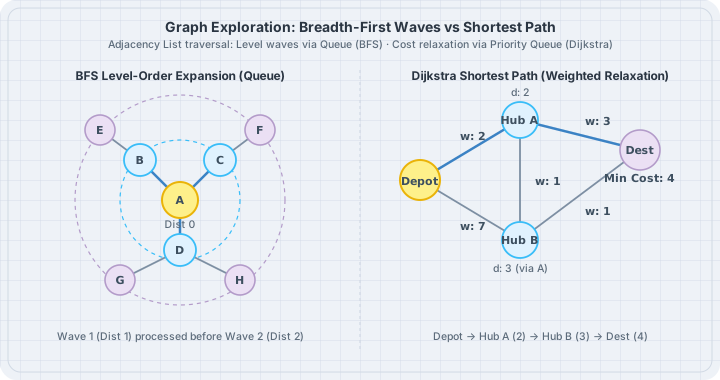
Mental model
Graph Representation: Adjacency List
An adjacency matrix allocates an \(V \times V\) grid, consuming \(O(V^2)\) memory even if most nodes have few connections. An adjacency list stores only existing edges, consuming \(O(V + E)\) memory:
Adjacency List:
[Depot A] -> [Hub B, Hub C]
[Hub B]   -> [Depot A, Station D]
[Hub C]   -> [Depot A, Station D]
[Station D] -> [Hub B, Hub C]
BFS vs DFS Traversals
- Breadth-First Search (BFS): Uses a FIFO Queue. It expands outward in concentric rings (all distance-1 neighbors first, then all distance-2 neighbors). Guarantees the shortest path in an unweighted graph.
- Depth-First Search (DFS): Uses a Stack (or call stack recursion). It plunges as deep as possible along each branch before backtracking. Ideal for topological sorting, maze solving, and cycle detection.
BFS Waves (Queue):            DFS Dive (Stack / Recursion):
       (A)                          (A)
     /  |  \                       /
   (B) (C) (D)  <- Wave 1        (B)
    |                             |
   (E)          <- Wave 2        (E) <- Dive deep before (C)
Worked examples
Case 1: Generic Graph with Adjacency List and BFS Shortest Hop
Save as graph_bfs.go. Model a fulfillment routing network and find the shortest hops from central depot to satellite hubs.
// graph_bfs.go
package main

import (
    "fmt"
)

type Graph[T comparable] struct {
    adj map[T][]T
}

func NewGraph[T comparable]() *Graph[T] {
    return &Graph[T]{adj: make(map[T][]T)}
}

func (g *Graph[T]) AddEdge(u, v T, bidirectional bool) {
    g.adj[u] = append(g.adj[u], v)
    if bidirectional {
        g.adj[v] = append(g.adj[v], u)
    }
}

// BFS returns the shortest path (in number of edges) from start to target.
func (g *Graph[T]) ShortestPathBFS(start, target T) []T {
    if start == target {
        return []T{start}
    }

    visited := make(map[T]bool)
    parent := make(map[T]T)
    queue := []T{start}
    visited[start] = true

    found := false
    for len(queue) > 0 {
        curr := queue[0]
        queue = queue[1:]

        if curr == target {
            found = true
            break
        }

        for _, neighbor := range g.adj[curr] {
            if !visited[neighbor] {
                visited[neighbor] = true
                parent[neighbor] = curr
                queue = append(queue, neighbor)
            }
        }
    }

    if !found {
        return nil
    }

    // Reconstruct path backward from target to start
    var path []T
    curr := target
    for {
        path = append(path, curr)
        if curr == start {
            break
        }
        curr = parent[curr]
    }

    // Reverse path
    for i, j := 0, len(path)-1; i < j; i, j = i+1, j-1 {
        path[i], path[j] = path[j], path[i]
    }
    return path
}

func main() {
    network := NewGraph[string]()
    network.AddEdge("Central-Depot", "North-Hub", true)
    network.AddEdge("Central-Depot", "South-Hub", true)
    network.AddEdge("North-Hub", "Station-East", true)
    network.AddEdge("South-Hub", "Station-West", true)
    network.AddEdge("Station-East", "Terminal-Z", true)
    network.AddEdge("Station-West", "Terminal-Z", true)

    start := "Central-Depot"
    dest := "Terminal-Z"

    path := network.ShortestPathBFS(start, dest)
    fmt.Printf("BFS Shortest Route (%d hops):\n", len(path)-1)
    for i, stop := range path {
        if i > 0 {
            fmt.Print(" -> ")
        }
        fmt.Print(stop)
    }
    fmt.Println()
}
Run:
go run graph_bfs.goOutput:
BFS Shortest Route (3 hops):
Central-Depot -> North-Hub -> Station-East -> Terminal-Z
Case 2: DFS for Workflow Cycle Detection
Save as graph_dfs_cycle.go. Check if a task dependency graph contains illegal circular dependencies before dispatching jobs.
// graph_dfs_cycle.go
package main

import "fmt"

type TaskGraph struct {
    adj map[string][]string
}

func NewTaskGraph() *TaskGraph {
    return &TaskGraph{adj: make(map[string][]string)}
}

func (g *TaskGraph) AddDependency(task, dependsOn string) {
    // task -> dependsOn
    g.adj[task] = append(g.adj[task], dependsOn)
}

// HasCycle uses 3-color DFS:
// 0: Unvisited, 1: Currently Visiting (in call stack), 2: Fully Visited
func (g *TaskGraph) HasCycle() bool {
    state := make(map[string]int)

    var dfs func(task string) bool
    dfs = func(u string) bool {
        state[u] = 1 // Mark visiting (in progress)

        for _, v := range g.adj[u] {
            if state[v] == 1 {
                // Found back-edge to an ancestor currently in recursion stack!
                return true
            }
            if state[v] == 0 {
                if dfs(v) {
                    return true
                }
            }
        }

        state[u] = 2 // Mark fully visited
        return false
    }

    for task := range g.adj {
        if state[task] == 0 {
            if dfs(task) {
                return true
            }
        }
    }
    return false
}

func main() {
    g := NewTaskGraph()
    g.AddDependency("Print-Receipt", "Verify-Payment")
    g.AddDependency("Verify-Payment", "Calculate-Tax")
    g.AddDependency("Calculate-Tax", "Read-Cart")

    fmt.Printf("Initial linear pipeline has cycle? %t\n", g.HasCycle())

    // Introduce circular deadlock: Read-Cart requires Print-Receipt
    fmt.Println("Introducing circular dependency: Read-Cart -> Print-Receipt")
    g.AddDependency("Read-Cart", "Print-Receipt")
    fmt.Printf("Updated pipeline has cycle? %t\n", g.HasCycle())
}
Run:
go run graph_dfs_cycle.goOutput:
Initial linear pipeline has cycle? false
Introducing circular dependency: Read-Cart -> Print-Receipt
Updated pipeline has cycle? true
The trap
The most dangerous graph bug is traversing cyclic graphs without a visited set. If vertex \(A\) points to \(B\) and \(B\) points back to \(A\), an unguided recursive DFS will loop infinitely until the runtime exhausts goroutine stack memory (fatal error: stack overflow). Always maintain a visited[node] = true map or bitset.
The boring rule
- Use an adjacency list (
map[K][]K) by default. Graphs in business services are almost always sparse. - If you need the shortest path in an unweighted graph, always use BFS with a FIFO queue.
- If you need to detect cycles or topological ordering in directed pipelines, use DFS with a 3-color state tracking map.
- When reconstructing paths, store
parent[child] = currduring traversal rather than copying slice paths inside the queue.
Try this
- Implement topological sorting (
TopologicalSort() []string) using DFS post-order traversal to produce a valid execution schedule for non-cyclic desk workflows. - Enhance
ShortestPathBFSto return all connected clusters in an unpartitioned desk routing network.