Binary Search Trees
Binary Search Trees
A Binary Search Tree (BST) organizes comparable keys in a hierarchical structure where every left descendant is strictly smaller than the node, and every right descendant is strictly greater. The boring default in Go for key-value lookups is the built-in map, but a BST provides ordered iteration, range queries, and minimum/maximum finding in \(O(h)\) time where \(h\) is the tree height.
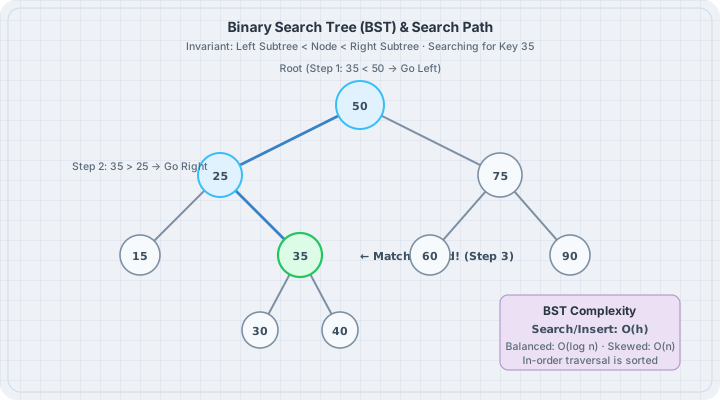
Mental model
In a balanced BST with \(n\) nodes, the height \(h \approx \log_2 n\). Searching, inserting, and deleting require traversing from root to leaf, taking \(O(\log n)\) operations.
            [ 50: Desk-A ]
            /            \
     [ 25: Desk-B ]     [ 75: Desk-C ]
      /          \
[ 15: Desk-D ] [ 35: Desk-E ]- Search Rule: To find key
35, compare with root50. Since \(35 < 50\), go Left to25. Since \(35 > 25\), go Right to35(Match!). - Traversals:
- In-Order (Left, Node, Right): Visits keys in strictly sorted ascending order (
15, 25, 35, 50, 75). - Pre-Order (Node, Left, Right): Useful for serializing the tree structure.
- Post-Order (Left, Right, Node): Useful for bottom-up cleanup or expression evaluation.
- In-Order (Left, Node, Right): Visits keys in strictly sorted ascending order (
Worked examples
Case 1: Generic BST with Insert, Search, and In-Order Traversal
Save as bst_desk.go. Implement a generic BST where keys satisfy cmp.Ordered and values represent desk dispatch records.
// bst_desk.go
package main

import (
    "cmp"
    "fmt"
)

type BSTNode[K cmp.Ordered, V any] struct {
    Key   K
    Value V
    Left  *BSTNode[K, V]
    Right *BSTNode[K, V]
}

type BST[K cmp.Ordered, V any] struct {
    Root *BSTNode[K, V]
    size int
}

func (t *BST[K, V]) Insert(key K, val V) {
    t.Root = insertNode(t.Root, key, val)
    t.size++
}

func insertNode[K cmp.Ordered, V any](node *BSTNode[K, V], key K, val V) *BSTNode[K, V] {
    if node == nil {
        return &BSTNode[K, V]{Key: key, Value: val}
    }
    if key < node.Key {
        node.Left = insertNode(node.Left, key, val)
    } else if key > node.Key {
        node.Right = insertNode(node.Right, key, val)
    } else {
        node.Value = val // Update existing key
    }
    return node
}

func (t *BST[K, V]) Search(key K) (V, bool) {
    curr := t.Root
    for curr != nil {
        if key == curr.Key {
            return curr.Value, true
        } else if key < curr.Key {
            curr = curr.Left
        } else {
            curr = curr.Right
        }
    }
    var zero V
    return zero, false
}

func (t *BST[K, V]) InOrder(visit func(key K, val V)) {
    inOrderWalk(t.Root, visit)
}

func inOrderWalk[K cmp.Ordered, V any](node *BSTNode[K, V], visit func(key K, val V)) {
    if node == nil {
        return
    }
    inOrderWalk(node.Left, visit)
    visit(node.Key, node.Value)
    inOrderWalk(node.Right, visit)
}

func main() {
    tree := &BST[int, string]{}
    tree.Insert(50, "Central Depot")
    tree.Insert(25, "North Annex")
    tree.Insert(75, "South Terminal")
    tree.Insert(15, "Substation 1")
    tree.Insert(35, "Substation 2")

    // Lookups
    target := 35
    if val, ok := tree.Search(target); ok {
        fmt.Printf("Search Key %d: Found '%s'\n", target, val)
    }

    // Sorted in-order traversal
    fmt.Println("\nIn-order sorted walkthrough:")
    tree.InOrder(func(k int, v string) {
        fmt.Printf("  Key %d -> %s\n", k, v)
    })
}
Run:
go run bst_desk.goOutput:
Search Key 35: Found 'Substation 2'

In-order sorted walkthrough:
  Key 15 -> Substation 1
  Key 25 -> North Annex
  Key 35 -> Substation 2
  Key 50 -> Central Depot
  Key 75 -> South Terminal
Case 2: Deleting a node from a BST
Save as bst_delete.go. Implement node deletion considering three structural cases: leaf node, node with one child, and node with two children (replaced by in-order successor).
// bst_delete.go
package main

import (
    "cmp"
    "fmt"
)

type Node[K cmp.Ordered] struct {
    Key   K
    Left  *Node[K]
    Right *Node[K]
}

func insert[K cmp.Ordered](root *Node[K], key K) *Node[K] {
    if root == nil {
        return &Node[K]{Key: key}
    }
    if key < root.Key {
        root.Left = insert(root.Left, key)
    } else if key > root.Key {
        root.Right = insert(root.Right, key)
    }
    return root
}

func minNode[K cmp.Ordered](node *Node[K]) *Node[K] {
    curr := node
    for curr.Left != nil {
        curr = curr.Left
    }
    return curr
}

func deleteNode[K cmp.Ordered](root *Node[K], key K) *Node[K] {
    if root == nil {
        return nil
    }

    if key < root.Key {
        root.Left = deleteNode(root.Left, key)
    } else if key > root.Key {
        root.Right = deleteNode(root.Right, key)
    } else {
        // Found node to delete

        // Case 1 & 2: 0 or 1 child
        if root.Left == nil {
            return root.Right
        } else if root.Right == nil {
            return root.Left
        }

        // Case 3: 2 children -> Find in-order successor (smallest in right subtree)
        successor := minNode(root.Right)
        root.Key = successor.Key
        root.Right = deleteNode(root.Right, successor.Key)
    }
    return root
}

func printTree[K cmp.Ordered](root *Node[K]) {
    if root == nil {
        return
    }
    printTree(root.Left)
    fmt.Printf("%v ", root.Key)
    printTree(root.Right)
}

func main() {
    var root *Node[int]
    keys := []int{50, 30, 70, 20, 40, 60, 80}
    for _, k := range keys {
        root = insert(root, k)
    }

    fmt.Print("Initial tree: ")
    printTree(root)
    fmt.Println()

    fmt.Println("Deleting leaf 20 (no children)...")
    root = deleteNode(root, 20)
    printTree(root)
    fmt.Println()

    fmt.Println("Deleting node 30 (one child 40)...")
    root = deleteNode(root, 30)
    printTree(root)
    fmt.Println()

    fmt.Println("Deleting root 50 (two children: replaced by successor 60)...")
    root = deleteNode(root, 50)
    printTree(root)
    fmt.Println()
}
Run:
go run bst_delete.goOutput:
Initial tree: 20 30 40 50 60 70 80
Deleting leaf 20 (no children)...
30 40 50 60 70 80
Deleting node 30 (one child 40)...
40 50 60 70 80
Deleting root 50 (two children: replaced by successor 60)...
40 60 70 80
The trap
The degenerate tree trap occurs when keys are inserted in pre-sorted order (1, 2, 3, 4, 5). Without self-balancing (such as Red-Black or AVL rotations), each new node attaches exclusively to the right pointer, turning the tree into a linked list with \(O(n)\) height. A query that should take 20 hops in a balanced tree takes 1,000,000 hops in a degenerate tree, blowing out stack frames.
Degenerate BST (from sorted input):
[ 1 ]
     \
     [ 2 ]
          \
          [ 3 ]
               \
               [ 4 ]  <-- Search time degraded to O(n)!
The boring rule
- If you only need fast \(O(1)\) lookups and updates, use Go’s built-in
map. Do not build a tree. - Use a tree when you need sorted traversal, predecessor/successor queries, or finding keys within a numerical range (
minKey <= k <= maxKey). - If keys arrive in sorted order, shuffle them or use a balanced variant to avoid degenerate \(O(n)\) linked list chains.
- Prefer iterative loops over deep recursion for
Searchto eliminate function call overhead and stack exhaustion.
Try this
- Implement
FindRange(min, max K) []VonBSTto collect all desk orders between two ticket IDs. - Calculate the height of the tree using a recursive
Height(node)function and compare it between random vs sorted insertions.