Why Go Binaries Are Big: Sections, Reachability, and the Linker’s Method Rules
Why Go Binaries Are Big: Sections, Reachability, and the Linker’s Method Rules
Thesis
A Go “hello world” that calls fmt.Println is 2.3 MB. A program that only registers an HTTP handler is 8.6 MB. Most advice stops at -ldflags="-s -w", which removes about a third of the file. That flag removes metadata, though, not code. The code that stays is decided earlier, by the linker’s dead-code pass: it starts at the entry point, follows every reference, and keeps only what it reaches. Methods get special rules, and one call to reflect.Value.MethodByName with a name the compiler cannot see makes the linker keep every exported method of every reachable type.
This chapter takes binaries apart with tools that ship with Go: debug/elf for sections, go tool nm -size for symbols, and the linker’s own -dumpdep graph to see why a symbol was kept. It ends with a short list of changes that actually shrink a binary, ordered by what they cost you.
Verified on Go 1.27.2 (linux/amd64, CGO_ENABLED=0), Linux 6.12, on 2026-10-19. Source links are pinned to the go1.27.2 tag. All sizes below are from this machine; yours will differ by a few kilobytes between Go releases.
Learning goals
- Split a Go executable into its sections and say which ones the program needs at run time
- Explain what
-sand-wremove, and what you lose (and keep) when you strip - Total symbol sizes per package from
go tool nm -sizeto find who pays for the bytes - Describe the linker’s dead-code pass: roots, the flood fill, and the three ways a method can stay reachable
- Use
-ldflags=-dumpdepto find the function that turned off method pruning - Choose between stripping, avoiding dynamic reflection, and changing dependencies
Mental model
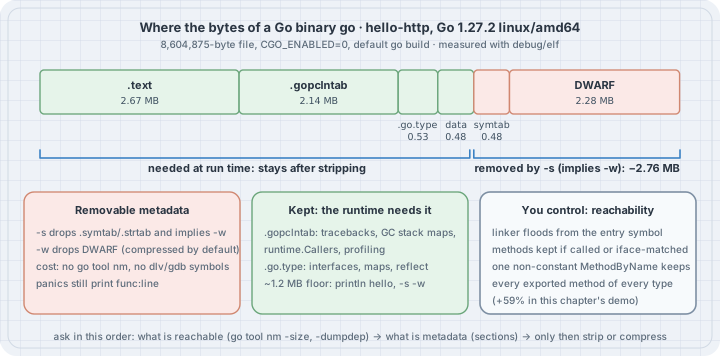
| Part of the file | What it is | Needed at run time? |
|---|---|---|
.text |
Machine code for every reachable function, including the runtime | Yes |
.gopclntab |
Maps each program counter to function, file and line; points at stack maps and other per-function data | Yes: tracebacks, runtime.Callers, profiling and the garbage collector’s stack scan read it |
.go.type |
Type descriptors (abi.Type) and method tables |
Yes: interfaces, maps, reflect, the GC |
.rodata, .data, .noptrdata |
Constants, strings, initialised globals | Yes |
.symtab, .strtab |
ELF symbol table for nm, debuggers and perf |
No; -s removes it |
.debug_* |
DWARF for debuggers (compressed by default) | No; -w removes it, -s implies -w |
Two separate questions follow from the table:
- Metadata: do you ship the symbol table and DWARF? That is a debugging trade-off, settled by a flag.
- Code: what is reachable? That is a design question, settled by what your program and its dependencies could call.
Worked examples
All listings live in one module. Every command below was run from its root (/tmp/binsize on the test machine, which is why that path appears in some output).
// go.mod
module example.com/binsize

go 1.27
Case 1: Three programs, two builds each
// hello-println/main.go
package main

func main() {
    println("hello")
}
// hello-fmt/main.go
package main
import "fmt"
func main() {
fmt.Println("hello")
}// hello-http/main.go
package main
import (
"fmt"
"net/http"
"os"
)
func main() {
http.HandleFunc("/", func(w http.ResponseWriter, r *http.Request) {
fmt.Fprintln(w, "hello")
})
if len(os.Args) > 1 && os.Args[1] == "serve" {
http.ListenAndServe("127.0.0.1:8080", nil)
}
}A small script builds each one with default flags and with -s -w:
#!/bin/sh
# sizes.sh - build each program twice (default, and -s -w) and print bytes.
set -e
mkdir -p bin
printf '%-14s %9s %9s\n' program default '-s -w'
for p in "$@"; do
    CGO_ENABLED=0 go build -o bin/$p ./$p
    CGO_ENABLED=0 go build -ldflags='-s -w' -o bin/$p.sw ./$p
    printf '%-14s %9d %9d\n' $p $(stat -c %s bin/$p) $(stat -c %s bin/$p.sw)
done
$ go version
go version go1.27.2 linux/amd64
$ ./sizes.sh hello-println hello-fmt hello-http
program default -s -w
hello-println 1895652 1220768
hello-fmt 2342505 1511584
hello-http 8604875 5841056Three things to notice:
- There is a floor. A program that only calls the
printlnbuiltin is still 1.2 MB stripped. That is the runtime: scheduler, garbage collector, allocator, maps, signal handling and the tables that describe them. Every Go executable carries it. fmtcosts about 290 KB stripped. It formats throughreflect, so it pulls in reflection and number formatting.- One
net/httphandler costs 4.3 MB more. The rest of this chapter explains where that goes.
Case 2: Sections: what -s -w actually removes
debug/elf in the standard library reads the section headers. This program prints every section of 16 KB or more, largest first:
// sections/main.go: print the size of every ELF section in a binary,
// largest first, and how much of the file is debug information.
package main

import (
    "cmp"
    "debug/elf"
    "fmt"
    "log"
    "os"
    "slices"
    "strings"
)

func main() {
    f, err := elf.Open(os.Args[1])
    if err != nil {
        log.Fatal(err)
    }
    defer f.Close()

    secs := slices.Clone(f.Sections)
    slices.SortFunc(secs, func(a, b *elf.Section) int {
        return cmp.Compare(b.FileSize, a.FileSize)
    })

    var total, debug uint64
    for _, s := range secs {
        if s.Type == elf.SHT_NOBITS { // .bss/.noptrbss take no file space
            continue
        }
        total += s.FileSize
        if strings.HasPrefix(s.Name, ".debug_") || strings.HasPrefix(s.Name, ".zdebug_") {
            debug += s.FileSize
        }
        if s.FileSize >= 16<<10 {
            fmt.Printf("%-20s %9d\n", s.Name, s.FileSize)
        }
    }
    fmt.Printf("%-20s %9d\n", "sections total", total)
    fmt.Printf("%-20s %9d (%.0f%%)\n", "debug_*", debug, 100*float64(debug)/float64(total))
}
$ go build -o bin/sections ./sections
$ bin/sections bin/hello-http
.text 2673425
.gopclntab 2136688
.debug_info 930317
.go.type 532368
.debug_line 526276
.debug_loclists 503135
.strtab 282633
.noptrdata 249601
.debug_rnglists 203263
.symtab 196416
.rodata 180633
.debug_frame 104330
.data 53234
.debug_addr 16905
sections total 8594716
debug_* 2284636 (27%)
$ bin/sections bin/hello-http.sw
.text 2673425
.gopclntab 2136688
.go.type 532368
.noptrdata 249601
.rodata 180665
.data 53234
sections total 5830949
debug_* 0 (0%)-s -w removed DWARF (2.28 MB) and the ELF symbol and string tables (0.48 MB). .text, .gopclntab and .go.type are byte-for-byte the same size. Stripping cannot touch them, because the program reads them while it runs.
The linker flags interact, and the cmd/link documentation spells it out: -s “Omit the symbol table and debug information. Implies the -w flag, which can be negated with -w=0.” DWARF is also compressed by default (-compressdwarf, default true):
$ for f in "" "-s" "-w" "-s -w" "-compressdwarf=false"; do
>   CGO_ENABLED=0 go build -ldflags="$f" -o /tmp/hb ./hello-http
>   printf '%-24s %9d\n' "-ldflags='$f'" $(stat -c %s /tmp/hb)
> done
-ldflags=''                8604875
-ldflags='-s'              5841056
-ldflags='-w'              6320121
-ldflags='-s -w'           5841056
-ldflags='-compressdwarf=false'  11303171
-s alone already gives the -s -w size. Uncompressed DWARF would add another 2.7 MB, so “Go binaries are huge because of debug info” was more true before compression was the default than it is now.
Case 3: What you lose by stripping, and what you keep
// crash/main.go: does a stripped binary still give a useful panic?
package main

func divide(a, b int) int { return a / b }

func main() {
    println(divide(1, len("")))
}
$ CGO_ENABLED=0 go build -ldflags='-s -w' -o bin/crash ./crash
$ bin/crash
panic: runtime error: integer divide by zero
goroutine 1 [running]:
main.divide(...)
/tmp/binsize/crash/main.go:4
main.main()
/tmp/binsize/crash/main.go:7 +0xa
$ go tool nm bin/crash
reading bin/crash: no symbol section
reading bin/crash: no symbols
$ go version -m bin/crash
bin/crash: go1.27.2
path example.com/binsize/crash
mod example.com/binsize (devel)
build -buildmode=exe
build -compiler=gc
build -ldflags="-s -w"
build CGO_ENABLED=0
build GOARCH=amd64
build GOOS=linux
build GOAMD64=v1The panic still names functions, files and lines, and even the inlined frame (main.divide(...)). That information comes from .gopclntab, not from DWARF or the symbol table. Build info (go version -m) also survives, because it is stored as data rather than as a symbol, so tools that read it (such as govulncheck -mode=binary) still see the module list.
What you lose: go tool nm, perf and gdb symbol names, and source-level debugging in Delve, which needs DWARF. The panic above also shows a local build path. -trimpath replaces it with the module path, and saves a few kilobytes as a side effect:
$ CGO_ENABLED=0 go build -trimpath -ldflags='-s -w' -o bin/crash.trim ./crash
$ bin/crash.trim
panic: runtime error: integer divide by zero

goroutine 1 [running]:
main.divide(...)
    example.com/binsize/crash/main.go:4
main.main()
    example.com/binsize/crash/main.go:7 +0xa
If you strip release binaries, archive the unstripped binary from the same build for later debugging. Rebuilding later with different flags gives a different binary: on this machine hello-http and hello-http.sw have the same .gopclntab bytes but differ in 11,175 bytes of .text, and their build IDs differ.
Case 4: Who pays for the bytes? Symbols per package
go tool nm -size prints every symbol with its size and kind. The largest symbols in hello-http are a misleading place to start:
$ go tool nm -size -sort size bin/hello-http > nm.txt
$ head -8 nm.txt
  9d30a0   33554432 B crypto/internal/fips140/drbg.memory
  8676e8     365096 r go:func.*
  99c780      93464 B runtime.mheap_
  96eae0      88064 D crypto/internal/fips140/nistec.p256PrecomputedEmbed
  9c20a0      69632 B runtime.cgroupScratch
  9ba880      30736 B crypto/internal/fips140/edwards25519.basepointTablePrecomp
  967160      19650 D vendor/golang.org/x/text/unicode/norm.decomps
  62ab60      19580 T crypto/internal/fips140/sha3.keccakF1600.abi0
The 32 MB “symbol” is kind B: it lives in .bss, which is zero-filled when the program loads and takes no space in the file. (It is address space, not file bytes. On Linux pages that are never touched are never backed by memory either.) Per-package totals that skip .bss are more useful:
// pkgsize/main.go: read `go tool nm -size` output on stdin and total
// symbol sizes per package, so you can see who pays for the bytes.
package main

import (
    "bufio"
    "cmp"
    "fmt"
    "os"
    "slices"
    "strconv"
    "strings"
)

// pkgOf turns "net/http.(*conn).serve" into "net/http" and
// "type:*net/http.conn" into "net/http".
func pkgOf(sym string) string {
    sym = strings.TrimPrefix(sym, "type:")
    sym = strings.TrimPrefix(sym, "go:itab.")
    sym = strings.TrimLeft(sym, "*")
    slash := strings.LastIndexByte(sym, '/')
    if dot := strings.IndexByte(sym[slash+1:], '.'); dot >= 0 {
        return sym[:slash+1+dot]
    }
    return sym
}

func main() {
    sizes := map[string]int{}
    total := 0
    sc := bufio.NewScanner(os.Stdin)
    for sc.Scan() {
        // "addr size kind name"; generic names may contain spaces.
        f := strings.Fields(sc.Text())
        if len(f) < 4 {
            continue
        }
        n, err := strconv.Atoi(f[1])
        // U = undefined, B/b = .bss: zero-filled at load, no file bytes.
        if err != nil || f[2] == "U" || f[2] == "B" || f[2] == "b" {
            continue
        }
        sizes[pkgOf(strings.Join(f[3:], " "))] += n
        total += n
    }
    type row struct {
        pkg string
        n   int
    }
    var rows []row
    for p, n := range sizes {
        rows = append(rows, row{p, n})
    }
    slices.SortFunc(rows, func(a, b row) int { return cmp.Compare(b.n, a.n) })
    for _, r := range rows[:min(12, len(rows))] {
        fmt.Printf("%-32s %8d %5.1f%%\n", r.pkg, r.n, 100*float64(r.n)/float64(total))
    }
    fmt.Printf("%-32s %8d\n", "symbols total", total)
}
$ go build -o bin/pkgsize ./pkgsize
$ go tool nm -size bin/hello-fmt | bin/pkgsize
runtime 450642 58.3%
go:func 126400 16.3%
fmt 31041 4.0%
internal/strconv 28088 3.6%
reflect 24936 3.2%
internal/runtime/gc/scan 17873 2.3%
internal/runtime/maps 14966 1.9%
internal/runtime/cgroup 10065 1.3%
syscall 6642 0.9%
internal/sync 6216 0.8%
internal/poll 5683 0.7%
slices 5363 0.7%
symbols total 773461
$ go tool nm -size bin/hello-http | bin/pkgsize
runtime 492631 15.2%
go:func 365096 11.3%
crypto/tls 251735 7.8%
crypto/internal/fips140/nistec 155922 4.8%
net 136758 4.2%
net/http/internal/http2 128203 4.0%
net/http 115662 3.6%
crypto/x509 101560 3.1%
vendor/golang.org/x/text/unicode/norm 75715 2.3%
time 66902 2.1%
math/big 65955 2.0%
reflect 61528 1.9%
symbols total 3233351The program never mentions TLS, yet crypto/tls, the FIPS 140 elliptic-curve code, crypto/x509 and math/big are a fifth of its symbols. They are reachable: net/http’s server code handles *tls.Conn connections and HTTP/2, and the linker cannot know you will never pass it one. go:func.* is per-function metadata (stack maps and similar data that .gopclntab points to), so it grows with the amount of code.
The symbol totals are smaller than the file. .gopclntab appears in nm only as zero-sized boundary symbols (runtime.pclntab, runtime.epclntab), so the sections view and the symbols view answer different questions. Use both.
Importing a package is not the same as paying for it. Compare net.ParseIP with netip.ParseAddr:
// ip-net/main.go
package main

import (
    "net"
    "os"
)

func main() {
    ip := net.ParseIP(os.Args[1])
    os.Stdout.WriteString(ip.String() + "\n")
}
// ip-netip/main.go
package main
import (
"net/netip"
"os"
)
func main() {
ip, err := netip.ParseAddr(os.Args[1])
if err != nil {
os.Exit(1)
}
os.Stdout.WriteString(ip.String() + "\n")
}$ for p in ip-net ip-netip; do
> CGO_ENABLED=0 go build -ldflags='-s -w' -o bin/$p ./$p
> printf '%-10s %8d bytes %3d packages\n' $p $(stat -c %s bin/$p) $(go list -deps ./$p | wc -l)
> bin/$p 2001:db8::1
> done
ip-net 1560736 bytes 67 packages
2001:db8::1
ip-netip 1405088 bytes 59 packages
2001:db8::1All of package net is in the dependency graph, but the resolver, dialer and listener are unreachable from ParseIP, so the linker drops them. The 152 KB difference is what ParseIP and net’s package initialisation do reach (for example package time and the GODEBUG machinery in internal/bisect, both absent from the netip build), not 4 MB. What counts is what is reachable.
Case 5: How the linker decides what is reachable
The dead-code pass is cmd/link/internal/ld/deadcode.go. In a normal executable it starts from the entry symbol (which leads to runtime.main, main.main and every package’s init tasks) plus runtime.unreachableMethod, then marks everything those symbols refer to, and so on. Functions are easy: a call is a relocation, so it gets followed.
Methods are the hard part, because a method can be called without a direct reference. The comment above deadcode lists the three ways:
- direct call
- through a reachable interface type
- reflect.Value.Method (or MethodByName), or reflect.Type.Method (or MethodByName)
Case 2 is handled conservatively: every method of a type that was converted to an interface is kept if its name and signature match a method of any reachable interface type. Case 3 is the dramatic one:
All functions that call reflect.Value.Method or reflect.Type.Method are REFLECTMETHODs. Functions that call reflect.Value.MethodByName or reflect.Type.MethodByName with a non-constant argument are REFLECTMETHODs, too. If we find a REFLECTMETHOD, we give up on static analysis, and mark all exported methods of all reachable types as reachable.
If the argument to MethodByName is a compile-time constant, the compiler emits a relocation with the method name. Matching methods are kept in all reachable types.
To see the difference, generate a type with 300 exported methods, each doing a little real work. The generator carries a //go:build ignore constraint so it is not part of the module’s packages:
// gen/gen_big.go: write methods/big.go with 300 exported methods.
//go:build ignore

package main

import (
    "fmt"
    "os"
    "strings"
)

func main() {
    var b strings.Builder
    b.WriteString("// methods/big.go (generated): a type with 300 exported methods.\n")
    b.WriteString("package main\n\nimport \"strconv\"\n\ntype Big struct{ n int }\n\n")
    for i := range 300 {
        fmt.Fprintf(&b, "func (b *Big) M%d(s string) string "+
            "{ return strconv.Itoa(b.n+%d) + s + strconv.Quote(s[:len(s)/2]) }\n", i, i)
    }
    if err := os.WriteFile("methods/big.go", []byte(b.String()), 0o644); err != nil {
        panic(err)
    }
}
Then call one method three ways. mode is a constant, written into its own file by the build loop, so the two branches not taken are removed by the compiler:
// methods/main.go: how a reflect call decides which methods survive linking.
package main

import (
    "fmt"
    "os"
    "reflect"
)

func main() {
    b := &Big{n: 1}
    switch mode {
    case "direct": // static call: the linker sees exactly one method used
        fmt.Println(b.M7("go"))
    case "const": // MethodByName with a constant: still only M7 is needed
        fmt.Println(reflect.ValueOf(b).MethodByName("M7").Call(
            []reflect.Value{reflect.ValueOf("go")})[0])
    case "dynamic": // name known only at run time: every exported method may be called
        name := "M7"
        if len(os.Args) > 1 {
            name = os.Args[1]
        }
        fmt.Println(reflect.ValueOf(b).MethodByName(name).Call(
            []reflect.Value{reflect.ValueOf("go")})[0])
    }
}
$ mkdir -p methods && go run gen/gen_big.go
$ for m in direct const dynamic; do
> printf 'package main\n\nconst mode = "%s"\n' $m > methods/mode.go
> CGO_ENABLED=0 go build -o bin/methods-$m ./methods
> printf '%-8s %8d bytes %4d Big methods %5d text symbols\n' $m \
> $(stat -c %s bin/methods-$m) \
> $(go tool nm bin/methods-$m | grep -cE ' main\.\(\*Big\)\.M[0-9]+$') \
> $(go tool nm bin/methods-$m | grep -cE ' T ')
> done
direct 2343128 bytes 1 Big methods 1570 text symbols
const 2518294 bytes 1 Big methods 1662 text symbols
dynamic 3717576 bytes 300 Big methods 3225 text symbols
$ bin/methods-dynamic M42
43go"g"- direct: one method survives.
- const: still one method. The extra 175 KB is
reflect.Value.Calland its metadata (packagereflectalone grows from 25 KB to 71 KB of symbols), not your methods. - dynamic: all 300
Bigmethods survive, and so do about 1,260 other functions, because the rule applies to every reachable type. A diff of the two symbol lists shows exported methods ofreflect.Value,time.Time,os.Fileandinternal/poll.FDthat nothing calls, plus the functions those methods call. The binary is 48% bigger thanconstand 59% bigger thandirect.
Case 6: Finding the function that turned pruning off
In a real program you did not write the MethodByName call yourself. -ldflags=-dumpdep makes the linker print every edge of its reachability graph as from -> to, and tags symbols with <ReflectMethod> and <UsedInIface> (see dumpDepAddFlags in deadcode.go). Filter it:
#!/bin/sh
# whyreflect.sh PKG - list the functions that switched off method pruning
# (the linker's <ReflectMethod> flag), excluding package reflect itself.
go build -o /dev/null -ldflags=-dumpdep "$@" 2>&1 |
    grep -oE '^[^ ]+ <ReflectMethod>' | sort -u | grep -v '^reflect\.' ||
    echo "none: method pruning is on"
$ ./whyreflect.sh ./hello-http
none: method pruning is on
$ ./whyreflect.sh ./methods
main.main <ReflectMethod>
$ go build -ldflags=-dumpdep -o /dev/null ./methods 2>&1 | grep -F 'main.(*Big).M42'
type:*main.Big <UsedInIface> -> main.(*Big).M42(methods/mode.go still says dynamic from the last loop iteration.) The last line is the whole explanation in one edge: M42 is kept because the type *Big reached an interface, and a ReflectMethod function exists.
The most common real culprit is text/template (and html/template, which uses it). A template field like {{.Name}} may name a method, and the template engine looks it up by a name it only learns at run time:
// tmpl/main.go: one text/template call, and what it costs in bytes.
package main

import (
    "os"
    "text/template"
)

type User struct{ Name string }

func main() {
    t := template.Must(template.New("hi").Parse("hello {{.Name}}\n"))
    t.Execute(os.Stdout, User{Name: "gopher"})
}
$ CGO_ENABLED=0 go build -o bin/tmpl ./tmpl && bin/tmpl
hello gopher
$ stat -c '%s %n' bin/hello-fmt bin/tmpl
2342505 bin/hello-fmt
4345676 bin/tmpl
$ ./whyreflect.sh ./tmpl
text/template.(*state).evalField <ReflectMethod>
$ go tool nm -size bin/tmpl | bin/pkgsize | head -6
runtime 474386 33.4%
go:func 208912 14.7%
reflect 138814 9.8%
time 79477 5.6%
text/template/parse 69079 4.9%
text/template 61804 4.4%One template almost doubles the “hello” binary, and time is now bigger than text/template itself: every exported method of time.Time and time.Duration is kept in case a template calls it (go tool nm finds 10 exported time.Duration methods in bin/tmpl and none in bin/hello-fmt). That is correct behaviour, not a bug. The template really could call any of them.
Case 7: The shrink list, cheapest first
| Change | Saves here | Costs |
|---|---|---|
-ldflags=-s (implies -w) |
2.76 MB of 8.60 MB (32%) | No symbols for nm/perf/gdb, no Delve; panics unaffected. Archive the unstripped build. |
-trimpath |
~12 KB | None for releases; also removes local paths from panics and build info |
Replace a dynamic MethodByName/Method(i) with a constant name, a switch, or an interface |
1.2 MB in the methods demo |
A little code; the set of callable methods becomes explicit |
Avoid text/template in tiny tools (use fmt or strings.Replacer) |
2.0 MB vs hello-fmt |
Less flexible output formatting |
Drop a dependency whose reachable code is large (check with pkgsize, not with go list -deps) |
Depends | Engineering time |
What is not on the list: hand-editing the ELF file, or packers. A packer such as UPX compresses the file and decompresses it into memory at start-up, which costs start-up time and memory, can trip malware scanners, and breaks tools that read the binary on disk (go version -m, govulncheck). It is not covered or measured here; read its documentation before you consider it.
The trap
- Treating
-s -was “the” size fix. It removes only metadata..text,.gopclntaband.go.typeare unchanged, and inhello-httpthey are two thirds of the file. - Reading the largest
nmsymbols without the kind column.B/bsymbols live in.bssand take no file space. A 32 MBBsymbol in a 6 MB binary is not a mistake. - Counting packages instead of reachable code.
netwas fully in the dependency graph and cost 152 KB.text/templatewith one field cost 2 MB. - One dynamic reflection call in a shared library package.
REFLECTMETHODis a whole-program switch. A helper in one package that callsreflect.Value.Method(i)makes every binary that reaches it keep all exported methods of all reachable types. - Stripping and then rebuilding to debug. A later rebuild with different flags is a different binary. Keep the unstripped artifact from the release build.
The boring rule
Measure before you strip, and strip last. Track the stripped size of each release binary in CI. When it jumps, run pkgsize on the before and after binaries and whyreflect.sh on the new one: a new <ReflectMethod> line or a new large package explains most jumps. Use -trimpath always and -s for release artifacts, and archive the unstripped build next to each release.
Try this
- Add
-ldflags=-w=0to an-sbuild ofhello-http. Which sections come back? Does the panic output change? - Replace the
MethodByName(name)call inmethods/main.gowith aswitch name { case "M7": ... }that calls methods directly. Re-run the size loop. How close todirectdo you get? - Run
whyreflect.shon one of your own services. If it prints a line, follow the-dumpdepedges backwards (grep -- '-> text/template'and so on) until you reach your own code. - Diff
go tool nm bin/methods-constandgo tool nm bin/methods-dynamic(kindTonly). Which standard-library types gained the most methods? - Build
hello-httpwithCGO_ENABLED=1(if a C compiler is installed) and compare the size andgo version -moutput. Which part ofnetchanged?
Sources
Go source at the go1.27.2 tag:
- Linker dead-code pass, roots, method rules and
-dumpdepflags: https://github.com/golang/go/blob/go1.27.2/src/cmd/link/internal/ld/deadcode.go reflect.Value.MethodByNameandMethod: https://github.com/golang/go/blob/go1.27.2/src/reflect/value.go#L1950text/templatefield evaluation (evalField): https://github.com/golang/go/blob/go1.27.2/src/text/template/exec.go#L682
Go documentation:
cmd/linkflags (-s,-w,-compressdwarf,-dumpdep): https://pkg.go.dev/cmd/linkcmd/gobuild flags (-ldflags,-trimpath) andgo version -m: https://pkg.go.dev/cmd/gogo tool nm(symbol kindsT,D,B,R,U): https://pkg.go.dev/cmd/nmdebug/elf: https://pkg.go.dev/debug/elfreflect.Value.MethodByName: https://pkg.go.dev/reflect#Value.MethodByName- Go 1.2 runtime symbol information (the design of the pc-value tables in
.gopclntab): https://go.dev/s/go12symtab - Debugging Go code with GDB (what DWARF provides): https://go.dev/doc/gdb
- Release history (Go 1.27.2, 2026-10-08): https://go.dev/doc/devel/release
Tools: Go 1.27.2 (go build, go tool nm, go tool buildid, go version -m), debug/elf, and GNU objcopy (for the .text comparison in Case 3).