Heaps and Priority Queues
Heaps and Priority Queues
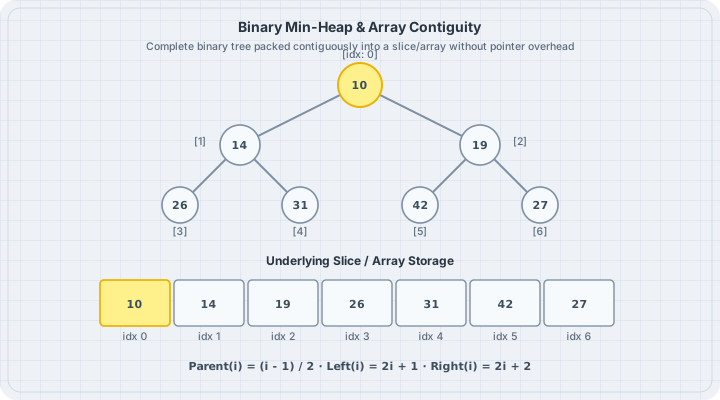
A binary heap is a complete binary tree packed contiguously into a slice without pointer overhead. A priority queue uses this heap structure to ensure that the element with the highest (or lowest) priority is always available at the root in \(O(1)\) time, with additions and removals running in \(O(\log n)\) time. In Go, the boring default is the standard library’s container/heap package, but understanding the underlying array arithmetic explains how it works.
Mental model
A binary heap satisfies two core invariants:
- Shape Property: It is a complete binary tree. Every level is fully filled, except possibly the bottom level, which is filled from left to right.
- Heap Property: In a Min-Heap, every parent is \(\le\) its children (\(Root\) is the absolute minimum). In a Max-Heap, every parent is \(\ge\) its children.
Because the tree is complete, it requires zero pointers. It maps directly to an array or slice:
Tree view:                Array index view:
       [ 10 (idx:0) ]     +----+----+----+----+----+----+
       /            \     | 10 | 14 | 19 | 26 | 31 | 42 |
  [ 14 (1) ]    [ 19 (2) ] +----+----+----+----+----+----+
   /      \      /          0    1    2    3    4    5
[ 26(3)] [31(4)][42(5)]
Given any index \(i\):
- \(\text{Parent}(i) = \lfloor (i - 1) / 2 \rfloor\)
- \(\text{Left Child}(i) = 2i + 1\)
- \(\text{Right Child}(i) = 2i + 2\)
Operations:
- Push (Sift-Up): Append item to the end of the slice; repeatedly swap with its parent until heap order is restored.
- Pop (Sift-Down): Swap the root with the last element; pop the end off the slice; repeatedly sift the new root down by swapping with its smallest child.
Worked examples
Case 1: Generic Min-Heap from scratch
Save as heap_scratch.go. Build an array-backed generic min-heap using Go generics and index arithmetic.
// heap_scratch.go
package main

import (
    "cmp"
    "fmt"
)

type MinHeap[T cmp.Ordered] struct {
    items []T
}

func (h *MinHeap[T]) Push(val T) {
    h.items = append(h.items, val)
    h.siftUp(len(h.items) - 1)
}

func (h *MinHeap[T]) Pop() (T, bool) {
    var zero T
    if len(h.items) == 0 {
        return zero, false
    }
    min := h.items[0]
    lastIdx := len(h.items) - 1
    h.items[0] = h.items[lastIdx]
    h.items = h.items[:lastIdx]

    if len(h.items) > 0 {
        h.siftDown(0)
    }
    return min, true
}

func (h *MinHeap[T]) siftUp(idx int) {
    for idx > 0 {
        parent := (idx - 1) / 2
        if h.items[idx] < h.items[parent] {
            h.items[idx], h.items[parent] = h.items[parent], h.items[idx]
            idx = parent
        } else {
            break
        }
    }
}

func (h *MinHeap[T]) siftDown(idx int) {
    n := len(h.items)
    for {
        smallest := idx
        left := 2*idx + 1
        right := 2*idx + 2

        if left < n && h.items[left] < h.items[smallest] {
            smallest = left
        }
        if right < n && h.items[right] < h.items[smallest] {
            smallest = right
        }
        if smallest != idx {
            h.items[idx], h.items[smallest] = h.items[smallest], h.items[idx]
            idx = smallest
        } else {
            break
        }
    }
}

func main() {
    h := &MinHeap[int]{}
    scores := []int{42, 10, 31, 14, 26, 19}
    fmt.Println("Pushing scores:", scores)
    for _, s := range scores {
        h.Push(s)
    }

    fmt.Print("Popping in ascending priority order: ")
    for {
        val, ok := h.Pop()
        if !ok {
            break
        }
        fmt.Printf("%d ", val)
    }
    fmt.Println()
}
Run:
go run heap_scratch.goOutput:
Pushing scores: [42 10 31 14 26 19]
Popping in ascending priority order: 10 14 19 26 31 42
Case 2: Standard Library container/heap Priority Queue
Save as desk_priority_queue.go. Triage incoming desk maintenance tickets where priority 1 is critical emergency and priority 5 is routine cleanup.
// desk_priority_queue.go
package main

import (
    "container/heap"
    "fmt"
)

type Ticket struct {
    ID       int
    Title    string
    Priority int // 1 = Critical, 2 = High, 3 = Normal, 4 = Low
    index    int // Index needed for update/fix operations
}

// PriorityQueue implements heap.Interface
type PriorityQueue []*Ticket

func (pq PriorityQueue) Len() int           { return len(pq) }
func (pq PriorityQueue) Less(i, j int) bool { return pq[i].Priority < pq[j].Priority }
func (pq PriorityQueue) Swap(i, j int) {
    pq[i], pq[j] = pq[j], pq[i]
    pq[i].index = i
    pq[j].index = j
}

func (pq *PriorityQueue) Push(x any) {
    n := len(*pq)
    item := x.(*Ticket)
    item.index = n
    *pq = append(*pq, item)
}

func (pq *PriorityQueue) Pop() any {
    old := *pq
    n := len(old)
    item := old[n-1]
    old[n-1] = nil // Avoid memory leak
    item.index = -1
    *pq = old[0 : n-1]
    return item
}

func main() {
    pq := &PriorityQueue{}
    heap.Init(pq)

    heap.Push(pq, &Ticket{ID: 201, Title: "Restock register tape", Priority: 4})
    heap.Push(pq, &Ticket{ID: 202, Title: "Kitchen grill failure", Priority: 1})
    heap.Push(pq, &Ticket{ID: 203, Title: "VIP Table Reservation", Priority: 2})
    heap.Push(pq, &Ticket{ID: 204, Title: "Wipe table 8", Priority: 3})

    fmt.Println("Dispatching tickets by urgency:")
    for pq.Len() > 0 {
        ticket := heap.Pop(pq).(*Ticket)
        fmt.Printf("  [Priority %d] Ticket #%d: %s\n", ticket.Priority, ticket.ID, ticket.Title)
    }
}
Run:
go run desk_priority_queue.goOutput:
Dispatching tickets by urgency:
  [Priority 1] Ticket #202: Kitchen grill failure
  [Priority 2] Ticket #203: VIP Table Reservation
  [Priority 3] Ticket #204: Wipe table 8
  [Priority 4] Ticket #201: Restock register tape
The trap
The most prevalent bug with container/heap is calling the slice methods pq.Push() or pq.Pop() directly instead of the package-level functions heap.Push(pq, x) and heap.Pop(pq). Calling pq.Push() appends without re-sifting; calling heap.Push(pq, x) invokes pq.Push() and then calls siftUp() to maintain the heap invariant.
// bad_heap_call.go
package main

import (
    "container/heap"
    "fmt"
)

type IntHeap []int

func (h IntHeap) Len() int           { return len(h) }
func (h IntHeap) Less(i, j int) bool { return h[i] < h[j] }
func (h IntHeap) Swap(i, j int)      { h[i], h[j] = h[j], h[i] }
func (h *IntHeap) Push(x any)        { *h = append(*h, x.(int)) }
func (h *IntHeap) Pop() any {
    old := *h
    n := len(old)
    x := old[n-1]
    *h = old[0 : n-1]
    return x
}

func main() {
    h := &IntHeap{20, 30}
    heap.Init(h)

    // WRONG: Direct method call bypasses heap ordering
    h.Push(5)
    fmt.Printf("After direct Push(5), root is still wrong: %d\n", (*h)[0])

    // RIGHT: heap.Push maintains invariant
    heap.Push(h, 2)
    fmt.Printf("After heap.Push(2), root is true minimum: %d\n", (*h)[0])
}
Run:
go run bad_heap_call.goOutput:
After direct Push(5), root is still wrong: 20
After heap.Push(2), root is true minimum: 2
The boring rule
- Use
container/heapfor production priority queues in Go. It avoids reinventing sift math and is heavily optimized. - Always call
heap.Push(pq, item)andheap.Pop(pq)through theheappackage, never on the type directly. - In
Pop(), always assignold[n-1] = nilbefore truncating the slice to prevent memory leaks when holding pointer references. - If you need a Max-Heap instead of a Min-Heap, simply reverse the comparison in
Less(i, j)(return pq[i] > pq[j]).
Try this
- Implement
heap.Fix(pq, i)indesk_priority_queue.goto upgrade an existing ticket’s priority from 4 (routine) to 1 (critical) after it has already been pushed. - Use a Min-Heap of fixed size \(k\) to track the top-\(k\) most expensive orders in a continuous stream of desk transactions.