CSRF Without Tokens: net/http CrossOriginProtection
CSRF Without Tokens: net/http CrossOriginProtection
Thesis
Cross-Site Request Forgery is a confused-deputy attack: a page on evil.example makes the victim’s browser send a state-changing request to your site, and the browser attaches the victim’s cookies. For twenty years the answer was a CSRF token in every form, which meant every form, every fetch, and every template had to carry a secret correctly. Hand-rolled versions of that scheme still turn up in code review, model-written ones included. They often get the hard parts right (random tokens, constant-time compare) and the boring parts wrong (an Origin check done with strings.HasPrefix, logic spread across handlers).
Since Go 1.25 the standard library ships the modern answer: http.CrossOriginProtection. It is middleware that rejects non-safe, cross-origin browser requests using the Sec-Fetch-Site Fetch-metadata header that every major browser has sent since 2023, and falls back to comparing Origin with Host. It needs no tokens, no cookies, and no template changes. On Go 1.27 a cookie-authenticated Go service should start from this middleware and justify any hand-rolled scheme on top of it.
Mental model
The browser already knows where a request came from and, for HTTPS and localhost targets, it tells the server in Sec-Fetch-Site:
Sec-Fetch-Site |
Meaning | CrossOriginProtection |
|---|---|---|
same-origin |
Your own page, same scheme + host + port | allow |
none |
User-initiated: typed URL, bookmark | allow |
same-site |
Sibling origin, e.g. blog.example.com → app.example.com |
reject |
cross-site |
Anyone else | reject |
Check uses that header first. It ignores safe methods and falls back to Origin for older browsers. The flow below is the actual Check from net/http/csrf.go in Go 1.27.2:
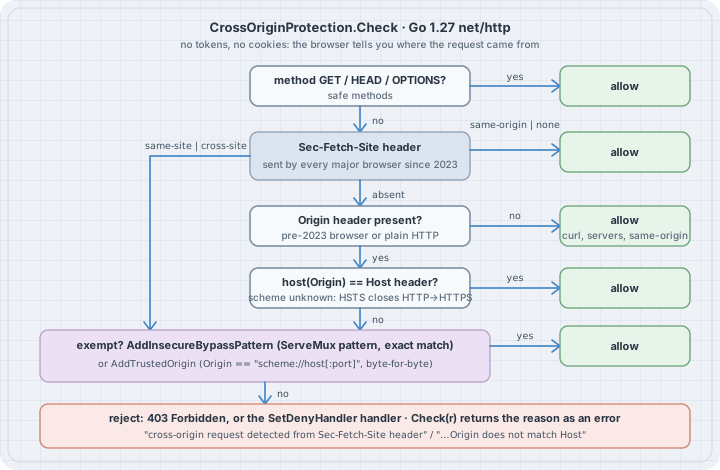
Four properties to keep in your head:
- It protects unsafe methods only.
GET,HEAD, andOPTIONSalways pass, so a handler that changes state onGETis outside the protection by design. - Same-site is not same-origin.
SameSite=Laxcookies stop cross-site requests but not a compromised marketing subdomain posting to your app.Sec-Fetch-Site: same-siteis rejected. - No headers means “not a browser”. Requests carrying neither
Sec-Fetch-SitenorOrigincome from curl, servers, or very old browsers, and they pass. CSRF needs a browser’s ambient cookies, so this is correct. It also means CSRF protection is not authentication. - Exemptions are explicit and narrow.
AddTrustedOrigintakes an exactscheme://host[:port]value.AddInsecureBypassPatterntakes aServeMuxpattern and matches only requests that hit it directly. The deny path is a 403, or your handler viaSetDenyHandler.
The API is small:
cop := http.NewCrossOriginProtection()          // zero value is also valid
err := cop.AddTrustedOrigin("https://admin.example.com")
cop.AddInsecureBypassPattern("POST /sso/acs")   // panics on invalid/conflicting pattern
cop.SetDenyHandler(h)                           // default: 403 + reason text
err = cop.Check(r)                              // nil = allowed; side-effect free
handler := cop.Handler(mux)                     // wrap the whole router
All of the configuration methods are safe to call concurrently with request handling and apply to future requests.
Worked examples
Every listing was run with Go 1.27.2 on Linux (amd64). The output blocks are pasted from those runs. Each case is its own module so go run . sees one main package:
mkdir -p csrf/case1 && cd csrf/case1
go mod init example.com/csrf/case1
Case 1: A hand-rolled origin check versus the standard library
This is the kind of middleware that shows up in review. It accepts a POST when Origin “starts with” the site’s origin. We feed it, and the stdlib middleware, the header combinations real browsers produce.
// main.go — the same POST handler behind a hand-rolled origin check and
// behind net/http.CrossOriginProtection, fed the requests browsers send.
package main

import (
    "fmt"
    "net/http"
    "net/http/httptest"
    "strings"
)

// transfer is a state-changing handler: it must only run for requests
// the user's own pages (or non-browser clients) made.
func transfer(w http.ResponseWriter, r *http.Request) {
    fmt.Fprintln(w, "transferred")
}

// handRolled is the kind of check that shows up in reviews: it compares
// Origin to the expected origin "as strings".
func handRolled(next http.Handler) http.Handler {
    return http.HandlerFunc(func(w http.ResponseWriter, r *http.Request) {
        if r.Method == http.MethodPost {
            o := r.Header.Get("Origin")
            if o != "" && !strings.HasPrefix(o, "https://bank.example") {
                http.Error(w, "bad origin", http.StatusForbidden)
                return
            }
        }
        next.ServeHTTP(w, r)
    })
}

type probe struct {
    name, method, site, origin string
}

func main() {
    stdlib := http.NewCrossOriginProtection().Handler(http.HandlerFunc(transfer))
    hand := handRolled(http.HandlerFunc(transfer))

    probes := []probe{
        {"own form (modern browser)", "POST", "same-origin", "https://bank.example"},
        {"evil.example form", "POST", "cross-site", "https://evil.example"},
        {"look-alike domain", "POST", "cross-site", "https://bank.example.evil.net"},
        {"sibling subdomain", "POST", "same-site", "https://blog.bank.example"},
        {"bookmark / typed URL", "POST", "none", ""},
        {"opaque origin (sandboxed iframe)", "POST", "cross-site", "null"},
        {"old browser, own page", "POST", "", "https://bank.example"},
        {"old browser, evil page", "POST", "", "https://evil.example"},
        {"curl / server-to-server", "POST", "", ""},
        {"cross-site GET", "GET", "cross-site", "https://evil.example"},
    }

    fmt.Printf("%-34s %-11s %-10s %s\n", "request", "Sec-Fetch", "hand", "stdlib")
    for _, p := range probes {
        fmt.Printf("%-34s %-11s %-10d %d\n", p.name, or(p.site, "-"),
            code(hand, p), code(stdlib, p))
    }
}

func code(h http.Handler, p probe) int {
    req := httptest.NewRequest(p.method, "https://bank.example/transfer", nil)
    if p.site != "" {
        req.Header.Set("Sec-Fetch-Site", p.site)
    }
    if p.origin != "" {
        req.Header.Set("Origin", p.origin)
    }
    rec := httptest.NewRecorder()
    h.ServeHTTP(rec, req)
    return rec.Code
}

func or(s, d string) string {
    if s == "" {
        return d
    }
    return s
}
go run .Output:
request                            Sec-Fetch   hand       stdlib
own form (modern browser)          same-origin 200        200
evil.example form                  cross-site  403        403
look-alike domain                  cross-site  200        403
sibling subdomain                  same-site   403        403
bookmark / typed URL               none        200        200
opaque origin (sandboxed iframe)   cross-site  403        403
old browser, own page              -           200        200
old browser, evil page             -           403        403
curl / server-to-server            -           200        200
cross-site GET                     cross-site  200        200
Read the table row by row:
- Look-alike domain.
https://bank.example.evil.netstarts withhttps://bank.example, so the hand-rolled check waves it through. Stringly-typed origin comparison is the classic bug.CrossOriginProtectionnever compares prefixes:Sec-Fetch-Site: cross-siteis rejected outright. - Sibling subdomain. Both reject it here, but only by accident in the hand-rolled version.
SameSitecookies would not have stopped it. none. A bookmark or typed URL is user-initiated, so it is allowed.- Opaque origin. Sandboxed iframes and some redirects send
Origin: null. Modern browsers also mark itcross-site, and even theOrigin-only fallback rejectsnullbecause its host never equalsHost. - Old browser rows. With no
Sec-Fetch-Site, the middleware compares the host ofOriginwith theHostheader. - curl row. No browser headers, no ambient cookies, no CSRF. The request is allowed, and your authentication layer still has to do its job.
- Cross-site GET. Allowed. This is the trap later in the chapter.
Case 2: Trusted origins are exact strings
A separate admin SPA on https://admin.bank.example posts to https://api.bank.example. That is a same-site request, so it is rejected unless you trust the origin explicitly.
mkdir -p ../case2 && cd ../case2 && go mod init example.com/csrf/case2// main.go — trusted origins: what AddTrustedOrigin accepts, and how
// exactly it has to match the Origin header the browser sends.
package main
import (
"fmt"
"net/http"
"net/http/httptest"
)
func main() {
cop := http.NewCrossOriginProtection()
// The admin SPA lives on its own origin and posts to the API.
for _, o := range []string{
"https://admin.bank.example",
"https://admin.bank.example/", // trailing slash = a path
"admin.bank.example", // no scheme
"https://partner.example:8443",
} {
if err := cop.AddTrustedOrigin(o); err != nil {
fmt.Println("AddTrustedOrigin:", err)
} else {
fmt.Printf("AddTrustedOrigin: %q ok\n", o)
}
}
fmt.Println()
h := cop.Handler(http.HandlerFunc(func(w http.ResponseWriter, r *http.Request) {
fmt.Fprintln(w, "ok")
}))
for _, origin := range []string{
"https://admin.bank.example",
"https://ADMIN.bank.example",
"http://admin.bank.example",
"https://admin.bank.example:443",
"https://partner.example:8443",
"https://partner.example",
} {
req := httptest.NewRequest("POST", "https://api.bank.example/v1/payees", nil)
req.Header.Set("Sec-Fetch-Site", "same-site")
req.Header.Set("Origin", origin)
rec := httptest.NewRecorder()
h.ServeHTTP(rec, req)
fmt.Printf("%-32s -> %d\n", origin, rec.Code)
}
}go run .Output:
AddTrustedOrigin: "https://admin.bank.example" ok
AddTrustedOrigin: invalid origin "https://admin.bank.example/": path, query, and fragment are not allowed
AddTrustedOrigin: invalid origin "admin.bank.example": scheme is required
AddTrustedOrigin: "https://partner.example:8443" ok

https://admin.bank.example       -> 200
https://ADMIN.bank.example       -> 403
http://admin.bank.example        -> 403
https://admin.bank.example:443   -> 403
https://partner.example:8443     -> 200
https://partner.example          -> 403
AddTrustedOrigin validates its input. It requires a scheme and a host, and rejects any path, query, or fragment, including a trailing /. Matching is a map lookup on the raw Origin header, so the value must be the browser’s serialization: lowercase host, scheme included, default port omitted. Browsers never send https://admin.bank.example:443 or an uppercase host, so those rows are only here to show that nothing is normalized for you. Configure origins exactly as a browser prints window.location.origin.
Case 3: Bypass patterns for the flows that are cross-site by design
Some legitimate flows are cross-site browser POSTs by construction. In a SAML HTTP-POST binding, or an OIDC response_mode=form_post callback, the identity provider’s page auto-submits a form to you. Those routes need an exemption. Webhooks usually do not, because they come from servers and carry no browser headers.
mkdir -p ../case3 && cd ../case3 && go mod init example.com/csrf/case3// main.go — insecure bypass patterns: which requests they exempt, and
// which near-misses they deliberately do not.
package main
import (
"fmt"
"net/http"
"net/http/httptest"
)
func main() {
mux := http.NewServeMux()
ok := func(w http.ResponseWriter, r *http.Request) { fmt.Fprintln(w, "ok") }
mux.HandleFunc("POST /sso/acs", ok) // SAML HTTP-POST binding
mux.HandleFunc("POST /oauth/{provider}/callback", ok) // OIDC response_mode=form_post
mux.HandleFunc("POST /account/delete", ok)
mux.HandleFunc("POST /webhooks/github", ok)
cop := http.NewCrossOriginProtection()
// Cross-site browser POSTs that are legitimate by design: the IdP's
// page auto-submits a form to us. Nothing else gets an exemption.
cop.AddInsecureBypassPattern("POST /sso/acs")
cop.AddInsecureBypassPattern("POST /oauth/{provider}/callback")
h := cop.Handler(mux)
send := func(path string, browser bool) {
req := httptest.NewRequest("POST", "https://bank.example"+path, nil)
if browser {
req.Header.Set("Sec-Fetch-Site", "cross-site")
req.Header.Set("Origin", "https://idp.example")
}
rec := httptest.NewRecorder()
h.ServeHTTP(rec, req)
kind := "server"
if browser {
kind = "cross-site browser"
}
fmt.Printf("%-18s POST %-24s -> %d\n", kind, path, rec.Code)
}
send("/sso/acs", true)
send("/sso/acs/", true) // not matched by the pattern
send("//sso/acs", true) // ServeMux would clean + redirect
send("/sso/../account/delete", true) // cleaned path is not a bypass
send("/oauth/google/callback", true)
send("/account/delete", true)
send("/webhooks/github", false) // no bypass needed: not a browser
// Patterns follow ServeMux rules, including conflict detection.
defer func() { fmt.Println("\npanic:", recover()) }()
cop.AddInsecureBypassPattern("POST /oauth/{name}/callback")
}go run .Output:
cross-site browser POST /sso/acs                 -> 200
cross-site browser POST /sso/acs/                -> 403
cross-site browser POST //sso/acs                -> 403
cross-site browser POST /sso/../account/delete   -> 403
cross-site browser POST /oauth/google/callback   -> 200
cross-site browser POST /account/delete          -> 403
server             POST /webhooks/github         -> 200

panic: pattern "POST /oauth/{name}/callback" (registered at /usr/local/go/src/net/http/csrf.go:114) conflicts with pattern "POST /oauth/{provider}/callback" (registered at /usr/local/go/src/net/http/csrf.go:114):
POST /oauth/{name}/callback matches the same requests as POST /oauth/{provider}/callback
A bypass pattern exempts only requests that match it directly. /sso/acs/, //sso/acs, and /sso/../account/delete would be cleaned or redirected by ServeMux, so they are rejected instead of slipping through. The exemption is checked by a private ServeMux inside the middleware, so pattern syntax, wildcards, and conflict detection behave exactly like your router. Registering an overlapping pattern panics at startup, which is where you want to find out. The server-side webhook passes without any exemption. Verify its signature in the handler, because CSRF protection says nothing about who sent it.
Case 4: Production wiring behind a proxy, with a deny handler
In production the app sits behind a TLS-terminating proxy and sees Host: app:8080. Modern browsers are unaffected because Sec-Fetch-Site decides. But the Origin == Host fallback for old browsers would now reject your own pages. Fix it by naming the public origin as trusted. The deny handler returns JSON and logs the reason, which you get from calling Check again (it has no side effects).
mkdir -p ../case4 && cd ../case4 && go mod init example.com/csrf/case4// main.go — production wiring: one CrossOriginProtection in front of the
// whole mux, a deny handler that logs why, and real requests over TCP.
package main
import (
"fmt"
"io"
"log/slog"
"net/http"
"net/http/httptest"
"os"
"strings"
)
func newServer(log *slog.Logger) http.Handler {
mux := http.NewServeMux()
mux.HandleFunc("GET /settings", func(w http.ResponseWriter, r *http.Request) {
fmt.Fprintln(w, `<form method="post" action="/settings/email">...</form>`)
})
mux.HandleFunc("POST /settings/email", func(w http.ResponseWriter, r *http.Request) {
fmt.Fprintln(w, "email updated")
})
cop := http.NewCrossOriginProtection()
// Behind the TLS-terminating proxy the app sees Host: app:8080, so
// old browsers' Origin never equals Host. Name the public origin.
if err := cop.AddTrustedOrigin("https://app.example"); err != nil {
panic(err)
}
cop.SetDenyHandler(http.HandlerFunc(func(w http.ResponseWriter, r *http.Request) {
// Check is side-effect free; call it again to get the reason.
log.Warn("csrf rejected",
"method", r.Method, "path", r.URL.Path,
"origin", r.Header.Get("Origin"),
"sec_fetch_site", r.Header.Get("Sec-Fetch-Site"),
"reason", cop.Check(r))
w.Header().Set("Content-Type", "application/json")
w.WriteHeader(http.StatusForbidden)
io.WriteString(w, `{"error":"cross_origin_request"}`+"\n")
}))
return cop.Handler(mux)
}
func main() {
log := slog.New(slog.NewTextHandler(os.Stdout, &slog.HandlerOptions{
ReplaceAttr: func(_ []string, a slog.Attr) slog.Attr {
if a.Key == slog.TimeKey {
return slog.Attr{} // stable output
}
return a
},
}))
srv := httptest.NewServer(newServer(log)) // a real listener on 127.0.0.1
defer srv.Close()
do := func(label, origin, site string) {
req, _ := http.NewRequest("POST", srv.URL+"/settings/email",
strings.NewReader("email=x@example.com"))
req.Header.Set("Content-Type", "application/x-www-form-urlencoded")
if origin != "" {
req.Header.Set("Origin", origin)
}
if site != "" {
req.Header.Set("Sec-Fetch-Site", site)
}
resp, err := http.DefaultClient.Do(req)
if err != nil {
panic(err)
}
body, _ := io.ReadAll(resp.Body)
resp.Body.Close()
fmt.Printf("%-26s %d %s", label, resp.StatusCode, body)
}
do("Go http.Client (no hdrs)", "", "")
do("browser, same-origin", "https://app.example", "same-origin")
do("old browser via proxy", "https://app.example", "")
do("old browser, evil page", "https://evil.example", "")
do("browser, cross-site", "https://evil.example", "cross-site")
}go run .Output:
Go http.Client (no hdrs)   200 email updated
browser, same-origin       200 email updated
old browser via proxy      200 email updated
level=WARN msg="csrf rejected" method=POST path=/settings/email origin=https://evil.example sec_fetch_site="" reason="cross-origin request detected, and/or browser is out of date: Sec-Fetch-Site is missing, and Origin does not match Host"
old browser, evil page     403 {"error":"cross_origin_request"}
level=WARN msg="csrf rejected" method=POST path=/settings/email origin=https://evil.example sec_fetch_site=cross-site reason="cross-origin request detected from Sec-Fetch-Site header"
browser, cross-site        403 {"error":"cross_origin_request"}
httptest.NewServer is a real listener on 127.0.0.1, so these are real HTTP/1.1 requests through http.DefaultClient. Note the first row: a Go client sends neither header and is allowed. The two error strings are the two rejection reasons Check can return. They are worth logging, because the “browser is out of date” one tells you the request came through the fallback path.
Case 5: Pin the contract in a test
Middleware is easy to drop in a refactor: a new router, a second http.Server, a handler mounted outside the wrapped mux. A table test on the exported router keeps the contract visible.
mkdir -p ../case5 && cd ../case5 && go mod init example.com/csrf/case5// app.go — the application's router, CSRF protection included.
package app
import "net/http"
func Routes() http.Handler {
mux := http.NewServeMux()
mux.HandleFunc("GET /profile", func(w http.ResponseWriter, r *http.Request) {})
mux.HandleFunc("POST /profile", func(w http.ResponseWriter, r *http.Request) {})
mux.HandleFunc("DELETE /profile", func(w http.ResponseWriter, r *http.Request) {})
mux.HandleFunc("POST /sso/acs", func(w http.ResponseWriter, r *http.Request) {})
cop := http.NewCrossOriginProtection()
cop.AddInsecureBypassPattern("POST /sso/acs")
return cop.Handler(mux)
}// app_test.go — pin the CSRF contract so a refactor cannot drop it.
package app
import (
"net/http"
"net/http/httptest"
"testing"
)
func TestCrossOriginContract(t *testing.T) {
h := Routes()
tests := []struct {
method, path, site string
want int
}{
{"POST", "/profile", "same-origin", http.StatusOK},
{"POST", "/profile", "cross-site", http.StatusForbidden},
{"POST", "/profile", "same-site", http.StatusForbidden},
{"DELETE", "/profile", "cross-site", http.StatusForbidden},
{"GET", "/profile", "cross-site", http.StatusOK},
{"POST", "/sso/acs", "cross-site", http.StatusOK}, // the one exemption
}
for _, tt := range tests {
t.Run(tt.method+" "+tt.path+" "+tt.site, func(t *testing.T) {
req := httptest.NewRequest(tt.method, "https://app.example"+tt.path, nil)
req.Header.Set("Sec-Fetch-Site", tt.site)
rec := httptest.NewRecorder()
h.ServeHTTP(rec, req)
if rec.Code != tt.want {
t.Fatalf("got %d, want %d", rec.Code, tt.want)
}
})
}
}go test -count=1 -v .Output:
=== RUN   TestCrossOriginContract
=== RUN   TestCrossOriginContract/POST_/profile_same-origin
=== RUN   TestCrossOriginContract/POST_/profile_cross-site
=== RUN   TestCrossOriginContract/POST_/profile_same-site
=== RUN   TestCrossOriginContract/DELETE_/profile_cross-site
=== RUN   TestCrossOriginContract/GET_/profile_cross-site
=== RUN   TestCrossOriginContract/POST_/sso/acs_cross-site
--- PASS: TestCrossOriginContract (0.00s)
    --- PASS: TestCrossOriginContract/POST_/profile_same-origin (0.00s)
    --- PASS: TestCrossOriginContract/POST_/profile_cross-site (0.00s)
    --- PASS: TestCrossOriginContract/POST_/profile_same-site (0.00s)
    --- PASS: TestCrossOriginContract/DELETE_/profile_cross-site (0.00s)
    --- PASS: TestCrossOriginContract/GET_/profile_cross-site (0.00s)
    --- PASS: TestCrossOriginContract/POST_/sso/acs_cross-site (0.00s)
PASS
ok      example.com/csrf/case5  0.003s
The trap
CrossOriginProtection trusts the HTTP method. It assumes that safe methods do not change state, which HTTP has always required and many handlers still violate. A pattern without a method accepts GET, and a cross-site <img src> or link is enough to fire it.
mkdir -p ../trap && cd ../trap && go mod init example.com/csrf/trap// main.go — CrossOriginProtection trusts the HTTP method. A handler that
// changes state on GET is outside its protection by design.
package main
import (
"fmt"
"net/http"
"net/http/httptest"
)
func main() {
subscribed := true
mux := http.NewServeMux()
// No method in the pattern: GET, POST, anything reaches the handler.
mux.HandleFunc("/newsletter/unsubscribe", func(w http.ResponseWriter, r *http.Request) {
subscribed = false
fmt.Fprintln(w, "unsubscribed")
})
h := http.NewCrossOriginProtection().Handler(mux)
// evil.example embeds <img src="https://bank.example/newsletter/unsubscribe">
req := httptest.NewRequest("GET", "https://bank.example/newsletter/unsubscribe", nil)
req.Header.Set("Sec-Fetch-Site", "cross-site")
rec := httptest.NewRecorder()
h.ServeHTTP(rec, req)
fmt.Println("cross-site GET:", rec.Code, "subscribed =", subscribed)
// Fix: state changes only on unsafe methods, and say so in the pattern.
subscribed = true
mux2 := http.NewServeMux()
mux2.HandleFunc("POST /newsletter/unsubscribe", func(w http.ResponseWriter, r *http.Request) {
subscribed = false
})
h2 := http.NewCrossOriginProtection().Handler(mux2)
for _, m := range []string{"GET", "POST"} {
req := httptest.NewRequest(m, "https://bank.example/newsletter/unsubscribe", nil)
req.Header.Set("Sec-Fetch-Site", "cross-site")
rec := httptest.NewRecorder()
h2.ServeHTTP(rec, req)
fmt.Printf("fixed, cross-site %-4s: %d subscribed = %v\n", m, rec.Code, subscribed)
}
}go run .Output:
cross-site GET: 200 subscribed = false
fixed, cross-site GET : 405 subscribed = true
fixed, cross-site POST: 403 subscribed = true
With the method in the pattern, a cross-site GET gets 405 from ServeMux and the cross-site POST gets 403 from the middleware. The same review applies to “unsubscribe” links in emails, GET /logout, and ?action=delete query parameters. Give them a confirmation page that submits a POST.
Other edges to know about:
- Plain HTTP and pre-2023 browsers.
Sec-Fetch-Siteis only sent to trustworthy origins (HTTPS andlocalhost). TheOrigin == Hostfallback cannot see the scheme, so an out-of-date browser is exposed to an HTTP→HTTPS request from a network attacker. HSTS closes that gap. - Header-stripping extensions. An extension that removes
OriginandSec-Fetch-Sitemakes a browser request look like curl. That is a vulnerability in the extension, and no server-side scheme can detect it. - Mounting. Wrap the whole mux (or the outermost handler) once. Protection added per route is protection someone forgets on the next route.
- CORS is a different problem. CORS controls who may read responses. CSRF controls who may cause state changes.
CrossOriginProtectionsets no CORS headers, and CORS configuration does not stop form posts.
The boring rule
Wrap the outermost handler of every cookie-authenticated Go service in http.NewCrossOriginProtection().Handler(...), put an explicit method on every state-changing route, exempt only the SSO callbacks that are cross-site by design with exact bypass patterns, trust only exact browser-serialized origins, keep HSTS on, and delete the hand-rolled token code unless a written threat model still needs it.
Try this
- Add a probe to Case 1 with
Sec-Fetch-Site: same-originandOrigin: https://evil.example. Predict the result from the flow diagram before you run it, then explain whySec-Fetch-Sitewins. - In Case 4, remove
AddTrustedOriginand rerun. Which row changes, and why do modern browsers not care? - Register
cop.AddInsecureBypassPattern("/sso/")instead of"POST /sso/acs". Which requests are now exempt? Write a Case 5 test row that would have caught the widening. - Replace the deny handler in Case 4 with one that increments an
expvarcounter labelled by theCheckerror, and graph rejections during a deploy. - Grep a codebase you maintain for
HandleFunc("/patterns without a method that write to a database. Each one is a cross-siteGETwaiting to happen.
Sources
net/httppackage documentation,CrossOriginProtection: https://pkg.go.dev/net/http#CrossOriginProtection- Go 1.25 release notes,
net/httpsection (introducesCrossOriginProtection): https://go.dev/doc/go1.25#nethttppkgnethttp - Go source,
src/net/http/csrf.go(behaviour verified against Go 1.27.2): https://cs.opensource.google/go/go/+/refs/tags/go1.27.2:src/net/http/csrf.go - Go release history (Go 1.27.2, released 2026-10-08): https://go.dev/doc/devel/release
- Filippo Valsorda, “Cross-Site Request Forgery” (the analysis and algorithm behind the proposal): https://words.filippo.io/csrf/
- W3C, Fetch Metadata Request Headers (
Sec-Fetch-Site): https://www.w3.org/TR/fetch-metadata/ - MDN,
Sec-Fetch-Site: https://developer.mozilla.org/en-US/docs/Web/HTTP/Reference/Headers/Sec-Fetch-Site - OWASP Cross-Site Request Forgery Prevention Cheat Sheet (Fetch Metadata section): https://cheatsheetseries.owasp.org/cheatsheets/Cross-Site_Request_Forgery_Prevention_Cheat_Sheet.html