Deprecating APIs with //go:fix inline
Deprecating APIs with //go:fix inline
Thesis
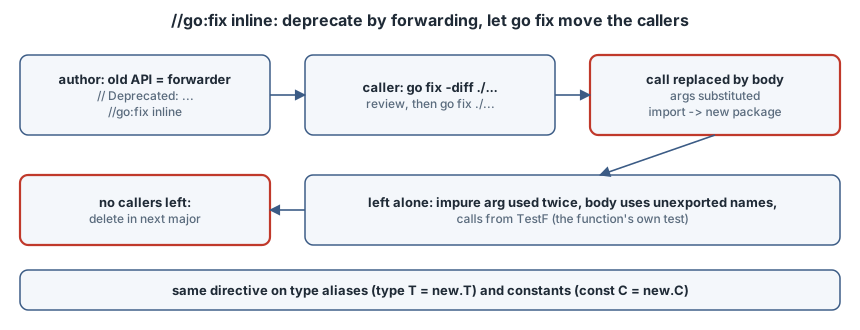
The usual way to retire an exported function is to mark it // Deprecated: and wait for callers to notice. Since Go 1.26, go fix can do the migration for them. You rewrite the old function as a one-line forwarder to the new API and add a //go:fix inline directive. From then on, go fix ./... in any caller’s module replaces each call with the forwarder’s body: arguments are substituted and imports are rewritten to the new package. The same directive works on type aliases and constants.
The rewrite comes from the same source-level inliner gopls uses for its “Inline call” refactoring, so it keeps the program’s behaviour, including argument evaluation order. When it can’t do that cleanly, it leaves the call alone.
This chapter runs the whole cycle on a small module with Go 1.27.2 and shows where the tool stops.
The setup: a v1 package and its replacement
example.com/desk/desk is the old package. deskv2 is the redesign. In it, Open takes an explicit priority and trims the title:
// deskv2/deskv2.go
package deskv2

import "strings"

type Ticket struct {
    ID       int
    Title    string
    Priority int
}

// Open creates a ticket. Priority is now explicit.
func Open(id int, title string, priority int) Ticket {
    return Ticket{ID: id, Title: strings.TrimSpace(title), Priority: priority}
}

const DefaultPriority = 3
The old package keeps compiling, but each exported name is now a forwarder to deskv2, marked for inlining:
// desk/desk.go
package desk

import "example.com/desk/deskv2"

// Deprecated: use deskv2.Ticket.
//
//go:fix inline
type Ticket = deskv2.Ticket

// Deprecated: use deskv2.Open with deskv2.DefaultPriority.
//
//go:fix inline
func Open(id int, title string) Ticket {
    return deskv2.Open(id, title, deskv2.DefaultPriority)
}

// Deprecated: use deskv2.DefaultPriority.
//
//go:fix inline
const Normal = deskv2.DefaultPriority
Three rules make this work:
- The body is written in terms of the new API. Whatever the body says is what will appear at the call sites. That is why
Openspells outdeskv2.DefaultPriorityand doesn’t hide it behind a helper. Ticketis a type alias (=), not a new defined type. Old and new values are the same type, so callers can migrate one file at a time.- A constant can be inlined only if it refers to another named constant.
const Normal = 3would not qualify.const Normal = deskv2.DefaultPrioritydoes.
A caller that hasn’t migrated yet:
// cmd/triage/main.go
package main

import (
    "fmt"

    "example.com/desk/desk"
)

func label(t desk.Ticket) string {
    return fmt.Sprintf("#%d %s (p%d)", t.ID, t.Title, t.Priority)
}

func main() {
    a := desk.Open(101, " printer jam ")
    b := desk.Open(102, "VPN drops")
    fmt.Println(label(a))
    fmt.Println(label(b), b.Priority == desk.Normal)
}
Preview with go fix -diff
Always look before writing. -diff prints a unified diff and exits non-zero if there’s anything to change, so it also works as a CI gate:
$ go run ./cmd/triage
#101 printer jam (p3)
#102 VPN drops (p3) true
$ go fix -diff ./...
--- cmd/triage/main.go (old)
+++ cmd/triage/main.go (new)
@@ -3,16 +3,16 @@
 import (
    "fmt"

-   "example.com/desk/desk"
+   "example.com/desk/deskv2"
 )

-func label(t desk.Ticket) string {
+func label(t deskv2.Ticket) string {
    return fmt.Sprintf("#%d %s (p%d)", t.ID, t.Title, t.Priority)
 }

 func main() {
-   a := desk.Open(101, " printer jam ")
-   b := desk.Open(102, "VPN drops")
+   a := deskv2.Open(101, " printer jam ", deskv2.DefaultPriority)
+   b := deskv2.Open(102, "VPN drops", deskv2.DefaultPriority)
    fmt.Println(label(a))
-   fmt.Println(label(b), b.Priority == desk.Normal)
+   fmt.Println(label(b), b.Priority == deskv2.DefaultPriority)
 }
--- desk/desk.go (old)
+++ desk/desk.go (new)
@@ -11,7 +11,7 @@
 // Deprecated: use deskv2.Open with deskv2.DefaultPriority.
 //
 //go:fix inline
-func Open(id int, title string) Ticket {
+func Open(id int, title string) deskv2.Ticket {
    return deskv2.Open(id, title, deskv2.DefaultPriority)
 }

exit status 1
(The last line comes from the lab script, which runs echo "exit status $?" after go fix -diff.)
Things to notice:
- The import changed. Once nothing in
main.gorefers todesk, the import is replaced withdeskv2. This is how a module can move callers frompkgtopkg/v2. - The hidden default is now visible.
deskv2.DefaultPriorityappears at each call site, so it’s clear which callers took the default. - The alias is resolved everywhere, including the signature of
desk.Openitself in the declaring package. That is harmless: it’s the same type. desk/desk_test.goisn’t in the diff. It callsOpenfromTestOpen. The analyzer deliberately skips calls toFfrom its ownTestF, because that test exists to exercise the old function.
Apply, then prove nothing changed
$ go fix ./... && go run ./cmd/triage && go test ./...
#101 printer jam (p3)
#102 VPN drops (p3) true
?       example.com/desk/cmd/triage [no test files]
ok      example.com/desk/desk   0.002s
?       example.com/desk/deskv2 [no test files]
$ go fix -diff ./... ; echo $?
0
The output is identical before and after, and a second -diff comes back empty. Commit this as its own change, separate from feature work, so that reviewers see only mechanical edits.
Where the inliner stops
The inliner refuses any rewrite that would change behaviour. To see this, here is a package with a few more forwarders:
// oldapi/oldapi.go (excerpt)

// Deprecated: use Area.
//
//go:fix inline
func Square(side int) int {
    return Area(side, side)
}

func Area(w, h int) int { return w * h }

// Deprecated: callers should stop normalizing; it is a no-op.
//
//go:fix inline
func Clean(s string) string {
    return normalize(s)
}

func normalize(s string) string { return s }
A caller in another package (the StartsWithIgnoreCase and MaxItems forwarders are written the same way as in desk):
var calls int

func next() int { calls++; return calls * 3 }

func main() {
    fmt.Println(oldapi.StartsWithIgnoreCase("HTTP/1.1", "http/"))
    fmt.Println(oldapi.MaxItems)
    fmt.Println(oldapi.Square(7))
    fmt.Println(oldapi.Square(next()), "calls =", calls)
    fmt.Println(oldapi.Clean("x"))
}
$ go fix -diff ./app
--- app/main.go (old)
+++ app/main.go (new)
@@ -11,9 +11,9 @@
func next() int { calls++; return calls * 3 }
func main() {
- fmt.Println(oldapi.StartsWithIgnoreCase("HTTP/1.1", "http/"))
- fmt.Println(oldapi.MaxItems)
- fmt.Println(oldapi.Square(7))
+ fmt.Println(oldapi.HasPrefixFold("HTTP/1.1", "http/"))
+ fmt.Println(oldapi.DefaultLimit)
+ fmt.Println(oldapi.Area(7, 7))
fmt.Println(oldapi.Square(next()), "calls =", calls)
fmt.Println(oldapi.Clean("x"))
}Square(7)becomesArea(7, 7). The argument is a constant, so duplicating it is free.Square(next())is left alone. WritingArea(next(), next())would callnexttwice. A safe rewrite would need either a binding declaration (var side = next()) or a function literal (func() int {...}()). In this run it did neither, even when the statement was moved into its owns := oldapi.Square(next())line and-inline.allow_binding_decl=truewas passed. The analyzer docs say it always throws away the function-literal form “on grounds of style”, and binding declarations are only “permitted”, never required.Clean("x")is left alone. Its body callsnormalize, whichappcan’t reference from another package. Inlining it would produce code that doesn’t compile.
None of these skipped calls produced a warning from go fix; the calls just stay deprecated. Deprecation checkers such as staticcheck’s SA1019 will still flag them, and a search for the old names finds them too. Design the forwarder so it inlines: use each parameter at most once (a parameter used twice only inlines when the argument has no side effects), and only reference exported names that callers can see. The lab’s Square breaks the first rule because it uses side twice. A callers-first fix is to give the new API a single-argument form, or to accept that some calls will need a hand edit.
A deprecation playbook
- Ship the new API first (
deskv2, orpkg/v2). It must be able to express every old call. - Rewrite every old exported name as a forwarder with
// Deprecated:and//go:fix inline. Use a type alias for types, and a constant that names another constant for constants. - Tell callers how to migrate in the release notes: run
go fix -diff ./..., review, thengo fix ./.... That’s one command instead of a migration guide. - Hand-fix what’s left, using a search for the old package name. The cases above are the usual reasons calls get skipped.
- Remove the old names only in the next major version. Until then, they’re still part of your compatibility promise.
Pitfalls
- Forwarders with logic. If the old function validates input, logs or recovers from panics, that code will be copied into every caller. Move it into the new API first.
- Defined types instead of aliases.
type Ticket deskv2.Ticketcreates a new type, so nothing can be inlined and old and new values don’t mix. - Assuming every call was migrated. Skipped calls don’t produce a warning, so grep for the old package name after
go fix. - Generated code.
go fixwon’t touch generated files. Fix the generator instead. - Version skew.
go fixapplies these rewrites only from Go 1.26 on; on older toolchains the directive is just a comment. Until every caller has migrated, the forwarders have to keep working as ordinary functions.
Takeaways
//go:fix inlineturns a deprecation notice into a migration that runs automatically, for functions, type aliases and constants.- Write the forwarder body in terms of the new API, because that body is exactly what callers will end up with.
go fix -diffpreviews the change and doubles as a CI check.go fixapplies it, and the program’s behaviour stays the same.- The inliner will skip a call rather than change behaviour. Plan for a few hand edits, and design forwarders that inline cleanly.
Sources
- Alan Donovan, “//go:fix inline and the source-level inliner”, The Go Blog, 10 March 2026.
- “Using go fix to modernize Go code”, The Go Blog.
- Go 1.26 release notes: the rewritten
go fix. golang.org/x/tools/go/analysis/passes/inline: analyzer docs, flags, theTestFrule and constant rules (also available offline withgo tool fix help inline).go fixcommand documentation.- Proposal:
//go:fix inlinedirectives (go.dev/issue/32816). - Go wiki: Deprecated: the
// Deprecated:comment convention.